Table of Contents >> Show >> Hide
- Why “Disgusting” Delicacies Exist in the First Place
- 1. Casu Marzu, Sardinia, Italy: The Cheese That Fights Back
- 2. Hákarl, Iceland: Fermented Shark with a Chemical Punch
- 3. Huitlacoche, Mexico: Corn Fungus Turned Gourmet
- 4. Kiviak, Greenland: Holiday Dinner in a Fermented Seal
- 5. Virgin Boy Eggs, Dongyang, China: Springtime in a Pot of Urine
- 6. Shirako, Japan: Fish Sperm Sacs for Dinner
- 7. Century Eggs, China: Black, Jelly-Like Time Capsules
- 8. Bird’s Nest Soup, Southeast Asia: Luxury Built on Saliva
- 9. Shiokara, Japan: Fermented Seafood Guts in a Bowl
- 10. Stinkheads (Tepa), Alaska, USA: Fermented Fish for the Truly Brave
- How to (Safely) Explore Disgusting Delicacies
- Traveler Tales: A Round-the-World Tour of Gross Delicacies
- Final Thoughts: Gross Today, Gourmet Tomorrow?
Every country has that one dish locals swear is “amazing” while visitors quietly
calculate how rude it would be to fake a sudden allergy. From maggot-infested cheese
to eggs boiled in… well, things that should never be anywhere near a kitchen, these
so-called delicacies challenge even the bravest eaters. In this guide, we’ll tour
ten of the world’s most disgusting delicacies the same infamously gross lineup
popularized by Listverse and take a closer look at why people eat them, how
they’re prepared, and whether you should ever say “yes” when they’re offered.
Why “Disgusting” Delicacies Exist in the First Place
Before you judge anyone’s rotten shark or fermented bird, remember this:
today’s “gross” food is often yesterday’s survival strategy. Many of these dishes
were born in harsh climates, remote communities, or eras when refrigeration
didn’t exist and wasting calories was not an option. Fermentation, curing, and
creative use of every part of an animal meant the difference between going hungry
and staying alive.
Over generations, these necessity foods turned into tradition. What started as
“we have to eat this” slowly became “we are proud to eat this.” That emotional
connection explains why locals can lovingly tuck into a plate of something that
makes a tourist’s soul try to leave their body.
Flavor, Status, and the Thrill Factor
Another reason “disgusting delicacies” endure is that many of them actually do
deliver intense flavor: funky umami, rich fat, deep fermented notes, or a unique
texture that no other food replicates. Some are expensive status symbols, others
are tied to festivals, holidays, or rites of passage. For travelers, they offer a
strange badge of honor a story you can retell forever.
1. Casu Marzu, Sardinia, Italy: The Cheese That Fights Back
Let’s start strong. Casu marzu is often called “maggot cheese,” which tells you
pretty much everything you need to know about why it makes global disgusting-food
lists. This Sardinian sheep’s milk cheese is intentionally infested with cheese
flies. The larvae burrow through the wheel, digesting and breaking down the curds
into a soft, oozing paste.
What it actually is
The process begins with a normal pecorino-style cheese that’s partially aged.
Producers open the rind so flies can lay their eggs. Weeks later, you end up with
a creamy, pungent cheese writhing with live maggots that may literally jump when
disturbed. Some locals even insist the cheese is only safe to eat while the larvae
are still alive.
Why people eat it
Fans say casu marzu has an intense, complex flavor: salty, spicy, almost smoky,
with a lingering funk that makes blue cheese taste like a beginner’s snack. The
cheese is deeply rooted in Sardinian tradition and is sometimes served at weddings,
big family celebrations, and special gatherings.
Should you try it?
Food safety authorities have raised concerns about hygiene and parasite risk, so
regulations are strict. If you do seek it out, go with a trusted local guide and
maybe don’t watch the maggots too closely as you eat.
2. Hákarl, Iceland: Fermented Shark with a Chemical Punch
Hákarl is Greenland shark that’s been buried, drained of toxins, then hung to dry
for months until it’s “ready” which is to say, aggressively rotten to the nose
but technically safe to eat. Historically, this was a practical way for Icelanders
to preserve a difficult but abundant food source in a brutal climate.
The result? Cubes of fish with a texture somewhere between firm cheese and
rubber, and an ammonia-rich odor often compared to industrial cleaning products.
Many famous chefs have tasted it and sworn never to repeat the experience, yet
Icelanders traditionally serve it during midwinter festivals, sometimes chased
with a shot of fiery local schnapps.
3. Huitlacoche, Mexico: Corn Fungus Turned Gourmet
Huitlacoche, sometimes marketed as “Mexican truffle,” is actually a fungal disease
that infects corn kernels, causing them to balloon into gray, swollen growths.
To a farmer expecting healthy corn, it’s a nightmare. To many Mexican cooks,
it’s a delicacy.
Once harvested and cleaned, the fungus is sautéed with onions, garlic, and chiles,
then folded into quesadillas, tamales, soups, and sauces. The flavor is earthy,
slightly smoky, and surprisingly refined more like mushrooms than moldy corn.
The disturbing appearance makes it a perfect addition to any list of disgusting
delicacies, but its taste has earned it a serious fan base.
4. Kiviak, Greenland: Holiday Dinner in a Fermented Seal
Kiviak is essentially Arctic survival food dialed up to horror-movie levels.
Inuit communities in Greenland traditionally prepare it by stuffing dozens or even
hundreds of small seabirds (feathers, bones, and all) into the cleaned body of a
seal. The seal is then sewn shut, sealed with fat, buried under rocks, and left
to ferment for months.
When the seal is opened during winter celebrations, the birds inside are soft,
pungent, and eaten whole sometimes with the fermented juices sipped as an extra
“treat.” It’s rich in fat and calories, crucial in an environment where hunting
during stormy, sunless months can be dangerous or impossible. For visitors,
however, the smell alone is often enough to send them sprinting for fresh air.
5. Virgin Boy Eggs, Dongyang, China: Springtime in a Pot of Urine
Virgin boy eggs are hard-boiled eggs simmered in the urine of prepubescent boys,
a specialty in the Chinese city of Dongyang. The practice is centuries old and is
even recognized locally as part of the region’s cultural heritage.
During spring, schools and families collect urine in buckets, which is then used
to soak and boil the eggs for hours. The shells crack and absorb the liquid,
leaving the eggs with a distinctive aroma and flavor that locals describe as
warming and medicinal. They’re believed to help prevent illness and boost energy,
though there’s no strong scientific evidence behind those claims.
For outsiders, the idea is usually far more disturbing than the taste. But as
with many traditional remedies, cultural meaning often matters more than
clinical data.
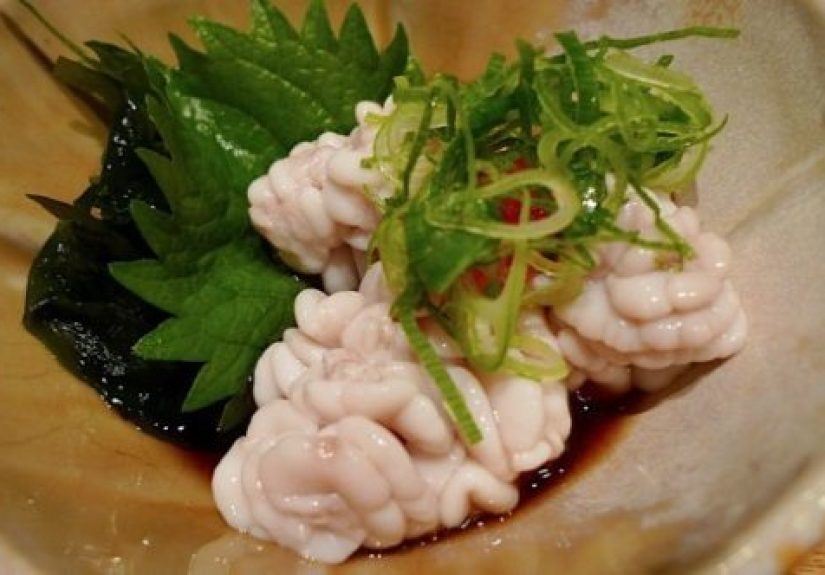
6. Shirako, Japan: Fish Sperm Sacs for Dinner
Shirako is the polite Japanese word for fish milt basically, the sperm sacs of
male fish such as cod, anglerfish, or pufferfish. On the plate, it looks like
shiny white brain tissue or a cluster of soft, pale clouds.
Served raw, lightly steamed, or tempura-fried, shirako is prized for its rich,
creamy texture and subtle sweetness. In upscale restaurants, a small portion can
be shockingly expensive. While many Western diners find the concept disturbing,
in Japan it’s considered a luxurious winter delicacy, comparable in status to
high-end uni (sea urchin).
7. Century Eggs, China: Black, Jelly-Like Time Capsules
Century eggs also known as thousand-year eggs or pidan are duck, chicken, or
quail eggs preserved in an alkaline mixture of tea, salt, lime, and ash for weeks
or months. Despite the dramatic name, they aren’t actually centuries old, but
they definitely look like they’ve seen some things.
The egg white transforms into a translucent, amber-black jelly, while the yolk
turns dark green or gray with a creamy, sometimes chalky texture. The flavor is
intense, sulfuric, and deeply savory. For many Western eaters, the smell of
ammonia and the wobbly, alien appearance are immediate deal-breakers.
In parts of China, however, century eggs are comfort food: sliced over tofu,
congee, or cold appetizers, they’re loved for their rich umami and unique bite.
8. Bird’s Nest Soup, Southeast Asia: Luxury Built on Saliva
Bird’s nest soup sounds charming until you learn that the “nest” comes from the
hardened saliva of cave-dwelling swiftlets. These tiny birds build cup-shaped
nests high on cave walls using only their spit, layer by layer.
Harvesters climb precarious ladders or ropes to scrape the nests from the rock.
When cleaned and simmered in broth, the dried saliva strands turn into a
gelatinous, slippery texture that’s prized in Chinese cuisine. The dish is often
marketed as a luxurious health food, believed to support skin, immunity, and
general vitality.
The ethical concerns are considerable: over-harvesting can disturb breeding and
nesting, placing pressure on wild populations. But in high-end restaurants, a
single serving of bird’s nest soup still commands eye-watering prices.
9. Shiokara, Japan: Fermented Seafood Guts in a Bowl
Shiokara is a blanket term for various Japanese dishes made from chopped seafood
mixed with its own viscera, heavily salted, and left to ferment. One of the most
notorious versions uses cuttlefish: meat and guts combined into a brownish paste
with a consistency somewhere between chunky sauce and sludge.
Its flavor is intensely fishy, salty, and funky so much so that many Japanese
people consider it an acquired taste. A common tip is to swallow a bite quickly
and chase it with strong alcohol. That tells you everything you need to know
about how challenging it can be.
10. Stinkheads (Tepa), Alaska, USA: Fermented Fish for the Truly Brave
Stinkheads, or tepa, are made from the heads of salmon or whitefish, traditionally
eaten by some Indigenous communities in Alaska. The heads and occasionally other
parts are placed in containers or pits and left to ferment underground until they
soften into a pungent, paste-like mass.
Historically, this was an efficient way to preserve high-fat fish parts for
months without refrigeration. The resulting food is rich in calories and can be
eaten with minimal preparation incredibly useful in remote regions with
limited supplies.
Modern health officials have warned about the risk of botulism if fermentation
isn’t carefully controlled. As a result, some communities have shifted toward
safer methods or rely less on traditional fermentation. Still, stinkheads remain
a powerful symbol of cultural identity and resilience in the Arctic.
How to (Safely) Explore Disgusting Delicacies
Curious but nervous? That’s normal. Trying these foods is as much about respect
and context as it is about flavor. If you’re tempted to say yes when a local
offers something that smells like a chemical spill, keep a few rules in mind.
- Go with reputable vendors. Traditional doesn’t have to mean unsafe. Choose places known for good hygiene.
- Start with tiny bites. You’re not winning a TV challenge. A pea-sized taste still counts as “I tried it.”
- Learn the story behind the dish. Understanding why a food exists makes it easier to respect, even if you don’t enjoy it.
- Know your limits. Allergies, food sensitivities, or medical issues are more important than bragging rights.
- Be polite, not fake. It’s okay to say, “Thank you, but I can’t finish this,” as long as you’re respectful.
Traveler Tales: A Round-the-World Tour of Gross Delicacies
Imagine you’re on a year-long backpacking trip, determined to say “yes” to every
local specialty at least once. Your first stop is Iceland. At a small coastal
restaurant, your host proudly sets down a plate of hákarl tidy little cubes
that smell like a fish market colliding with a bottle of ammonia. Everyone at the
table is watching. You spear a piece, hold your breath, chew twice, and chase it
with a shot of strong schnapps. The flavor is sharp, sour, and deeply marine. You
don’t love it, but you feel oddly triumphant.
Months later in Mexico, you’re sitting in a bustling market, staring at a quesadilla
filled with something that looks like blackened mushrooms. It’s huitlacoche.
The vendor grins and tells you this fungus is more expensive than regular corn.
You bite in cautiously, expecting pure horror but it’s delicious: earthy,
smoky, almost like truffle. You suddenly realize that if you’d only seen photos
online, you’d have sworn this was inedible. In person, it’s a genuine highlight.
In Sardinia, someone’s cousin “knows a guy” who has casu marzu. The cheese arrives
at a family gathering, hidden until everyone has a glass of wine in hand. The
wheel is cut open to reveal a creamy interior… crawling. You’re advised not to
look too closely. A small piece is spread on bread and passed to you. The smell
is strong but not as terrifying as you expected like very ripe blue cheese.
You take a bite. The flavor is powerful, nutty, and spicy. The texture is smooth,
and if you ignore the wriggling part, it’s almost… good. Almost.
In Japan, a winter izakaya menu features shirako. It’s presented artfully in a
small bowl, topped with green onions and ponzu sauce. If you didn’t know what it
was, you might think it’s just a silky tofu or custard. Instead, you’re fully
aware you’re eating fish sperm sacs. You take a tiny spoonful. It’s warm, creamy,
and surprisingly delicate. Your brain screams, but your taste buds shrug and say,
“That’s not bad.”
Finally, you find yourself in Alaska talking with locals about traditional
fermented fish. They explain how these foods helped their ancestors survive long,
brutal winters and how modern safety concerns have changed some practices. You
might not actually sample stinkheads or you might decide this is one adventure
too far but by now you’ve learned something important: disgust is often more
about perception and culture than about the food itself.
By the end of your journey, you’ve discovered that “disgusting delicacies from
around the world” aren’t just shock fodder for viral lists. They’re complicated
intersections of history, climate, necessity, creativity, and identity. Some you
would gladly eat again (huitlacoche, bird’s nest soup), others you’d only revisit
for a dare (hákarl, casu marzu), and a few will live forever in the “once in a
lifetime is enough” category. But every one of them gave you a story and a deeper
appreciation for how wildly inventive humans can be when it comes to food.
Final Thoughts: Gross Today, Gourmet Tomorrow?
It’s easy to laugh at maggot cheese or fermented bird-in-seal dinner, but if you
zoom out, these disgusting delicacies tell an important story. They show how
people adapt to extreme environments, honor tradition, squeeze nutrition out of
every scrap, and turn necessity into culinary identity. Many of the foods we
consider “normal” today blue cheese, oysters, even sushi once seemed shocking
somewhere.
You don’t have to love every bizarre bite to respect it. But if you approach
strange foods with curiosity instead of judgment, you’ll gain more than
brag-worthy photos. You’ll gain insight into how other cultures live, survive,
and celebrate one unforgettable plate at a time.
SEO Summary for Publishers
meta_title: 10 Disgusting Delicacies From Around The World
meta_description: Explore 10 disgusting delicacies from around the world, how they’re made, why locals love them, and whether you should dare to try.
sapo:
From maggot-infested cheese and fermented shark to fish sperm sacs and eggs boiled
in urine, the world’s most disgusting delicacies are as fascinating as they are
stomach-churning. This in-depth guide revisits the infamous Listverse lineup of
gross global foods, explaining how each dish is prepared, why locals are proud to
eat it, and what brave travelers can expect in terms of flavor, safety, and
cultural meaning. Whether you’re planning your next foodie adventure or just want
to marvel at what other people willingly put on a plate, this article serves up
equal parts horror, history, and humor.
keywords:
disgusting delicacies,
disgusting delicacies from around the world,
weird foods,
bizarre foods,
gross foods,
strange delicacies,
unusual foods around the world