Table of Contents >> Show >> Hide
- 1. Bruce Willis’s Emotional Goodbye Was Shot on Day One
- 2. The Oil Rig Wasn’t a Set It Was the Real Deal
- 3. NASA Let Them Film on Real Launchpads and Borrow Real Gear
- 4. …And Yet NASA Uses Armageddon as a “What Not to Do” Lesson
- 5. The Script Was a Full-On Blockbuster Factory Project
- 6. Bruce Willis Did It as Part of a Three-Picture Deal
- 7. Ben Affleck Questioned the Plot and Got Told to “Shut Up”
- 8. The Criterion Commentary Track Has a Cult Following
- 9. Jason Isaacs Thought Michael Bay Hated His Acting
- 10. The Animal Cracker Scene Wasn’t in the Original Script
- 11. Real Space Experts Still Couldn’t Save the Science
- 12. Critics Were Lukewarm, Audiences Went Absolutely All-In
- Living With Armageddon: Experiences, Rewatches, and Why It Still Hits
Michael Bay’s Armageddon is the cinematic equivalent of chugging a Triple Espresso
and then riding a rocket strapped to a box of fireworks. It’s loud, shamelessly emotional,
scientifically bonkers, and somehow still one of the most rewatchable disaster movies ever
made. And behind all the slow-motion hero walks, Aerosmith power ballads, and “drillers in
space” chaos, there’s a treasure trove of behind-the-scenes stories and tiny details that
make Armageddon even more fascinating.
Whether you love the movie unironically or enjoy it as gloriously over-the-top
’90s blockbuster comfort food, these 12 Armageddon details and behind-the-scenes
stories will give you a new appreciation for how this wild ride came together.
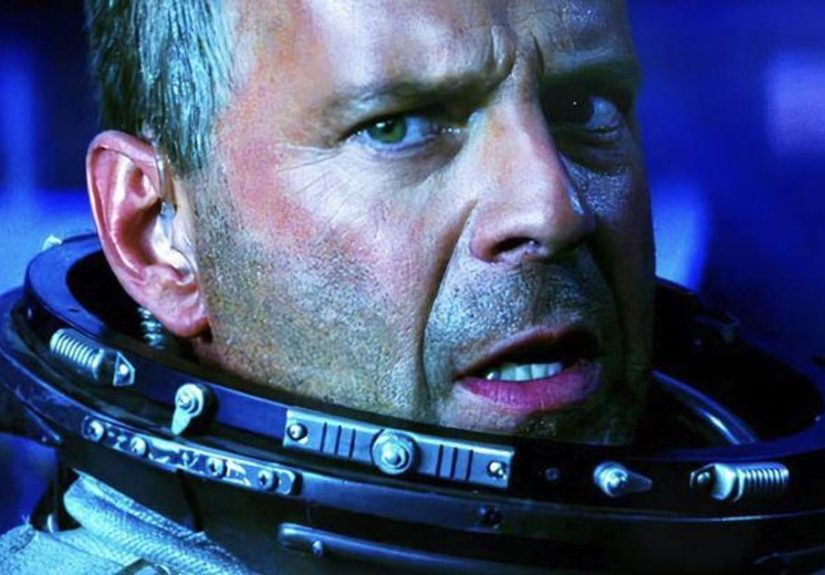
1. Bruce Willis’s Emotional Goodbye Was Shot on Day One
One of the most gut-punch moments in Armageddon comes near the end, when Harry
Stamper (Bruce Willis) says goodbye to his daughter Grace (Liv Tyler) before sacrificing
himself to save Earth. It feels like the emotional climax of the movie which is why it’s
wild that the scene was filmed on the very first day of shooting.
According to behind-the-scenes accounts, Willis used photos of his real-life daughters to
get into the right emotional headspace for the farewell scene. He reportedly looked at the
pictures between takes and channeled that real fatherly anxiety and heartbreak into Harry’s
goodbye.
So if you’ve ever felt ambushed by feelings during that scene yep, that’s very much
real dad energy coming through the frame. Not bad for Day One on a Michael Bay movie.
2. The Oil Rig Wasn’t a Set It Was the Real Deal
You’d assume those early oil-rig scenes were shot on a giant Hollywood soundstage built to
look like an offshore platform. Nope. Instead of building an expensive set, the production
filmed on a real oil rig near Galveston, Texas something that was almost unheard of for a
big-budget disaster movie at the time.
Shooting on a working rig meant the cast and crew had to adapt to cramped spaces, harsh
conditions, and real industrial hardware. It gives the movie’s opening act a surprisingly
gritty, authentic texture. For all of Armageddon’s over-the-top space nonsense,
the film’s first impression is actually grounded in real-world oilfield life.
It also helped Michael Bay shape the “blue-collar hero” tone of the movie: the idea that
the roughnecks we meet on that rig are exactly the kind of people who’d volunteer to go
blow up an asteroid the size of Texas because honestly who else is crazy enough?
3. NASA Let Them Film on Real Launchpads and Borrow Real Gear
One of the reasons Armageddon looks so convincing in certain moments (yes,
some moments) is that the production had unusually deep access to real NASA
facilities. Cinematographer John Schwartzman has talked about how the crew was allowed to
shoot on NASA’s actual launch gantry while the space shuttle Endeavour stood on the pad,
ready for a real mission just days away.
NASA also lent authentic spacesuits and allowed filming of real shuttle launches, which were
edited into the finished film. That’s why some shots look
jaw-droppingly real because they are. The rockets, the platforms, the towering gantries:
you’re seeing the actual infrastructure of the American space program.
To be clear, NASA did not sign off on the science. In fact, a disclaimer at the end of the
movie explicitly states that NASA’s cooperation doesn’t equal endorsement of the film’s
plot or science. Wise move.
4. …And Yet NASA Uses Armageddon as a “What Not to Do” Lesson
Here’s the twist: even though NASA helped make Armageddon, it also treats the film
like the world’s loudest wrong-answer key.
The agency has been widely reported to show Armageddon during parts of its
management or training programs and ask participants to identify the scientific and
logistical errors. Some sources claim staff have catalogued at least 168 scientific
impossibilities in the film.
Think about that: that’s more than one “nope, try again” moment per minute of runtime. It’s
become such a famous piece of trivia that Armageddon now exists in this weird
dual state as both a beloved blockbuster and a PowerPoint slide in a space-nerd
critique session.
Even NASA experts in more recent commentary have emphasized how much of the movie is
scientifically impossible, while still acknowledging that some of the locations and hardware
are very real.
5. The Script Was a Full-On Blockbuster Factory Project
If the plot of Armageddon sometimes feels like it was written by a committee…
that’s because it basically was.
The film started life as a “counter-programming” response to another asteroid movie:
Deep Impact. A Disney executive reportedly took notes about that project and then
launched a rival film which became Armageddon.
In total, nine writers worked on the script, including blockbuster names like J.J. Abrams,
Jonathan Hensleigh, Tony Gilroy, and Shane Salerno, plus several uncredited script doctors.
The result is exactly what you’d expect from a screenplay passed
between that many hands: big emotions, quippy one-liners, wild tonal swings, and enough
plot holes to swallow a small moon.
The upside? That many writers also means a dense concentration of quotable moments and
character beats that have stuck with audiences for decades.
6. Bruce Willis Did It as Part of a Three-Picture Deal
Bruce Willis didn’t just randomly sign onto Armageddon because he wanted to blow
up space rocks for fun (though, knowing ’90s Bruce, that probably didn’t hurt).
He was actually fulfilling a studio obligation. After a different film project,
Broadway Brawler, fell apart and cost Disney a lot of money, Willis agreed to a
three-picture deal with the studio to make up for it and Armageddon was one of
those films. He reportedly took a pay cut to make the arrangement work.
In hindsight, the trade-off worked out nicely. Armageddon ended up becoming the
highest-grossing film of 1998 worldwide, pulling in over $553 million on a budget of around
$140 million. So yes, the “make-good” deal turned into a monster hit.
7. Ben Affleck Questioned the Plot and Got Told to “Shut Up”
One of the most famous behind-the-scenes stories from Armageddon belongs to
Ben Affleck, who plays driller-turned-astronaut A.J. Frost. During production, Affleck
asked Michael Bay a perfectly reasonable question:
Why is it easier to train oil drillers to become astronauts than to train astronauts to
operate a drill?
According to Affleck’s legendary DVD commentary and later interviews, Bay’s response was
essentially: “Ben, just shut up.” Bay has described the
movie as a kind of fantasy, where logic bows to spectacle and emotion.
That exchange became part of film-nerd folklore. Affleck revisits the story in his
commentary with a mix of sarcasm and affection, joking about the rushed astronaut training,
the questionable science, and the movie’s fondness for melodrama.
8. The Criterion Commentary Track Has a Cult Following
In one of the most surprising moves in home-video history, Armageddon was given a
deluxe release by The Criterion Collection the same label known for arthouse greats and
foreign-film masterpieces. The release included extensive bonus features and not one but two
commentary tracks with Michael Bay, Jerry Bruckheimer, Bruce Willis, Ben Affleck, NASA
consultant Dr. Joe Allen, and asteroid expert Ivan Bekey, among others.
Over time, Affleck’s contribution in particular gained a cult following. Fans praise it as
a hilariously honest, slightly chaotic breakdown of the film’s logic and production. One
screening series even advertised the commentary as “the greatest commentary track of all
time.”
Affleck himself has joked that the commentary might be the “best work” of his career, since
so many people bring it up to him years later. When your DVD jokes are
as famous as your astronaut–oil-driller performance, you know you’ve left a mark.
9. Jason Isaacs Thought Michael Bay Hated His Acting
Jason Isaacs who plays scientist Dr. Ronald Quincy later became famous as Lucius
Malfoy in the Harry Potter series. But during Armageddon, he was still
early in his Hollywood career, and one Michael Bay quip nearly shattered his confidence.
Isaacs has recalled that after his first take, Bay looked at him and asked, “Is that what
they teach you in theater school?” For a moment, Isaacs thought he’d bombed the scene and
that his Hollywood experiment was over. Then Bay broke the tension by praising the work and
showing it to Bruce Willis, ultimately keeping Isaacs around longer than originally
planned and improvising more lines for him.
The result? Quincy, the slightly frazzled British brainiac, became one of the film’s
standout supporting characters proof that a little terror plus a little improv can go a
long way.
10. The Animal Cracker Scene Wasn’t in the Original Script
Perhaps no moment in Armageddon is more divisive than the infamous animal cracker
scene: A.J. (Affleck) traces animal crackers along Grace’s (Liv Tyler’s) bare stomach while
musing about whether they count as a cookie or a cracker.
Film fact: that scene wasn’t in the original script. Later accounts note it was developed
during rewrites and became a strange blend of romantic interlude and product placement for
actual animal crackers.
Viewers remain split. Some critics have called it “genuinely gag-worthy” and tonally
bizarre, arguing the same emotional beats could’ve been hit with a simpler, less crunchy
approach. Others see it as peak ’90s blockbuster charm
a scene so weird it loops back around to iconic. Either way, it worked: years later,
podcasters and fans still cite the animal cracker moment as one of the movie’s most
unforgettable scenes.
11. Real Space Experts Still Couldn’t Save the Science
One of the more ironic behind-the-scenes details is that Armageddon actually had
serious experts on board. NASA consultant Dr. Joe Allen and asteroid specialist Ivan Bekey
contributed to the film and appear on the Criterion commentary.
Despite that, the movie still ended up as a greatest-hits compilation of “absolutely not”
moments for physicists. Later analyses, including actual physics papers and pop-science
breakdowns, have torn apart the central “nuke the asteroid” plan and labeled it wildly
unrealistic.
Even astrophysicist Neil deGrasse Tyson has joked that Armageddon was, for a long
time, the movie that broke the most laws of physics per minute at least until newer
disaster films challenged it for the crown.
Still, that mix of real NASA hardware and gloriously fake science is part of what gives the
film its unique personality. It looks authentic enough that your brain wants to believe,
even as your inner science teacher is screaming.
12. Critics Were Lukewarm, Audiences Went Absolutely All-In
On release, critics were… not exactly kind. Review aggregators like Rotten Tomatoes and
Metacritic have long summarized Armageddon as slick, spectacular, and
aggressively not smart. The furious editing pace, over-the-top
sentimentality, and shaky science all rubbed reviewers the wrong way.
Audiences, however, loved it. Moviegoers gave it high cinema scores, and it dominated the
box office, becoming 1998’s top-grossing film worldwide. Over time,
it’s settled into a comfortable place in pop culture: a film that critics still side-eye,
but fans rewatch endlessly.
That’s the real legacy of Armageddon: not accuracy, not subtlety, but sheer,
unapologetic entertainment. It’s the movie equivalent of blasting Aerosmith at full volume
while slow-motion walking away from an explosion.
Living With Armageddon: Experiences, Rewatches, and Why It Still Hits
Beyond the production trivia, part of what keeps Armageddon alive in the cultural
bloodstream is how people experience it rewatching, laughing at it, crying with
it, and sometimes using it as an unofficial case study in how blockbusters work.
Nostalgia Fuel for ’90s Kids and Disaster-Movie Fans
For a lot of viewers, Armageddon is glued to a specific era: late-’90s summers,
packed theaters, and the heyday of big, earnest disaster movies. If you were a teenager
when it came out, there’s a good chance your first watch involved:
- Leaning way too close to a tube TV or early DVD player
- Trying not to cry during Harry and Grace’s goodbye scene
- Listening to “I Don’t Want to Miss a Thing” on repeat afterward
Revisiting the film now is like time-traveling back to a pre-franchise era when a single,
standalone blockbuster could dominate pop culture conversation for months.
The “Watch It with Commentary” Experience
If you’ve only ever seen the theatrical version, one of the best ways to experience
Armageddon today is with the famous commentary tracks. The Criterion release, plus
the fan fascination around Affleck’s segments, turn the movie into a kind of meta-comedy
where the people who made the film gently roast it in real time.
It’s especially fun to watch with friends: some people lock into the emotional beats like
it’s their first time, while others revel in the absurdity. You might have someone tearing
up over Harry’s sacrifice while someone else is muttering “still not how space works” in
the corner. Both reactions are valid Armageddon experiences.
NASA Trainees, Science Nerds, and the Joy of Picking It Apart
Then there’s the more academic side of the experience: using Armageddon as a
teaching tool. As we’ve seen, NASA and various physics educators love turning the movie
into a giant “spot the error” game.
If you watch the film with someone who knows orbital mechanics, you quickly learn that:
- The asteroid’s size and trajectory are wildly exaggerated.
- The nuke plan is extremely not how any of this would work.
- Most of the “we have 18 days to save Earth” timing is pure Hollywood adrenaline.
But that’s part of the fun. For science fans, Armageddon functions almost like a
cinematic lab exercise. You enjoy the spectacle, then you pause, rewind, and gleefully rip
it apart like a homework problem that failed upward into a $500-million box-office smash.
Why It Still Works (Even If You Know It’s Ridiculous)
When you strip away the steel plates, rocket fuel, and slow-motion flag shots, what makes
Armageddon endure is simple: it’s a story about messy humans being brave in
ridiculous circumstances.
The movie leans hard into:
- Found family among the crew of drillers
- A strained but tender father–daughter relationship
- Ordinary people asked to do something impossibly huge
Those themes still land, even if you’re watching with full awareness that no real space
agency would sign off on any of this. The very contrast real-looking NASA hardware,
huge emotions, and completely bonkers science is what gives the film its strange,
irresistible charm.
In the end, Armageddon isn’t a physics lesson. It’s a feelings machine. And once
you know the behind-the-scenes stories from Bruce Willis’s Day One heartbreak to Ben
Affleck’s commentary snark and NASA’s training-room roast sessions the movie somehow
becomes even more entertaining, whether you’re wiping away a tear or counting the errors
like a mission-control pro.