Table of Contents >> Show >> Hide
- Why We Keep Designing Impossible Bodies
- 20 Fictional Characters With the Least Realistic Body Proportions
- 1. Barbie – The Original Impossible Doll
- 2. Jessica Rabbit – The Human Hourglass Turned Up to 11
- 3. Princess Jasmine – Eyes Bigger Than Her Waist
- 4. Ariel – Mermaid Tail, Mini Torso, Max Problems
- 5. Kim Possible – Spy Skills, Micro Waist
- 6. Nami – One Piece of Anatomy That Makes No Sense
- 7. Power Girl – Super Chest, Super Back Pain
- 8. Lara Croft (Classic) – Adventure Archaeology, Comic-Book Anatomy
- 9. Bayonetta – Eleven Heads Tall and Zero Regard for Physics
- 10. Cammy – 75 Percent Legs, 25 Percent Everything Else
- 11. Chun-Li – Thunder Thighs on a Tiny Frame
- 12. Cable – Arms That Outgrow the Rest of the Body
- 13. Johnny Bravo – Top-Heavy to the Point of Collapse
- 14. Kronk – Bodybuilder Torso, Barbie Waist
- 15. Mr. Incredible – Muscles Beyond Natural Limits
- 16. Popeye – Forearms That Could Crush Steel (and His Elbows)
- 17. Arnold – The Football Head Kid
- 18. Gru – Triangle Man on Toothpick Ankles
- 19. The Hydra – Too Many Heads, Not Enough Support
- 20. The Strike Witches Squad – Jet Engines for Legs
- What These Designs Say About Us
- Fan Experiences With Unrealistic Cartoon Bodies
Fiction is where physics goes to take a nap. Superheroes fly, mermaids sing underwater, and cartoon characters bounce back from getting flattened by anvils.
But even in a world where magic and alien tech are normal, some fictional characters have body proportions so unrealistic that, if they existed in real life, they’d need a team of orthopedic surgeons on speed dial.
Stylized design is part of the fun, of course. The problem is when these exaggerated cartoon bodies quietly become our reference point for what “ideal” looks like. From the famously impossible Barbie doll to Disney princesses with eyes wider than their waists and video game heroines whose spines would give up instantly, pop culture is full of characters whose bodies simply could not function in reality.
Below, we’ll break down 20 fictional characters with the least realistic body proportions, look at what makes their designs so wild, and talk about what all of this means for how we think about bodies in the real world.
Why We Keep Designing Impossible Bodies
Before we roast any characters, it helps to understand why artists keep giving them impossible bodies. In animation, comics, and games, exaggerated anatomy is a quick visual shortcut. A huge chest, tiny waist, or massive shoulders instantly signal “sexy,” “strong,” or “goofy.” Superheroes are often drawn with hyper-muscular torsos and narrow waists to show power. Cartoon heroines frequently get the extreme hourglass figure: big chest, big eyes, very little in between.
Studies on toys like Barbie show that her original measurements, if translated to real human scale, would make it difficult to walk, breathe normally, or even fit internal organs properly. Similar research on princesses and animated heroines highlights extremely low waist-to-hip ratios and oversized eyes that simply don’t occur in real human anatomy. In other words, these designs aren’t just “fit” or “pretty.” They’re biologically impossible.
None of this means you have to give up your favorite cartoons or games. But it does mean it’s worth noticing when a body is more fantasy than anatomyand reminding yourself (and younger viewers) that real people are not supposed to look like this.
20 Fictional Characters With the Least Realistic Body Proportions
1. Barbie – The Original Impossible Doll
Let’s start with the icon. Classic Barbie’s proportions have been analyzed again and again, and the verdict is always the same: if she were human, she’d struggle to stay upright. Her chest is oversized, her waist is extremely tiny, and her legs go on for miles. Scale her up to life-size and you get a neck too long to support her head, a waist too narrow for normal organs, and feet permanently arched for heels. That’s before we even get into how influential she’s been on generations of kids learning what “pretty” looks like.
2. Jessica Rabbit – The Human Hourglass Turned Up to 11
Jessica Rabbit from Who Framed Roger Rabbit is basically a thought experiment in how far you can push the hourglass figure before it turns into a physics problem. Her chest is enormous, her waist is impossibly small, and her gown appears to be held up by sheer force of plot. In real life, the weight distribution alone would put massive strain on her spine and shoulders, and breathing would be a full-time job. She’s not “just drawn that way”she’s drawn that way in a way that no actual skeleton could manage.
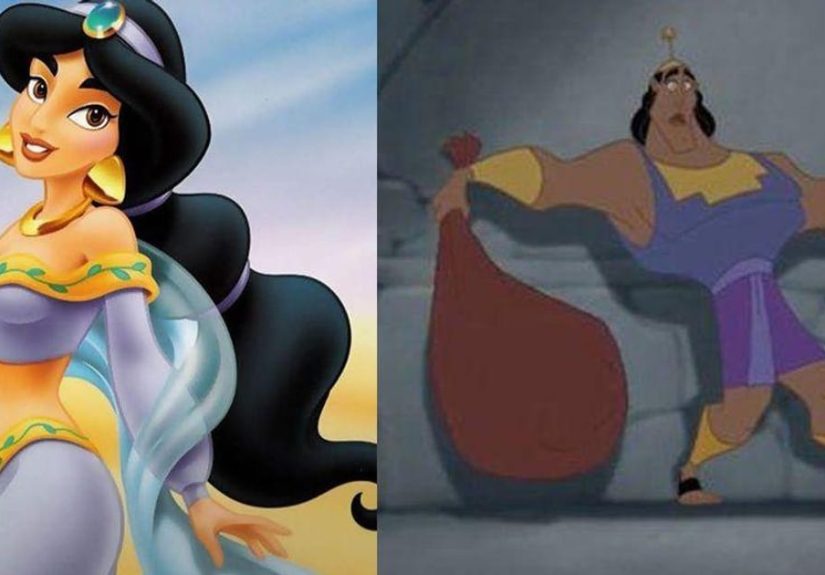
3. Princess Jasmine – Eyes Bigger Than Her Waist
Princess Jasmine from Aladdin is a classic example of the “huge eyes, tiny torso” Disney look. Her eyes are nearly as wide as her waist, which might be cute in a stylized drawing but makes zero sense when you think about organ placement or muscle structure. Her midriff is so slim there’s barely room for a spine, much less a digestive system. She’s charming and belovedbut her proportions are pure fantasy.
4. Ariel – Mermaid Tail, Mini Torso, Max Problems
Ariel takes Jasmine’s problem and adds a mermaid tail. She’s expected to power a huge, muscular fish tail with a torso that looks smaller than her own head. Real aquatic animals with powerful tails have thick, muscular trunks for a reason. Ariel’s waistline, combined with oversized eyes and a tiny ribcage, would leave her with almost no core strength. Realistically, she’d either float aimlessly or injure her spine the first time she tried a dramatic underwater hair flip.
5. Kim Possible – Spy Skills, Micro Waist
Kim Possible is a teen hero, gymnast, and martial artistand animated with a waist that looks thinner than her own neck. Her hips and chest are stylized too, but it’s the razor-thin midsection that stands out. For someone who runs, kicks, and flips as much as she does, she’d need serious core muscles and a stable spine. Instead, her design leans into a fashion-illustration silhouette that wouldn’t support all that action without something snapping.
6. Nami – One Piece of Anatomy That Makes No Sense
In One Piece, creator Eiichiro Oda is famous for giving many of his women a very specific body type: huge chest, long legs, and a waist so narrow it looks Photoshopped. Nami is one of the most recognizable examples. Her torso is so small compared with her bust and hips that, in real life, she’d be at constant risk for serious back problems and wouldn’t have enough space for normal internal organs. It’s not “slim”; it’s structurally impossible.
7. Power Girl – Super Chest, Super Back Pain
Power Girl, a version of Supergirl from an alternate universe, is best known for two things: tremendous strength and an even more tremendous chest. Comics have long exaggerated superhero physiques, but Power Girl’s design takes it to the point where anatomical realism taps out. Her upper body mass compared to her relatively small waist suggests enormous strain on her back and neck, and her costume’s cut-out “window” would be a practical nightmare in any real-world fight.
8. Lara Croft (Classic) – Adventure Archaeology, Comic-Book Anatomy
Early versions of Lara Croft from the original Tomb Raider era were designed in the 1990s when “bigger is better” was practically the default setting for female characters in games. She has a sharply exaggerated chest, extremely narrow waist, and surprisingly thin limbs for someone who climbs cliffs, hauls gear, and sprints through ruins. Some designers even admitted her proportions came from a “joke” scaling accident that they decided to keep. More recent games have toned her design down, which tells you just how over-the-top the original model really was.
9. Bayonetta – Eleven Heads Tall and Zero Regard for Physics
Bayonetta is a stylish witch whose entire design leans into over-the-top glamour: mile-long legs, ultra-slim torso, and a body shape that looks like it was stretched in a graphics editor. Analysis of her model suggests she’s closer to eleven “heads tall” than the typical seven or so used in figure drawing. Add in acrobatic combat moves in unforgiving high heels, and you get a character whose joints and connective tissue would be in constant emergency mode in the real world.
10. Cammy – 75 Percent Legs, 25 Percent Everything Else
Cammy from the Street Fighter series is effectively a pair of legs with some torso attached. Her thighs are massive, her glutes are emphasized by a thong leotard, and her waist is incredibly small. As a stylized design, she’s instantly recognizable. As a functional human body, she’d have serious trouble fitting the lungs, liver, and intestines she’d need to power those kicks. The muscle mass in her lower body also looks disproportionate to what her spine and hips could realistically support.
11. Chun-Li – Thunder Thighs on a Tiny Frame
Chun-Li is famous for her “legs of justice.” Her thighs are depicted as so muscular and oversized that, in some artwork, they’re nearly the width of her torso. While elite athletes can develop very powerful legs, Chun-Li’s proportions go well beyond that, turning her into an anatomical caricature. Add in small feet and delicate shoes trying to support all that mass, and every spinning bird kick becomes a potential ankle disaster.
12. Cable – Arms That Outgrow the Rest of the Body
Cable, the time-traveling mutant from the X-Men universe, is peak 1990s comic-book exaggeration: enormous shoulders, gigantic arms, tons of weapons, and comparatively modest legs. His biceps and forearms are often drawn wider than his head, which would wreak havoc on his joints in reality. The amount of muscle on his upper body would be extremely difficult to support with his lower body structure, making balance and long-term mobility a serious challenge.
13. Johnny Bravo – Top-Heavy to the Point of Collapse
Johnny Bravo’s entire joke is that he’s a big, arrogant guy who thinks he’s irresistible. His character design matches that attitude with a comically huge chest, shoulders, and hair…balanced on tiny legs. His hips and lower limbs are so small compared with his upper body that, in reality, his knees and ankles would be under extreme compressive stress. One strong flex and his femurs would probably wave a little white flag.
14. Kronk – Bodybuilder Torso, Barbie Waist
Kronk from The Emperor’s New Groove is lovable, earnest, and completely impossible. His chest and shoulders are bulked up like a competitive bodybuilder, but his waist cinches in dramatically, almost like a corseted fashion drawing. A torso that top-heavy resting on such a slender midsection would risk serious spinal instability. Bend down to pick something up? In a realistic scenario, that would be a fast track to emergency surgery.
15. Mr. Incredible – Muscles Beyond Natural Limits
Mr. Incredible from Pixar’s The Incredibles is meant to embody the classic superhero power fantasy: massive chest, huge arms, and a neck thicker than some people’s waists. While he’s not as wildly distorted as some characters on this list, his musculature still pushes the limits of what humans can achieve naturally. His barrel chest, tiny waist, and relatively small lower legs combine into a figure that would be incredibly hard to maintain without superpowersor a very unhappy orthopedic specialist.
16. Popeye – Forearms That Could Crush Steel (and His Elbows)
Popeye’s whole brand is “I’m strong because I eat spinach,” but his design concentrates almost all of that strength into his forearms. They’re giganticoften as wide as his waistwhile his upper arms are thin in comparison. In real life, that kind of disproportion would destroy his elbows. The joint would be bearing loads it was never designed to handle, making every punch a high risk for instant injury.
17. Arnold – The Football Head Kid
Arnold from Hey Arnold! looks adorable with his football-shaped head, but if we imagine him as a real human child, things get alarming quickly. The weight and shape of that head would place a lot of stress on his neck, especially during growth. Childbirth would also be a serious medical emergency for his mother. It’s a great example of how a simple, funny design tweak can become terrifying when you drag it into three-dimensional reality.
18. Gru – Triangle Man on Toothpick Ankles
Gru from Despicable Me is basically a walking isosceles triangle. His upper body is broad and rounded, tapering down to extremely thin legs and tiny feet. From a character-design perspective, it communicates his awkwardness perfectly. But as an anatomical model, it’s a disaster waiting to happen. His center of gravity would be so high and his base of support so narrow that he’d be at constant risk of topplingor shattering his ankles the moment he tried to jog after a Minion.
19. The Hydra – Too Many Heads, Not Enough Support
Mythological creatures never promised realism, but the Hydra really pushes it. The monster is often depicted with multiple heavy heads branching from one body, and in some versions, it grows two more heads whenever one is cut off. All that extra weight concentrated on a single torso and neck structure would put incredible strain on its spine and connective tissues. Before any hero had a chance to fight it, the Hydra would likely collapse under its own skull collection.
20. The Strike Witches Squad – Jet Engines for Legs
The girls in the anime Strike Witches strap plane parts and engines directly to their legs, then fly into aerial battles. In-universe, it’s explained with magic and advanced tech. Outside the story, it’s a biomechanics nightmare. Real limbs simply aren’t built to anchor that kind of weight and thrust. The stress on hips, knees, and lower backs would be catastrophic. It looks cool on screenbut as a design for actual human bodies, it’s pure wish fulfillment.
What These Designs Say About Us
Taken together, these characters show clear patterns. Female characters are often exaggerated into the “impossible hourglass”: huge chest, very slim waist, long legs, and large eyes. Male characters, on the other hand, tend to be drawn with huge torsos and tiny legs, or oversized arms that scream strength and dominance. Both extremes are meant to communicate traits at a glancebeauty, power, sex appeal, comedybut they also normalize bodies that don’t exist.
For adults, it’s usually easy to separate “fun cartoon” from “real-life body standard.” For kids and teens, though, constant exposure to these unrealistic proportions can influence what they think they’re supposed to look like. Dolls, superheroes, and princesses become quiet benchmarks in the background. That doesn’t mean watching a cartoon will instantly cause body dissatisfaction, but it does mean we should be aware of the trend and talk about it openly.
The good news is that more recent media has started to experiment with a wider range of body types, even in stylized worlds: thicker waists, different heights, varied silhouettes, and less “copy-paste” idealization. The shift is slow, but it’s happeningand audiences are embracing characters who look a bit more like actual people.
Fan Experiences With Unrealistic Cartoon Bodies
If you talk to fans, you’ll hear a mix of reactions to these exaggerated designs. Some people remember being kids and loving these characters without ever thinking about anatomy. Others only realized as adults how extreme those bodies wereand how much they had quietly influenced their own self-image.
One common experience is the “princess mirror moment.” A child stands in front of a mirror, comparing their body to a favorite princess or doll. They notice their waist isn’t that small, their legs aren’t that long, or their eyes aren’t that big. Even if nobody says anything out loud, a little seed of “I don’t look right” can start to grow. Over time, especially when combined with edited photos on social media, that seed can turn into constant body comparison.
Cosplayers see this from another angle. When people cosplay characters like Lara Croft, Nami, or Cammy, the goal is rarely perfect anatomical accuracy. Most cosplayers learn pretty quickly that if you try to imitate those proportions exactly, you’ll end up uncomfortable, injured, or just unhappy. Instead, they adapt the look to their own bodyaltering cuts, changing fabrics, or tweaking details so they can move, breathe, and feel confident. It’s a very practical reminder that the human body has limits, and those limits deserve respect.
Gamers and fans of action franchises often talk about having a double reaction. On one hand, they enjoy the over-the-top fantasy of characters like Bayonetta or Power Girl. On the other, they recognize that these designs are created with specific ideals in mindoften tied to the male gaze or narrow beauty standards. That tension is real: you can like a character and still be critical of how they’re drawn.
Parents and educators also find themselves having new kinds of conversations. When kids ask why a princess has such a tiny waist or why a superhero looks like a stack of bowling balls, adults have the chance to explain: “It’s just a drawing. Real bodies don’t look like that, and they’re not supposed to.” Pointing out the exaggeration doesn’t ruin the fun; it actually helps kids appreciate the artistry while staying grounded about their own bodies.
Many people eventually reach a healthier place by curating what they consume. They follow artists who draw a variety of body types, seek out shows with characters who look more like real humans, and remind themselves that stylized designs are visual shorthandnot instructions. The more we see diverse, realistic bodies represented alongside the exaggerated ones, the easier it becomes to enjoy fantasy without turning it into a measuring stick for ourselves.
In the end, these 20 fictional characters with the least realistic body proportions can be both entertaining and educational. They highlight how far we’ll stretch anatomy in the name of styleand they give us a starting point to talk about what healthy, functional bodies actually look like. Enjoy the fiction, laugh at the physics, and remember: your body doesn’t have to look like a cartoon to be strong, beautiful, or worthy.
SEO metadata