Table of Contents >> Show >> Hide
- First: What Is a Square’s Diagonal (and Why Should You Care)?
- Way 1: Use the Pythagorean Theorem (The Classic, Always-Works Method)
- Way 2: Use the 45-45-90 Triangle Ratio (The Shortcut Disguised as Wisdom)
- Way 3: Use the Distance Formula (When Your Square Lives on a Coordinate Plane)
- Way 4: Work Backward From Area or Perimeter (When You Don’t Have the Side)
- Which Method Should You Use?
- Common Mistakes (So Your Square Doesn’t Turn Into a Trapezoid Emotionally)
- Mini Practice Set (With Answers)
- Experience Section (About ): Where Square Diagonals Show Up in Real Life
- Conclusion
A square is the geometry world’s reliable friend: four equal sides, four right angles, and exactly zero dramauntil someone asks, “What’s the diagonal?” Suddenly, your calm little square becomes a tiny math escape room.
This guide pulls together the most commonly taught approaches across U.S.-based math education resources (universities, open textbooks, and classroom materials) and rewrites them into one easy, fun, actually-useful article. No fluff, no weird “AI template vibes,” and definitely no keyword confetti cannon.
First: What Is a Square’s Diagonal (and Why Should You Care)?
The diagonal of a square is the line segment connecting two opposite corners. It’s the longest straight line you can draw inside the square, and it splits the square into two identical right triangles.
Diagonals show up everywhere: measuring screens, cutting across tiles, planning a diagonal brace in woodworking, checking whether something is perfectly square, or just surviving a geometry test with your dignity intact.
Let the side length of the square be s. The diagonal will be d. Our goal is to find d using different sets of information.
Way 1: Use the Pythagorean Theorem (The Classic, Always-Works Method)
If you draw a diagonal in a square, you create a right triangle where both legs are the square’s side length s, and the hypotenuse is the diagonal d.
Step-by-step
- Recognize the right triangle formed by the diagonal.
- Use the Pythagorean Theorem: a2 + b2 = c2.
- Here, a = s, b = s, and c = d.
- So: s2 + s2 = d2 → 2s2 = d2.
- Take the square root: d = s√2.
Example
Suppose a square has side length s = 8 inches.
d = 8√2 ≈ 8 × 1.4142 ≈ 11.31 inches
When to use it: Almost always. If you know the side length, this is the go-to method.
Way 2: Use the 45-45-90 Triangle Ratio (The Shortcut Disguised as Wisdom)
When you slice a square along its diagonal, you get a special right triangle: a 45-45-90 triangle. That means:
- The two legs are equal (that’s your s and s).
- The hypotenuse is leg × √2 (that’s your diagonal).
- Side ratio: 1 : 1 : √2
How it works
If the side of the square is s, then the diagonal (hypotenuse) is:
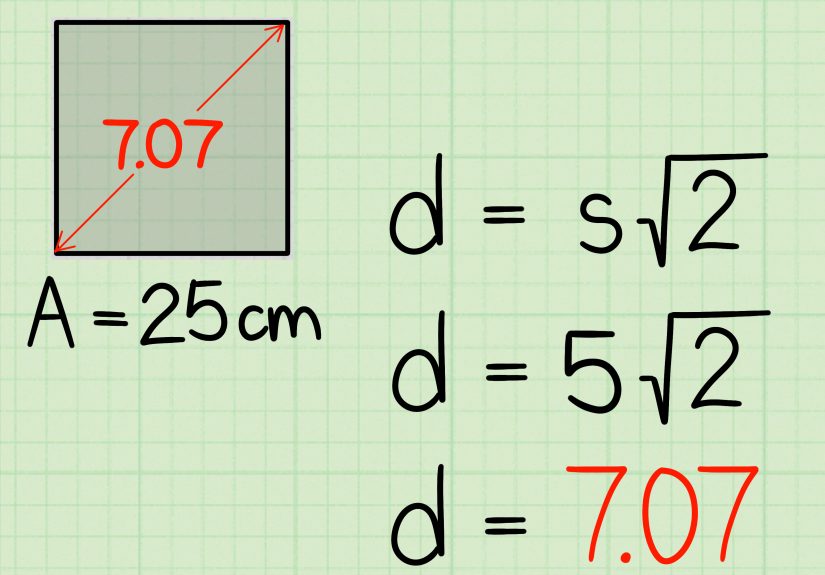
d = s√2
Example (with a “nice” number)
Let s = 5 cm. Then:
d = 5√2 ≈ 7.07 cm
When to use it: When your teacher says “special right triangles,” when you want speed, or when you’re trying to avoid writing “Pythagorean theorem” for the 900th time.
Way 3: Use the Distance Formula (When Your Square Lives on a Coordinate Plane)
Sometimes the square isn’t politely labeled “side = 10.” Instead, it’s plotted on a coordinate grid like it’s trying to be mysterious. If you know the coordinates of two opposite corners, you can compute the diagonal directly using the distance formula.
The distance formula
If diagonal endpoints are (x1, y1) and (x2, y2), then:
d = √((x2 − x1)2 + (y2 − y1)2)
Example
Suppose opposite corners of a square are at (2, 3) and (7, 8).
Compute differences: Δx = 7 − 2 = 5, Δy = 8 − 3 = 5
So:
d = √(52 + 52) = √(25 + 25) = √50 = 5√2 ≈ 7.07
Notice what happened: the differences were equal (5 and 5), which is exactly what you’d expect when the diagonal runs “up and over” the same amountvery square behavior.
When to use it: Coordinate geometry problems, graphing tasks, design grids, map-like layouts, and any time your square has coordinates instead of manners.
Way 4: Work Backward From Area or Perimeter (When You Don’t Have the Side)
Sometimes you don’t know the side length s, but you do know something else, like the square’s area or perimeter. You can still find the diagonaljust take a short detour.
4A) If you know the area
Area of a square: A = s2
So: s = √A
Then diagonal: d = s√2 = √A · √2 = √(2A)
Example (Area)
Suppose A = 144 in2.
s = √144 = 12
d = 12√2 ≈ 16.97 inches
4B) If you know the perimeter
Perimeter of a square: P = 4s
So: s = P/4
Then diagonal: d = (P/4)√2
Example (Perimeter)
Suppose P = 40 cm.
s = 40/4 = 10
d = 10√2 ≈ 14.14 cm
When to use it: Word problems, real-world measurement situations, and “Here’s the area/perimeter, now impress me” test questions.
Which Method Should You Use?
- You know the side length → Use Way 1 (Pythagorean) or Way 2 (45-45-90). Same math, different outfits.
- You have coordinates for corners → Use Way 3 (Distance formula).
- You know area or perimeter → Use Way 4 (Work backward, then multiply by √2).
Secret truth: all four methods are connected. They’re like different entrances to the same buildingpick the door that matches the information you have.
Common Mistakes (So Your Square Doesn’t Turn Into a Trapezoid Emotionally)
- Forgetting the square root: From 2s2 = d2, you must take a square root to get d. Otherwise you’re solving for “diagonal squared,” which is not usually what anyone asked for.
- Mixing up side and diagonal: The diagonal is longer. If your answer is smaller than the side length, your calculator is fineyour setup isn’t.
- Rounding too early: Keep √2 until the end when possible. Rounding mid-problem can snowball into “why is my answer off?” misery.
- Unit confusion: If the side is in inches, the diagonal is in inches. (Math is powerful, not magical.)
Mini Practice Set (With Answers)
Problems
- A square has side length 9 ft. Find the diagonal.
- A square has area 98 m2. Find the diagonal (exact form is fine).
- Opposite corners are at (−1, 4) and (5, 10). Find the diagonal length.
- A square’s perimeter is 52 inches. Find the diagonal.
Answers
- d = 9√2 ≈ 12.73 ft
- d = √(2A) = √(196) = 14 m
- Δx = 6, Δy = 6 → d = √(36 + 36) = √72 = 6√2 ≈ 8.49
- s = 52/4 = 13 → d = 13√2 ≈ 18.38 inches
Experience Section (About ): Where Square Diagonals Show Up in Real Life
Square diagonals aren’t just a “school thing.” They sneak into everyday life like a math ninja wearing a tool belt. One classic example is screen sizes. A TV or monitor is advertised by its diagonal measurement, not its width or height. Even though screens aren’t perfect squares, that diagonal idea comes from the same logic: a rectangle (or square) diagonal is the “corner-to-corner” distance. Understanding that diagonal relationship helps you estimate how big a screen will feel on your desk before you end up with something that either looks like a postage stamp or blocks the sun.
Diagonals also show up in DIY and home projects. If you’ve ever watched someone build a frame, a cabinet face, or even a simple square picture frame, you may have heard: “Check the diagonals.” That’s because if both diagonals match, the shape is square (or at least properly rectangular). If one diagonal is longer, the corners are slightly offmeaning the project might wobble, the drawer might stick, or the final result might look like it’s leaning away from responsibility. Measuring diagonals is one of the fastest “reality checks” in construction and woodworking.
Another place diagonals matter is tiling and flooring. Imagine laying square tiles and needing to cut tiles along corners or edges. The diagonal becomes the cleanest way to measure a corner-to-corner cut or to line up a design pattern. The formula d = s√2 can save time when you’re estimating cut lengths, especially if you’re working with consistent tile sizes. It’s also handy for planning diagonal layoutsthose fancy patterns that make a room look more dynamic and, coincidentally, make installers quietly whisper “why did we choose diagonal again?”
Diagonals pop up in games and digital design too. On a grid-based map, moving one square up and one square right is a diagonal move. That distance isn’t 2 unitsit’s √2 units. Game designers sometimes adjust diagonal movement speed so characters don’t move faster when traveling diagonally. If you’ve ever wondered why some games feel “fair” when you move diagonally and others feel like you discovered a speed glitch, congratulations: you’ve felt the diagonal of a square in your hands without even touching a ruler.
Finally, diagonals can be a confidence booster in math. Many learners have a moment where geometry stops being random rules and starts feeling connected: squares create triangles, triangles trigger the Pythagorean theorem, and suddenly a diagonal becomes predictable instead of mysterious. Once you see that connection, you don’t just memorize a formulayou understand where it comes from. And that’s the kind of math that sticks around long after the test ends.