Table of Contents >> Show >> Hide
- Why Potted Tomatoes Need Support (Even the “Well-Behaved” Ones)
- Before You Pick a Support, Check These 3 Things
- Way #1: The Reinforced Tomato Cage (Best “Set It and Forget It” Option)
- Way #2: The Single Stake + Soft Ties (Best for Tall Tomatoes and Tight Spaces)
- Way #3: The Spiral Stake or Tomato Ladder (Best “Vertical Without Bulk” Option)
- Way #4: Trellis or Overhead String Support (Best for High Yields in a Small Footprint)
- Common Support Problems (and Quick Fixes)
- A Simple Weekly Maintenance Routine (5–10 Minutes)
- Conclusion: Pick the Support That Matches Your Tomato (and Your Lifestyle)
- Experience Notes: What I Learned Supporting Tomatoes in Pots (The “Oops” Edition)
Growing tomatoes in pots is a little like raising a teenager: they start out sweet and compact, then suddenly they’re taller than you, heavier than expected, and constantly leaning into bad decisions (like flopping over right before the first ripe fruit). The good news? With the right support system, potted tomato plants stay upright, healthier, easier to prune, and way less likely to turn your patio into a tomato crime scene.
This guide covers four reliable ways to support tomato plants in potsplus how to choose the right option for your variety, your container size, and your space (balcony, porch, driveway, or that one sunny corner you defend like it’s a national park).
Why Potted Tomatoes Need Support (Even the “Well-Behaved” Ones)
Tomatoes get top-heavy fast. In containers, that top-heavy feeling is amplified because pots dry out quicker, wind hits harder, and the plant can’t spread roots as far to stabilize itself. A good support system helps you:
- Prevent snapping and flopping when fruit sets and stems start acting dramatic.
- Improve airflow so leaves dry faster after rain or watering (a big deal for disease prevention).
- Keep fruit cleaner and reduce rot from tomatoes resting against damp soil.
- Make harvesting easierbecause crawling around a pot like a treasure hunter gets old.
Before You Pick a Support, Check These 3 Things
1) Your tomato type: determinate vs. indeterminate
Determinate tomatoes grow to a set size and tend to produce fruit in a more concentrated window. Indeterminate tomatoes keep growing and fruiting until cold weather shuts them downmeaning they’ll happily climb into the next zip code if you let them. Indeterminates typically need taller, sturdier support and more training.
2) Your container size and weight
A support system is only as stable as what it’s anchored to. A lightweight pot plus a tall tomato equals a physics lesson you didn’t ask for. Bigger containers (with a wider base) help keep everything upright. If your pot is small, choose a support that won’t turn it into a sail in the wind.
3) Your location: wind, walls, railings, and overhead options
Balconies and patios can be windy tunnels. If you’ve ever watched a patio umbrella attempt flight, assume your tomato is next. On the flip side, if you have a wall, fence, railing, or pergola nearby, you can use it to create vertical support that’s stable and space-saving.
Way #1: The Reinforced Tomato Cage (Best “Set It and Forget It” Option)
Tomato cages are the classic solution: drop one over the plant early, let it grow through the rings, and enjoy a relatively low-maintenance season. The trick with pots is avoiding the flimsy cone cage that looks helpful but folds the moment your plant gets confident.
Who this works best for
- Determinate varieties and compact “patio” tomatoes
- Gardeners who want minimal pruning
- Containers that are large enough to keep the cage stable
How to do it (without the cage tipping over)
- Choose the right cage: Go for a heavier-duty cage or one made from sturdier wire. Taller plants need taller cages.
- Install early: Put the cage in when the plant is young. Waiting risks damaging roots and turning installation into a wrestling match.
- Anchor the cage: In pots, push cage legs down into the soil, then add an anchor strategy:
- Zip-tie the cage to a sturdy stake sunk deep in the pot
- Or secure the cage to the pot handles/structure if your container allows it
- Guide growth: As stems grow, gently nudge them inside the cage rings so the plant is supported instead of spilling outward.
Pros and cons
- Pros: Low effort, good fruit support, minimal tying, beginner-friendly.
- Cons: Cheap cages fail, tall indeterminates can outgrow cages, storage can be awkward.
Practical example: If you’re growing a compact tomato like a patio hybrid in a 10–15 gallon container, a sturdy cage can keep the plant upright with very little daily fuss. Add one stake for reinforcement if your balcony gets gusty.
Way #2: The Single Stake + Soft Ties (Best for Tall Tomatoes and Tight Spaces)
Staking is simple: one strong stake, regular tying, and (usually) some pruning to keep the plant focused. This method shines in containers because it takes up minimal footprintyour pot stays the same size, your tomato stays vertical, and your walkway stays walkable.
Who this works best for
- Indeterminate tomatoes that keep growing
- Containers on patios where space is limited
- Gardeners willing to do weekly check-ins (no helicoptering required, just a quick “how you holding up?”)
How to stake potted tomatoes step-by-step
- Pick a sturdy stake: Wood, metal, fiberglass, bamboojust make sure it can handle weight. Taller tomatoes need taller stakes.
- Place it close but not crowding: Insert the stake near the plant, avoiding the main stem, and push it down firmly for stability.
- Start tying early: Use soft plant ties, stretchy garden tape, or fabric strips. Avoid thin wire that can cut stems.
- Tie the right way: Make a loose figure-eight loopone loop around the stake, one around the stemso the stem isn’t pressed against the stake.
- Decide your training style:
- One main stem (most controlled): prune suckers regularly for a tidy, vertical plant.
- Two main stems (more yield, still manageable): keep the main stem + one strong sucker and prune the rest.
Pros and cons
- Pros: Saves space, works well for tall plants, easy to customize, great airflow.
- Cons: Requires consistent tying and pruning, can look a bit “medical device chic” if you don’t like the aesthetic.
Practical example: If you’re growing an indeterminate cherry tomato in a sunny corner, staking plus one- or two-stem pruning keeps the plant productive without turning your pot into a jungle. You’ll harvest more easily because clusters are visible instead of hidden in a leafy soap opera.
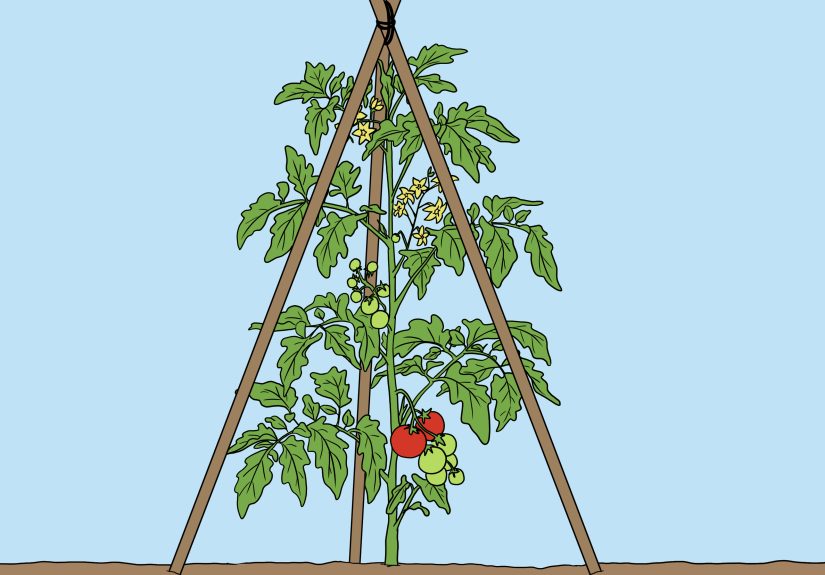
Way #3: The Spiral Stake or Tomato Ladder (Best “Vertical Without Bulk” Option)
Spiral stakes and tomato ladders are like the minimalist apartment of tomato supports: efficient, space-saving, and surprisingly functional when used correctly. The plant climbs upward, and you guide it along the support with occasional ties and selective pruning.
Who this works best for
- Small patios, balconies, and porch gardens
- Tomatoes that are vigorous but not monstrous
- Gardeners who want a support that’s easy to store off-season
How to use a spiral or ladder support in a pot
- Install early: Insert the spiral/ladder while the plant is still small and roots are flexible.
- Encourage the main stem upward: Gently wrap or guide the stem along the spiral, or tie it to the ladder rungs.
- Prune for control: This system works best when you limit extra side shoots so the plant doesn’t turn into a sideways shrub.
- Check ties weekly: Tight ties become stem-stoppers. Keep them loose and adjustable.
Pros and cons
- Pros: Compact, tidy look, great storage, quick setup.
- Cons: Needs pruning to stay neat, may not support very heavy fruit loads unless reinforced.
Practical example: For a balcony gardener growing a mid-sized slicer tomato, a spiral stake can keep the plant upright while leaving room for herbs and flowers in neighboring pots. It’s a smart choice when your “garden” is really a patio chair and a dream.
Way #4: Trellis or Overhead String Support (Best for High Yields in a Small Footprint)
If you want maximum vertical growth without crowding your container area, a trellis or overhead string system is your power move. Instead of relying on the pot alone, you attach the support to something stable: a trellis panel, a railing, a wall-mounted frame, or an overhead bar.
Who this works best for
- Indeterminate tomatoes that grow all season
- Balconies, patios, and porches with a wall/rail/fence nearby
- Gardeners who like training plants (it’s basically tomato yoga)
Three container-friendly versions
- Trellis panel behind the pot: Place your pot in front of a sturdy trellis and tie stems as they grow upward. This keeps the pot stable and gives vines a clear vertical path.
- Overhead string (string trellis): Hang a strong string from an overhead support (like a pergola beam or a sturdy frame) down into the pot area. Clip or gently wrap the stem as it climbs.
- “Mini weave” inside one big pot: If you have a large container with multiple plants (or one very ambitious plant), insert two strong stakes and weave twine back and forth to cradle stems as they grow.
How to set up a simple trellis system for potted tomatoes
- Secure the structure first: Don’t trust a flimsy trellis that wiggles when you blink. Anchor it to a wall, railing, or heavy base.
- Position the pot: Place the pot close enough that stems can be trained upward without sharp bending.
- Train and tie: Use clips or soft ties to attach stems to the trellis as they grow. Adjust regularly.
- Prune strategically: Trellised tomatoes do best with fewer main stems so energy goes into fruit, not chaos.
Pros and cons
- Pros: Big yields in small space, excellent airflow, easy harvesting, looks intentional (like you planned it).
- Cons: Requires a stable structure, more training effort, not ideal if you need to move pots often.
Practical example: If your balcony has a railing and you can mount a vertical trellis panel, an indeterminate tomato can grow up instead of outfreeing floor space and making harvest a breeze. You’ll also reduce leaf crowding, which helps the plant dry faster and stay healthier.
Common Support Problems (and Quick Fixes)
The whole pot tips over
- Move the pot out of wind tunnels if possible.
- Use a wider, heavier container or add weight (without blocking drainage).
- Choose a less top-heavy support (stake instead of a wide cage).
Stems get damaged where they’re tied
- Switch to soft, wide ties and loosen them.
- Use the figure-eight tie method to reduce rubbing and pressure.
- Check weeklyfast growth turns “fine” into “too tight” quickly.
The plant outgrows the support mid-season
- For indeterminates, plan taller support from the start (or transition to a trellis/string system).
- Prune to one or two leaders to reduce bulk.
- Top the plant late in the season if you need to focus on ripening existing fruit.
A Simple Weekly Maintenance Routine (5–10 Minutes)
- Retie and reposition: Guide new growth into the cage/along the stake/onto the trellis.
- Prune with purpose: Remove suckers if you’re training to a stake, spiral, or trellis.
- Inspect for stress: Look for snapped stems, rubbing points, and crowded foliage.
- Water smart: Water at the soil line when possible to keep leaves drier.
- Harvest frequently: Regular picking reduces weight and encourages production.
Conclusion: Pick the Support That Matches Your Tomato (and Your Lifestyle)
The best way to support tomato plants in pots isn’t just about what looks sturdyit’s about what fits your tomato variety, container size, and daily reality. If you want simple, choose a reinforced cage. If you want tall growth in tight quarters, stake and prune. If you want compact and tidy, go spiral or ladder. And if you want serious vertical productivity, trellis or string support is your best friend.
Start early, anchor well, tie gently, and check in weekly. Do that, and your tomatoes will stay uprightlike they’re posing for a seed catalog instead of collapsing like a lawn chair.
Experience Notes: What I Learned Supporting Tomatoes in Pots (The “Oops” Edition)
After enough seasons of container tomatoes, you start to realize the plants aren’t the unpredictable onesyou are. Here are the real-life lessons that show up once the weather heats up, the plant triples in size overnight, and you suddenly have 14 green tomatoes hanging like ornaments. First, the number one mistake is trusting a lightweight cage because it “came with the vibe.” Those thin conical cages are fine for decoration and interpretive dance, but not great for supporting a fruiting tomato on a breezy deck. The first strong gust will turn your plant into a slow-motion tumbleweed, and you’ll be sprinting outside in slippers, trying to save your harvest like it’s a game-winning touchdown. If you want to use a cage in a pot, reinforce it earlyadd a stake and secure itbefore the plant becomes a leafy, fruit-laden sail.
Second, ties matter more than you think. When I first started, I used whatever was nearby: twist ties, random string, even a bit of wire (I know, I know). Tomatoes grow fast, and a tie that feels loose today can become a stem pincher next week. The plant doesn’t complainit just quietly gets damaged where the tie bites in. Now I only use soft, wide ties and I never cinch them tight. I also learned the figure-eight tie method the hard way: tying a stem directly against a stake invites rubbing, and rubbing invites injury. If you’ve ever seen a tomato stem scar up from friction, you’ll become a soft-tie believer immediately.
Third, pruning is less about being “strict” and more about preventing a container plant from turning into a crowded bush that can’t breathe. In a garden bed, a tomato can sprawl a bit and still find airflow. In a pot on a patio, dense foliage stays wet longer after watering, and that’s when problems show up. When I started pruning indeterminate tomatoes to one or two main stems (especially with staking or trellising), everything got easier: tying was simpler, fruit was easier to spot, and the plant looked like it had a plan. The best part? Harvesting didn’t feel like I was playing hide-and-seek with tomatoes that had blended into the leaves.
Fourth, wind planning is not optional. Even if your pot feels heavy, a tall tomato plant changes the math. If your growing spot gets gusty, place pots closer to a wall, use a heavier container, and pick a support style that stays narrow and stable (staking often beats wide cages in wind). I once had a gorgeous trellised tomato that looked like a garden magazine coverright up until a storm rolled in and I realized the trellis wasn’t truly anchored. The plant survived, but my confidence did not. Now I treat every support system like it needs to pass a “shake test.” If it wobbles when I grab it, it’s not ready.
Finally, the biggest lesson: install support early. Waiting until the plant is big feels logical (“I’ll see how it grows”), but it usually ends with bent stems, broken branches, and you trying to thread a cage over a plant that has already decided to expand sideways. If you’re unsure which support to pick, choose the sturdier option sooner rather than later. Tomatoes are forgiving, but they’re not magicand neither is duct tape (though it will try its best).