Table of Contents >> Show >> Hide
- Why Solar Eclipse Photos Grip the Internet So Hard
- What Makes a Solar Eclipse Photo Truly Great?
- The Best Solar Eclipse Photos From Around the Internet, Ranked by What They Do Best
- Best Close-Up of Totality: The Corona Steals the Show
- Best Diamond Ring Moment: Pure Celestial Drama
- Best Human-Scale Photo: Tiny People, Enormous Sky
- Best Editorial Gallery: Storytelling Over Spectacle
- Best Reader Photos: The Internet at Its Most Delightful
- Best Science-Forward Image: The Eclipse Seen From Space
- Best Local-Mood Photos: Partial Eclipse, Full Vibes
- Best Atmospheric Image: Clouds, Haze, and Luck
- Best “I Can’t Believe This Is Real” Shot: The Crowd Under Totality
- What the Best Eclipse Galleries Teach Us About Photography
- The Experience of Falling Down a Solar Eclipse Photo Rabbit Hole
- Final Thoughts
Some photos are pretty. Some photos are historic. And then there are solar eclipse photos, which somehow manage to be both while also making the sky look like it briefly forgot its job description. The best solar eclipse photos from around the internet do more than show a dark circle with a glowing halo. They capture suspense, scale, emotion, science, and that strange feeling humans get when the universe decides to put on a live performance with no rehearsal and no encore on your lunch break.
The April 2024 total solar eclipse gave photographers, editors, and everyday skywatchers a visual feast. Galleries from major newsrooms, science publications, and photo desks showcased everything from razor-sharp corona close-ups to crowd scenes full of eclipse glasses, open mouths, and the universal expression of, “Okay, wow, that was worth the traffic.” Looking across those collections, a few trends stood out. The strongest images were not always the most technical. Often, the most memorable eclipse pictures were the ones that balanced beauty with context: the sun and moon above a packed park, a dim midday street beneath totality, or a moment of human wonder placed against a cosmic backdrop.
Why Solar Eclipse Photos Grip the Internet So Hard
A total solar eclipse is already dramatic in person. In photographs, it becomes something else: a frozen argument against boredom. When the moon fully covers the sun, the corona suddenly becomes visible, turning a familiar daytime sky into something eerie, elegant, and just a little supernatural. That visual contrast is exactly why eclipse photography spreads so quickly online. It looks unreal, yet it is absolutely real.
That mix of science and spectacle is what made the best eclipse galleries so compelling. NASA highlighted the event with images that emphasized geography, timing, and the sheer reach of the eclipse across North America. Major outlets such as AP, ABC News, CBS News, TIME, and PBS leaned into the human side of the event, showing families, travelers, school groups, and professional photographers all trying to catch the same brief miracle. Smithsonian Magazine and Scientific American offered a more curated visual appreciation, focusing on what made the images meaningful instead of simply flashy. The Washington Post and Space.com added another layer by gathering reader images and web roundups, which gave the event a more communal, internet-wide feel.
That is why the phrase “best solar eclipse photos” does not just mean the prettiest pictures. It means the images that best tell the full story of the day: the astronomy, the atmosphere, the crowds, the weather drama, the improvisation, and the oddly emotional experience of seeing daylight act like midnight for a few unforgettable minutes.
What Makes a Solar Eclipse Photo Truly Great?
1. It Shows More Than a Black Circle
The internet is full of eclipse images, but not all of them land. A great solar eclipse photo reveals texture in the corona, catches the diamond ring effect, or preserves the red prominences near the sun’s edge. These details give the image depth and turn it from a record shot into a visual event. The best close-ups feel crisp, intentional, and almost delicate, even though the subject itself is enormous and violent in the most astrophysical sense.
2. It Gives You a Sense of Place
Some of the strongest images from the 2024 eclipse were not close-ups at all. They were wide shots with skylines, parks, ball fields, roads, lakes, or public landmarks. These photographs reminded viewers that the eclipse was not happening in abstract space. It was happening over real cities, real neighborhoods, and real people standing around in paper glasses looking deeply fashionable in the least glamorous possible way.
3. It Captures Human Reaction
The best eclipse photography often includes faces, silhouettes, gestures, and body language. A crowd looking up in unison can be just as powerful as the sun’s corona. That is because eclipse images are not only about astronomy. They are about witness. Good editors know this, which is why so many top galleries mixed sky shots with reaction shots instead of choosing one or the other.
4. It Embraces Imperfection
Some of the internet’s most interesting eclipse images were shaped by clouds, haze, airplane windows, last-second repositioning, or unusual foregrounds. A technically “imperfect” image can still be unforgettable if it captures mood. In fact, a little atmospheric chaos often makes the photo feel more lived-in and honest.
The Best Solar Eclipse Photos From Around the Internet, Ranked by What They Do Best
Best Close-Up of Totality: The Corona Steals the Show
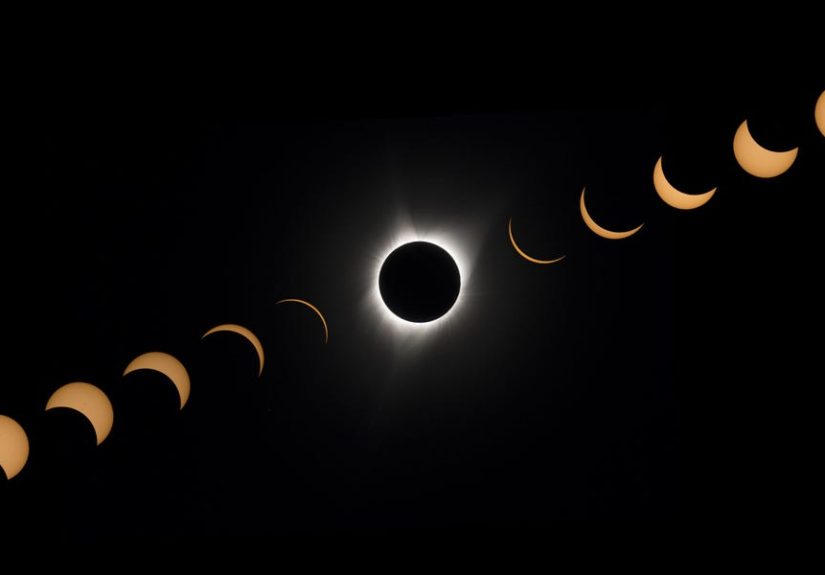
The classic winner in any eclipse roundup is the close-up totality shot, where the moon becomes a perfectly dark disk and the sun’s corona blooms outward in white streamers. These are the photographs that make people stop scrolling. NASA imagery, science-focused coverage, and several specialist outlets showcased versions of this shot with remarkable clarity. What makes these images so powerful is their restraint. There is no clutter, no distraction, just one of nature’s cleanest visual flexes. When the corona appears sharp and structured, the image feels almost architectural, like light built a cathedral for two minutes and then tore it down.
Best Diamond Ring Moment: Pure Celestial Drama
If totality is the elegant part of the show, the diamond ring effect is the show-off part. This is the moment when a final bright bead of sunlight flashes along the edge of the moon just before or after full totality. The best solar eclipse photos online used this instant brilliantly. You get tension, contrast, and a sense of motion even in a still frame. It is the astrophotography version of a mic drop. A strong diamond ring image feels timed rather than merely taken, and that timing is part of why viewers love it so much.
Best Human-Scale Photo: Tiny People, Enormous Sky
AP, CBS, and other major galleries excelled at images that placed viewers beneath the eclipse rather than isolating the eclipse alone. Some of the most memorable frames showed crowds in parks, people taking selfies, families watching from lawns, and city scenes transformed by strange dim light. These photos work because they restore proportion. They remind us that the event was both cosmic and personal. The moon may have been performing precision orbital theater, but on the ground, people were still bumping shoulders, pointing upward, and trying to remember whether they had put their glasses in the backpack or the car.
Best Editorial Gallery: Storytelling Over Spectacle
Smithsonian Magazine, TIME, and PBS stood out for galleries that felt curated rather than merely assembled. Instead of repeating the same eclipse image in twenty slight variations, they gave readers a visual narrative. One picture might emphasize anticipation, another totality, another crowd emotion, and another local color. That editorial pacing matters. A great photo roundup should feel like a guided experience, not a digital shoebox dumped on the floor. The best editors understand that eclipse coverage is not a contest to collect the most halos. It is a chance to tell the story of a rare afternoon when ordinary routines lost the argument to the sky.
Best Reader Photos: The Internet at Its Most Delightful
One of the nicest surprises from the eclipse coverage was the quality of reader-submitted images. The Washington Post and Space.com, among others, highlighted how much good visual material came from non-professionals. These images were not always the sharpest or most meticulously exposed, but many had charm, originality, and the kind of perspective professionals do not always get. Reader photos often had the best foregrounds, the best travel stories, or the best accidental poetry. A parking lot, a backyard, a roadside stop, a crowd by a fence line: those settings made the eclipse feel accessible rather than remote.
Best Science-Forward Image: The Eclipse Seen From Space
The best internet-wide coverage was not limited to ground photography. NASA and other science outlets helped broaden the visual story by showing the eclipse shadow from above Earth. These images are less intimate but wildly effective. They turn the event from a personal viewing experience into a planetary one. Instead of seeing the sun disappear, you see the moon’s shadow racing across land and cloud tops like a giant moving punctuation mark. If close-up totality shots make the eclipse feel sacred, space-based views make it feel mechanical, precise, and gloriously big.
Best Local-Mood Photos: Partial Eclipse, Full Vibes
Not every region got totality, and yet some partial eclipse coverage still produced standout images. Local reporting, including city-based galleries, captured crowds gathered outside observatories, schools, and public spaces to watch the sun turn crescent-shaped. These pictures matter because they show how communal the event became even in places that did not get the full dark-sky payoff. A partial eclipse may not have the same visual fireworks, but it still creates a shared mood. The best local images leaned into that mood rather than apologizing for it.
Best Atmospheric Image: Clouds, Haze, and Luck
Perfect skies are nice, but some of the most interesting eclipse photography came from places where clouds played co-star. Thin cloud layers softened the light. Haze diffused the edges. Unexpected breaks in overcast skies created frames that looked less clinical and more cinematic. Weather is usually treated like the villain of eclipse day, but visually it can become a strange collaborator. The best atmospheric eclipse photos feel like they were discovered, not manufactured.
Best “I Can’t Believe This Is Real” Shot: The Crowd Under Totality
There is a specific kind of image that appears in every strong eclipse roundup: a wide scene where the land is dim, the crowd is frozen in awe, and the black sun hangs overhead like a special effect nobody has the budget to fake. These shots may not be the most detailed or technical, but they are often the most emotionally complete. They show the eclipse as a lived event rather than an object. They also remind us that the internet’s best eclipse photos are not just about the sun. They are about witness, scale, and shared astonishment.
What the Best Eclipse Galleries Teach Us About Photography
After looking across a broad mix of reputable eclipse coverage, one thing becomes obvious: the strongest solar eclipse photography is not only about gear. Yes, lens choice, exposure timing, and filters matter. But what really separates a standout photo from a forgettable one is intent. Editors and photographers who knew what story they wanted to tell produced the best work. Some chased scientific detail. Some chased public emotion. Some framed the eclipse as landscape, some as portrait, some as live theater. All of those approaches worked when they were deliberate.
That is also why the phrase “best solar eclipse pictures from around the internet” is more interesting than it sounds. It implies range. A roundup should include NASA precision, newsroom urgency, reader surprise, and artistic instinct. It should have the clean corona shot everyone expects, but also the messy public scene, the moody cloud frame, the airplane-window oddity, the child in eclipse glasses, and the city street that suddenly looked like evening at noon. The internet at its best is not just a storage unit for images. It is a giant comparison engine for perspective.
The Experience of Falling Down a Solar Eclipse Photo Rabbit Hole
There is a very specific experience that comes with browsing solar eclipse photos online after the event is over. You start with one gallery, telling yourself you are just going to glance at a few pictures. Ten minutes later, you are on your seventh photo roundup comparing coronas like a very niche art critic. One image is all elegance. Another is pure chaos. Another has a crowd in matching eclipse glasses that makes the whole thing look like a very excited secret society. And somewhere in the middle of all this, you realize you are not just looking at photos. You are reliving a shared moment that happened across an entire continent.
That is part of what makes eclipse photography so different from ordinary sky pictures. A sunset can be beautiful, but a sunset does not come with the same feeling of collective suspense. An eclipse does. Everyone knows it will be brief. Everyone knows weather might ruin it. Everyone knows you may never get the exact same chance in the exact same place again. So when you scroll through these images later, you can feel that tension preserved inside them. The photos do not just show the eclipse. They show people waiting for it, reacting to it, and trying to hold onto it after it passes.
There is also something wonderfully democratic about eclipse galleries from around the internet. The event belongs to scientists, sure, but it also belongs to parents holding paper glasses, to students on school lawns, to journalists racing deadline clocks, to photographers standing in fields with tripods, and to random people who somehow captured a fantastic image with a phone, a filter, and a stubborn refusal to miss the moment. That mix is what makes the overall visual archive feel alive. It is not one polished perspective. It is thousands of perspectives stitched together by awe.
And then there is the strange emotional effect of the best photos themselves. Some images make the eclipse look majestic. Some make it look eerie. Some make it look almost tender, especially the frames where the corona glows softly around the moon like a lantern behind black glass. Others feel hilarious in the best way because they show humanity doing what humanity always does when confronted with the sublime: craning our necks, fumbling with gadgets, and trying to narrate the universe in real time with phrases like “No way,” “Look at that,” and “Did you get it?”
Maybe that is why these photos last. They are not just documents of a celestial event. They are evidence of human behavior under wonder. They show what happens when millions of people pause at once, look up together, and briefly agree that email can wait. The best solar eclipse photos from around the internet are memorable because they hold both halves of the experience. They show the mechanics of the sky, yes, but they also show the mood of the ground. They remind us that rare events become meaningful not only because they happen, but because people gather to witness them.
So if you are the kind of person who keeps opening one more eclipse gallery, that is understandable. You are not procrastinating. You are conducting very serious research into beauty, timing, light, shadow, and the emotional instability of a species that sees a glowing halo in the sky and immediately decides to take 14,000 photos of it. Frankly, that feels healthy.
Final Thoughts
The best solar eclipse photos from around the internet succeed for one simple reason: they do not all try to do the same thing. Some aim for scientific precision. Some chase atmosphere. Some center the sky, while others center the people beneath it. Together, they create a fuller portrait of the event than any single image ever could. That is the real joy of an internet-wide eclipse roundup. It lets you see one rare moment through many eyes, many lenses, and many kinds of storytelling.
If the strongest photos share a single lesson, it is this: the most unforgettable eclipse images are the ones that combine wonder with context. They do not just show what happened in the sky. They show how it felt down here, where humans stopped what they were doing, looked up, and got humbled in the most photogenic way possible.