Table of Contents >> Show >> Hide
- Mallorca: A Natural Stage for Indoor/Outdoor Living
- Meet Can Lis: Jørn Utzon’s Cliffside Compound
- Material Palette: Calm by Design
- Indoor/Outdoor Living, the Utzon Way
- What You Can Steal for Your Own Home
- How This Dreamscape Fits Into Today’s Mallorca Design Scene
- A Day Inside an Indoor/Outdoor Dreamscape: Experiential Walkthrough
- Why This Remodelista Dreamscape Still Matters
High above the glittering Mediterranean, on a rocky cliff near Porto Petro in southern Mallorca, sits one of the most
influential houses ever built for “just” one family. Designed in the early 1970s by Danish architect Jørn Utzon
the mind behind the Sydney Opera Housethis modest stone compound, known as Can Lis, has become an indoor/outdoor
dreamscape studied by architects, designers, and design lovers around the world.
Remodelista helped turn this once-private retreat into a cult favorite, spotlighting the way it blurs house and
landscape, furniture and architecture, shade and sun. Far from a flashy mega-villa, it’s a low-slung sequence of
rooms, terraces, and outdoor “hallways” that feel as if they grew straight out of the cliff itself. Calm, quiet,
and radically simple, the house proves that indoor/outdoor living is not about having a big pool and folding glass
wallsit is about orchestrating light, breezes, views, and everyday rituals.
If you are dreaming of Mediterranean modernism, love Remodelista-style restraint, or want ideas for your own
indoor/outdoor home design, this Mallorca dreamscape is a master class in how to live with the landscape, not just
next to it.
Mallorca: A Natural Stage for Indoor/Outdoor Living
Mallorca is not just a vacation-happy Balearic island; it is a testing ground for how architecture can respond to
intense sun, salty air, and dramatic topography. From stone farmhouses tucked into terraced hillsides to ultra-modern
villas facing infinity pools toward the horizon, the island’s best homes share a few traits: thick walls that store
coolness, deep porches that shelter you at midday, and outdoor rooms that feel as intentional as interior spaces.
The climate practically begs for indoor/outdoor living. Summers are hot and dry; winters are mild; breezes off the
sea can be both refreshing and harsh. Traditional Mallorcan buildings responded with limewashed stone, narrow
openings, deep thresholds, and shaded courtyards. Contemporary architects have taken those movescourtyards,
pergolas, loggiasand reworked them into modern compositions with clean lines and large panes of glass.
Jørn Utzon’s cliffside retreat sits right inside this tradition, but with a twist: he combines a deep knowledge of
Mediterranean vernacular with his own fascination for modular geometry and sculpted light. The result is a house
that feels timeless, as if it always belonged to the cliff, the pines, and the sea below.
Meet Can Lis: Jørn Utzon’s Cliffside Compound
A summer house with a monumental pedigree
After leaving Australia in the 1960s, exhausted by the political turmoil surrounding the Sydney Opera House project,
Utzon looked for a place where he could reset with his family. Mallorca offered sun, quiet, and rugged coastline. On
a low cliff near Porto Petro, he acquired a site and began designing a home not as a showpiece but as a retreata
place where mornings, siestas, and evenings could unfold in sync with the sea and the sky.
The house, completed in the early 1970s, is named Can Lis, after Utzon’s wife. Despite its modest square footage, it
has become a pilgrimage destination for architects and students. Instead of one big box, it is made up of several
pavilions, each with a slightly different angle and function, connected by outdoor corridors and terraces. It is
both a family house and a landscape you move through.
Four pavilions tuned to sun and sea
Rather than lining every room up in a single bar facing the water, Utzon organizes the house as a chain of small
stone volumes, each oriented differently. One holds the main living area; another houses the kitchen and dining;
others contain bedrooms and a study. Between them are open-air courtyards and shaded loggias that act like
circulation spaces and outdoor living rooms.
This layout is what makes the house feel like an indoor/outdoor dreamscape. You rarely move from one interior room
directly to another; instead, you step outside, feel the sun or shade, glance at the sea, maybe hear the waves, and
then slip back indoors. The architecture gently insists that you stay aware of weather, light, and time of day.
Sculpted from stone, light, and shadow
At first glance, Can Lis appears almost straightforward: pale stone walls, chunky columns, tile floors, big openings
facing the water. But stand still for a moment and you see how carefully everything is proportioned. The window
recesses are deep, so the sunlight entering is softened and framed. The ceilings, built with prefabricated bovedilla
blocks and concrete beams, create a subtle rhythm overhead. The floors mirror the ceiling’s geometry, reinforcing the
sense of order.
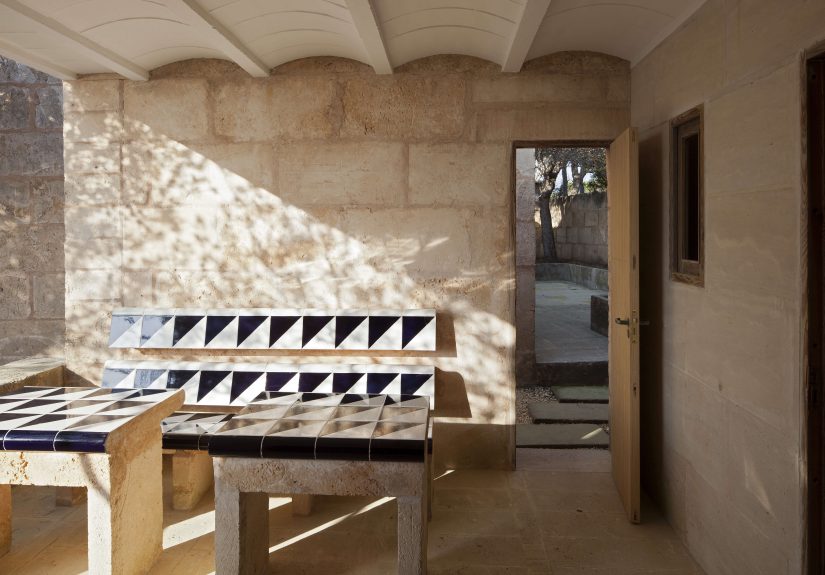
Inside, most furniture is built in: benches rising smoothly from the floor, tables formed from stone slabs, tiled
ledges that double as seating or display. There is very little that looks “decorated,” and almost nothing that feels
temporary. You do not so much put furniture into this house as sit on the architecture itself.
Material Palette: Calm by Design
One reason this house feels so serene in photographs is that the material palette is radically restrained. Utzon
uses local sandstonemarèsfor exterior walls and columns, and a denser local stone known as Santanyí for floors and
many interior surfaces. The tones run from blushy beige to a warm pale pink. When the sun hits them, the walls glow,
and at sunset the whole house seems to deepen in color.
Stone serves both aesthetics and performance. Thick walls absorb heat during the day and release it gradually at
night, smoothing temperature swings. Deep openings prevent harsh sun from blasting directly into the rooms,
protecting the glass and keeping the interiors comfortable. Overhanging loggias and covered terraces extend shade
outward, allowing you to sit inches away from the sun while staying comfortably protected.
The other starring materialsconcrete and ceramic tileare durable and easily cleaned, ideal for a salty, sandy
environment. The built-in benches often wear a cap of glazed terra-cotta tiles; the outdoor dining table uses the
same tiles, visually linking furniture and architecture. With this limited toolkit of stone, tile, wood, and glass,
the house maintains an unusually calm visual field. Your eye is free to focus on what really matters: the horizon.
Indoor/Outdoor Living, the Utzon Way
Courtyards and loggias as outdoor rooms
One of the most powerful lessons from this Mallorca dreamscape is that “indoor/outdoor” does not just mean giant
sliding doors. Here, small courtyards, side terraces, and covered walkways do most of the work. Each transition
space has a clear role: an early-morning coffee terrace sheltered from the wind; a midday passage that offers shade
between the kitchen and sitting room; an evening loggia perfectly positioned for watching the sea turn indigo.
Because each outdoor space is partially enclosedby walls, columns, or low parapetsit feels like a room without a
ceiling. That sense of enclosure makes them comfortable for sitting, reading, or eating, even when they are fully
open to the sea air.
Built-in furniture that refuses to blow away
On a windy cliff, lightweight patio furniture would be a liability. Utzon’s elegant workaround: build the furniture
into the house. Benches and low platforms are cast in concrete or assembled from stone blocks, then topped with
cushions or tiles. Dining surfaces are stone slabs anchored to masonry supports. In the bathroom, stone shelves and
niches are carved right into the wall thickness.
This approach has several advantages. It reduces visual clutter, keeps the outdoor areas from feeling like a catalog
spread, and ensures that every seat takes advantage of a specific view or breeze. It is also extremely low
maintenance: there is no hauling chairs indoors every time the forecast looks dramatic.
Views as carefully framed scenes
Though the house sits only about twenty meters above the sea, it never feels exposed. Instead, deep window reveals
and thick columns act as a kind of proscenium arch for the landscape. From certain built-in benches, the Mediterranean
is framed like a painting: a slice of water, a band of sky, the silhouette of a pine.
This is where Utzon’s opera-house sensibility shows through. The house stages the landscape as a sequence of scenes:
the dazzling midday shimmer, the sodium-orange sunset, the silvery afterglow when the water and sky are almost the
same color. Indoors and outdoors are not opposites here; they are simply different tiers of the same theater.
What You Can Steal for Your Own Home
Most of us are not about to build a cliffside compound in Mallorca, but the design strategies in this Remodelista
favorite easily scale down to an ordinary house or even an apartment balcony. A few takeaways:
- Work with the sun, not against it. Plan spaces based on time of day. A breakfast corner facing the
rising sun, a shady mid-afternoon retreat, and a west-facing terrace for evening light can make a modest home feel
surprisingly luxurious. - Turn transitions into experiences. Instead of a plain hallway from living room to bedroom, think
about a short outdoor path, a glazed porch, or a small landing with a view. Even in cooler climates, a semi-open
mudroom or porch can introduce a breath of outdoor life into your daily routine. - Simplify your material palette. Choose two or three main materials and repeat them indoors and
out. For example, one type of stone or paver for both terrace and living room, or the same wood tone for indoor
shelving and outdoor benches. Continuity makes spaces feel larger and more serene. - Build in what you use every day. A permanent bench along a wall, a built-in outdoor dining
platform, or a tiled ledge that doubles as seating can be far more elegant (and sturdy) than a cluster of random
chairs. - Frame, do not overshare, your views. Sometimes a smaller, carefully shaped opening is more
dramatic than a wall of glass. A single picture window, a deep-set doorway, or a cutout in a garden wall can focus
attention on a tree, a skyline, or a distant hill.
How This Dreamscape Fits Into Today’s Mallorca Design Scene
Contemporary Mallorcan architecturefrom rustic-chic farmhouses to glassy smart homesstill borrows from the
principles that Can Lis embodies: local stone, indoor/outdoor circulation, and a constant dialogue between shelter
and openness. Many newer projects on the island use tall sliding doors, infinity pools, and high-tech shading, but
the best ones remain grounded in the same essentials: orientation, thickness, shade, and texture.
Even as villas grow more luxurious and hotels more curated, designers continue to look back at this 1970s house for
guidance. It is a reminder that good indoor/outdoor living does not rely on a huge budget or a long list of
amenities. It relies on understanding how people actually livehow they move, where they sit, when they seek light,
and when they crave shade.
A Day Inside an Indoor/Outdoor Dreamscape: Experiential Walkthrough
To really understand why this house holds such a grip on design lovers, it helps to “spend” a day there in your
imagination. Picture arriving early in the morning, when the air is still cool and the light is almost white. You
walk along a slightly jagged stone wall that shields the house from the coastal path. A simple entry bench signals
the threshold: no grand gate, just a quiet invitation to step inside.
Crossing into the first courtyard, you feel the temperature change. The stone underfoot still carries the night’s
cool; the walls glow faintly pink in the rising light. Ahead, a low opening pulls your eye toward a flash of bluethe
sea beyond. You follow that hint of color and find yourself in the main sitting pavilion, where a built-in bench
wraps along the wall. The seat is wide enough for morning stretching, a tray of coffee, or three people sharing a
book.
By late morning, the house begins to offer choices. One terrace is already bright and sun soaked; another, tucked
slightly back, holds onto the shade. You carry a book and a straw hat out to a loggia framed by stone columns. From
here, the sea is half-screened by pine branches. The scent of resin mixes with salt air, and the tiles beneath your
feet are just warm enough to be comfortable.
Lunchtime pulls you toward the kitchen pavilion. Inside, open shelves hold just what you need: simple plates, a few
copper pots, glasses lined up in neat rows. The counters are pared back and spare, with tiled recesses instead of
bulky cabinets. You assemble a meal heavy on local ingredientstomatoes, olives, grilled fishand carry it straight
out to a stone dining table under the loggia. No elaborate tablescape, no fuss; the view is the decor.
As the afternoon heat builds, the house subtly redirects you. You drift to the shadiest courtyard, where high walls
and a smaller opening toward the sea make the air feel noticeably cooler. A long built-in bench along one wall
becomes the perfect siesta spot. The thick stone muffles the outside world; you hear only muffled waves and an
occasional gull.
When the sun begins to slide west, the house changes character again. Openings that felt too bright at noon now glow
softly. You move back to the main living pavilion, where the deep window reveals transform into frames for the
show outside. The sea shifts from electric turquoise to a denser blue; clouds catch impossible colors. From certain
seats, you cannot even see the horizon linejust bands of color stacked like an abstract painting.
After sunset, the interior comes forward. Small lamps and indirect lighting bounce off stone walls, highlighting
their texture. The built-in benches feel more like hearths than furniture. You notice how the ceilings, with their
regular bovedilla pattern, lend a quiet rhythm to the space. There is nothing glossy to distract you, nothing
over-designed. The house seems to exhale as the day ends.
This imagined day reveals what makes the house so compelling: it choreographs your movement, your attention, and your
comfort without shouting about it. Indoors and outdoors are not competing zones; they are steps along a single,
continuous experience. That is what “indoor/outdoor dreamscape” really means herenot an amenity list, but a way of
living where architecture and landscape are permanently intertwined.
Why This Remodelista Dreamscape Still Matters
Decades after it was built, this architect’s indoor/outdoor dreamscape in Mallorca remains a touchstone for
considered design. It proves that a house can be both rigorous and relaxed, deeply rooted in local building
traditions yet unmistakably modern. By using stone, light, and carefully shaped space instead of gimmicks and
gadgets, Jørn Utzon created a family retreat that feels as relevant to today’s climate-conscious, experience-focused
homeowners as it did in the 1970s.
Whether you are planning a full remodel, sketching your dream home, or just rethinking a balcony, there is something
powerful to borrow from this project: respect the landscape, simplify your materials, and design your rooms around
daily life and natural rhythms. When indoor and outdoor spaces are allowed to trade roles and blend into one another,
even the simplest home can become its own kind of dreamscape.