Table of Contents >> Show >> Hide
Movies run on patterns. That is not a bug; it is the whole magic trick. Audiences love setups, payoffs, genre expectations, and familiar emotional beats. A great trope is like a cast-iron skillet: seasoned, reliable, and capable of turning simple ingredients into something glorious. But an overdone film trope? That is a microwave fish situation. Everybody notices. Nobody is happy.
That is why so many viewers have grown tired of the same old movie clichés getting wheeled out with a fresh coat of cinematic makeup. We have all seen the rom-com heroine with a suspiciously huge apartment, the action hero who defeats thirty henchmen but suddenly develops a moral crisis when the villain appears, and the horror character who hears a noise in the basement and responds by turning on exactly zero lights. These overused movie tropes are not annoying because they exist. They are annoying because filmmakers often use them as shortcuts instead of storytelling.
The truth is, modern audiences are sharp. They binge. They meme. They dissect trailers, swap takes online, and recognize lazy screenwriting from a mile away. If a film wants to use familiar devices, it has to do something clever with them. Otherwise, viewers start feeling like they are not watching a story at all. They are just watching a screenplay assemble itself in real time.
Why Overdone Film Tropes Wear Out Their Welcome
The problem with tired Hollywood tropes is not just repetition. It is predictability without payoff. Audiences do not mind formula when the formula still delivers character, tension, humor, or surprise. What people resent is the sense that a movie is leaning on a cliché because it has not bothered to build anything more specific. That is how you end up with identical love triangles, interchangeable villains, and “twists” that can be spotted from the parking lot.
Overused film tropes also tend to flatten characters into functions. The “strong female character” becomes a punch machine instead of a person. The awkward girl is clearly played by someone who looks like she stepped out of a luxury shampoo ad. The wise mentor exists only to die on schedule. The result is a strange kind of cinematic déjà vu: you are not meeting a character, you are recognizing a template.
And once audiences start seeing the scaffolding, it is hard to unsee it. So, with sympathy for the screenwriters who are trying their best and a side-eye for the ones who absolutely are not, here are 40 overdone film tropes audiences are tired of seeing.
40 Overdone Film Tropes That Audiences Are Tired Of Seeing
Romance, Lifestyle, and Character Clichés
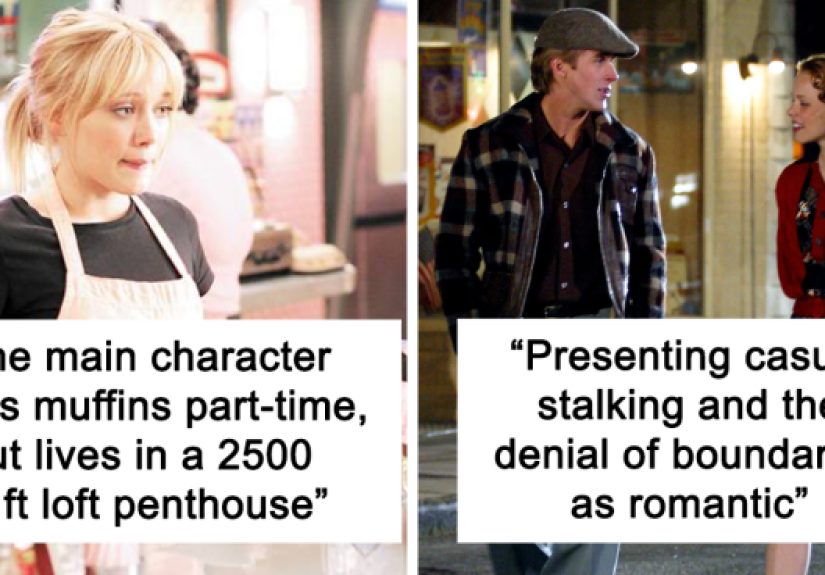
- The part-time-job, luxury-loft fantasy. She froths oat milk at a neighborhood bakery three mornings a week, yet somehow lives in a sun-soaked industrial penthouse with exposed brick, skyline views, and enough square footage for a dance number. In 2026, audiences have seen rent. This trope now plays less like fantasy and more like tax fraud.
- The “plain” girl who is obviously stunning. Hollywood loves pretending glasses, a ponytail, and one paint smudge transform a gorgeous actor into an invisible goblin. Nobody buys it. Viewers are not rejecting movie magic; they are rejecting a lie so flimsy it would lose in traffic court.
- The clumsy heroine as a personality substitute. If she spills coffee, drops folders, and crashes into a handsome stranger, that is not characterization. That is slapstick with a blowout. Quirky should mean specific, not “human giraffe in a blazer.”
- The workaholic woman cured by one rugged man and a small town. She is ambitious, tightly wound, and allergic to Christmas. He owns a hardware store, wears flannel like a religion, and teaches her the meaning of “slowing down.” It is as if female success is a temporary illness only cured by cider and eye contact.
- Stalking framed as romance. Following someone home, refusing to take no for an answer, or orchestrating grand boundary-violating gestures is not adorable just because a soundtrack swells behind it. Audiences are increasingly impatient with behavior movies insist on wrapping in glitter.
- The endless “will they, won’t they” reset. Some films and franchises treat emotional progress the way gyms treat January memberships: full of promise, then quietly abandoned. If two characters keep breaking up and re-realizing they are meant to be together every 40 minutes, viewers stop rooting and start checking the runtime.
- The misunderstanding that one sentence could fix. “Wait, I can explain!” is followed by the other character storming off at the pace of a distracted mall walker. The explanation is always simple, immediate, and weirdly postponed for dramatic reasons. This trope does not create tension anymore; it creates audience resentment.
- The public grand gesture that erases bad behavior. A speech at the airport, a song outside the window, or a mic-drop confession at someone else’s wedding is apparently supposed to undo lying, neglect, or three acts of emotional chaos. It rarely feels romantic now. It feels like branding.
- The manic muse with no inner life. She exists to shake up a gloomy man, teach him to feel again, and vanish before anyone asks what she wants. Audiences have become much more alert to one-sided characterization, and rightly so. A human plot device is still a plot device.
- The nerd signal that is not nerdy at all. Liking one massively popular franchise does not make a character a social outcast. If the screenplay wants to tell us someone is weird, it needs better evidence than “owns a comic book” or “knows what Star Wars is.”
Lazy Plot Devices and Narrative Shortcuts
- The ex-cop dragged out of retirement. Apparently the entire state, federal system, and all existing personnel are helpless until one grizzled guy with divorce papers and a denim jacket is called back in. This trope can still work, but too often it arrives with canned dialogue and no fresh angle.
- The hero who kills henchmen but spares the mastermind. After mowing through a small village’s worth of anonymous goons, the protagonist suddenly decides murder is wrong precisely when it would be narratively convenient to finish the actual villain. Audiences notice the moral math, and the math is not mathing.
- The villain monologue before the kill shot. The hero is beaten, disarmed, and seconds from death. Naturally, the villain chooses this moment to explain the entire plan, childhood trauma, corporate grievance, and maybe the thematic message of the film. Thank you, evil TED Talk. Very helpful.
- The omnipotent hacker. One person can access satellites, security cameras, police databases, offshore accounts, and a subway signal system in 14 seconds while eating cold noodles. Computers in movies are either wizardry or decorative aquarium screensavers. There is no middle ground.
- The phone that dies exactly when the plot needs silence. No battery, no signal, cracked screen, mysterious interference, sudden software failure. Modern storytelling keeps inventing reasons characters cannot simply text the truth. At this point, the smartphone is less a device than a hostage.
- The refusal to call for help. A monster is loose, the building is on fire, and evidence of a conspiracy is literally in hand, yet everyone decides to handle it personally. Not every movie needs a realistic emergency response timeline, but the total absence of common sense gets old fast.
- The prophecy that picks the hero for no good reason. The chosen one trope can still be powerful, but too often it is a shortcut around development. Instead of becoming interesting through choices, the protagonist is declared important by ancient paperwork.
- The exposition dump disguised as dialogue. Two experts explain their shared field to each other like they just met on a bus. “As you know, the government’s top-secret quantum engine has been unstable since the Geneva incident.” Ah yes, how naturally humans speak.
- The fake-out death. If a movie lingers on tears, swells the music, then reveals the character survived thanks to a conveniently non-fatal stabbing, it is not being emotional. It is playing peekaboo with stakes.
- The shock-value death with no narrative purpose. Killing a character can be devastating and meaningful. Killing one just to make the audience gasp for eight seconds is the storytelling equivalent of throwing a plate for attention.
Action, Thriller, and Franchise Habits We’ve Seen Too Many Times
- The final-act sky beam, portal, or giant energy thing. Somewhere along the line, “big ending” became synonymous with “glowing object stabbing the clouds.” It is visual shorthand for importance, but it has become so common that it now feels like stock footage with a budget.
- The surprise villain who was barely in the movie. If the twist depends on a character we forgot existed, that is not clever. That is attendance. A satisfying reveal feels inevitable in hindsight, not random because the screenplay hid the ball under the couch.
- The sequel villain with family ties to the hero. Half-brother, forgotten child, ex-partner, old squadmate, secret parent. Franchises love retroactive intimacy because it creates instant drama, but it often shrinks the story instead of deepening it. The world starts to feel less epic and more weirdly inbred.
- The government agency staffed entirely by fools. There is always one competent rebel and a whole building full of clipboard goblins whose main job is telling the hero to stand down. Institutions can absolutely fail in real life; the problem is when every authority figure becomes the same cardboard obstacle.
- The detective with family problems as default seasoning. He missed the recital. She drinks too much coffee and slept in the office. The kid is mad. The ex is furious. None of that is bad on its own, but it has become such routine shorthand that it now feels prepackaged.
- The comic relief that punctures every serious moment. Humor is great. Relentless undercutting is not. Some blockbusters have become so afraid of sincerity that they answer every emotional beat with a joke, like a nervous best man ruining the toast.
- The expert acting like an idiot so the plot can continue. Scientists forget protocol. Assassins leave witnesses. Generals ignore obvious threats. Doctors abandon basic ethics. When highly trained characters become foolish on cue, audiences do not feel suspense; they feel manipulated.
- The resurrection retcon. If nobody stays dead, then nothing matters. A character’s return should expand the story, not simply restore a familiar face because the franchise got nervous without it.
- The nostalgia cameo mistaken for storytelling. A beloved legacy character walks in, the audience claps, the music winks, and the script hopes dopamine will do the rest. Cameos can be delightful, but they are not a substitute for plot, momentum, or new ideas.
- The universe-building ending that forgets to end the movie. Instead of closure, we get a teaser, a symbol, a mysterious file, a post-credit eyebrow, and a setup for Chapter Nine. Viewers do not need every ending tied in a bow, but they do need an ending.
Horror, Representation, and World-Building Clichés
- The horror character who never turns on a light. You heard whispering in the cellar. Why are you entering with a candle and vibes? Darkness is scary, sure, but self-preservation should occasionally get a speaking role.
- The group that splits up in obvious danger. There is a masked killer outside. The house is huge. The best plan, somehow, is to separate and “cover more ground.” At this point, audiences almost root for the furniture.
- The palm slice for blood magic. Movies love characters slashing the center of the palm to provide a dramatic drop of blood, as if that would not instantly wreck your ability to hold literally anything. The trope persists because it looks cool, not because it makes sense.
- The body disappears, so obviously the villain lives. If the corpse is offscreen, the sequel is on. This can still be effective, but it has become such a transparent franchise maneuver that audiences see the contract extension from ten rows back.
- The trauma metaphor with no new insight. Horror has every right to explore grief, guilt, and family pain. But when “buried trauma” becomes a generic all-purpose engine instead of a carefully built emotional truth, it starts to feel like thematic wallpaper.
- The copy-paste final survivor. The final girl or final survivor can be iconic when the character is sharply drawn. It gets stale when survival itself is the only interesting thing about them. Endurance is not a personality.
- The “strong female character” who is only allowed to be strong. Audiences increasingly want women written as people, not action-figure slogans. Competence is great. Complexity is better. Give her fear, contradiction, humor, selfishness, and actual texture.
- The stereotype standing in for culture. The exotic city, the mystical foreigner, the wise elder, the comic immigrant, the glamorous outsider with no real community around them; these shortcuts age badly because they were always shallow. Modern audiences are less willing to accept caricature as atmosphere.
- The fantasy world that still runs on generic medieval settings and chosen-one politics. If every kingdom feels copied from the same dusty shelf of visual assumptions, the wonder evaporates. World-building should expand imagination, not recycle it.
- The “look, we’re self-aware” defense. Self-awareness can be charming, but it is not an all-access pass. A movie does not become original just because it points at its own cliché before using it anyway. Winking at the audience is not the same thing as surprising them.
The Audience Experience: Why These Tropes Feel More Annoying Now Than They Used To
Part of the reason these movie tropes audiences hate feel worse today is simple exposure. People do not just watch one Friday-night release and move on. They stream entire franchises in a weekend, revisit old favorites, watch breakdown videos, scroll hot takes, and compare stories across decades and genres. Repetition that might have slipped by in the 1990s now sticks out like a fog machine in a dentist’s office. Once you notice a cliché, you start spotting its cousins everywhere.
There is also the realism problem. Viewers are more conscious of everyday economics, social behavior, and representation than they used to be. So when a character with a barely-there income lives in absurd luxury, the fantasy no longer feels harmlessly glossy; it feels disconnected from reality in a way that can break immersion. The same goes for romance plots built on stalking, breakups caused by one missing sentence, or “empowered” characters who have no real interior life. People are not just consuming stories. They are measuring what those stories normalize.
Another huge factor is pacing. Modern audiences are incredibly literate in film language. They know what a fake-out death looks like. They know that if a villain pauses to monologue, somebody is about to crash through a window. They know that if a body disappears, the studio is planning a sequel. That familiarity changes the viewing experience. What used to feel like suspense now feels like waiting for the screenplay to catch up with you.
And yet, the funny thing is that audiences do not actually want tropes to vanish. They want them refreshed. People still love enemies-to-lovers, final survivors, revenge stories, haunted houses, and underdog victories when those stories have texture. What they are tired of is automation. They want characters who seem to have existed before the camera found them. They want conflict that emerges from personality, not convenience. They want movies that trust them enough not to spoon-feed every beat or recycle every trick.
That is why the best films still get away with familiar ingredients. They bring specificity. They give the awkward character an actual worldview. They make the villain’s plan reveal something surprising about the hero. They let fear come from atmosphere instead of volume. They understand that cliché is not born from repetition alone; it is born from repetition without imagination.
So yes, audiences may grumble about overused movie clichés more loudly now. But that is not proof people have become impossible to please. It is proof they still care. If nobody cared, nobody would complain when a film settled for lazy shorthand. The groan is actually a strange kind of compliment. It means viewers still believe movies can do better, and they are disappointed when one chooses the easiest, most overfamiliar road.
Final Thoughts
Overdone film tropes are not going anywhere, and honestly, they do not need to. The goal is not to ban every familiar device and replace cinema with two hours of abstract whispering in a field. The goal is craft. If a filmmaker uses a trope with wit, emotional truth, and a little nerve, audiences will happily come along for the ride. But if the script treats cliché like a substitute for originality, viewers will spot it instantly and drag it harder than a fake New York apartment listing.
In other words, tropes are tools. Used well, they build stories. Used lazily, they build eye rolls. And the modern audience? It has plenty to spare.