Table of Contents >> Show >> Hide
- Quick Snapshot
- The Best Buttermilk Pancake Recipe
- Why Buttermilk Pancakes Taste Better (And Rise Higher)
- Pro Technique: How to Get Fluffy Pancakes Without Weird Tricks
- Flavor Boosters and Variations (Choose Your Pancake Adventure)
- Buttermilk Substitutions (When Real Buttermilk Ghosts You)
- Toppings That Actually Make Sense
- Troubleshooting: Pancake Problems and Fixes
- Make-Ahead, Storage, and Reheating
- Serving a Crowd (Without Becoming the Pancake Employee of the Month)
- Experience Notes: What People Learn After Making Buttermilk Pancakes a Few Times
- Conclusion
If pancakes had a love language, it would be buttermilk. Not because it’s fancy (it’s not),
but because it does three important things at once: it makes batter taste tangy and “diner-right,”
it helps pancakes brown like they’re showing off, and it teams up with baking soda to create that
fluffy lift that makes a stack feel like a weekendeven if it’s a Tuesday.
This guide gives you a reliable from-scratch buttermilk pancake recipe, plus the “why it works”
details (so you can troubleshoot like a pro), smart substitutions, and a pile of variations that
won’t turn your kitchen into a science fair. The goal: pancakes that are tender, golden, and
proudly tallwithout tasting like a sponge that got a degree in disappointment.
Quick Snapshot
- Yield: About 10–12 medium pancakes (4–5 inches)
- Time: ~10 minutes prep + 15 minutes rest + 15 minutes cook
- Texture: Fluffy inside, lightly crisp at the edges
- Flavor: Buttery, gently sweet, with a pleasant tang
The Best Buttermilk Pancake Recipe
Ingredients
- 2 cups all-purpose flour
- 2 tablespoons sugar
- 2 teaspoons baking powder
- 1/2 teaspoon baking soda
- 1 teaspoon kosher salt (or 3/4 teaspoon fine salt)
- 2 large eggs (room temp helps, but don’t panic if they aren’t)
- 2 cups buttermilk
- 4 tablespoons unsalted butter, melted and cooled slightly (plus more for the pan)
- 1 teaspoon vanilla extract (optional, but highly encouraged)
Instructions
-
Mix the dry ingredients.
In a large bowl, whisk together the flour, sugar, baking powder, baking soda, and salt.
Whisking isn’t just for dramathis helps spread the leaveners evenly so every pancake rises the same. -
Mix the wet ingredients.
In a separate bowl (or a big measuring cup), whisk the eggs, buttermilk, melted butter, and vanilla. -
Combine gently (the “don’t bully the batter” step).
Pour wet into dry and stir with a spatula or wooden spoon until just combined.
The batter should look lumpy and a little shaggy. If it’s perfectly smooth, you went too far.
A few streaks of flour are fine; they’ll hydrate during the rest. -
Rest the batter.
Let it sit for 15 minutes at room temp. (If you can spare it, a longer rest can be even better.)
This rest helps the flour hydrate and relaxes gluten so the pancakes stay tender instead of chewy. -
Preheat your cooking surface.
Heat a griddle or nonstick skillet over medium heat. Lightly butter it, then wipe off excess
with a paper towel so you get even browning instead of fried-butter freckles. -
Scoop and cook.
Use about 1/4 cup batter per pancake. Cook until you see bubbles forming on the surface
and the edges look set, 2–3 minutes (timing depends on your stove). -
Flip once.
Flip and cook another 1–2 minutes until golden and springy. Avoid pressing them downthose
precious air pockets are your pancake’s entire personality. -
Serve warm.
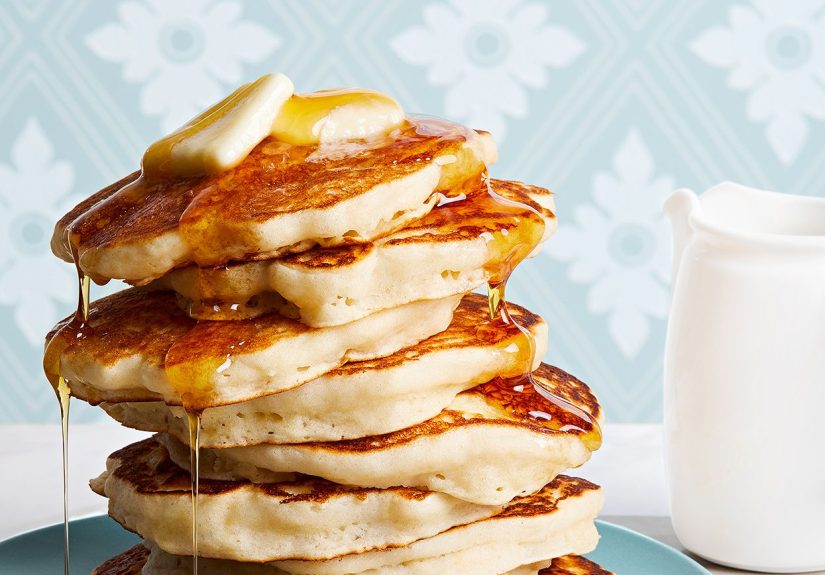
Stack them, butter them, syrup them. Or eat one straight from the pan “for quality control”
like a responsible adult.
Why Buttermilk Pancakes Taste Better (And Rise Higher)
Most store-bought “buttermilk” is cultured buttermilkmilk fermented with lactic acid bacteria.
That fermentation adds tang and subtle buttery aroma notes, and it changes how the batter behaves.
The acidity also reacts with baking soda to create carbon dioxide bubblesaka lift.
Using both baking powder and baking soda is a classic move. Baking soda helps with browning
and works with the buttermilk’s acidity. Baking powder gives reliable, steady rise so your pancakes
don’t depend on a single chemical reaction happening at exactly the perfect moment.
Pro Technique: How to Get Fluffy Pancakes Without Weird Tricks
1) Don’t overmix (lumps are your friend)
Overmixing develops gluten, which is great for chewy bread and terrible for tender pancakes.
Stir until the dry bits are mostly moistened, then stop. If your batter looks like satin, your
pancakes may eat like a yoga mat.
2) Rest the batter (yes, it matters)
A short rest gives flour time to absorb liquid and allows the batter to thicken slightly.
It also relaxes gluten so your pancakes stay soft. Think of it as letting the batter take a quick nap
before its big performance.
3) Control the heat (medium beats “volcano”)
Pancakes want a steady medium heat. Too hot and you’ll get a brown outside with a raw middle.
Too cool and they’ll dry out before they color. A helpful test: flick a few drops of water onto the pan.
They should sizzle and skitter, not vanish like they fell into the sun.
4) Flip once, confidently
Wait until bubbles pop and leave little craters that don’t immediately fill back in, and the edges look set.
Then flip with commitment. Hesitation leads to pancake tearsand not the emotional kind.
Flavor Boosters and Variations (Choose Your Pancake Adventure)
Classic add-ins
- Blueberries: Sprinkle on top right after you portion batter onto the griddle (prevents purple batter chaos).
- Chocolate chips: Same strategy as blueberries; keep chips from sinking by adding per pancake.
- Banana: Thin slices on the surface after pouring batter. (Mash-in banana can make batter heavy.)
Extra-tender “brunch flex” version
Want pancakes that feel a little more restaurant-style? Add 2 tablespoons sour cream or
ricotta to the wet ingredients. You’ll get a richer crumb and a slightly more luxurious bite.
Whole-grain version that doesn’t taste like homework
Swap 1/2 cup of the all-purpose flour for whole wheat flour. If the batter thickens too much,
add a splash of buttermilk. Whole wheat absorbs more liquid and benefits from a slightly longer rest.
Buttermilk Substitutions (When Real Buttermilk Ghosts You)
If you’re out of buttermilk, you still have options. Some substitutes are better than others because
real cultured buttermilk is both acidic and usually slightly thick.
Best substitute: Kefir
Use kefir 1:1 in place of buttermilk. It’s tangy and closer in texture to cultured buttermilk,
so it performs well in pancake batter.
Very good substitute: Plain yogurt (thinned)
Mix 3/4 cup plain yogurt + 1/4 cup milk to replace 1 cup buttermilk. This mimics both tang and thickness.
Emergency-only substitute: Milk + lemon juice or vinegar
Stir 1 tablespoon lemon juice or white vinegar into 1 cup milk and let it sit 5 minutes.
It adds acidity, but it doesn’t fully match cultured buttermilk’s texturestill, it’ll get you pancakes today.
Tip: If your substitute is less acidic than buttermilk, your baking soda may not react as strongly.
In that case, rely more on baking powder (this recipe already uses both, which makes it forgiving).
Toppings That Actually Make Sense
- Warm maple syrup + salted butter (the classic for a reason)
- Berry compote (microwave frozen berries with a little sugar and lemon; stir, then spoon)
- Peanut butter + sliced banana (messy, delicious, oddly motivating)
- Greek yogurt + honey + toasted nuts (a “brunch board” vibe with minimal effort)
Troubleshooting: Pancake Problems and Fixes
My pancakes are flat
- Old leaveners: Baking powder and baking soda lose punch over time. Fresh matters.
- Overmixed batter: Too much stirring knocks out bubbles and builds gluten.
- Heat too low: The batter spreads before it can set and rise.
They’re browned outside but raw inside
- Griddle is too hot. Lower heat and give the pan a minute to stabilize.
- Too much batter per pancake. Slightly smaller pancakes cook more evenly.
They’re tough or rubbery
- Overmixing is the #1 culprit.
- Too much flour can also do itspoon and level if you’re using cups.
Make-Ahead, Storage, and Reheating
Pancakes are one of the best “cook once, eat twice” breakfastsespecially if you freeze them.
Good news: cooked pancakes freeze beautifully. Less good news: pancake batter is not a great freezer project.
Refrigerator
Cool pancakes completely, then store in an airtight container.
For best quality, enjoy within a couple days; for safety, many cooked leftovers can be refrigerated for
3–4 days.
Freezer
Freeze pancakes in a single layer until firm, then transfer to a freezer bag with parchment between layers.
For best quality, aim to use within 3–4 months.
Reheating
- Toaster: Best for crisp edges and speed.
- Oven: 300°F on a sheet pan, covered loosely with foil, 8–10 minutes.
- Microwave: Works, but can soften edgescover with a damp paper towel to prevent drying.
Serving a Crowd (Without Becoming the Pancake Employee of the Month)
If you’re cooking for a group, keep finished pancakes warm in a 250°F oven on a rack-lined sheet pan.
That keeps steam from turning them soggy while you finish the batch. Also: recruit a helper to handle toppings.
Delegation is the secret ingredient the recipe card never mentions.
Experience Notes: What People Learn After Making Buttermilk Pancakes a Few Times
The funny thing about a “simple” buttermilk pancake recipe is that it’s often the first place home cooks
notice how small choices change the final result. Not in a scary waymore in a “wow, this is why diners
taste different” way.
One common experience: the first batch is rarely the best batch. It’s not you; it’s the pan.
Griddles and skillets take a minute to settle into a steady temperature, and pancakes are basically
edible mood rings for heat control. That first pancake sometimes browns too fast or spreads too much,
and then suddenly batch two looks like it belongs in a syrup commercial. Many cooks quietly accept
the “first pancake tax” and treat it as a chef snack (purely for calibration, of course).
Another familiar moment is discovering how much batter texture matters. People often expect pancake batter
to look smooth like cake batter, so they keep stirring until every lump disappears. Then they wonder why
the pancakes feel a little tight. The second time around, they stop mixing earlierwhen it looks a bit lumpy
and imperfectand the pancakes come out softer. It’s a surprisingly satisfying lesson: sometimes the
“messier” choice is the correct one.
The batter rest is another upgrade that cooks tend to “feel” after they try it. With a short rest,
the batter thickens slightly and pours differentlyless runny, more like it’s choosing to become a pancake
instead of a crepe. The pancakes often hold their shape better, rise more evenly, and taste more tender.
And in real life, that 15-minute rest doesn’t feel like waiting; it’s the perfect window to slice fruit,
warm syrup, set the table, and pretend you’re the kind of person who has it all together before 9 a.m.
Buttermilk itself can be a little eye-opening. Some people expect it to taste like melted butter (the name
makes a strong promise), but cultured buttermilk is tangy and slightly thick. Once you recognize that tang,
you start noticing it in pancakes from restaurants and cafes. It’s also why pancakes made with plain milk
can taste “fine” but not quite as interesting. Many cooks describe buttermilk pancakes as having more depth,
like the difference between a good song and the same song with bass turned on.
There’s also the “flip confidence” journey. Early pancake attempts often involve flipping too soon, too late,
or twice “just to check.” After a few rounds, most people get a feel for the cues: bubbles that pop and stay,
edges that look set, and a surface that shifts from glossy to matte. At that point, flipping becomes less of
a gamble and more like a smooth, satisfying motionone spatula swoop, no drama. (Okay, maybe a little drama,
but the fun kind.)
Finally, a lot of pancake makers end up with a personal preference that becomes their signature:
slightly smaller pancakes that cook evenly; a touch more salt for flavor; vanilla that makes the kitchen smell
like happiness; or add-ins sprinkled per pancake so the batter stays consistent. That’s the real joy of a
dependable buttermilk pancake recipe: once the foundation is solid, you can make tiny adjustments and
build a stack that feels like your breakfast.
Conclusion
A great buttermilk pancake recipe is less about fancy ingredients and more about smart basics:
use buttermilk for tang and lift, combine baking soda and baking powder for reliable fluffiness,
mix gently, rest the batter, and cook at steady heat. Once you’ve made this a couple times, you’ll
start spotting the little details that turn “pretty good pancakes” into “why are we not doing this every weekend?”