Table of Contents >> Show >> Hide
- The Real Problem Isn’t Real vs. ArtificialIt’s “What Are We Optimizing For?”
- What the Data Suggests: Neither Side Is Perfect (Sorry, Internet)
- So Where Does Christmas Tree Rental Fit In?
- The Convenience Angle: Rentals Beat Both Sides at Their Own Game
- The “Real Tree” Experience Without the Biggest Real-Tree Hassles
- How to Rent a Christmas Tree Like a Pro
- Specific Examples: Where Rentals Shine
- FAQ: Quick Answers to Common Rental Questions
- What It’s Like to Rent a Christmas Tree: of Real-World Experiences
- Conclusion: The Debate Ends When the Tree Leaves on Schedule
Every December, Americans reenact a holiday classic: the annual argument over whether a real Christmas tree is worth the needles,
or if an artificial Christmas tree is the smarter, cleaner, “I-have-a-life” choice. It’s basically the festive version of
“Is a hot dog a sandwich?”except with more sap and at least one person dramatically whispering, “But the smell.”
Here’s the plot twist: you don’t actually have to pick a side. Christmas tree rental (especially living, potted tree rentals)
is the third option that steals the best lines from both teamsreal-tree vibes with fake-tree convenienceand somehow manages to be
easier on your storage closet, your schedule, and often your conscience.
The Real Problem Isn’t Real vs. ArtificialIt’s “What Are We Optimizing For?”
The tree debate gets framed like a binary choice, but most households are juggling multiple goals that don’t always play nicely together:
- Convenience: minimal shopping, minimal mess, minimal post-holiday “now what?”
- Experience: that warm, nostalgic, “this is a movie set” feeling
- Cost: affordable now, not just “technically cheaper after 9 years”
- Space: storage (or lack of it) in apartments, condos, and already-full garages
- Environmental impact: carbon footprint, waste, recyclability, transport
- Health & safety: allergies, fire safety, and what’s actually in that plastic
When you look at it this way, “real vs. artificial” isn’t a debateit’s a spreadsheet. And the best answer depends on which column matters most
in your house this year.
What the Data Suggests: Neither Side Is Perfect (Sorry, Internet)
Let’s get the big truth out of the way: the “best” tree is the one that fits your life and doesn’t become a guilt ornament you hang every
year. Environmental impact varies widely based on manufacturing, transport, how long you use the tree, and how it’s disposed of.
Artificial Trees: The Convenience King With a Long Manufacturing Shadow
Artificial trees win on tidy living: no watering, no needles in your socks, no “Who forgot to give the tree a drink?” drama. But they’re typically
made from plastics (often PVC) plus metal, produced using fossil fuels, and shipped long distances. The carbon “break-even” point depends on how long
you reuse itmany analyses land somewhere around 5+ years, and some suggest considerably longer depending on assumptions.
Translation: if you buy a fake tree and treat it like a long-term relationship (commitment, storage, and all), you can reduce its per-year impact.
If you buy one, get bored after two seasons, and banish it to the curb like a failed New Year’s resolution… that’s where it gets ugly.
Real Trees: Renewable, Nostalgic, and a Whole Lot More Nuanced Than “We Cut Trees!”
Real Christmas trees are grown as an agricultural cropplanted, cultivated, harvested, and replanted. While growing, they store carbon and support
working farmland and green space. After the holidays, they’re biodegradable and can often be turned into mulch or compost through local programs.
But they also require annual harvesting, transport each year, and responsible end-of-life handling to keep the footprint low.
In other words, a real tree can be a very reasonable choiceespecially when it’s locally sourced and properly recycled. But if it ends up in a landfill,
it can create avoidable emissions. (Your tree deserves better than “forever trash mountain.”)
So Where Does Christmas Tree Rental Fit In?
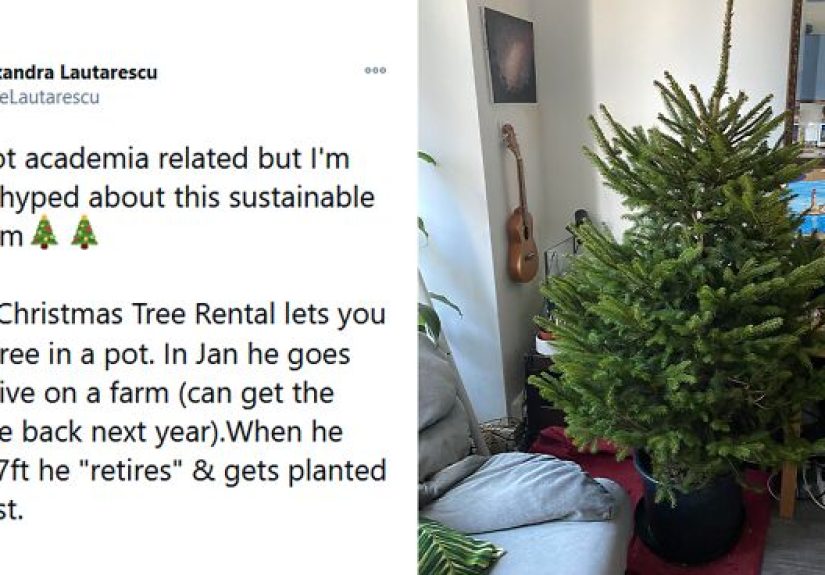
Christmas tree rentalmost commonly a living, potted Christmas tree rental with delivery and pickupsidesteps the
most frustrating tradeoffs:
- You get an authentic, real-tree look (and often fragrance) without cutting a tree down.
- You don’t have to store a bulky artificial tree for 11 months.
- You don’t have to wrestle with disposal logistics after the holidays.
- The tree can keep livingeither returning to a nursery for continued care or being planted in an appropriate setting.
How Tree Rentals Typically Work (In Human Terms)
Most rental services operate like this:
- Choose a size/species that fits your space (and your ceiling fan’s personal boundaries).
- Delivery arrives with a potted, living treeoften already shaped and ready to decorate.
- You keep it for the holiday window (usually a couple weeks, sometimes longer depending on the service and tree type).
- Pickup happens after the holidays, and the company takes the tree back for ongoing care.
In practical terms: it’s the “real tree experience” with the logistics of a Netflix subscription.
Why Rentals Can Be a Smart Sustainability Move
Sustainability isn’t only about the objectit’s about the system. Rentals can reduce waste and repeated manufacturing by keeping a tree in circulation
as a living plant. If a potted tree is cared for properly and survives year to year, you’re not buying “a new tree” annually (real or artificial).
You’re borrowing a living one that keeps doing tree things after the ornaments come down.
Another underrated benefit: rentals can pair beautifully with existing community recycling habits. Even if you don’t rent, many cities run tree
recycling events that turn used trees into mulch. Rental customers typically skip that step entirely because the tree returns to care instead of becoming
waste. Either way, the modern path is increasingly “reuse or recycle,” not “landfill and forget.”
The Convenience Angle: Rentals Beat Both Sides at Their Own Game
If you’ve ever tried to wedge a 7-foot artificial tree box into a closet that already contains suitcases, camping gear, and the treadmill you “definitely”
use… you understand why rentals are gaining fans.
No Storage = No Silent Resentment
Artificial trees are only “easy” if you have space. Rentals remove the storage problem entirely. That’s huge for apartments, townhomes, and anyone whose
garage is already playing Tetris with strollers and sports equipment.
Delivery and Pickup = Peak December Sanity
Real trees can be magical. The errand to get them can be… less magical. Rentals offer a smoother rhythm: tree arrives, tree leaves, you remain emotionally stable.
(Or at least more stable than you’d be hauling a tree onto your roof rack in freezing rain.)
The “Real Tree” Experience Without the Biggest Real-Tree Hassles
Rental trees are real. They’re not “real-ish.” They’re living conifers in soil, which means:
- They look natural and photograph beautifully.
- Many varieties smell like the holidays (though scent strength varies by species).
- You don’t get the same level of needle drop as a drying cut treeespecially if you follow care basics.
But Yes, Living Trees Have Needs (They Are Not Decorative Robots)
A potted tree is alive, which means it’s temporarily tolerating your indoor climate like a polite guest who’s quietly dehydrating. Most living tree
guidance recommends limiting indoor timeoften roughly about a week to 10 days for many outdoor conifersbecause warm, dry air can break dormancy
and stress the plant. Some “living Christmas tree” options are better suited to indoor life, but in general, shorter indoor stays plus smart placement
matter.
How to Rent a Christmas Tree Like a Pro
If you want the rental experience to feel like a holiday upgrade (not a horticulture final exam), use this checklist.
Questions to Ask Before You Book
- What species are available? Some handle indoor conditions better than others.
- How long is the rental window? Confirm delivery and pickup timing.
- What’s included? Stand, drip tray, protective mat, optional delivery upstairs, etc.
- What’s the care expectation? Watering frequency, ideal placement, light needs.
- What happens after pickup? Continued nursery care, replanting, donation programs, or retirement plan for the tree.
Care Tips That Make a Big Difference
- Acclimate gradually if possible (a cool garage or covered area before moving inside can reduce shock).
- Keep it cool: away from fireplaces, vents, radiators, and direct heat sources.
- Water consistently: soil should be moist, not swampy.
- Use LED lights: less heat stress on the foliage.
- Pick a smart spot: bright, indirect light is your tree’s love language.
Think of it this way: you’re hosting a tree for the holidays. Be the kind of host you’d like to be invited back by.
Specific Examples: Where Rentals Shine
Apartment Holidays: Big Tree Energy, Small Space Reality
Rentals can be a game-changer for apartments: you get the full tree moment without storing a bulky artificial tree or dragging a cut tree through elevators.
Delivery and pickup turn a potential logistical circus into something closer to “festive concierge service.”
Offices and Lobbies: Professional Cheer Without a Facilities Meltdown
Commercial spaces want holiday ambiance, not a January cleanup project. A rental can provide a polished centerpiece with fewer disposal headaches,
and it signals sustainability in a way that’s visible to employees and visitors.
Families Who Want TraditionsMinus the Annual Chaos
If your family loves decorating a real tree but hates the annual shopping and disposal, rentals split the difference. You still get the ritual,
the ornaments, the photos, the “who put the candy cane on the dog” memorieswithout the roof-rack commute or the landfill guilt spiral.
FAQ: Quick Answers to Common Rental Questions
Is renting a Christmas tree more expensive?
It can be, depending on your area, tree size, and whether delivery/pickup is included. But compare apples to apples: a rental may bundle services
(delivery, setup options, pickup) that you’d otherwise pay for in time, gas, and post-holiday disposal work. For many households, it’s less “tree cost”
and more “December sanity subscription.”
Will a living rental tree drop needles?
Less than a drying cut tree in many cases, but yessome needle drop is normal. Heat, low humidity, and inconsistent watering increase shedding.
Can I plant it after?
Sometimesbut it depends on the rental program and whether the tree is meant to return to the nursery. Also, planting success depends on your climate,
timing, species, and proper site preparation. If planting is your goal, look for services that explicitly support that pathway.
What It’s Like to Rent a Christmas Tree: of Real-World Experiences
People who try Christmas tree rental often describe the first year as a “Why didn’t we do this sooner?” momentusually right around the time
they realize they won’t be crawling into the attic to retrieve a dusty box the size of a small refrigerator. The experience tends to break into three phases:
the arrival, the living-with-it, and the “goodbye” (which is far less dramatic than it soundsunless your kids name the tree, in which case, good luck).
Phase one: the arrival. Delivery is where rentals feel instantly different from the traditional tree routine. Instead of squeezing a tree
into your car and apologizing to it at every turn, it shows up like a well-mannered holiday guest. Many renters say this is the first time they’ve had a
real tree without turning the day into an expedition. In homes with tight stairwells or elevators, that convenience feels borderline miraculous. Some people
even schedule delivery to coincide with decorating night, which turns setup into an event rather than a chore.
Phase two: living with a living tree. This is where expectations matter. A potted tree isn’t a plastic propit’s aliveso renters often learn
a few new habits: checking soil moisture, choosing a cooler spot, and swapping older incandescent lights for LEDs. Many describe it as surprisingly easy once
they treat it like a plant instead of a seasonal statue. A common “aha” moment is realizing that the tree looks better when it’s not roasting next to a
fireplace. Some households also love the subtle ritual of caring for itwatering becomes part of the daily holiday rhythm, like lighting a candle or putting on
the same playlist for the hundredth time.
Phase three: the easiest breakup you’ll ever have. Pickup is where renters become true believers. There’s no dead-tree drag to the curb,
no needles migrating into your life until February, no frantic search for the local recycling drop-off you swear you bookmarked. People often describe this as
“the best part,” which sounds heartless until you’ve done the annual tree disposal tango in a snowstorm. Parents especially appreciate that the holiday wind-down
feels calmer; the house resets faster, and the post-holiday cleanup doesn’t become a weekend-long project.
Over time, repeat renters tend to get sentimental in a different way than traditional tree buyers. Instead of “we cut this one down ourselves,” the story becomes
“we rented the same size again,” or “we tried a new species,” or even “we made it a tradition to decorate the night it arrives.” It’s still festive. It’s still
personal. It’s just less chaoticand for many people, that’s the most magical part.
Conclusion: The Debate Ends When the Tree Leaves on Schedule
The real vs. artificial debate sticks around because both sides are right about something. Real trees deliver the sensory holiday experience. Artificial trees
deliver convenience and long-term reuseif you actually keep them for years. But Christmas tree rental (especially living Christmas tree delivery)
offers a third path: authentic holiday charm without the annual cut-tree waste or the decade-long storage commitment.
If you’ve been stuck between “I want a real tree” and “I don’t want the real-tree hassle,” renting is a practical compromise that feels oddly futuristic
like the holiday season finally got the same upgrade as food delivery and streaming. And honestly, anything that reduces stress in December deserves a little tinsel.