Table of Contents >> Show >> Hide
- What Scientists Mean by “Hydrogen Forests”
- Why Hydrogen Can Point to Something We Cannot See
- The Study Behind the Headline
- What This Does Not Mean
- Why the Lyman-Alpha Forest Is Such a Big Deal for Dark Matter Research
- How Scientists Actually Read the Forest
- Could This Change Cosmology?
- Why This Story Captures the Imagination
- Experiences Related to the Topic: What It Feels Like to Chase an Invisible Universe
- Conclusion
Note: SEO tags are included in JSON format at the end of this article.
If dark matter is the universe’s greatest disappearing act, hydrogen may be the stage light finally giving away the trick. That is the idea behind the eye-catching claim that dark matter may be hidden in “hydrogen forests.” It sounds like the title of a sci-fi novel you would find next to a lava lamp and an old telescope catalog, but the science is very real. Researchers are using patterns in ancient hydrogen gas to trace where matter gathers across the cosmos, including the invisible matter we still cannot see directly.
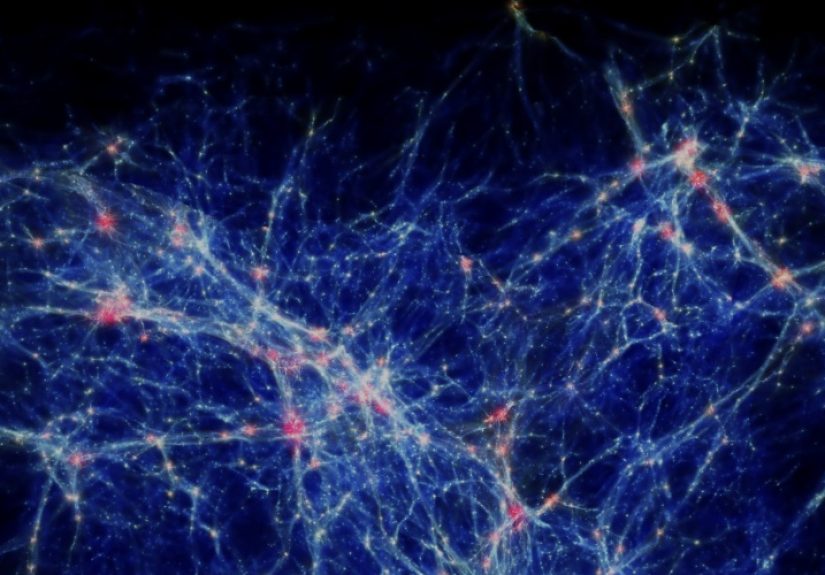
The headline is dramatic, but the underlying story is even better. Scientists are not saying dark matter is literally tucked inside some misty grove of space trees. They are saying that a feature known as the Lyman-alpha forest may help reveal where dark matter collects and how it shapes the large-scale structure of the universe. In some analyses, those hydrogen patterns also hint that our standard model of cosmology may be missing something important. That “something” could turn out to be a new particle, a subtle physical effect, or a correction to how we model galaxy growth. In science, that counts as an excellent day at the office.
What Scientists Mean by “Hydrogen Forests”
Despite the poetic nickname, a hydrogen forest is not a clump of leaves drifting through space. It is a pattern of absorption lines imprinted on the light from extremely bright, distant objects such as quasars. As that light travels across the universe, it passes through clouds and filaments of intergalactic hydrogen. Each patch of hydrogen absorbs a tiny slice of the light at a characteristic wavelength. Because the universe is expanding, each absorption feature is shifted by a different amount depending on distance. Stack enough of those lines together, and the spectrum looks like a dense thicket. Hence the name: the Lyman-alpha forest.
This matters because hydrogen is everywhere. It is the most abundant element in the universe, and in its neutral form it acts like a backlit curtain stretched across cosmic history. When astronomers study the forest, they are effectively reading a shadow map of matter distributed over billions of light-years. It is not a direct snapshot. It is more like reconstructing the traffic pattern of an entire city by studying the dents in the guardrails. Oddly enough, that method works astonishingly well.
Why Hydrogen Can Point to Something We Cannot See
Dark matter does not emit light, reflect light, or politely introduce itself to telescopes. Scientists infer its presence through gravity. Galaxies rotate too quickly, clusters hold together too strongly, and large-scale structures formed in ways ordinary matter alone cannot explain. So researchers need tracersvisible stuff that falls into the same gravitational valleys as dark matter.
Hydrogen is one of the best tracers available. Where gravity pulls matter into denser regions, intergalactic hydrogen tends to collect as well. In other words, hydrogen does not solve the dark matter mystery by itself, but it follows the gravitational landscape dark matter helps create. That makes the Lyman-alpha forest a kind of cosmic dye test. If the invisible matter shapes the riverbed, hydrogen helps reveal where the current is going.
This is why scientists get excited about quasar spectra. A quasar is outrageously bright, powered by matter falling into a supermassive black hole. Its light can travel across much of the observable universe before reaching us. Along the way, intervening hydrogen leaves a barcode of absorption features. Decode the barcode correctly, and you gain access to the distribution of matter on scales that are otherwise difficult to study.
The Study Behind the Headline
PRIYA simulations and eBOSS data
The recent wave of attention comes from work led by researchers at the University of California, Riverside, who used a new simulation framework called PRIYA to analyze data from the eBOSS Lyman-alpha forest survey. The goal was not to stage a press conference for dark matter hiding in shrubbery. It was to compare observed hydrogen absorption patterns with high-resolution theoretical models and then reconstruct how matter is distributed through the universe.
PRIYA is important because the Lyman-alpha forest is sensitive to several overlapping effects. The signal depends on cosmology, yes, but also on the temperature of intergalactic gas, the thermal history of the universe, and the timing of reionization. That means researchers need sophisticated simulations to separate one ingredient from another. PRIYA was built to do exactly that with unusually high precision across a large parameter space.
What the researchers found
Using this simulation suite, the team found that the hydrogen forest data support a tension between observations and some theoretical expectations. More specifically, the inferred clumpiness of matter on certain scales appears lower than what cosmic microwave background measurements from missions such as Planck would lead many scientists to expect. That does not mean the standard cosmological model has collapsed onto the floor in dramatic fashion. It does mean the data are interesting enough to keep theorists very awake at night.
One possible explanation is that some new physical effect is at work. Another possibility is that the mismatch comes from how astrophysicists model processes inside galaxies, especially the role of supermassive black holes and feedback mechanisms that can alter structure growth. The researchers themselves were cautious. They did not claim a discovery of a new particle. They argued that if the discrepancy survives future datasets, then new physics becomes a more compelling explanation.
What This Does Not Mean
Let us rescue this story from the internet’s habit of putting roller skates on every headline. “Dark Matter May Be Hidden in Hydrogen Forests” does not mean scientists have found dark matter directly. It also does not mean hydrogen contains dark matter in any literal chemical sense. Hydrogen is acting as a tracer, not a vault.
It also does not mean one study has overturned decades of cosmology. Tensions in physics are not rare. Some fade when better data arrive. Some survive and grow sharper. A few eventually open the door to major breakthroughs. The responsible reading of this result is that the Lyman-alpha forest is becoming a sharper tool, and that sharper tool is asking tougher questions about the universe.
That alone is a big deal. In science, a better question is often more valuable than a rushed answer.
Why the Lyman-Alpha Forest Is Such a Big Deal for Dark Matter Research
The Lyman-alpha forest is not just useful because it is pretty on a graph. It probes matter on relatively small scales and at high redshifts, meaning it lets researchers study how structure formed when the universe was much younger. That is crucial for dark matter research because different dark matter models predict different amounts of small-scale structure.
For example, if dark matter were “warm” rather than cold, it would free-stream more efficiently in the early universe and smooth out small clumps of matter. The Lyman-alpha forest is sensitive to that smoothing. Recent work using high-redshift Lyman-alpha forest power spectra has placed some of the strongest limits yet on warm dark matter behavior. In plain English: the forest is not only helping scientists map invisible matter, it is helping them narrow down what dark matter can and cannot be.
That is one reason large spectroscopic surveys matter so much. DESI, the Dark Energy Spectroscopic Instrument, has already used hundreds of thousands of quasars to extend Lyman-alpha measurements deep into cosmic history. As datasets get larger and cleaner, scientists should be able to test whether the current tension is a statistical fluke, an astrophysical modeling issue, or a genuine hint of new physics.
How Scientists Actually Read the Forest
Imagine looking at a rainbow and seeing narrow bites taken out of it at many different places. Each missing sliver corresponds to hydrogen that absorbed light along the way. Because those gas clouds sit at different distances, their absorption appears at different shifted wavelengths. By measuring the spacing, depth, and clustering of those lines, researchers can reconstruct how hydrogen is distributed along the line of sight to the quasar.
Now repeat that process across enormous numbers of quasars. The result is not just one line through space, but a giant statistical map of the intergalactic medium. Scientists compare those measurements with simulations that include gravity, gas physics, heating, expansion, and dark matter effects. If the simulations match the data, the model survives another day. If not, cosmologists start sharpening pencils and muttering exciting things about “parameter tension.”
That is what makes this field so fascinating. The evidence for dark matter is being chased not only with underground detectors and particle experiments, but also with ancient hydrogen spread across the cosmos like invisible weather.
Could This Change Cosmology?
Potentially, yesbut only if the signal holds up. If future analyses continue to find that matter clustering inferred from the Lyman-alpha forest is lower than expected, researchers may need to adjust more than a few spreadsheet tabs. They may need to rethink parts of the standard picture of structure formation.
That could mean revisiting assumptions about feedback from supermassive black holes. It could mean refining the thermal history of intergalactic gas. Or it could mean entertaining genuinely new ingredients in physics, such as previously unobserved particles or interactions that alter how structure grows over time. None of these options should be treated as a confirmed answer yet. But all of them are scientifically meaningful.
And that is the beauty of the current moment. Dark matter research is no longer stuck in a simple yes-or-no search. It is branching into a richer set of methods: gravitational lensing, galaxy motions, direct detection experiments, cosmic microwave background analyses, and now increasingly precise hydrogen forest studies. The mystery remains unsolved, but the map around the mystery is getting better.
Why This Story Captures the Imagination
Part of the appeal is emotional. There is something irresistible about the idea that the universe keeps its secrets in plain sight. Not hidden behind a locked door, but hidden in data we already have if only we learn how to read it better. The hydrogen forest is a perfect example. For years, those absorption lines were known as a powerful cosmological tool. Now they are becoming even more valuable as a way to test dark matter models and measure the growth of cosmic structure with greater precision.
There is also a strange comfort in the method itself. Scientists are not waiting for dark matter to become photogenic. They are studying its gravitational fingerprints in everything from galaxies to intergalactic hydrogen. It is detective work on a cosmic scale. No fedora required, though one suspects some theorists would wear one if given the chance.
Experiences Related to the Topic: What It Feels Like to Chase an Invisible Universe
One of the most remarkable experiences tied to this topic is the feeling of learning that the universe can be measured through absence. Most of us grow up thinking discovery means seeing more clearly: a sharper image, a brighter object, a bigger telescope. But the Lyman-alpha forest flips that instinct on its head. Here, the information lives in what is missing. Scientists stare at light from quasars and pay obsessive attention to the narrow pieces that are gone. That is a deeply humbling idea. It reminds us that knowledge often begins not with a spotlight, but with a shadow.
There is also the experience of scale, which this subject delivers in absurdly generous quantities. The light in these studies has traveled for billions of years. The hydrogen clouds are spread across intergalactic space. The dark matter structures being inferred are larger than any ordinary human intuition can comfortably hold. Yet the actual work is incredibly meticulous. It happens in code, in calibration, in error bars, in careful comparisons between simulations and spectra. So the emotional experience is this strange combination of awe and bookkeeping. You contemplate the largest structures in existence, then spend an afternoon worrying about line widths, instrument noise, and whether a model of helium reionization is slightly too enthusiastic.
For scientists, there is probably another layer to the experience: patience. Dark matter has refused to cooperate for decades. It does not show up directly in detectors. It does not send cheerful little notifications saying, “You’re getting warmer.” So researchers learn to work indirectly. They become experts in inference. They build better surveys, better simulations, and better statistical tools. They look for consistency across different methods. They learn how to get excited without getting reckless. In a way, the hydrogen forest story captures the emotional discipline of modern cosmology: be bold enough to imagine new physics, but cautious enough not to mistake every strange result for a revolution.
For readers and science lovers, the experience is often wonder mixed with relief. Wonder, because the universe is still weird enough to surprise us. Relief, because the mystery is not dead. We have not reduced existence to a tidy user manual. There are still cracks in the story, still mismatches between observation and theory, still places where hydrogen lines in distant quasar spectra can whisper that our model may be incomplete. That keeps the scientific adventure alive.
And maybe that is the most satisfying part. The phrase “dark matter may be hidden in hydrogen forests” is catchy, but the real experience is richer than the headline. It is the experience of realizing that nature leaves clues in places no one would call obvious. A forest made of spectral lines. A map drawn by missing light. Invisible matter outlined by ancient hydrogen. If that sounds a little magical, good. Science should occasionally have that effect. It means we are still paying attention.
So, are scientists saying they have found dark matter in hydrogen forests? Not exactly. They are saying the hydrogen forest may be one of the smartest ways yet to track where dark matter gathers, test how structure grows, and stress-test the cosmological model we rely on. That is less flashy than a final answer, but far more exciting in the long run. It means the story is still unfolding. And somewhere, in the long journey of quasar light through the ancient universe, the next clue may already be on its way.
Conclusion
The idea that dark matter may be hidden in hydrogen forests is best understood as a scientific metaphor with real power behind it. The Lyman-alpha forest does not contain a neat little label reading “dark matter here,” but it does offer one of the clearest indirect paths to studying invisible cosmic structure. With tools like PRIYA, data from eBOSS, and the growing reach of DESI, astronomers are turning ancient hydrogen into a precision probe of the dark universe.
If future observations confirm today’s tensions, this line of research could help uncover new physics. If they do not, it will still have improved our understanding of how matter, gas, and gravity shaped the cosmos. Either way, the hydrogen forest is no longer just a poetic phrase in astrophysics. It is one of the most intriguing laboratories in modern cosmology.