Table of Contents >> Show >> Hide
- First Things First: Are These Actually Yams?
- The Grandma Formula: What Makes Candied Yams So Good?
- Ingredients
- Grandma’s Candied Yam Recipe (Classic Oven Method)
- Variations Grandma Would Allow (Because She Loved You)
- Pro Tips for Truly Legendary Candied Yams
- Make-Ahead, Storage, and Reheating
- What to Serve With Grandma’s Candied Yams
- Troubleshooting: When the Dish Has Opinions
- of Real-Life “Grandma’s Kitchen” Experience (The Part That Makes This Dish a Memory)
- Conclusion
If your family has ever said, “We’re just having a small holiday dinner,” and then somehow produced enough food to feed a marching band,
you already understand the role of candied yams. They’re the sweet, buttery side dish that quietly threatens to become dessert.
Grandma knew what she was doing: tender slices, a glossy brown sugar glaze, warm spices, and that “just one more bite” energy.
This is a classic, old-school Grandma’s Candied Yam Recipethe kind you bake in a casserole dish while the house smells like cinnamon
and everybody keeps “checking on it” (with a spoon). You’ll get the traditional flavor, modern reliability, and a few optional upgrades that still feel
like they belong on Grandma’s table.
First Things First: Are These Actually Yams?
In most American kitchens, “candied yams” are made with orange-fleshed sweet potatoes. True yams are a different plant altogether and
tend to be starchier, drier, and more common in specialty markets. Grocery-store “yams” in the U.S. are usually sweet potatoes wearing a nickname that
stuck. So yesGrandma’s candied “yams” are almost certainly sweet potatoes, and noyour holiday memories are not a lie. They’re just… creatively labeled.
The Grandma Formula: What Makes Candied Yams So Good?
Candied yams are basically sweet potatoes dressed up for a special occasion. The magic comes from a simple balance:
butter + brown sugar + warm spices + a tiny pinch of salt. The butter carries flavor, the sugar caramelizes into sauce, spices add that
cozy “it’s definitely a holiday” vibe, and salt keeps it from tasting like you accidentally made sweet potato candy (unless that’s your goalno judgment).
Flavor notes Grandma would approve of
- Dark brown sugar for deeper caramel and molasses flavor
- Cinnamon + nutmeg for classic warmth (a pinch of cloves if you like a stronger spice cabinet moment)
- Vanilla for a bakery-style finish
- Orange zest/juice (optional) to brighten the sweetness
Ingredients
This version serves about 8–10 and fits in a standard 9×13-inch baking dish.
It’s sweet, saucy, and designed for people who believe leftovers are a love language.
For the sweet potatoes
- 3 pounds orange-fleshed sweet potatoes (often labeled “yams”), peeled
- Water (for par-cooking, optional but recommended for even tenderness)
For the candied glaze
- 8 tablespoons (1 stick) butter
- 3/4 cup packed dark brown sugar
- 2 tablespoons granulated sugar (optional, for extra shine)
- 1/2 cup orange juice or water (orange juice adds brightness)
- 1 tablespoon maple syrup or light corn syrup (optional, helps keep sauce silky)
- 1 teaspoon ground cinnamon
- 1/4 teaspoon ground nutmeg
- Pinch of ground cloves (optional)
- 1 teaspoon vanilla extract
- 1/2 teaspoon fine salt
- 1 teaspoon orange zest (optional, but charming)
Optional toppings (choose your personality)
- 1/2 cup chopped pecans (toasted if you have time and ambition)
- 2 cups mini marshmallows (the classic “sweet potato in a sweater” look)
Grandma’s Candied Yam Recipe (Classic Oven Method)
Step 1: Prep the sweet potatoes
- Heat oven to 350°F. Butter (or spray) a 9×13-inch baking dish.
-
Slice peeled sweet potatoes into 1/2-inch rounds.
Try to keep them similar in thickness so they cook evenlyGrandma didn’t measure with a ruler, but she also didn’t serve crunchy yams.
Step 2: Par-cook (optional, but strongly “Grandma Practical”)
Par-cooking prevents the “top slices are perfect, bottom slices are still doing homework” problem.
If you’re short on time, you can skip this and bake longerjust keep an eye on the sauce.
- Bring a large pot of water to a boil. Add the sliced sweet potatoes.
- Boil 8–10 minutes, until the slices are just barely tender (a fork goes in, but the slice doesn’t fall apart).
- Drain carefully and let steam-dry for a minute or two.
Step 3: Make the glaze
-
In a saucepan over medium heat, melt the butter.
Stir in brown sugar (and granulated sugar if using), cinnamon, nutmeg, cloves (if using), salt, and orange zest. - Pour in orange juice (or water) and maple/corn syrup (if using). Stir until smooth and glossy.
- Simmer gently for 2–3 minutesjust enough to marry the flavors, not enough to turn it into candy-making season.
- Remove from heat and stir in vanilla.
Step 4: Assemble and bake
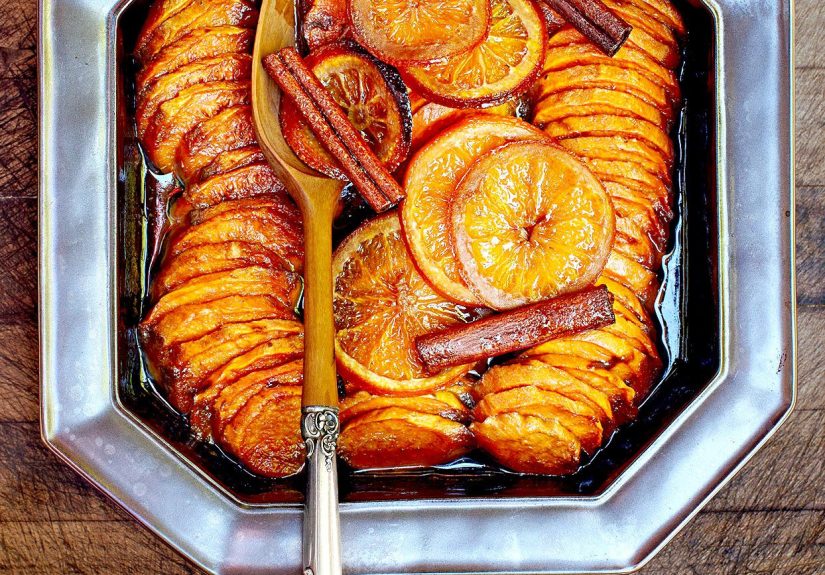
- Arrange sweet potato rounds in the baking dish, overlapping slightly like cozy little shingles.
- Pour the warm glaze evenly over the top. Use a spoon to nudge sauce into gaps.
- Cover with foil and bake 25 minutes.
-
Uncover, baste with sauce, and bake 20–25 minutes more, basting once halfway through,
until the sweet potatoes are tender and the sauce is bubbling and slightly thickened. - Rest 10 minutes before serving so the sauce can settle into that perfect spoon-coating texture.
How to tell they’re done
- A fork slides in easily with little resistance.
- The sauce bubbles around the edges and looks glossy, not watery.
- The kitchen smells like cinnamon is hosting a reunion tour.
Variations Grandma Would Allow (Because She Loved You)
1) Marshmallow topping
For the classic holiday look: add mini marshmallows during the last 5–8 minutes of baking.
Watch closelymarshmallows go from golden to “campfire incident” fast.
2) Pecan crunch
Sprinkle chopped pecans over the top for the last 10 minutes of baking.
Toasted pecans add a nutty counterpoint that keeps the dish from leaning too dessert-y (unless you want it to).
3) Orange-vanilla “grown-up” version
Use orange juice + zest and don’t skip the vanilla. It tastes like candied yams wearing a nice coat.
If you see versions that include bourbon, you can absolutely skip itorange and vanilla still bring plenty of depth.
4) Shortcut with canned sweet potatoes
Grandma loved a smart shortcut. If using canned sweet potatoes (“yams”), drain them well, make the glaze,
and bake at 350°F just until hot and bubblyusually 20–30 minutes. Add marshmallows at the end if desired.
The texture will be softer, but the flavor still hits the nostalgia button.
Pro Tips for Truly Legendary Candied Yams
- Cut evenly: 1/2-inch slices are the sweet spotthin slices can turn jammy, thick slices can stay firm.
- Don’t drown them: The sauce should be generous, not a swimming pool. It thickens as it bakes and rests.
- Foil first, then uncovered: Covered baking softens; uncovered baking caramelizes.
- Baste once or twice: It’s the difference between “nice” and “please send the recipe.”
- Pinch of salt matters: it sharpens the flavors and keeps the sweetness from getting flat.
-
Want extra natural sweetness? Cook sweet potatoes a bit more gently (not blazing hot the whole time).
Sweet potatoes can taste sweeter when they spend more time in a moderate temperature range before fully softening.
Make-Ahead, Storage, and Reheating
Candied yams are a holiday hero because they reheat beautifully. Make them the day before, cover, and refrigerate.
Rewarm at 325°F until heated through. If the sauce thickens too much, add a splash of water or orange juice and spoon it over.
Food safety basics (the boring part that keeps everyone happy)
- Refrigerate leftovers within 2 hours of serving.
- Eat refrigerated leftovers within 3–4 days.
- Freeze for longer storage (best quality within a few months).
- Reheat leftovers until steaming hot throughout.
What to Serve With Grandma’s Candied Yams
Candied yams love a savory partner. Try them alongside:
- Roast turkey, ham, or chicken
- Green beans (especially garlicky or lemony)
- Collard greens or sautéed kale
- Mac and cheese (because joy is allowed)
- Anything smoked or pepperysweet + smoky is always a win
Troubleshooting: When the Dish Has Opinions
“My sauce is thin.”
Bake uncovered a little longer and let the dish rest. The sauce tightens as it cools.
Next time, simmer the glaze 1–2 minutes longer before pouring it on.
“My sauce got grainy.”
Sugar likely cooked too hot too fast. Keep the glaze at a gentle simmer, not a rolling boil.
Dark brown sugar also dissolves more smoothly when given a minute to melt into the butter.
“My sweet potatoes turned mushy.”
Slices were likely too thin, or par-cooked too long. Aim for “barely tender” before baking,
and keep slices around 1/2 inch thick.
of Real-Life “Grandma’s Kitchen” Experience (The Part That Makes This Dish a Memory)
Candied yams don’t just show up on the tablethey arrive. They come in with a warm-spice perfume that drifts down the hallway and announces,
“Something good is happening in this house.” In a lot of families, the first clue that the holidays are officially underway is the sound of a casserole
dish sliding into the oven and someone asking, for the fifth time, “Do we have enough brown sugar?” (Spoiler: you never have enough brown sugar.
It disappears like it has plans.)
The funny thing about Grandma-style recipes is that they’re rarely written down in a neat little box. They live in habits: the way she peeled sweet
potatoes at the sink, the way she could eyeball “a good pinch” of cinnamon, the way she tasted the glaze and immediately knew whether it needed a
whisper more salt. If you ever watched someone cook this dish without measuring, you probably noticed the quiet confidence: butter melts, sugar follows,
spices float on top like tiny holiday rafts, and suddenly the kitchen feels warmereven if the thermostat says otherwise.
There’s also the “helping” part. Candied yams are one of those dishes that invite an extra set of hands: someone can slice sweet potatoes while someone
else stirs the glaze. And if you grew up in a house where kids were allowed to participate, you know the job assignments were very serious business.
Stirring was prestigious. Sprinkling marshmallows was basically a promotion. Basting the sauce? That was for people trusted with responsibility and
ladlesan honor reserved for those who wouldn’t “accidentally” lick the spoon and then pretend they didn’t.
And then there’s the moment of truth: pulling the dish out. The glaze bubbles at the edges like it’s applauding itself. The sweet potatoes look bronzed
and glossy. If you used marshmallows, they’re puffed and golden, flirting with toasted perfection. Somebody always tries to scoop too early, and
somebody else always says, “Let it sit.” That short rest is a tiny lesson in patiencebecause when the sauce thickens and clings to the slices, each
spoonful finally tastes like what you remember: buttery, spiced, deeply sweet, and comforting in a way that feels bigger than food.
The best part is how the dish connects generations without making a speech about it. You can tweak itadd orange zest, swap in pecans, skip the
marshmallows, make it less sweet, make it extra saucyand it still feels like the same tradition. Because the tradition isn’t only the ingredients.
It’s the ritual: gathering, cooking, tasting, laughing, and letting one casserole dish carry a whole little story to the table. If you make this once and
someone says, “This tastes like my childhood,” congratulationsyou just cooked with Grandma energy.
Conclusion
Grandma’s Candied Yam Recipe is simple on purpose: sweet potatoes, a buttery brown sugar glaze, warm spices, and a bake that turns it
all into glossy, tender perfection. Keep it classic, dress it up with pecans, or go full holiday with marshmallowseither way, you’re making the kind of
dish people remember (and mysteriously “need” a second helping of, immediately).