Table of Contents >> Show >> Hide
- The Incident That Turned a Warplane Into a Symbol
- Why the Su-24 Matters
- What the Fire Said About Russian Airbase Security
- From Isolated Arson to a Wider Pattern of Sabotage
- Why Bombers and Strike Aircraft Are Such Attractive Targets
- The Strategic Meaning: This Was About More Than One Fire
- The Human and Strategic Experience Behind Stories Like This
- Conclusion
For a machine built to streak through contested skies at supersonic speed, the Russian Su-24 has a wonderfully dramatic job description. It is loud, fast, armed, and designed to make people on the ground very nervous. What it is not supposed to do is sit on a tarmac and become the star of a sabotage video. Yet that is exactly why the story of guerrilla arsonists setting fire to a Russian supersonic bomber grabbed so much attention. It was not just about one burning aircraft. It was about something more unnerving for Moscow: the idea that the war could creep past the front line, slip around fences, and light a match inside Russia’s own military ecosystem.
The headline sounds like a pulp thriller, but the deeper meaning is less cinematic and more strategic. Reports in 2023 pointed to an arson attack on a Sukhoi Su-24 near Novosibirsk, far from the Ukrainian border. The incident looked small compared with missile barrages or major drone raids, yet it carried an outsized message. If a bomber or strike aircraft can be reached on the ground, then prestige, geography, and concrete do not automatically equal security. In modern war, a cheap improvised attack can embarrass a very expensive air force. That is a terrible trade if you are the one paying for the bomber.
The Incident That Turned a Warplane Into a Symbol
According to reporting that circulated in May 2023, footage appeared to show an arson attack on a Russian Su-24 parked near the Novosibirsk aircraft production complex. Whether the aircraft was fully operational mattered less than what the footage implied: someone was able to get close enough to a sensitive military asset, record the act, and turn the resulting fire into information warfare. In a conflict already defined by drones, missiles, and satellite imagery, the image of a bomber burning on home turf had a very different flavor. It felt intimate. Almost rude, really.
That is what made the story travel. A missile strike says, “We can hit you from far away.” A sabotage attack says, “We can stand next to your equipment, do damage, and leave you to explain the smoke.” The psychological impact is different. Air forces are built around control, access, maintenance schedules, guarded perimeters, and ritualized order. Sabotage turns all of that into a punch line.
The event also landed at a moment when Russia was already trying to manage military strain, equipment losses, and the optics of a long war. A fire on a tarmac might not change the front overnight, but it can change the mood. It tells officers to worry about their rear areas, commanders to rethink force protection, and propagandists to work overtime pretending that nothing important happened. Nothing says “everything is fine” quite like rapidly insisting that the burning aircraft was not important anyway.
Why the Su-24 Matters
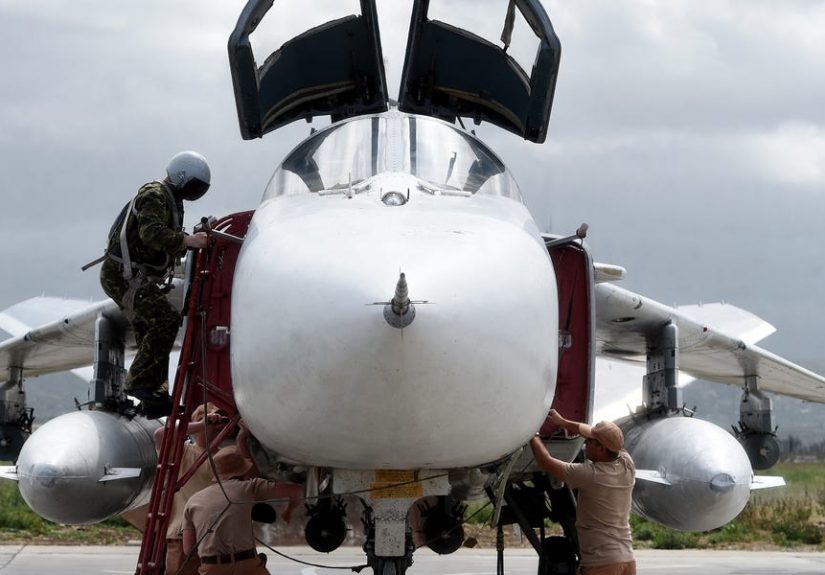
The Su-24, known by NATO as the Fencer, is no museum ornament. It is a Cold War-era strike aircraft designed for all-weather attack missions, low-level penetration, and fast delivery of bombs and missiles. The jet’s variable-sweep wing and rugged strike profile made it a serious tool in Soviet and later Russian air doctrine. Even as newer aircraft such as the Su-34 took over more of the spotlight, the Su-24 remained part of the broader combat ecosystem that supports Russian offensive airpower.
That matters because military symbolism is often tied to platform identity. A burning truck is one thing. A burning strike aircraft is another. Aircraft represent reach, technological competence, and state prestige. They are expensive to maintain, difficult to replace quickly, and central to the image of a modern military. When one is damaged in combat, that is expected. When one is damaged through sabotage on home ground, it suggests a failure of protection rather than a simple battlefield loss.
The Su-24 also sits inside a family story. Sukhoi’s later Su-34 was developed to replace it in many roles, which makes any attack near a production or maintenance site symbolically richer. The fire was not just about a single airframe. It highlighted vulnerabilities around the industrial and logistical chain that keeps warplanes flying in the first place. Bombers do not live on bravado alone. They need bases, technicians, fuel, spare parts, and guards who are awake.
What the Fire Said About Russian Airbase Security
The most important question raised by the arson story was not “How badly was this one aircraft damaged?” It was “How many other assets are just one clever infiltrator away from trouble?” Air power depends on concentration. Aircraft, munitions, maintenance crews, and fuel infrastructure are grouped together because that is how military aviation works. The downside is obvious: concentration creates valuable targets.
For much of the war, analysts watched long-range attacks on bases, fuel depots, and logistics hubs. But sabotage added another layer. It exploited weak points that traditional air defense cannot easily solve. Surface-to-air missiles are useful against incoming aircraft and drones. They are much less helpful against someone already inside the perimeter with a camera, a plan, and a very bad attitude.
Security failures at airfields are especially costly because they force military planners to spend resources on defense rather than operations. More patrols, more surveillance, more hardened shelters, more dispersal, more internal vetting, more restrictions on access. Every one of those measures costs money and time. Every one of them also signals that the threat is no longer theoretical. Once sabotage becomes plausible, every parked aircraft starts to look slightly flammable in the imagination of the chain of command.
From Isolated Arson to a Wider Pattern of Sabotage
The Su-24 fire did not exist in a vacuum. Over time, reporting pointed to a broader pattern of attacks, sabotage claims, and deep strikes aimed at Russian or Russian-aligned air assets. In late 2022, reports described apparent sabotage against Russian helicopters at Ostrov. In early 2023, Belarusian guerrillas claimed responsibility for a drone attack on a Russian A-50 airborne early warning aircraft at Machulishchy in Belarus. Later in 2023, AP reported on drone strikes and sabotage claims involving bomber bases such as Soltsy and Shaykovka. By 2025, attacks on deeper and more strategic bomber infrastructure, including Engels and the operation widely discussed under the name “Spiderweb,” made clear that aircraft parked well away from the front were still part of the war’s target list.
A Campaign of Pressure, Not Just a Collection of Stunts
Seen together, these incidents suggest a campaign logic. The point is not always to destroy the maximum number of aircraft in a single night. Sometimes the goal is to impose insecurity, force dispersal, raise defense costs, and shake confidence in rear-area sanctuaries. That is smart asymmetric warfare. A country with fewer aircraft and fewer resources cannot necessarily win a straight industrial contest in the air. It can, however, make the other side spend heavily to protect expensive machines from surprisingly cheap attacks.
This is where the humble sabotage video becomes strategically potent. It travels online, fuels rumors, raises questions inside military circles, and invites analysts to connect dots across multiple incidents. One fire becomes a pattern. One pattern becomes a vulnerability. A vulnerability, once understood, becomes a planning problem.
Why Bombers and Strike Aircraft Are Such Attractive Targets
Russian bombers and strike aircraft matter because they help sustain pressure on Ukrainian infrastructure, military positions, and cities. Even when a particular platform is older, it still contributes to the overall attack architecture. Aircraft do not have to be glamorous to be useful. They just have to carry munitions, survive long enough, and remain available for repeated sorties.
That is why attacks on parked aircraft carry both military and symbolic value. Every damaged airframe can mean fewer available sorties, more maintenance strain, more relocation, and more caution in how aircraft are based. On the symbolic side, they puncture the myth of untouchability. Strategic bombers project national power. When they burn on camera, the projection flickers.
There is also a blunt economic truth here. A cheap sabotage act, or a modest drone strike launched in the right place, can threaten equipment worth tens of millions of dollars. That is the sort of exchange ratio that makes defense planners sweat through their uniforms. It is not merely destructive. It is humiliatingly efficient.
The Strategic Meaning: This Was About More Than One Fire
The arson attack on the Su-24 became meaningful because it fit the changing character of the Russia-Ukraine war. This is not only a contest of trenches, artillery, and missile stockpiles. It is also a contest over who can identify and exploit hidden weaknesses. Rear-area security, base hardening, logistics resilience, internal discipline, and counter-sabotage all matter more than many militaries would like to admit.
In that sense, the incident was an early warning. It suggested that the battlefield had widened into workshops, depots, rail links, and airfields. Later operations only reinforced the lesson. A modern military cannot assume that distance from the front equals safety. If an opponent or a network of sympathizers can operate covertly, then depth becomes relative. Siberia starts to feel less remote when the flames are on your runway.
For Russia, the implication was uncomfortable but clear: protecting aircraft requires more than air defense systems and public bravado. It requires disciplined perimeter security, better counterintelligence, dispersal of valuable assets, hardened shelters, and the ability to detect threats that do not arrive in formation. That is a large bill to pay because one saboteur, one drone team, or one partisan network decided to make a point.
The Human and Strategic Experience Behind Stories Like This
One reason stories like this resonate so strongly is that they compress the experience of modern war into a single unsettling image. A bomber on fire is not just an incident report. It is a reminder that war no longer stays politely inside the front-line map in an evening news graphic. For military personnel, the experience is one of creeping uncertainty. The threat may come from above, from far away, from a drone launched nearby, or from a saboteur who walked in with a disguise and a plan. That uncertainty changes behavior. Guards become jumpier. Maintenance crews work under more pressure. Commanders start asking not only whether aircraft can fly, but whether they can sleep safely on the ground.
For local civilians living near airfields, the experience is different but no less stressful. A base that once looked like a distant military world suddenly becomes a magnet for attention, smoke, rumors, and emergency response. Even when casualties are not reported, fear has a way of showing up anyway. Residents wonder whether the next blast will be bigger, whether the airfield makes their town a target, and whether official reassurances are worth the paper they would have been printed on if governments still printed things for that purpose.
For analysts and journalists, incidents like the Su-24 fire create a strange mix of fascination and restraint. Fascination, because the event reveals how warfare is evolving. Restraint, because every dramatic clip online arrives wrapped in uncertainty, propaganda, selective framing, and competing claims. The experience of following such a story is less like reading a neat textbook and more like assembling a puzzle while someone keeps stealing pieces and replacing them with memes.
For Ukraine and anti-Kremlin partisan networks, assuming involvement in a given case is claimed or alleged rather than fully proven, the experience is often about leverage. They do not need to destroy an entire air fleet to create strategic value. They need to show that valuable aircraft are vulnerable, that geography does not guarantee protection, and that Russia must keep looking over its shoulder. In asymmetric conflict, making the other side spend energy on fear can be a form of operational success all by itself.
For Russia, these incidents create a more corrosive experience: the erosion of confidence. Aircraft are supposed to embody order, control, and technological mastery. When they are hit in rear areas, the damage goes beyond metal. It affects assumptions. How secure is the base? How reliable is the internal screening process? How many holes exist in the perimeter? Once those doubts start multiplying, every parked aircraft becomes not just an asset but a responsibility with a shadow attached.
There is also a broader experience here for anyone watching modern conflict unfold. These stories reveal how warfare has become flatter, cheaper, and weirder. Big-ticket systems still matter, of course. So do missiles, bombers, satellites, and industrial output. But increasingly, so do small teams, covert access, consumer-adjacent technology, improvised tactics, and information effects. The mighty still matter. They are just more combustible than they used to pretend.
That may be the lasting lesson of the Su-24 arson story. The incident was memorable not because one aircraft burned, but because it captured the sensation of a new era: no sanctuary feels entirely safe, no perimeter feels entirely complete, and no military platform is too prestigious to become a vulnerability if the enemy is clever enough. In that sense, the experience behind this story is the experience of modern war itselfrestless, improvisational, psychologically sharp, and never quite where old doctrine expected it to be.
Conclusion
The story of guerrilla arsonists setting fire to Russia’s supersonic bomber works as more than a striking headline. It marks a shift in how people understand military vulnerability in the Russia-Ukraine war. A bomber is not only a weapons platform. It is a symbol of state power, industrial capacity, and strategic reach. When such an aircraft can be damaged through sabotage, the message lands far beyond the flames.
The May 2023 Su-24 fire mattered because it hinted at a wider reality that later attacks made impossible to ignore: rear areas are part of the battlefield, airfields are not automatically safe, and expensive military aviation can be threatened by tools and tactics that cost a tiny fraction of the aircraft they target. That is the sort of military math that keeps generals awake and internet observers refresh-happy.
In the end, the headline is catchy because it feels cinematic. The real story is more serious. It is about the democratization of disruption in modern war. And for any air force still relying on the old comfort of distance, concrete, and secrecy, that is a very uncomfortable plot twist.