Table of Contents >> Show >> Hide
- Why Masks Break Facial Recognition (And Which Part Breaks First)
- What the Pandemic Revealed: Performance DroppedFast
- How Facial Recognition Learns to Recognize Masked Faces Now
- 1) Train on occlusion on purpose (a.k.a. “practice being confused”)
- 2) Focus on the periocular region (eyes, brows, upper cheeks)
- 3) Use attention and part-based recognition (a.k.a. “stop staring at the mask”)
- 4) Improve face detection and landmarking for masked faces
- 5) Add quality gates, retries, and multi-frame capture
- A Familiar Example: How Your Phone Learned the Same Trick
- Airports, Borders, and Security: Masked Faces in the Real World
- What’s Still Hard (Even When the Model Is “Mask-Aware”)
- Practical Takeaways for Using Facial Recognition When Masks Exist
- Conclusion
- Real-World Experiences: What It’s Like When the Camera Can Only See Your Eyes
For a brief, unforgettable moment in modern history, a simple rectangle of fabric turned facial recognition into a
very expensive guessing game. Cameras could still “see” you, but the algorithms often couldn’t recognize you.
The mouth vanished. The nose went on vacation. And suddenly, the most distinctive part of many faces (the lower
half) was gonelike trying to identify a song after someone muted the chorus.
Since then, facial recognition has been doing what it always does: adapting. Not by developing human-level intuition
(sorry), but by getting smarter about partial informationlearning to rely more on the eyes and brows, training on
occlusions on purpose, and using better detection and quality checks so the system doesn’t panic when it meets a
mask, scarf, or winter coat.
This article breaks down what went wrong when masks became common, what changed in the science and engineering,
and what’s still trickyeven for the “top-performing” systems. We’ll keep it practical, realistic, and only mildly
sarcastic (as a treat).
Why Masks Break Facial Recognition (And Which Part Breaks First)
Step 1: Find the face (harder than it sounds)
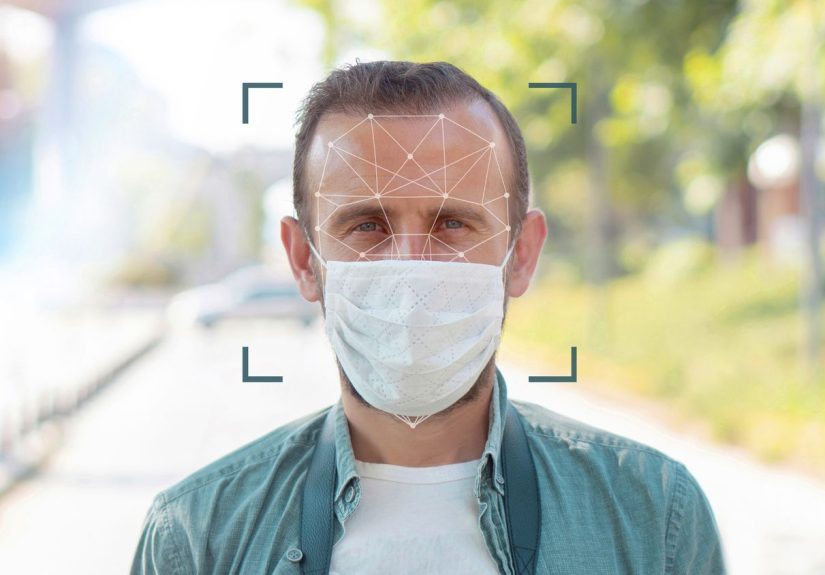
Facial recognition is usually a pipeline. Before you ever get to “Is this person Jane?”, the system has to do
“Is there a face here?” That early stepface detectioncan fail when a mask changes the visible shape of the face,
hides landmarks, or creates weird edges and shadows. If detection fails, recognition never even gets a chance to be
wrong. It’s just… absent. Like a group project partner who “didn’t see the notification.”
Step 2: Turn the face into a mathematical fingerprint
Once a face is detected, modern systems (usually deep-learning models) convert it into a compact set of numbers
called an embedding. The embedding is designed so that two photos of the same person produce
“close” vectors, while different people produce “far” vectors. Masks disrupt this because:
- Information is missing: the nose and mouth region carries a lot of identity signal.
- Alignment gets noisier: fewer landmarks are visible, so face “straightening” is less precise.
- Texture cues change: the mask introduces patterns, folds, and edges the model may overreact to.
Verification vs. identification: the stakes are different
Not all facial recognition is the same job. 1:1 verification is when you compare a person to one
known identity (unlocking a phone, matching a passport photo). 1:N identification is searching a
person against many identities in a database. Masks can hurt both, but large-scale searching tends to be more
sensitive to small errors because the system is asked to make more comparisonsand more comparisons means more
chances to mess up.
What the Pandemic Revealed: Performance DroppedFast
When masks became common, independent testing helped quantify what many users were experiencing: “It works…
until it doesn’t.” In early pandemic-era evaluations of algorithms built before COVID-19, error rates rose sharply
when masks were digitally applied. Even top performers saw failure rates jump, and many otherwise capable systems
struggled badlyespecially as the mask covered more of the nose.
That mattered because masks weren’t some rare edge case. They were suddenly everywhere: hospitals, public
transit, airports, schools, offices, retail stores. Face recognition wasn’t “broken forever”but it had been
trained on a world where faces were mostly uncovered. The world changed. The training data hadn’t.
How Facial Recognition Learns to Recognize Masked Faces Now
The “fix” is not one magic model upgrade. It’s a bundle of strategiessome data-focused, some architecture-focused,
and some operational (how the system is used in real life).
1) Train on occlusion on purpose (a.k.a. “practice being confused”)
If a model only sees clean, front-facing, well-lit faces during training, it becomes a straight-A student who
panics the moment the test is printed in a different font. One major solution is
occlusion-aware training:
- Synthetic mask augmentation: digitally overlay masks of different shapes, colors, and nose coverage.
- Random erasing / cutout: randomly hide rectangles or regions so the model learns to be resilient.
- Mixed enrollment/probe training: match unmasked enrollment photos to masked “live” photos, because that’s common in practice.
The goal is to teach the model: “If the lower half is missing, don’t overfit to fabric edges; learn what’s still
stable.” This is also why newer testing programs began tracking mask-specific performance and publishing results
tables focused on masked probes.
2) Focus on the periocular region (eyes, brows, upper cheeks)
When the mouth and nose disappear, the periocular region becomes the star of the show. Many modern
systems explicitly extract features from the eye region and either:
- build a mask-specialized embedding that relies more heavily on periocular cues, or
- combine “full-face features” (when available) with “upper-face features” (when occluded).
This isn’t just a clever ideait’s a practical engineering response. The eyes remain visible in most mask
scenarios, and they offer stable geometry (eye corners, brow shape) plus texture cues (wrinkles, eyelid contours,
lash line patterns). It’s not perfectglasses, glare, and heavy makeup can complicate thingsbut it’s a better
starting point than pretending noses still exist.
3) Use attention and part-based recognition (a.k.a. “stop staring at the mask”)
Deep-learning models can be designed to “pay attention” to the most useful regions. In masked face recognition,
attention mechanisms and part-based networks can reduce reliance on occluded areas and emphasize what’s visible.
Instead of one monolithic representation, the system may build features from multiple regions and fuse them:
- upper face
- periocular zone
- forehead and hairline (when reliable)
- ears and side profile cues (in some camera angles)
That last point comes with a warning label: hair and ears are more variable (hairstyles change; hats exist), so good
systems treat them as “nice to have,” not “bet the farm.”
4) Improve face detection and landmarking for masked faces
A surprising amount of “recognition failure” is actually “detection failure.” To improve masked performance,
developers upgraded face detectors and landmark predictors to work with occlusion. In plain English: the system
gets better at finding a face and aligning it even when the lower landmarks are missing. When that front-end
improves, the entire pipeline benefits.
5) Add quality gates, retries, and multi-frame capture
In real deployments, the system doesn’t always rely on one single image. Many operational setups use multiple frames
from a short video, pick the sharpest shot, or prompt a re-capture if quality is too low. This is less about
“being pushy” and more about being honest: if the only image is blurry, backlit, and half occluded, the algorithm
isn’t a wizard. It’s math.
A Familiar Example: How Your Phone Learned the Same Trick
Consumer devices faced the mask problem tooespecially phones that used face-based unlocking dozens of times per day.
One highly visible response was Apple’s “Face ID with a Mask,” which relies on analyzing the unique features around
your eyes rather than requiring a full lower face. It’s a straightforward example of the industry-wide shift:
recognize what’s visible, and design the system to handle partial faces without pretending they’re complete.
The broader takeaway isn’t “phones are magic.” It’s that product teams were forced to make the tradeoffs explicit:
What accuracy is acceptable when only the upper face is visible? How do you handle glasses? What’s the fallback when
confidence is low? Those are the same questions airports, employers, and device makers have been answeringjust at
different scales.
Airports, Borders, and Security: Masked Faces in the Real World
Travel environments are especially important because they’re a classic “cooperative” setting: people are generally
expected to face the camera briefly, stand in a marked spot, and follow instructions. That structure helps. It also
means performance numbers from these environments may not translate to street surveillance (which is less controlled
and far more ethically controversial).
In the U.S., agencies have discussed high accuracy in certain operational identity verification deployments at
airports and ports of entrywhile also emphasizing oversight, opt-out options in some contexts, and ongoing
evaluation. Meanwhile, critics argue that “high accuracy” doesn’t settle concerns about consent, expansion, data
retention, and disparate impacts. Both things can be true: the tech can improve and still raise serious policy
questions.
What’s Still Hard (Even When the Model Is “Mask-Aware”)
Bias and uneven performance don’t vanish just because masks do
Masked face recognition can amplify existing issues. If a system already performs unevenly across demographic
groups, adding occlusion can widen gapsespecially if the training data doesn’t represent real-world diversity in
lighting, camera quality, skin tones, age ranges, and mask styles. That’s why serious evaluation programs test
demographic effects, not just overall averages.
False matches vs. false non-matches: pick your pain
There are two common errors:
false non-match (you are you, but the system says “no”) and
false match (you are not you, but the system says “close enough”).
Masks tend to increase false non-matches more than false matches in many scenarios, which means more inconvenience
and more fallback checks. But if a system is poorly configured or used for the wrong purpose, false matches become a
much bigger concernespecially in high-stakes settings.
Glasses + masks + bad lighting: the “triple threat”
Masks remove lower-face cues; glasses can distort or hide the eye region; poor lighting wipes out texture. Put them
together and you’ve built a perfect storm. The best systems respond with quality checks and multi-frame capture, but
there are still situations where a human check or alternative method is simply more appropriate.
Privacy and consent don’t go away because accuracy improves
Even if masked face recognition becomes extremely accurate, privacy concerns can remainor grow. Advocacy groups
argue that face recognition can enable broad surveillance, chill speech, and increase the risk of misidentification
in policing contexts. These concerns don’t depend solely on error rates; they depend on how, where, and why the
technology is deployed, and what safeguards exist.
Practical Takeaways for Using Facial Recognition When Masks Exist
- Measure masked performance explicitly: don’t assume your “great” accuracy number includes occlusion.
- Use updated, mask-aware models: older pre-pandemic systems can behave very differently on masked faces.
- Invest in detection and capture quality: better alignment and sharper images can matter as much as model choice.
- Design humane fallbacks: when confidence is low, use alternate verification (ID check, PIN, secondary scan) without drama.
- Document consent and opt-out policies: trust is part of system performanceespecially in public-facing deployments.
- Audit demographic effects: overall accuracy can hide uneven outcomes across groups.
Conclusion
Facial recognition didn’t “defeat masks” in a single heroic upgrade. It learned to deal with occlusion the way good
engineering usually works: more representative training data, better front-end detection, smarter feature extraction
from what’s visible, and operational practices that don’t pretend every image is perfect.
The bigger story is about adaptation under pressure. Masks forced the industry to confront a simple truth:
identity systems must function in the real world, not just in the “bright lighting, neutral expression, no winter
accessories” universe. The technology has improvedespecially for cooperative verificationbut the hardest questions
remain social: where it should be used, who controls it, how it’s regulated, and how we protect people when systems
fail.
Real-World Experiences: What It’s Like When the Camera Can Only See Your Eyes
If you lived through the peak mask years, you probably developed a strange new relationship with cameras. You’d
step toward a kiosk or raise your phone, and there’d be that tiny moment of suspense: “Will it recognize me, or am I
about to do the awkward shuffle?” The shuffle, of course, is when you tilt your head, lean forward, lean back,
squint slightly (as if that helps), and then pretend you weren’t just negotiating with a rectangle of glass.
In everyday life, masked facial recognition often felt less like sci-fi and more like a polite argument. At a phone
unlock screen, you’d get a quick “nope,” then instinctively raise your eyebrowsbecause apparently we all believe
eyebrows are the universal password. (They’re not. But they’re enthusiastic.) When the system did succeed,
it felt oddly personal, like your device was saying: “I know it’s you. I’m focusing on the upper half of your face.
We’re doing our best.”
Public settings added their own comedy. In some places, the camera angle wasn’t designed for real humansmore like
idealized humans who stand exactly on a footprint sticker and never slouch. People would hover in front of a
checkpoint camera the way you hover over a stubborn vending machine: with hope, mild confusion, and a readiness to
escalate. Add glasses and you’d see the full performance: a quick wipe of the lenses, a micro-adjustment of the
mask, a half-step to the left to escape glare, and then a resigned sigh when the machine asked for another attempt.
The most interesting part wasn’t the failureit was how quickly people adapted. We learned informal “camera manners”
without thinking: face the lens, pause for a beat, avoid backlighting, don’t talk while the system tries to read
you. In a way, that behavior is part of why some operational deployments report strong results: people cooperate,
even when nobody calls it cooperation. You don’t have to love the system to understand how it works.
Over time, the experience shifted. As mask-aware systems rolled out, some interactions got noticeably smoother.
Kiosks that used to reject masked faces started succeeding more often, and phone unlocking became less dramatic.
When it works well, it’s almost invisiblethe best and worst compliment technology can get. But the human feelings
didn’t disappear. Many people still felt uneasy about where the images go, how long they’re kept, and whether the
system treats everyone equally well. “It recognized me” is not the same as “I consented to be recognized.”
That tension is the real-world reality of masked face recognition: convenience meets uncertainty. The camera sees
your eyes, the model makes its best guess, and you decide whether the tradeoff is worth itsometimes in the span of
two seconds while you’re just trying to get on with your day. If nothing else, masks taught us this: even advanced
AI systems are still affected by something as simple as a piece of cloth. And honestly? That’s kind of comforting.