Table of Contents >> Show >> Hide
- What You’ll Learn
- Before You Start: The Two Rules That Matter Most
- Habitat Setup: Build a Snail Home That’s Safe, Humid, and Escape-Proof
- Humidity & Temperature: The “Goldilocks Zone” for Land Snails
- Food & Calcium: The Snail Menu That Builds Strong Shells
- Cleaning & Maintenance: Keep It Fresh Without Nuking the Ecosystem
- Handling & Health Checks: Gentle Touch, Smart Hygiene
- Sleep, Estivation, and Eggs: Normal Snail Life, Explained
- Quick Care Checklist (Print This in Your Brain)
- Experience-Based Tips (500+ Words): What Snail Keepers Learn the Funny Way
- Conclusion
Garden snails are basically tiny, polite bulldozers with built-in backpacks. They don’t bark, they don’t shed (unless you count… slime), and they’re surprisingly fascinating to watch once you give them a setup that feels like “a nice, damp evening in a leafy yard.”
This guide walks you through caring for common garden snails (the small land snails you might find outdoors), with practical steps for building a safe snail terrarium, feeding a balanced snail diet, keeping humidity steady, and avoiding the most common beginner mistakeslike turning the enclosure into either a desert or a swamp. (Both are equally unpopular with snails. They are dramatic in their own quiet way.)
Before You Start: The Two Rules That Matter Most
1) Don’t keep (or import) prohibited invasive snails
If you’ve ever seen photos of gigantic snails the size of a banana, pause right there. Several “giant African snail” species are considered serious agricultural pests and can also carry parasites that make people sick. In the U.S., they’re heavily restricted and generally prohibited without proper authorization. If you suspect you’ve found a large, unusual snail, don’t handle it barehandedreport it to local agriculture authorities.
2) Never release captive snails back outside
Even if your snail originally came from outdoors, once it’s lived in captivity it can pick up new microbes, hitchhiker pests, or simply end up in the wrong place. Releasing snails can also help spread invasive species. The safest approach is simple: keep them contained for life (or rehome them responsibly to someone who can).
Garden snail vs. “mystery snail”
This article is about land snails, not aquatic snails. Land snails need moist air, damp substrate, and land-based food (fresh produce). If your snail lives in water, that’s a different care checklist entirely.
Basic hygiene (because snails are cute, not sterile)
Snails and slugs can be part of parasite lifecycles in some regions. You don’t need to panicbut you do need to be smart: wash your hands after handling snails or cleaning the enclosure, and thoroughly wash any produce that might have been in contact with snails or slugs.
Habitat Setup: Build a Snail Home That’s Safe, Humid, and Escape-Proof
A good snail habitat has three goals: containment, comfort, and cleanliness. Your snail doesn’t need luxuryit needs consistency.
Choose the right container (and take escapes personally)
Snails are stronger than they look, and they’re great at finding weak lids. Use a glass aquarium or sturdy plastic bin with a secure lid. Add ventilation holes, but not so many that the enclosure dries out in an hour. If the lid flexes, locks poorly, or leaves gaps, your snail will treat it like a fun puzzle with one solution: freedom.
- Size: More floor space beats height. Snails explore horizontally, forage, and cruise the walls.
- Ventilation: Enough for fresh air, not enough to turn the habitat into a crispy crouton.
- Placement: Keep the enclosure out of direct sunlight. A sunbeam can overheat a small tank fast.
Substrate: damp, diggable, and chemical-free
Snails like to burrow, rest, and (sometimes) lay eggs in substrate. Use a clean, pesticide-free option such as coco coir, organic topsoil without fertilizers, or a snail-safe soil mix made for invertebrates. Aim for several inches so the snail can dig and feel secure.
Avoid grabbing soil from a yard or parkoutdoor soil can contain pesticides, fertilizers, or parasite eggs. In snail care, “natural” is great, but “unknown” is not.
Hideouts and enrichment: snails like privacy, too
Snails are typically more active when they feel safe. Add a few hiding places: a small terracotta pot laid on its side, a curved piece of cork bark, or a plastic plant pot. Add leaf litter, moss (snail-safe, pesticide free), and a branch for climbing. You’re not building a snail theme parkjust a comfortable, interesting little world.
Water dish: shallow and boring (that’s the point)
Use a very shallow dish or bottle cap-sized tray. Land snails don’t need a swimming pool, and deep water can be risky for small snails. The dish helps humidity and gives them a safe place to sip or sit.
Humidity & Temperature: The “Goldilocks Zone” for Land Snails
Most garden snails thrive in a habitat that stays consistently humid with damp (not soaked) substrate. In nature, they’re most active when the environment is moistthink evenings, rainy days, foggy mornings, and the underside of a leaf that still has dew on it.
How to manage humidity without turning it into a swamp
- Mist: Lightly mist the enclosure as needed to keep surfaces and substrate damp.
- Watch the substrate: It should clump slightly when squeezed, but not drip water.
- Balance ventilation: Too much airflow dries everything out; too little can cause stagnant air and mold.
If you see constant condensation raining down the walls, you’re probably over-misting or under-ventilating. If everything dries within hours, you may need to reduce ventilation or mist more consistently.
Temperature: usually “room temp” is fine
Common garden snails generally do well at typical indoor temperatures. What matters most is avoiding extremes: don’t bake them in sunlit windows, don’t freeze them in garages, and don’t put them right next to a heater or AC vent. Slow, stable conditions beat sudden swings.
Food & Calcium: The Snail Menu That Builds Strong Shells
In captivity, the goal is variety: a steady rotation of vegetables, leafy greens, and occasional fruitplus a reliable calcium source. A good snail diet supports growth, energy, and shell health.
Daily staples: veggies and leafy greens
Offer a mix of washed produce. Good options include:
- Romaine, collard greens, mustard greens
- Zucchini, cucumber, carrots, sweet potato (thin slices)
- Bell pepper, green beans, squash
- Small amounts of herbs like basil or parsley
Remove uneaten food daily to prevent mold and fruit fly drama. (Fruit flies are the uninvited guests who show up early, stay late, and contribute nothing.)
Fruit: treat status
Fruit can be fine in small amounts, but it molds quickly and can encourage picky eating. Think “dessert,” not “main course.” If your snail starts ignoring greens for fruit, you’ve accidentally created a tiny, slimy version of a kid who discovered candy.
Calcium: non-negotiable for shell strength
Snail shells are built from calcium compounds, and snails need ongoing access to calcium for shell growth and maintenance. Without enough calcium, shells can become thin, pitted, or more prone to cracks. Provide a constant calcium source such as:
- Cuttlebone (the classic, easy option)
- Plain, unflavored calcium carbonate (snail-safe supplement)
- Clean, baked eggshell powder (fine grind; offered dry)
Tip: keep calcium available all the time rather than “sometimes.” Snails don’t count caloriesthey graze as needed.
Water: misting + a shallow dish
Land snails absorb moisture through their bodies and drink droplets. Regular misting (with dechlorinated water, when possible) supports hydration and movement. A shallow dish helps, too, but humidity and misting do most of the heavy lifting.
Cleaning & Maintenance: Keep It Fresh Without Nuking the Ecosystem
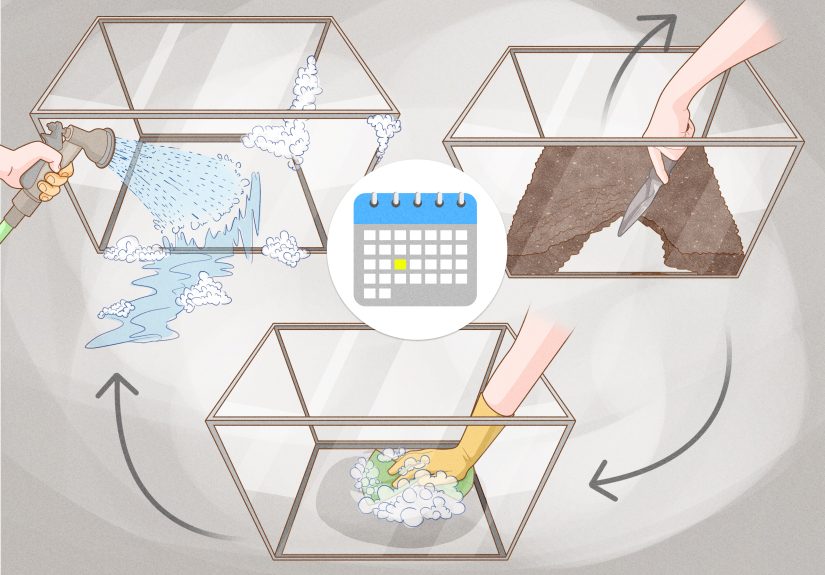
Snail enclosures work best when they’re “clean enough” and stable. Over-scrubbing every surface can remove beneficial micro-life in the substrate, while never cleaning invites mold, mites, and bad smells.
Daily (5 minutes)
- Remove old food and obvious waste
- Wipe any slimy food smears off glass with a damp paper towel
- Check humidity and mist if needed
Weekly (or as needed)
- Spot-replace dirty substrate areas
- Rinse the water dish
- Wipe interior walls with a damp sponge or cloth (no soap)
Monthly-ish refresh
Do a partial substrate change if it’s compacted, sour-smelling, or constantly molding. You usually don’t need to “sterilize” everythingjust remove problems and rebuild a healthy baseline.
Handling & Health Checks: Gentle Touch, Smart Hygiene
How to handle a snail without stressing it out
- Never pull a snail off glass or decor. If it’s stuck, it’s attached for a reason.
- Let it crawl onto your hand instead. If needed, encourage it with a light mist nearby.
- Keep your hands clean and slightly damp (not dripping).
Snails can get stressed by sudden movement, dry surfaces, or being handled too often. A good rule: observe more than you hold.
Quick health checklist
- Shell: looks smooth and sturdy, not chalky or flaking
- Activity: comes out at night or after misting; explores and eats
- Body: moist, not shriveled; no obvious swelling or unusual lesions
- Waste: regular droppings (yes, snail poop is a real sign of success)
Common problems and what they usually mean
Snail stays sealed up all the time: Often too dry, too hot, or stressed. Check humidity, temperature, and whether the enclosure gets direct sun.
Shell looks thin or pitted: Usually a calcium issue (or diet too heavy on watery foods with little mineral support). Offer constant calcium and rotate in more nutrient-dense greens and veggies.
Moldy enclosure: Too much moisture + old food left too long + not enough airflow. Remove food daily and tweak ventilation.
Odd tiny bugs: Could be soil mites or hitchhikers from decor/produce. Improve cleaning, reduce overfeeding, and consider replacing substrate with a fresh, snail-safe batch.
Sleep, Estivation, and Eggs: Normal Snail Life, Explained
Why your snail “disappears” during the day
Many land snails are more active at night or in dim, moist conditions. So if your snail spends daylight hours tucked under bark, in a pot, or half-buried in substrate, congratulations: it’s behaving like a snail.
Estivation and hibernation: the snail version of “do not disturb”
In dry heat, some snails enter estivation (a drought survival mode). In cold conditions, they may hibernate. You might notice the snail retract and form a thin seal over the shell opening to hold in moisture. If your home conditions are stable, you can often prevent long shutdowns by keeping humidity steady and avoiding temperature swings.
Eggs: yes, it can happen (and it can happen quickly)
Many land snails are hermaphrodites, and when conditions are warm and damp, they may reproduce. Snails often lay eggs in shallow soil, and clutches can be surprisingly large. If you keep more than one snailor even if a snail mated before you found ityou should assume eggs are possible.
Practical tips:
- Check the substrate occasionally, especially if you notice fresh digging.
- If you find eggs and you’re not prepared to raise many babies, contact a local extension office or a local invertebrate group for guidance.
- Whatever you do, do not release eggs or babies outdoors.
Quick Care Checklist (Print This in Your Brain)
- Enclosure: escape-proof lid + balanced ventilation
- Substrate: clean, pesticide-free, damp, deep enough to burrow
- Humidity: steady; mist as needed; avoid soggy standing water
- Diet: varied veggies/greens; fruit as a treat; remove old food daily
- Calcium: always available (cuttlebone/eggshell/calcium carbonate)
- Cleaning: spot clean daily; wipe down weekly; no soap
- Handling: minimal, gentle, never pull; wash hands afterward
- Ethics: never release; keep contained; avoid prohibited invasive species
Experience-Based Tips (500+ Words): What Snail Keepers Learn the Funny Way
Ask a handful of snail keepers what they’d do differently, and you’ll hear the same stories told with suspiciously specific emotion. That’s because snails are easyright up until they’re not. Here are the real-world “I wish someone told me” lessons that show up again and again.
1) The lid isn’t optional; it’s a lifestyle. People assume a snail is slow, therefore a snail is easy to contain. This is a logical mistake, like assuming toddlers can’t reach cookies because they’re short. Snails climb glass like it’s their job, and they can push against loose lids with surprising strength. If your enclosure has a gap, your snail will find it during the one hour you’re absolutely certain it’s sleeping. A secure lid with snug edges (and ventilation you control) solves 90% of “Where is my snail?!” mysteries.
2) Humidity problems usually come from ventilation problems. Beginners often respond to “tank is dry” by misting more and more. That can work, but it can also create a cycle where the surface becomes wet while the substrate stays weirdly inconsistent. If you’re misting constantly and still losing humidity, the enclosure is likely venting too aggressively. On the flip side, if your tank is always foggy and smells “earthy… in a bad way,” airflow may be too low. Snail care is a quiet negotiation between moisture and air. Dialing in ventilation makes everything else easier.
3) Fruit is the fastest route to a mold factory. Snails love soft, sweet foods. Fruit is also the fastest way to invite mold and fruit flies if leftovers sit too long. Many keepers eventually shift to a “greens and veggies most days, fruit occasionally” routine. Your snail won’t file a complaint. (It will, however, leave slime art on the glass to express its feelings.)
4) Calcium needs to be constant, not a once-in-a-while sprinkle. Shell issuesthin edges, pitting, rough spotsoften trace back to inconsistent calcium access. A cuttlebone in the enclosure is an easy “set it and forget it” solution. Keepers who provide calcium all the time tend to see stronger shells and fewer worries. If you only add calcium when the shell already looks bad, it’s like watering a plant only after it faints.
5) “My snail is sleeping” and “my snail is stressed” can look identical. Snails rest during the day, and many will tuck into a hide. But if a snail stays closed up for long stretches, especially when conditions are warm and damp, it can be a sign something’s offoften dryness, heat, or sudden environmental changes. Keepers learn to check the basics first: is the substrate damp? Is the enclosure in direct sun? Did the room temperature swing overnight? Snails are simple, but they’re also honest. If they’re unhappy, they stop showing up.
6) The “egg surprise” is real. Many people don’t expect eggs until they find little pearl-like clusters in the soil. If you keep more than one snail, eggs are a strong possibility. And even with one snail, prior mating can matter. The lesson here is planning: decide early what you’ll do if eggs appear, and never assume “nature will handle it.” In captivity, you are nature.
7) Observation is the best part of snail keeping. After the setup is stable, the joy is in noticing tiny patterns: which veggies disappear first, how your snail explores after misting, how it chooses a sleeping spot, and how it moves differently on bark versus glass. Snails reward patience. They’re not a pet you “play with.” They’re a pet you watchand if you lean into that, they’re genuinely relaxing to keep.
The biggest takeaway from experienced keepers is refreshingly consistent: make the environment stable and safe, then get out of the way. When the habitat is rightdamp substrate, steady humidity, good food, constant calciumsnails do what they’ve been doing successfully for millions of years: quietly thrive, one slow lap at a time.
Conclusion
Caring for garden snails isn’t complicated, but it is detail-driven. Get the fundamentals rightsecure enclosure, damp substrate, steady humidity, varied fresh food, and constant calciumand your snail will repay you by being the calmest roommate you’ve ever had. Keep it contained, keep it clean, keep it consistent, and you’ll have a tiny window into an underrated corner of nature.