Table of Contents >> Show >> Hide
- What Is Traditional Cumbia Colombiana?
- Before You Start Dancing: Rhythm, Posture, and Mindset
- Traditional Cumbia Colombiana Tutorial: Solo Foundations
- Partner Tutorial: How to Dance Traditional Cumbia Colombiana Together
- How to Move Like Traditional Cumbia (Without Looking Mechanical)
- Common Mistakes Beginners Make in Cumbia Colombiana
- Practice Plan: Learn Traditional Cumbia in 15 Minutes a Day
- Traditional Cumbia Music and Cultural Cues That Help You Dance Better
- Traditional Cumbia vs. Social/Modern Cumbia: Why the Difference Matters
- Conclusion: Dance Cumbia Colombiana with Rhythm, Respect, and Joy
- Experiences Related to Learning Traditional Cumbia Colombiana (Extended Section)
If you’ve ever watched traditional Cumbia Colombiana and thought, “That looks elegant, playful, and somehow impossible at the same time,” good news: it is absolutely learnable. Even better, it’s one of those dances that rewards rhythm, posture, and personality more than flashy acrobatics. In other words, your knees and your ego can both relax.
This tutorial walks you through how to dance traditional Colombian cumbia in a way that respects its cultural roots while still being beginner-friendly. We’ll cover the essentials: rhythm, posture, footwork, partner movement, body styling, common mistakes, and a simple practice plan. We’ll also explain how traditional cumbia differs from social cumbia variations you may see in clubs or ballroom studios.
Important note: cumbia has many regional and modern forms across Latin America. This guide focuses on traditional cumbia Colombiana fundamentalsthe style rooted in Colombia’s Caribbean region and commonly performed in folkloric and educational settings.
What Is Traditional Cumbia Colombiana?
Traditional cumbia is both a music tradition and a dance tradition with deep roots in Colombia’s Caribbean coast. It is widely described as a cultural blend shaped by African, Indigenous, and Spanish influences. That tri-cultural history matters, because it shows up in the rhythm, instruments, clothing, and overall dance character.
In practical dance terms, traditional cumbia often feels like a courtship dance: flirtatious, playful, and full of approach-and-retreat energy. The movement is grounded, gliding, and circular rather than jumpy or heavily vertical. Think “earthy elegance,” not “dance battle at a trampoline park.”
Before You Start Dancing: Rhythm, Posture, and Mindset
1) Feel the Rhythm First
Many beginners try to memorize steps before listening to the music. That’s like trying to frost a cake before baking it. Start with the beat. Traditional cumbia is percussion-forward, and you should feel a steady pulse before you worry about styling.
For practice, count a simple 1-2-3-4 (or feel an 8-beat phrase made from two sets of four). Educational cumbia lessons often use a four-count or eight-beat approach because it helps beginners organize movement cleanly.
2) Keep a Grounded Posture
Traditional cumbia is not stiff, but it is controlled. Use these posture cues:
- Slight bend in the knees (soft, not squatting)
- Weight low and centered
- Small steps close to the floor
- Chest lifted, shoulders relaxed
- Upper body elegant and relatively steady
A lot of the beauty comes from subtlety. If your shoulders are bouncing like you’re jogging in place, scale it back.
3) Think “Glide,” Not “Stomp”
Traditional cumbia footwork is often described as a shuffle or glide. The feet stay close to the floor, and the energy travels horizontally. Imagine you’re moving across warm sand while trying not to spill a candle. That mental image is actually pretty useful because candles are part of many traditional/folkloric cumbia performances.
Traditional Cumbia Colombiana Tutorial: Solo Foundations
Before adding a partner, learn the solo foundation. If you can hold the rhythm and move smoothly on your own, partner work becomes much easier (and much less chaotic).
Step 1: March in Place to Find the Beat
Start by marching in place for 8 counts:
1-2-3-4 / 5-6-7-8
Keep the steps small. Don’t lift your knees high. This is not a parade; it’s a rhythm check. Your goal is to connect your feet to the pulse.
Step 2: Add Hip Motion (Small and Natural)
Once you can keep time, place your hands lightly on your hips and let the hips move naturally with each step. This should feel like a response to the footwork, not a separate “performance.” The movement is relaxed and rhythmic, not exaggerated.
Beginner tip: if your hips feel forced, make your steps smaller and slow down. Good cumbia groove often looks effortless because the dancer is not overworking it.
Step 3: Practice the Side-to-Side Shuffle
A common beginner-friendly cumbia pattern is a side-to-side shuffle on four counts:
- Step to one side
- Bring the other foot in (small shuffle/collect)
- Step again
- Pause or mark the beat lightly
Then repeat to the other side. Keep your feet close to the ground. Focus on smooth weight transfer rather than speed.
Step 4: Add Arm Position and Elegance
In traditional/folkloric cumbia styling, the arms help create shape and storytelling. For solo practice, try this:
- One arm softly lifted (elbow relaxed, wrist natural)
- The other arm lower and balanced
- Hands expressive but not floppy
- Shoulders down, neck long
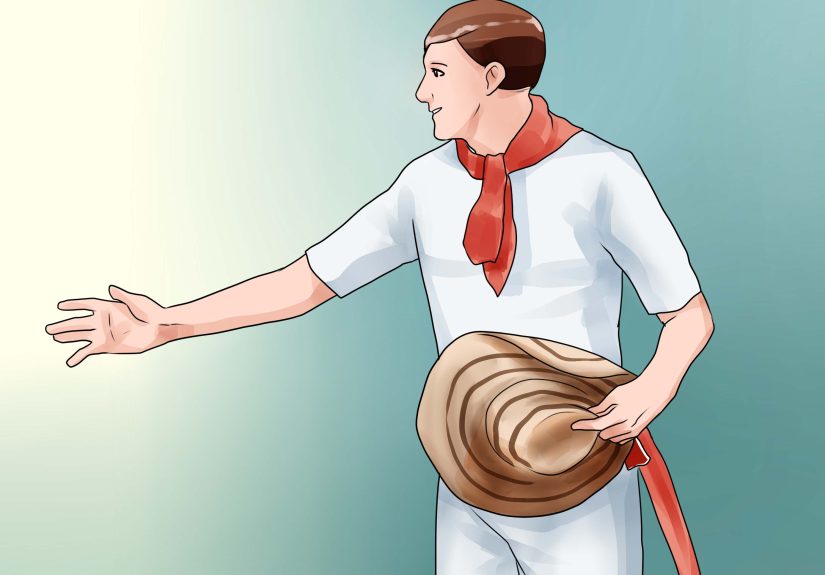
If you’re practicing the “woman’s role” styling, imagine holding a skirt. If you’re practicing the “man’s role” styling, imagine holding a hat in one hand. These props help define the character even when they’re imaginary.
Step 5: Turn in a Small Circle
Traditional cumbia often uses circular pathways. Practice turning slowly while maintaining your shuffle rhythm. Move in a small circle, keeping the upper body calm. The trick is not to “spin,” but to travel in a circle with rhythm.
Do two circles of 8 counts each, then stop and reset. If you get dizzy, congratulations: you turned too big or too fast.
Partner Tutorial: How to Dance Traditional Cumbia Colombiana Together
Once both dancers can keep the basic rhythm, you can build the classic cumbia interaction. In many traditional presentations, the dance emphasizes a courtship dynamic with distinct roles, props, and playful approach/retreat patterns.
Partner Setup
- Face each other with comfortable distance (do not crowd)
- Maintain eye contact on and off (friendly, playful, not a staring contest)
- Keep steps small and grounded
- Move around each other in circular patterns
Traditional Role Styling (Folkloric Basics)
In many instructional and performance examples, the man’s role may use a hat and candle (or gesture as if holding them), while the woman’s role may hold a candle and gather or display the skirt. Even when props are not used, the movement often keeps that same visual logic: offering space, circling, teasing, and responding.
Partner Sequence for Beginners (8-Count Friendly Version)
Phase A: Approach and Retreat (8 Counts)
- Counts 1-4: One partner advances slightly with small shuffle steps.
- Counts 5-8: The other partner responds by circling or retreating while staying on beat.
The key is control. Traditional cumbia is flirtation through rhythm, not rushing forward like you forgot your phone on the other side of the room.
Phase B: Circle Together (8 Counts)
Both partners travel in a small circle, maintaining their own footwork. Stay aware of spacing. You are creating a shared shape, not following a straight-line dance lane.
Phase C: Shoulder-to-Shoulder Orientation (8 Counts)
A common folkloric teaching variation includes standing with right shoulders closer and moving in a circle, then changing direction. This builds coordination and helps dancers feel cumbia’s circular flow without relying on a tight handhold.
Phase D: Side-by-Side Front-and-Back (8 Counts)
Stand side by side and step forward/back together while looking toward each other. This is a great drill for timing and sync. If one person is on count 1 and the other is on count “surprise,” pause and reset.
How to Move Like Traditional Cumbia (Without Looking Mechanical)
Use Texture, Not Tension
Cumbia looks best when the body is alive but not rigid. Add texture through:
- Soft knee pulse
- Gentle hip swing
- Controlled arm lines
- Facial expression (yes, smiletraditional teaching often emphasizes this)
Match the Music’s Personality
Traditional cumbia can be joyful, ceremonial, and deeply social. Don’t dance it like a drill exercise. Listen for the percussion and melodic lines (including flute/gaita textures in traditional ensembles), and let the phrasing shape your movement.
Common Mistakes Beginners Make in Cumbia Colombiana
- Taking giant steps: Big steps break the gliding feel and ruin balance.
- Bouncing the shoulders: The upper body should stay poised and elegant.
- Overdoing the hips: Cumbia groove is rhythmic, not forced.
- Ignoring the beat: Pretty arms cannot save lost timing.
- Standing too close: Traditional partner work needs visual space.
- Dancing only with the feet: Use eyes, posture, and intention too.
Practice Plan: Learn Traditional Cumbia in 15 Minutes a Day
Minutes 1-3: Rhythm Training
Clap or step to the beat. Count 1-2-3-4, then feel two groups of four (8 counts). No choreography yet.
Minutes 4-7: Solo Footwork
March in place, then side-to-side shuffle. Focus on grounded steps and smooth weight transfer.
Minutes 8-10: Arms and Styling
Add graceful arm positions. Practice “skirt hand” or “hat hand” styling without losing timing.
Minutes 11-13: Circular Travel
Move in small circles while keeping the same rhythm. Practice changing direction without breaking posture.
Minutes 14-15: Partner Drill (or Imaginary Partner Drill)
Practice approach-and-retreat and circle patterns. If you don’t have a partner, use a chair as a spacing marker. (No, don’t flirt with the chair. Just use it as a guide.)
Traditional Cumbia Music and Cultural Cues That Help You Dance Better
To dance traditional cumbia more authentically, it helps to understand the music’s sonic foundation. Educational and cultural sources commonly point to percussion instruments such as the tambora, llamador, and alegre, along with maracas and Indigenous flutes (often gaitas) as core elements in traditional cumbia sound.
Why does that matter for dancing? Because each part suggests a different movement quality:
- Steady pulse: your foot timing
- Calling rhythm: your directional changes
- Improvised drum energy: your playful accents and personality
- Melodic flute lines: your arm styling and phrasing
If you dance only to the loudest beat, your cumbia may look flat. If you also listen to the layered rhythms, it starts to breathe.
Traditional Cumbia vs. Social/Modern Cumbia: Why the Difference Matters
This is where many tutorials get messy. “Cumbia” can mean different dance styles depending on the country, region, and social context. You may see:
- Traditional Colombian folkloric cumbia
- Colombian social cumbia variations
- Cumbia Tejana / Texas cumbia
- Mexican cumbia styles (including sonidera-related forms)
- Ballroom-inspired cumbia teaching methods
They are related, but not identical. So if one class teaches a rock step and another teaches a shuffle-based circular pattern, that does not necessarily mean someone is “wrong.” It may simply be a different cumbia tradition. For this article, we stayed focused on traditional Cumbia Colombiana fundamentals.
Conclusion: Dance Cumbia Colombiana with Rhythm, Respect, and Joy
Learning how to dance the traditional cumbia colombiana is less about memorizing a long choreography and more about building three things: rhythm, posture, and connection. Start with the beat. Keep your steps grounded and small. Let the upper body stay elegant. Then add the playful courtship energy that gives cumbia its unmistakable charm.
The best cumbia dancers are not always the fastest or flashiest. They are the ones who make the dance feel alive, social, and musical. Practice a little each day, listen carefully to traditional cumbia music, and you’ll start to feel the difference between “doing steps” and actually dancing cumbia.
Experiences Related to Learning Traditional Cumbia Colombiana (Extended Section)
One of the most interesting experiences people describe when learning traditional cumbia colombiana is that the dance feels simple at first glance and surprisingly deep once they begin. A beginner often starts with confidence“Okay, I can walk to a beat”and then discovers that cumbia asks for a very specific kind of control: grounded steps, elegant upper body, calm shoulders, and precise rhythm. That moment of realization can be humbling, but in a good way. It teaches patience. Many learners say that cumbia helped them become better listeners because the dance only starts to feel natural when they stop rushing and start hearing the layered percussion in the music.
Another common experience is the shift from “exercise mode” to “social mode.” At the beginning, students tend to count loudly, stare at their feet, and treat the dance like a checklist. After a few practice sessions, something changes: they lift their gaze, notice their partner, and begin to play with the courtship energy built into traditional cumbia. That is usually when the dance becomes genuinely fun. The room gets lighter. People smile more. Timing improves because they are no longer fighting the music. Instructors often point out that cumbia is not just about steps; it is about intention, character, and respectful interaction.
Learners who practice with propsor even imaginary propsalso report a major breakthrough. Pretending to hold a skirt, hat, or candle changes posture instantly. The arms become more purposeful, and the movement looks less random. A student who seemed stiff in a basic drill may suddenly look graceful once given a simple styling cue like, “Lift the candle and protect your space,” or “Present the hat, then circle.” These visual images help the body organize itself without overthinking technique. It is a reminder that traditional dances carry stories, and those stories often unlock movement quality faster than mechanical instructions alone.
Group practice creates another memorable experience: cumbia’s community effect. When several people dance the same rhythm in small circles, the energy becomes collective. Even beginners who miss a step can recover quickly because they feel the group pulse. This makes cumbia especially welcoming in mixed-skill settings. A more experienced dancer can model calm timing and elegant posture, while a newer dancer follows the shape and learns by imitation. Instead of feeling judged, many beginners feel carried by the rhythm and supported by the format.
Finally, people often describe cumbia as a dance that improves their confidence beyond the dance floor. Because the style rewards composure and presence, students learn to move with intention rather than panic. They stop trying to “perform” and start trying to communicate. That mindset transfers well into everyday lifepublic speaking, social situations, and even stress management. Traditional cumbia teaches you to stay grounded, stay musical, and stay connected. Not bad for a dance lesson that started with a simple count of one-two-three-four.