Table of Contents >> Show >> Hide
- What counts as a “real” pull-up?
- Before you start: equipment and safety setup
- How to Do Pull Ups for Beginners: 12 Steps
- Step 1: Choose your grip (and stop overthinking it)
- Step 2: Set your body like a “quiet plank”
- Step 3: Warm up your shoulders and upper back (2–4 minutes)
- Step 4: Learn the dead hang (your pull-up’s starting line)
- Step 5: Add an “active hang” (scapular engagement)
- Step 6: Practice the top position (isometric holds)
- Step 7: Use assistance (bands or machine) to learn the groove
- Step 8: Train the lowering phase (negative pull-ups)
- Step 9: Strengthen the “supporting cast” (rows and pulldowns)
- Step 10: Put the pieces together for your first strict rep
- Step 11: Fix the 5 most common beginner mistakes
- Step 12: Follow a simple 3-day beginner plan (repeat for 4–8 weeks)
- Troubleshooting: “Why can’t I do a pull-up yet?”
- Beginner-friendly pull-up variations (pick what fits your body)
- How often should beginners train pull-ups?
- of beginner experiences: what pull-up progress actually feels like
- Conclusion
Pull-ups look simple: you hang, you pull, you feel heroic. In real life, beginners discover two things immediately:
(1) gravity is extremely committed to its job, and (2) your lats have been quietly freelancing instead of working full-time.
The good news? Pull-ups are learnable for almost anyone with smart progressions, consistent practice, and a tiny bit of
patience (yes, that word you pretend not to know).
This guide breaks down exactly how to do pull-ups for beginners using a clean, joint-friendly techniqueand the
stepping-stones that get you from “I can hang… briefly” to your first real rep. You’ll also get troubleshooting tips,
a simple weekly plan, and a realistic look at what progress feels like.
What counts as a “real” pull-up?
A strict pull-up starts from a controlled hang (arms straight), moves up by pulling your chest toward the bar, and ends
with your chin clearly above the barthen returns under control to the start. No frantic leg flailing, no launching off
the floor, no “my neck touched the bar so it counts.” (Nice try.)
Muscles you’re actually training
Pull-ups are a full-body strength move, not just an “arms day” party trick. Your upper back (especially lats),
mid-back, biceps, forearms/grip, and core all contribute. Done well, they build strength you can feel in everyday
lifecarrying, climbing, lifting, and generally being hard to knock over.
Before you start: equipment and safety setup
- A sturdy pull-up bar (doorway, wall-mounted, rack, or playground bar).
- A box/step to help you get into position safely (especially for negatives).
- Optional: resistance bands or an assisted pull-up machine.
- Optional: chalk or grippy tape if your hands sweat like they’re nervous for an exam.
Quick safety rule: you should never feel sharp pain in the shoulder, elbow, or wrist. Muscle effort and “this is hard”
are normal. Pinchy, stabby, or “my joint is angry” is not. If you’ve had shoulder issues, consider building shoulder
stability work into your warm-up (more on that below).
How to Do Pull Ups for Beginners: 12 Steps
Step 1: Choose your grip (and stop overthinking it)
Start with a comfortable overhand grip (palms facing away) about shoulder-widthmaybe slightly wider. Wrap your thumbs
around the bar (full grip), because your hands deserve security too. If overhand feels impossible at first, you can
practice with a neutral grip (palms facing each other) if your setup allows, or even start with chin-ups (underhand)
as a stepping-stone.

Step 2: Set your body like a “quiet plank”
Beginners often leak strength by wiggling. Before you pull, lightly squeeze your glutes, brace your abs, and keep your
ribs from flaring up like you’re trying to show off your sternum. Think: a hollow-ish body positionquiet legs, steady
torso, no swinging. Cross your ankles if it helps you stay controlled.

Step 3: Warm up your shoulders and upper back (2–4 minutes)
Pull-ups demand the shoulder blades move well and the shoulder joint stays centered. A fast warm-up improves your
pulling quality and reduces the chance you “yank” into a bad position. Do:
- 10–15 band pull-aparts or rear-delt fly motions
- 8–10 “I-Y-T” shoulder blade raises (light, controlled)
- 20–30 seconds of gentle hanging or partial hangs

Step 4: Learn the dead hang (your pull-up’s starting line)
Start by simply hanging with arms straight and a solid grip. If a full hang is too much, keep one foot lightly on a box
to unload some weight. Your goal is to own this position without pain, panic, or instantly sliding off like a cartoon
character.
Beginner target: accumulate 30–60 seconds total hanging time (broken into sets) across your workout.

Step 5: Add an “active hang” (scapular engagement)
Here’s the secret sauce: before you bend your elbows, set your shoulder blades. From a hang, pull your shoulders
down and slightly back (scapular depression and retraction) without bending your elbows muchyour body rises a
tiny bit. This teaches you to use your lats and lower traps instead of hanging passively in your joints.
Do 2–3 sets of 5–8 reps, pausing 1 second in the “active” position.

Step 6: Practice the top position (isometric holds)
The top of the pull-up is where beginners either win… or turn into a chin-hovering question mark. Use a box to step up
so your chin is over the bar. Hold that position for 5–15 seconds while keeping your ribs down and shoulders away from
your ears. If you can’t hold it yet, start with 3–5 seconds and build.

Step 7: Use assistance (bands or machine) to learn the groove
Assisted pull-ups let you practice the full motion with good form before you’re strong enough for bodyweight reps.
Bands are great because they help most at the bottom (where you’re weakest). The key: pick enough assistance
that you can do controlled repsno bouncing, no slingshotting.
Starter prescription: 3 sets of 4–8 smooth reps, stopping 1–2 reps before your form falls apart.

Step 8: Train the lowering phase (negative pull-ups)
Negatives are beginner gold because you can control the eccentric (lowering) even before you can pull up. Step to the
top position (chin above bar), set your shoulders down/back, then lower yourself slowly to straight arms.
Aim for a 3–6 second descent. Do 3–5 reps per set for 2–4 sets. If your elbows complain, shorten the total volume and
keep the lowering controlled (not aggressive).

Step 9: Strengthen the “supporting cast” (rows and pulldowns)
If pull-ups are the movie star, rows and pulldowns are the stunt doubles doing the hard work behind the scenes.
Include 2–3 of these each week:
- Inverted rows (under a table/TRX/rings) aim for 3×8–12
- Lat pulldowns keep chest tall, pull elbows down/back, control the return
- One-arm dumbbell rows pause at the top, avoid twisting
A helpful benchmark: when you can do 3 sets of 10–12 solid rows and hold a dead hang for 30+ seconds, you’re usually
ready to push assisted pull-ups harder.

Step 10: Put the pieces together for your first strict rep
Now we combine: (1) active hang, (2) tight body line, (3) pull “elbows to ribs.” Start from a controlled hang.
Engage your shoulder blades firstshoulders down away from earsthen pull your elbows down and slightly back.
Think about pulling your chest toward the bar, not just popping your chin over it.
At the top, pause for a split second. Then lower under control to straight arms. If you can’t control the bottom,
return to negatives and active hangs for another week.

Step 11: Fix the 5 most common beginner mistakes
- Shrugging up into your ears: Reset with active hangs. Cue “shoulders in back pockets.”
- Half reps: Use a box to help you reach full range and earn clean reps.
- Excessive swinging: Start each rep from stillness. Cross ankles and brace abs/glutes.
- Pulling with arms only: Think “drive elbows down” and start the pull from the shoulder blades.
- Doing too much too soon: Tendons adapt slower than muscles. Keep volume modest and progress weekly.

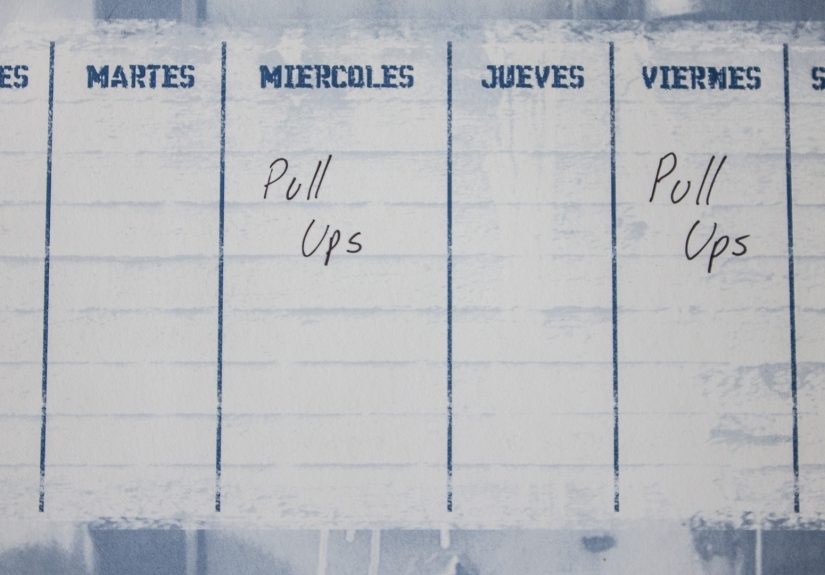
Step 12: Follow a simple 3-day beginner plan (repeat for 4–8 weeks)
Consistency beats heroic one-day efforts. Here’s a beginner-friendly schedule that builds skill and strength without
turning your elbows into a complaint department.
Day A (Technique + Strength)
- Dead hang: 3×15–30 seconds
- Active hang (scapular pulls): 3×5–8
- Band-assisted pull-ups: 3×4–8
- Inverted rows: 3×8–12
- Optional: farmer’s carries 2×30–60 seconds (grip)
Day B (Eccentric focus)
- Dead hang: 2×20–40 seconds
- Top holds: 3×5–15 seconds
- Negative pull-ups: 3–4×3–5 (3–6 sec down)
- Lat pulldown or dumbbell rows: 3×8–12
- Core: hollow hold 3×15–30 seconds
Day C (Volume + Back accessories)
- Band-assisted pull-ups: 4×3–6 (slightly harder band than Day A if possible)
- Inverted rows: 4×8–10
- Biceps curls: 2–3×10–15
- Rear-delt work (band pull-aparts): 2×15–25
Progression rule: when you can complete the top end of the rep range with clean form for all sets, reduce assistance
slightly (thinner band, less machine help) or add 1 rep per set. Tiny upgrades compound fast.
Troubleshooting: “Why can’t I do a pull-up yet?”
If your grip fails first
Grip is often the first limiter. Add farmer’s carries, dead hangs, and slow negatives. If your hands tear easily,
manage calluses (file them, moisturizeyes, strength can be moisturized).
If your elbows hurt
Elbow irritation can happen if you jump into too many negatives too quickly. Reduce eccentric volume, use more
assistance, and increase pulling with rows/pulldowns for a week or two. Keep wrist position neutral and avoid death-gripping the bar.
If your shoulders feel pinchy
Prioritize scapular control (active hangs) and shoulder conditioning work. If symptoms persist, get evaluated by a
qualified clinicianespecially if pain shows up during daily activities.
Beginner-friendly pull-up variations (pick what fits your body)
- Chin-up (underhand): Often easier at first due to biceps leverage.
- Neutral-grip pull-up: Usually friendlier on shoulders and elbows if you have handles.
- Tempo pull-ups: Slow up, pause, slow downgreat when you can do a few strict reps.
- Assisted pull-ups: Bands or machinebest learning tool for beginners.
How often should beginners train pull-ups?
Most beginners do best with 2–3 pull-up sessions per week with at least a day between harder sessions.
You’re training strength skill, not trying to win a “Most Sore Person Alive” award. More isn’t always better; better is better.
of beginner experiences: what pull-up progress actually feels like
Beginner pull-up training has a very specific emotional arc, and it usually starts with: “Wait… that’s it?” You walk
up to the bar, hang, and realize your forearms are doing a full Broadway performance after 10 seconds. That’s normal.
Your grip adapts quickly when you practice consistently, and the first win is often boring: hanging doesn’t feel scary anymore.
Next comes the “active hang revelation.” The first time you depress your shoulder blades and your body rises half an inch,
it feels like discovering a hidden level in a video game. Many beginners report that pull-ups suddenly make more sense
once they learn to start the movement from the shoulder blades rather than yanking with the arms. It’s also where you
notice the difference between “hanging” and “owning the hang.”
Then negatives enter the chat. At first, a 3-second descent feels like an eternity. You’ll probably shake. You might
also make a face that suggests you’re reading a very sad email. Over a few weeks, though, you’ll begin to control the
lowering phase better, and that’s a huge sign you’re building the exact strength pull-ups require. Beginners often say
their back feels “awake” after negativeslike muscles they forgot existed just logged in.
There’s also a common plateau moment: you get stronger on rows and pulldowns, but the first full pull-up still won’t
happen on command. This is where many people quitright before it clicks. Pull-ups are skill + strength. Your nervous
system needs practice coordinating tension: bracing the core, setting the shoulder blades, and pulling smoothly without
swinging. That coordination usually improves in small, unglamorous steps: cleaner assisted reps, longer top holds, and
slower negatives.
When the first strict rep finally happens, it often feels weirdly quiet. No fireworks. Just a smooth pull, a chin over
the bar, and a sudden thought: “Oh. So that’s how it’s supposed to feel.” After that, progress tends to accelerate
because you now have a reference point. Your next goal becomes repeatability: turning “one magical rep” into “one rep
whenever I want,” then “sets of two,” then “sets of three.” That’s the real beginner superpowershowing up, doing the
basics well, and letting the reps stack up like interest in a high-yield savings account (but sweatier).
Conclusion
If you’re a beginner, the fastest path to your first pull-up isn’t brute forceit’s smart practice: dead hangs,
active hangs, assisted reps, controlled negatives, and back-building accessories. Train 2–3 days per week, keep your
reps clean, and progress in tiny steps. Your first pull-up isn’t a mystery. It’s a recipe.