Table of Contents >> Show >> Hide
- Why even a small ammonia reading matters
- What to do first when ammonia is a little high
- Common reasons ammonia creeps up in a fish tank
- Should you use ammonia neutralizers or bottled bacteria?
- What not to do when ammonia is only slightly elevated
- A simple 3-day plan for mild ammonia
- How to keep ammonia from coming back
- Real-world experiences aquarium owners commonly have with mild ammonia issues
- Conclusion
A slight ammonia reading in a fish tank is a bit like smelling smoke in the kitchen. The house is not necessarily on fire, but you definitely do not sit down and butter toast like nothing happened. In aquarium terms, mildly elevated ammonia is often a warning sign that your tank’s biological balance is under pressure. Maybe you fed a little too generously. Maybe a plant leaf melted in the corner and started decomposing like a tiny underwater villain. Maybe the filter is still catching up after a cleaning or a recent fish addition.
The good news is that if ammonia levels are not very high, you usually do not need a dramatic, movie-worthy rescue mission. No frantic bucket brigade. No complete tear-down. No emotional speech to the goldfish. What you do need is a calm, smart response that lowers ammonia without destabilizing the tank even more.
This guide walks through exactly how to lower ammonia levels in a fish tank when the reading is mild, what causes the problem, what not to do, and how to stop the issue from coming back. The goal is simple: safer water, less fish stress, and fewer moments where you stare at a test strip like it just insulted your family.
Why even a small ammonia reading matters
Ammonia is one of the most important aquarium water parameters because fish produce it constantly. It comes from waste, uneaten food, decaying plants, and other organic debris. In a healthy tank, beneficial bacteria convert ammonia into nitrite and then into nitrate. That is the nitrogen cycle doing its quiet, glorious janitorial work.
When ammonia shows up, even at a low level, it means one of two things is happening: your tank is producing waste faster than the biofilter can process it, or something has interrupted the bacteria that normally handle the load. Either way, ammonia is not a number you want to ignore and “circle back to later.” Fish do not enjoy surprise chemistry experiments.
If the level is only slightly elevated and your fish are acting normal, you usually have time to correct the problem gently. But gently does not mean slowly forever. It means taking measured steps right away.
Signs the ammonia issue is still mild
When ammonia is not very high, fish may still look mostly normal. You might notice only subtle clues such as reduced appetite, mild restlessness, extra time near the filter flow, or a reading on your test kit that is higher than it should be but not yet alarming.
If fish are gasping at the surface, clamping fins, lying at the bottom, showing red or irritated gills, or the ammonia keeps climbing from one test to the next, stop treating it like a “small problem.” At that point, you are moving out of the mild-ammonia zone and into urgent-fix territory.
What to do first when ammonia is a little high
1. Do a partial water change, not a total reset
The first move is usually the best one: change part of the water with properly conditioned replacement water. For a mild ammonia rise, a modest partial water change often does the trick. Think in the range of a small-to-moderate change rather than draining the tank like you are renovating a swimming pool.
Why not replace all the water? Because a full or massive water change can create a sudden shift in temperature, pH, and overall water chemistry. That can stress fish and destabilize the aquarium even more. If your ammonia is only slightly elevated, the smart move is a controlled partial change that dilutes the toxin without shocking the system.
Match the new water as closely as possible to the tank’s temperature, and always treat tap water with a conditioner before it goes in. Chlorine and chloramine can harm fish and damage the beneficial bacteria you are depending on to solve the problem.
2. Feed less for the next day or two
If ammonia is creeping up, food is often part of the story. Every pellet, flake, wafer, and “just one more pinch because they looked hungry” decision eventually becomes waste. Less food in means less ammonia out.
You do not need to start a fish hunger strike worthy of a political movement. Just feed lightly for a day or two, and make sure everything offered is eaten quickly. If food is landing on the substrate and sitting there like sad confetti, you are feeding too much.
For established fish, a brief reduction in feeding is usually easier on them than living in dirty water. The point is not punishment. The point is lowering waste production while the tank catches up.
3. Remove visible debris
If you can see the gunk, remove the gunk. Siphon uneaten food, fish waste, dead plant leaves, and mulm from the substrate. Clean out any obviously decaying material hiding behind decorations, in corners, or trapped in plants.
This matters because ammonia often comes from breakdown, not just from live fish. A mild spike sometimes has a very boring cause: one dead leaf, one forgotten algae wafer, one overenthusiastic feeding session, or one spot in the gravel that looks clean until you disturb it and discover it has been hosting its own compost program.
4. Check the filter, but do not overclean it
Your filter is not just a machine that moves water around for dramatic effect. It is home to beneficial bacteria that process toxic waste. If flow is reduced, gently rinse the mechanical media in old tank water that you removed during the water change. Do not blast the biological media under untreated tap water and do not replace all filter media at once unless the manufacturer specifically calls for it and you understand how to preserve the biofilter.
This is one of the most common mistakes in aquarium care. People see a water quality issue, clean the tank aggressively, replace everything, and accidentally evict the microbial workforce that was trying to help them.
5. Pause any new fish additions
If you were about to add more fish, now is a fantastic time to not do that. Even a well-meaning “just two little tetras” can push a slightly stressed tank into a bigger ammonia problem. Let the aquarium stabilize first.
Overstocking and adding fish too quickly are classic causes of ammonia trouble, especially in newer tanks or tanks that recently had a filter change, medication, deep cleaning, or other disruption.
6. Retest within 24 hours
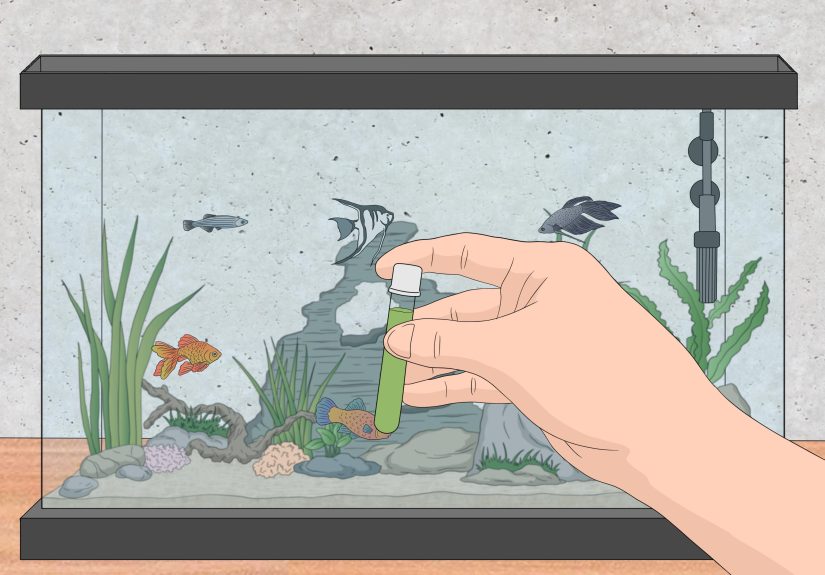
After the water change, lighter feeding, and cleanup, test again within about a day. If the number is lower, great. Your tank is responding. If the reading is unchanged or higher, you need to keep troubleshooting instead of congratulating yourself too early.
Ammonia control is not about one heroic action. It is about checking whether your actions actually worked.
Common reasons ammonia creeps up in a fish tank
Overfeeding
This is the celebrity villain of aquarium water quality problems. Too much food creates more waste from fish and more decay from leftovers. Cloudy water, dirty substrate, and rising ammonia often arrive as a package deal.
Too many fish for the tank or filter
Even if a tank is technically not overcrowded on paper, the biofilter may not be able to handle a sudden increase in bioload. A tank can look roomy and still be chemically overworked.
Disrupted beneficial bacteria
Replacing all filter cartridges, washing media in untreated tap water, heavy cleaning, or certain medications can reduce the bacteria that convert ammonia. When that bacterial population drops, ammonia rises.
New tank syndrome
In a newer aquarium, the nitrogen cycle may not be fully established yet. Mild ammonia readings are common while the tank matures. In that case, the solution is not panic. It is supporting the cycle with patient maintenance, careful feeding, and time.
Decaying plant or organic matter
Live plants can help absorb nitrogen waste, but dead plant material does the opposite. Trim melting leaves, remove rotting stems, and do not assume every green thing in the tank is helping just because it is technically a plant.
Tap water and chloramine confusion
Sometimes the tank is not the only source of the problem. Some tap water supplies use chloramine, and some test kits or water conditioners can make ammonia readings confusing. If ammonia seems to reappear after every water change, test your source water separately and make sure you understand what your test kit measures.
Should you use ammonia neutralizers or bottled bacteria?
If ammonia is only slightly elevated, your first tools should still be partial water changes, reduced feeding, and waste removal. Those are the basics, and the basics win a shocking number of fights.
That said, bottled beneficial bacteria can be useful, especially in a new tank or after filter disruption. They may help strengthen the biofilter and speed recovery. Ammonia-neutralizing products can also help in some situations, but they should be treated as support tools, not permission slips to ignore the underlying cause.
If you use a conditioner or ammonia-locking product, read the instructions carefully and know that some test kits measure total ammonia rather than just the more dangerous free ammonia. That can make it look like “nothing changed” when the chemistry is actually more nuanced.
What not to do when ammonia is only slightly elevated
Do not do a full tank teardown
If the ammonia is mildly high, there is no prize for turning your aquarium into a disaster zone. A full strip-down often causes more instability than the original problem.
Do not replace all filter media at once
Your beneficial bacteria live on surfaces, especially filter media. Replacing everything at one time can wipe out much of your biological filtration.
Do not chase pH with sudden adjustments
Yes, pH affects ammonia toxicity. But rapid pH swings stress fish. Instead of swinging chemistry wildly, focus on dilution, filtration, and stability.
Do not assume activated carbon fixes ammonia
Activated carbon is useful for some water quality issues, but it is not your main ammonia solution. If you are relying on carbon alone to solve a nitrogen problem, your tank may soon send you a strongly worded rebuttal.
Do not keep feeding normally “because the fish look hungry”
Fish are talented beggars. That is not the same as being underfed. During a mild ammonia issue, a lighter hand with food is part of the treatment.
A simple 3-day plan for mild ammonia
Day 1
Test ammonia. Do a partial water change with conditioned, temperature-matched water. Siphon out visible debris. Feed very lightly or skip one feeding. Check that the filter is running properly.
Day 2
Retest. If the reading is improving, stay the course. Remove any fresh debris, trim dead plant matter, and continue light feeding. If the number is flat or rising, do another modest water change and inspect whether the filter media or stocking level is the real issue.
Day 3
Retest again. If ammonia is heading back toward zero, resume normal but careful maintenance. If it is not improving, stop calling it a mild issue and escalate your response. At that point, the tank may be cycling, overstocked, or suffering from filter damage that needs a bigger correction.
How to keep ammonia from coming back
The long-term fix for low-level ammonia is not magical. It is consistent. Feed only what fish can finish promptly. Perform regular partial water changes. Vacuum the substrate. Keep the filter maintained without sterilizing it. Add fish gradually. Test water when anything changes, such as new livestock, medication, filter upgrades, or unexplained fish behavior.
Live plants can help, especially fast growers and floaters, because they absorb nitrogen waste and support a healthier ecosystem. A mature, stable aquarium tends to handle small mistakes far better than a brand-new or heavily disrupted one.
In other words, ammonia prevention is mostly about not making your tank work overtime for no reason.
Real-world experiences aquarium owners commonly have with mild ammonia issues
One of the most common experiences is the “I swear I barely fed them” scenario. A fish keeper tests the water after noticing slightly cloudy water or fish acting a little off. The ammonia reading is not terrible, but it is clearly not zero. After a little investigating, the culprit turns out to be ordinary overfeeding. Maybe the fish were being spoiled. Maybe two people in the house were both feeding the tank. Maybe pellets were drifting behind a decoration and dissolving out of sight. The fix is often surprisingly simple: a partial water change, less food, a quick substrate vacuum, and a promise to stop treating the tank like an all-you-can-eat buffet.
Another very common experience happens right after a cleaning. Someone decides to be extra responsible and cleans the tank, scrubs the filter, swaps out the cartridge, rinses everything until it looks suspiciously sterile, and then wonders why the test kit suddenly shows ammonia. This is one of the most frustrating lessons in fishkeeping because it feels like punishment for being helpful. But the tank was not upset because it was cleaned. It was upset because the beneficial bacteria got evicted along with the sludge. In these cases, the best recovery is usually a series of careful partial water changes, reduced feeding, and leaving the biological side of the filter alone long enough for it to rebuild.
New tank owners run into a third kind of experience all the time. The aquarium looks beautiful. The water is clear. The decorations are arranged like a tiny underwater real estate listing. Then the test kit reports ammonia, and panic sets in. This usually happens because a tank can look finished long before it is biologically mature. The owner often assumes something is terribly wrong, when in reality the biofilter is simply still developing. The successful hobbyists in this situation are the ones who respond with patience: smaller feedings, regular testing, partial water changes, and no rushing to add more fish just because the tank has empty space begging to be filled.
There is also the mystery case where ammonia seems to show up after every water change. This sends people into a special kind of aquarium confusion. They are doing exactly what they were told to do, yet the test still looks wrong. Often the explanation is source water, chloramine, or a test-kit interpretation issue rather than a tank that is instantly re-polluting itself out of spite. Experienced aquarists usually learn to test their tap water separately, read conditioner directions more carefully, and stop assuming every odd result means the tank is collapsing.
Planted tank owners have their own version of this experience. They add live plants hoping for cleaner water, and many times that helps. But if several leaves melt at once, or a new plant does not adapt well, that decaying matter can nudge ammonia up instead of down. The lesson there is that plants are wonderful assistants, not magical interns who never need supervision.
What ties all these experiences together is that mild ammonia problems usually come from normal aquarium life, not from dramatic catastrophe. A little extra food, a little too much cleaning, a little impatience, a little hidden debris. The tank is rarely asking for a grand rescue. It is usually asking for measured maintenance, a steadier routine, and perhaps less confidence from the human holding the fish flakes.
Conclusion
If ammonia levels in your fish tank are not very high, that is actually good news. You have caught the problem early, before it turns into a full-scale emergency. The best response is usually simple: do a partial water change with conditioned water, feed less for a day or two, remove waste, protect your beneficial bacteria, and retest soon. Calm corrections beat dramatic overreactions almost every time.
The bigger lesson is that ammonia is not random. It is feedback. Your tank is telling you that waste production, filtration, or maintenance has drifted out of balance. Listen to that message early, and you can usually solve the issue without stressing your fish or wrecking your biofilter. Ignore it, and the tank will become much more persuasive.
In fishkeeping, success is often less about doing something heroic and more about doing something sensible before the water starts writing threats in chemistry.