Table of Contents >> Show >> Hide
- What a Toilet Fill Valve Does (and How to Know It’s the Problem)
- Tools and Materials You’ll Want Nearby
- Before You Start: Two Minutes That Can Save Your Afternoon
- Step-by-Step: How to Replace a Toilet Fill Valve
- Step 1: Shut off the water and drain the tank
- Step 2: Disconnect the water supply line
- Step 3: Remove the refill tube from the overflow tube
- Step 4: Remove the old fill valve
- Step 5: Adjust the new fill valve height before installing
- Step 6: Install the new fill valve in the tank
- Step 7: Attach the refill tube correctly (this part matters more than it looks)
- Step 8: Reconnect the water supply line
- Step 9: Turn the water on, check for leaks, and set the water level
- After-Install Troubleshooting (Because Toilets Love Plot Twists)
- How to Choose the Right Replacement Fill Valve
- When You Should Call a Plumber Instead
- Conclusion
- Real-World Experiences: What People Actually Run Into (and How to Handle It)
- 1) The shutoff valve “turns” but doesn’t actually shut off
- 2) The locknut is stuck like it’s been glued on by a villain
- 3) The refill tube keeps popping off (or someone shoved it too far down the overflow)
- 4) “I replaced the fill valve and my flush got worse”
- 5) The supply line leaks afterward, even though “it’s tight”
- 6) The “new part” is quieter… until it’s not
A running toilet is basically your bathroom’s way of leaving the faucet on… but with extra drama and a monthly water bill cameo.
The good news: replacing a toilet fill valve is one of the most DIY-friendly plumbing fixes out there. No torch. No wall demolition.
No bargaining with a plumber’s voicemail.
In this guide, you’ll learn exactly how to replace a toilet fill valve (the part that refills the tank after you flush),
how to set the water level correctly, and how to troubleshoot the common “Why is it still doing that?!” moments.
What a Toilet Fill Valve Does (and How to Know It’s the Problem)
The fill valve controls how water enters your toilet tank and when it shuts off. When it’s working properly, the tank refills to the
correct water level, stops cleanly, and sends a little refill water down the overflow tube to top off the bowl.
When it’s not working, your toilet may start auditioning for a role as a small indoor waterfall.
Common signs you need a toilet fill valve replacement
- The toilet keeps running long after a flush (or cycles on and off by itself).
- Refill takes forever (weak, slow tank fill).
- Hissing, squealing, or whistling while filling.
- Water level is too high or too low, causing weak flushes or constant overflow into the tube.
- Random “ghost flush” behavior (often flapper-related, but fill valves can contribute).
Quick reality check: if your tank water level is fine but the bowl slowly drains or the toilet runs intermittently, the flapper may be
the bigger culprit. Still, fill valves wear out and are inexpensive enough that replacement is often the simplest fix.
Tools and Materials You’ll Want Nearby
Tools
- Adjustable wrench or channel-lock pliers
- Sponge (or small cup) and a bucket
- Towel or two (because water always finds the least convenient direction)
- Scissors (to trim the refill tube if needed)
- Flashlight (optional, but helpful)
Materials
- Replacement toilet fill valve (most are universal-fit)
- Optional: New flexible braided toilet supply line (recommended if yours is old, stiff, or crusty)
Before You Start: Two Minutes That Can Save Your Afternoon
- Locate the shutoff valve behind the toilet near the wall/floor. Turn it clockwise to close.
If it won’t budge, don’t snap it like a breadstickuse gentle pressure and consider shutting off the home’s main water if needed. - Clear your workspace. Put down a towel. Place your bucket under the supply connection. This is not pessimismthis is wisdom.
- Take a quick “before” look inside the tank: note where the refill tube attaches and how the float mechanism sits.
A 10-second mental photo helps later.
Step-by-Step: How to Replace a Toilet Fill Valve
Step 1: Shut off the water and drain the tank
- Turn the toilet shutoff valve clockwise until it stops.
- Flush the toilet and hold the handle down to drain as much water as possible.
- Use a sponge to soak up the remaining water in the bottom of the tank and wring it into a bucket.
Step 2: Disconnect the water supply line
Under the tank, you’ll see the supply line connected to the fill valve’s threaded tailpiece.
Place your bucket under the connection, then loosen the nut (usually counterclockwise).
Some water may drip outthis is normal and not a personal attack.
Step 3: Remove the refill tube from the overflow tube
Inside the tank, a small rubber refill tube runs from the fill valve to the overflow tube (the vertical pipe near the middle).
Unclip it from the overflow tube. If your clip looks like it survived several presidential administrations, don’t worrymost kits include a new one.
Step 4: Remove the old fill valve
Under the tank, remove the locknut holding the fill valve in place. You may need to hold the fill valve steady inside the tank
while loosening the nut below so the whole assembly doesn’t spin.
Once the nut is off, lift the old fill valve straight up and out. Wipe down the tank base around the hole to remove grime or sediment.
A clean surface helps the new gasket seal properly.
Step 5: Adjust the new fill valve height before installing
Most replacement fill valves are height-adjustable. The goal is to set the valve so:
- The “water level” or “critical level” mark on the valve sits at least about 1 inch above the top of the overflow tube.
This helps prevent backflow risk and keeps things aligned. (Your valve may label this clearlyfollow the included instructions.) - The top of the valve does not interfere with the tank lid.
Tip: A too-tall valve can cause constant running or overflow; too short can cause weak flushes because the tank doesn’t hold enough water.
Step 6: Install the new fill valve in the tank
- Slide the rubber washer/gasket onto the fill valve tailpiece (per your kit instructions). This creates the internal seal.
- Insert the tailpiece through the hole in the bottom of the tank (usually left side when facing the toilet).
Aim the fill valve’s outlet toward the overflow tube for an easy refill tube route. - From below the tank, thread on the locknut and tighten.
Start hand-tight, then snug it with pliers/wrench a bit more.
Don’t overtightentoilet tanks are sturdy, but they’re not indestructible porcelain superheroes.
Step 7: Attach the refill tube correctly (this part matters more than it looks)
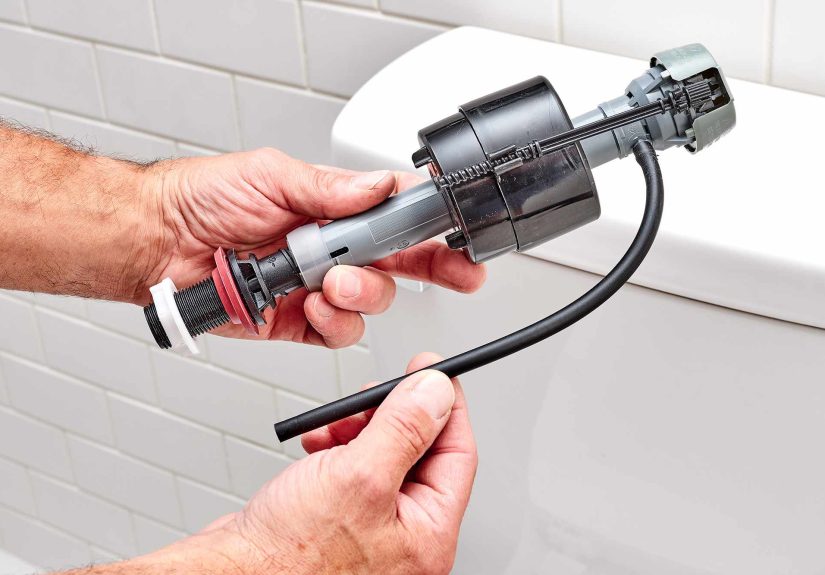
Connect the refill tube from the fill valve to the overflow tube using the clip.
Keep the end of the refill tube positioned so it sends water into the overflow tube without being shoved down below the tank’s waterline.
You want a clean refill flow, not an accidental siphon situation.
If the refill tube is too long and kinks, trim it so it reaches comfortably.
Step 8: Reconnect the water supply line
Thread the supply line nut onto the fill valve tailpiece under the tank.
Tighten by hand first, then snug with a wrench.
Many manufacturers advise avoiding sealants or “pipe dope” on these connectionscompression fittings are designed to seal without it.
Step 9: Turn the water on, check for leaks, and set the water level
- Slowly turn the shutoff valve counterclockwise to restore water flow.
- Watch the tank fill and look for leaks at the supply connection and locknut area.
- Adjust the fill valve so the water level lands at the manufacturer’s markcommonly around 1/2 inch below the top of the overflow tube
or to a marked waterline in the tank.
Then flush 2–3 times to confirm the valve shuts off cleanly and the bowl refills properly.
After-Install Troubleshooting (Because Toilets Love Plot Twists)
If the toilet keeps running
- Water level too high: Lower the float setting so water stops below the overflow tube top.
- Refill tube issue: Make sure it’s clipped properly and not shoved down into the overflow tube.
- Not actually the fill valve: Check the flapper seal and chain length; a leaky flapper can mimic fill valve trouble.
If the flush feels weak
- Tank water level too low: Raise the float setting gradually until you hit the recommended waterline.
- Fill valve height set too low: Some valves need to be extended so they can deliver the correct volume.
If you hear hissing, sputtering, or filling is slow
- Sediment can clog internal parts. Some manufacturers recommend flushing the valve by removing the cap and briefly turning water on
(a cup over the valve can help deflect spray). If cleaning doesn’t help, replacement is often the simplest route. - Also check your shutoff valve: a partially closed shutoff can make the toilet refill like it’s sipping water through a coffee stirrer.
If you spot a leak under the tank
- Supply connection: Slightly tighten the supply nut. If it still leaks, inspect the line washer or replace the supply line.
- Locknut/gasket seal: Ensure the internal washer is seated correctly and the nut is snug (not torqued like a car lug nut).
How to Choose the Right Replacement Fill Valve
Most homeowners do fine with a universal toilet fill valve. When shopping, look for:
- Universal fit (works with most 2-piece toilets)
- Height adjustment range compatible with your tank
- Quiet-fill design if noise drives you up the wall
- Included refill tube and clip (most kits do)
If you have a specialty toilet or brand-specific setup (some models have unique valves or preset water levels),
check your toilet’s documentation or use a manufacturer-matched replacement.
When You Should Call a Plumber Instead
Replacing a fill valve is usually straightforward, but consider professional help if:
- The shutoff valve is seized, leaking, or won’t fully close.
- You notice cracks in the tank or bowl (replacement is safer than repair).
- Leaks persist after replacing parts and tightening connections correctly.
- You have corrosion on old metal fittings that won’t loosen without risking damage.
Conclusion
Replacing a toilet fill valve is one of those rare home projects that’s genuinely low-cost, high-impact, and doesn’t require a second trip to the store
(unless you forget the bucket, in which case… you’ll remember next time).
Shut off the water, drain the tank, swap the valve, connect the refill tube correctly, and set the water level.
A few careful adjustments can stop running water, quiet the refill, and make your toilet behave like a well-trained household appliance again.
Real-World Experiences: What People Actually Run Into (and How to Handle It)
Instructions make replacing a toilet fill valve sound like a 10-minute victory lapand sometimes it is.
But in real homes with real mineral buildup, tight spaces, and supply lines that have been “temporarily” installed since 2009,
the experience can be a little more… character-building. Here are some common situations homeowners run into, plus what usually works.
1) The shutoff valve “turns” but doesn’t actually shut off
This is more common than people expect. You twist the valve clockwise, the handle spins, and you feel proudthen the tank keeps filling anyway.
Often the internal washer in the shutoff valve is worn, or mineral deposits prevent a full seal. The practical move is to shut off the main water
supply to the house (or to that bathroom line, if you have a manifold), then replace the toilet shutoff valve later.
For the fill valve job itself, you can still proceed, but only if you can fully stop water to the toilet.
Otherwise you’re doing plumbing on “hard mode,” and nobody needs that kind of cardio.
2) The locknut is stuck like it’s been glued on by a villain
Plastic locknuts usually come off with steady pressure, but older setups can get stubborn.
Two tricks that help: (1) hold the fill valve body inside the tank so it doesn’t spin while you turn the nut underneath,
and (2) use larger channel-lock pliers for more grip. If the nut won’t budge, don’t yank so hard you stress the porcelain.
Slow pressure beats sudden heroics. If the tank is very old or the fittings are corroded, it can be safer to stop and get help.
3) The refill tube keeps popping off (or someone shoved it too far down the overflow)
This is one of those tiny mistakes that creates big weird behaviorrandom running, odd refill sounds, or inconsistent bowl refill.
The refill tube should be clipped to the overflow tube so it sprays water down the overflow during the fill cycle, but it shouldn’t be jammed down
below the waterline. If it’s too long and kinks, trim it. If it’s too loose, use the proper clip from the kit.
Once clipped correctly, many “mystery toilet” issues magically disappear, which feels suspicious but wonderful.
4) “I replaced the fill valve and my flush got worse”
This usually comes down to water level. Many people play it safe and set the float low to prevent overflow,
but then the tank doesn’t have enough water volume to deliver a strong flush. The fix is typically simple:
adjust the float so the tank fills to the recommended mark (often around 1/2 inch below the overflow tube top).
Then flush a few times. A toilet is a gravity-powered systemno tank volume, no glory.
5) The supply line leaks afterward, even though “it’s tight”
The supply line connection under the tank is one of the most common leak points after any toilet repair.
Often the rubber washer inside the supply line nut is old, flattened, or cracked. Tightening can help, but overtightening can also distort the washer.
In practice, replacing the supply line with a new braided stainless line is cheap insurance and often faster than wrestling with a leaky old one.
(Also: this is why you put a towel down firstfuture-you deserves nice things.)
6) The “new part” is quieter… until it’s not
If your toilet starts refilling slowly or making noise again weeks later, sediment may be the causeespecially in areas with mineral-heavy water.
Some fill valves can be flushed/cleaned by removing the cap and briefly running water to clear debris.
If the problem keeps recurring, consider adding a small filter at the supply or addressing sediment at the plumbing source.
Toilets are simple machines, but they do not enjoy crunchy water.
Bottom line: most bumps in the road come from shutoff valves, water level adjustment, refill tube placement, or old supply lines.
If you take your time and double-check those areas, replacing a toilet fill valve goes from “Why did I start this?” to “Wait… I’m a plumbing wizard.”