Table of Contents >> Show >> Hide
- Why Green Onions Spoil So Quickly
- Method 1: Store Green Onions in a Jar of Water
- Method 2: Wrap in Paper Towels and a Bag
- Method 3: Simple Plastic Bag Storage
- Can You Freeze Green Onions?
- Common Mistakes When Storing Green Onions
- How to Tell If Green Onions Have Gone Bad
- Quick Cheat Sheet: Best Ways to Store Green Onions
- Real-Life Experiences: What Actually Works in an Everyday Kitchen
- Conclusion: Your Green Onions, Your Storage Strategy
Few things are as heartbreaking (in the kitchen, anyway) as reaching for a bunch of green onions and finding
a sad, slimy tangle hiding in the crisper drawer. The good news? Green onions are actually very easy to store
if you treat them the way growers, food-safety experts, and test kitchens recommend: keep them cold, control
the moisture, and give them a little airflow.
In this guide, you’ll learn how to store green onions so they stay crisp and flavorful for as long as possible
whether you’re planning to use them tonight or two weeks from now. We’ll walk through proven methods (jar of water,
paper towel and bag, and more), what to avoid, and how to freeze scallions for long-term use.
Why Green Onions Spoil So Quickly
Green onions (also called scallions or spring onions) are mostly water with thin, delicate cell walls.
That makes them wonderfully crisp and fragrantbut also highly perishable. Commercial and extension-agency
guidance says green onions are best stored just above freezing, around 32–36°F (0–2°C),
at very high humidity (around 90–100%).
At home, you probably don’t have a humidity-controlled produce warehouse (if you do, impressive),
but you can copy the same principles:
- Keep them cold: fridge, not the counter.
- Keep them moist, not wet: avoid drowning or trapping condensation.
- Protect them from crushing and drafts: crisper drawers are your friend.
Done right, you can push the shelf life from just a few days to 10–14 days or more, depending
on the method.
Method 1: Store Green Onions in a Jar of Water
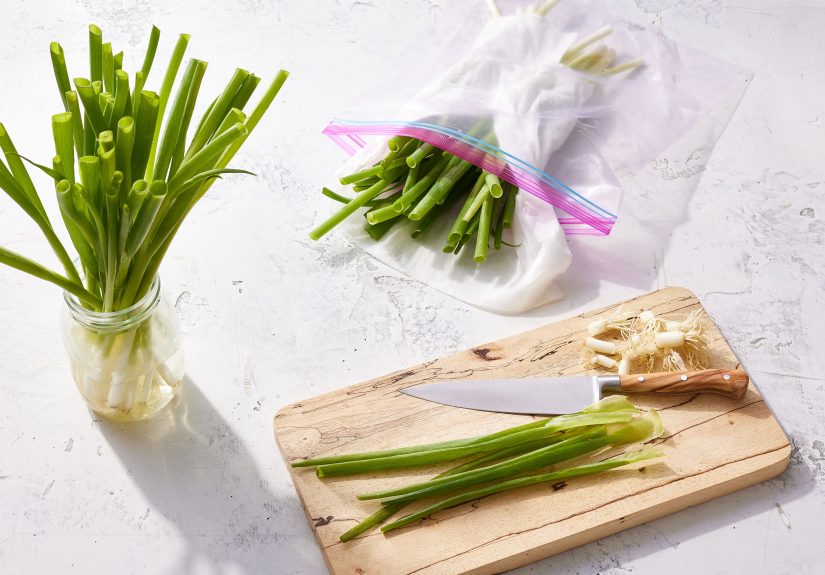
Treat green onions like a tiny bouquet of edible flowers and they’ll reward you. Many growers, recipe developers,
and extension programs recommend the jar-of-water method for maximum freshness.
Step-by-step: Jar-of-Water Method
-
Trim and tidy. Remove any rubber bands, wilted outer leaves, or mushy bits. Leave the roots intact;
they help keep the bundle together and slow moisture loss. -
Fill a jar. Use a glass or mason jar tall enough to support the stalks. Add about
1–2 inches of cold waterjust enough to cover the roots, not the whole white part. - Arrange root-down. Stand the bunch in the jar, roots in the water, green tops sticking up.
-
Cover loosely. Slip a clean plastic bag over the tops and loosely cinch it with a rubber band or
partially zip it. This traps humidity around the leaves without suffocating them. - Refrigerate upright. Place the jar in the fridge where it won’t be knocked over.
- Change the water. Swap the water every 2–3 days to keep it clear and odor-free.
With this method, green onions can stay fresh and crisp for 10–14 days, sometimes longer,
according to produce specialists and cooking sites that have tested it repeatedly.
You might see advice to leave the jar on the windowsill like a kitchen plant. That works for a short time,
but most U.S. food-safety guidance still prefers the fridge to reduce wilting and bacterial growthespecially
in warm or humid climates.
Method 2: Wrap in Paper Towels and a Bag
If you’re short on fridge space or worried about spilled jars, the paper towel method is easier to stack and
just as effective. It’s also the approach recommended by several food publications and extension programs.
Step-by-step: Paper Towel + Bag Method
-
Do not pre-wash. Storing green onions wet is a fast track to slime. Brush off dirt now;
wash just before using. -
Wrap in towels. Lay the stalks in a single layer on a dry paper towel. Roll them up like a burrito.
If your fridge is very dry, you can use a slightly damp towel, but not dripping. -
Bag them. Place the roll in a zip-top bag or reusable silicone bag. Don’t squeeze out all the air;
leave it a bit puffy so the onions aren’t compressed. -
Store in the crisper drawer. This part of your fridge is designed to keep humidity higherperfect
for green onions.
With this method, green onions usually last 7–10 days, and some home cooks report up to
three weeks when conditions are ideal and the towel is checked and changed if it becomes soggy.
Method 3: Simple Plastic Bag Storage
Sometimes you just want the “no extra dishes” approach. Many university and government resources say it’s fine to
store unwashed green onions in a perforated plastic bag in the vegetable drawer.
How to Store Green Onions in a Bag
- Leave the bunch intact, roots and all. Don’t wash yet.
- Place in a perforated produce bag or a regular plastic bag with a few small holes poked in it.
- Tuck into the crisper drawer, away from foods that easily absorb odors.
This method usually keeps green onions in good shape for about a week.
For longer storage or if your fridge runs very dry, switch to the jar or paper towel method instead.
Can You Freeze Green Onions?
Yes! Freezing green onions is a smart way to avoid food waste, especially if you only use a teaspoon here and there.
The texture will soften after freezing, so frozen green onions are best for cooked dishes such as soups,
stews, stir-fries, omelets, and casseroles, not for garnishing a salad or poke bowl.
How to Freeze Green Onions
- Wash and dry. Rinse well and pat completely dry. Extra moisture causes ice crystals.
-
Slice as desired. Most people chop them into thin rounds. You can separate whites and greens if
you like more control in recipes. - Tray-freeze first. Spread the pieces in a single layer on a parchment-lined tray and freeze until firm.
- Transfer to a container. Move the frozen pieces to a freezer-safe bag or container. Press out extra air.
This method gives you a loose, “sprinkle-able” bag of scallions you can grab by the handful. Most sources suggest
using them within 3–4 months for the best flavor and color, although they remain safe longer if kept
consistently frozen.
Common Mistakes When Storing Green Onions
1. Sealing Wet Onions in a Tight Plastic Bag
Moisture + no airflow = spoiled produce. Fully sealed plastic traps condensation and encourages slimy decay,
especially if the green onions went into the bag damp. Many food-storage experts specifically warn against this.
2. Leaving Them at Room Temperature for Too Long
While it’s okay to leave green onions out briefly while you cook or prep, room-temperature storage is not ideal.
Above about 40°F (4°C), quality declines quickly and microbial growth accelerates. Commercial guidance
for food handlers is clear: keep green onions refrigerated as close to 32°F as possible.
3. Forgetting to Change the Water
For jar storage, old water turns cloudy, smelly, and sometimes slimy. That slime can work its way up into the stems.
Changing the water every few days keeps everything fresh and crisp.
4. Crushing the Stalks Under Heavier Produce
Green onions bruise easily. When jammed under a pile of apples and a gallon of milk, they collapse, leak moisture,
and spoil faster. Store them where they have a bit of breathing room.
How to Tell If Green Onions Have Gone Bad
Even with perfect storage, no bunch of green onions lasts forever. Toss them if you notice:
- Slime on the white or green portions
- Strong off-odors (sour, rotten, or sulfurous beyond normal onion fragrance)
- Yellow, brown, or black spots spreading along the leaves
- Very limp, mushy texture that doesn’t perk up with rinsing
- Mold growth anywhere on the stems or roots
A little cosmetic damage (like a dry tip or a single yellowed leaf) is usually finejust trim it off and use the rest,
as long as there’s no slime or mold.
Quick Cheat Sheet: Best Ways to Store Green Onions
- Use within a few days: Perforated bag in the crisper drawer; keep unwashed and loosely packed.
- Use within 1–2 weeks: Jar of water, roots-down, with a bag loosely covering the tops in the fridge.
-
Use within 1–3 weeks (depending on fridge): Wrapped in paper towels and placed in a slightly puffed
zip-top bag in the crisper. - Long-term backup: Washed, chopped, and frozen for cooked dishes.
Real-Life Experiences: What Actually Works in an Everyday Kitchen
Advice is great, but nothing beats real-life testing. Here are some practical, experience-based notes that line up
with what many home cooks and food writers have discovered while experimenting with different ways to store green
onions over time.
Experiment 1: The “Forgotten Jar” in the Fridge
Imagine this: You buy a beautiful bunch of scallions, stand them in a jar with a little water, cover them with a bag,
and slide them into the side of the fridge. Life gets busy. A week later, you rediscover them and brace for impact…
only to find they still look pretty good.
That’s the magic of the jar-of-water method done right. People who’ve tried this often report that:
- The white parts stay firm and juicy.
- The green tops may fray slightly but remain vibrant enough for garnish.
- When the water is changed every 2–3 days, there’s little to no odor and minimal slime at the root ends.
One common observation: if you let the water level creep too high (covering more of the white stalk),
the submerged sections soften faster. Keeping just the roots in water seems to give the best results,
which echoes expert guidance about limiting wetness to where it’s truly needed.
Experiment 2: Paper Towels vs. No Paper Towels
Another popular at-home test is comparing plain bag storage to the paper towel method. When you toss green onions
straight into a plastic bag with no towel, condensation often forms as the onions cool down in the fridge.
That condensation leads to soggy spots, which quickly turn slimy.
By contrast, wrapping the stalks in paper towels offers a few real-world advantages:
- The towel absorbs excess moisture rather than letting it sit on the stems.
- It provides a tiny bit of cushioning, reducing bruising when other produce shifts.
- It makes it easier to pull out just a few stems without disturbing the rest.
Many home cooks find that with towels, green onions are still usable at day 10 or even day 14, while the bag-only
bunch is already sad by day 5–7. The difference is even more obvious in fridges that run a bit warm or humid.
Experiment 3: Windowsill “Regrow” vs. Food-Safety Reality
The internet loves showing jars of scallions growing on a sunny windowsill, and yes, you can absolutely coax
new green growth from the white ends. If your kitchen is cool and you’re changing the water regularly, you might
get a week or so of usable greens this way.
However, food-safety experts still favor the fridge because room-temperature storage increases the risk of wilting
and contaminationespecially in warmer homes. Many cooks compromise by:
- Letting green onions regrow briefly on the counter during the day, then
- Moving the jar back to the fridge overnight to keep them chilled.
That hybrid approach lets you enjoy the “mini kitchen garden” vibe without completely ignoring modern storage
recommendations.
Experiment 4: Freezer Backup for Busy Weeks
One of the most useful real-life tricks is keeping a small freezer bag of chopped green onions as insurance.
Whenever you notice your fresh bunch approaching the “use it or lose it” stageslightly limp but still safe
you wash, dry, chop, and freeze what’s left.
Over time, people report a few patterns:
- Frozen scallions are perfect in hot dishes but a bit too soft for topping ramen or tacos.
- The flavor stays surprisingly strong for a couple of months, especially when stored in a small, mostly full bag.
- The convenience factor is huge: you can toss a handful into eggs, fried rice, or soups without any chopping.
This doesn’t replace fresh storage methods, but it dramatically reduces waste and makes it easy to add onion flavor
even when you’ve run out of fresh bunches.
Small Tweaks That Make a Big Difference
Over many “oops, forgot those scallions again” moments, a few habits consistently stand out:
-
Don’t overbuy. If a recipe needs two stalks, you don’t always need three bunchesunless you plan
to freeze or meal prep. -
Pick the right method for your schedule. Jar of water if you’re a frequent cook, towel-and-bag if you cook
once or twice a week, freezer backup if you’re unpredictable. - Label bags in the freezer. “Scallions – June” beats “mystery green bits” every time.
Combine expert guidance with these real-life tweaks, and you’ll rarely toss green onions again. Instead, you get
bright, oniony flavor whenever you need itwithout the fridge full of regret.
Conclusion: Your Green Onions, Your Storage Strategy
Learning how to store green onions well is really about understanding what they need: cold temperatures,
steady but controlled moisture, and gentle handling. A jar of water in the fridge keeps them crisp and perky
for up to two weeks. Wrapping them in paper towels and a bag gives you tidy, stackable bundles that resist slime.
Perforated bags work for quick use, and the freezer has your back for long-term insurance.
Pick the method that fits your cooking styleand don’t be afraid to mix them. Use the freshest scallions for raw
garnishes, keep a jar for the week’s recipes, and freeze the leftovers before they go past their prime. With just
a little attention, your green onions can go from “forgotten mush” to one of the most reliable flavor-boosters
in your fridge.