Table of Contents >> Show >> Hide
- Why Cinnamon Works (And When It Doesn’t)
- The Golden Rule: Use a Light Hand
- Use #1: Cinnamon for Seedlings (Preventing “Floppy Stem Syndrome”)
- Use #2: Cinnamon as a “Plant Bandage” for Cuts and Wounds
- Use #3: Cinnamon for Cuttings (Propagation Without the Rot Drama)
- Use #4: Cinnamon for Ants (Natural Pest Control That’s More “Detour” Than “Defeat”)
- Use #5: Cinnamon for Fungus Gnats (Helpful… But Don’t Skip the Main Strategy)
- Use #6: Cinnamon Spray or “Cinnamon Tea” (When You Need Coverage)
- Use #7: Cinnamon Oil Products for Weeds (A Quick Note)
- Common Mistakes (So You Don’t Accidentally Create a Cinnamon Problem)
- FAQ: Quick Answers
- Conclusion: Cinnamon Is a Smart “Support Tool,” Not a Magic Spell
- Experience Notes: of Real-World Cinnamon Experiments
Cinnamon: the cozy spice that makes oatmeal taste like a hug… and (surprise) can also be a handy helper in your plant-care toolkit.
Used the right way, cinnamon can support healthier seedlings, reduce the odds of rot on fresh cuttings, and discourage certain pests from setting up
a tiny all-you-can-eat buffet on your begonias.
But let’s set expectations like reasonable adults: cinnamon isn’t a magical “one sprinkle fixes everything” powder. Think of it as a supportive sidekicklike
the friend who brings snacks and good vibes to your moving day. Helpful? Yes. Doing all the heavy lifting alone? No.
Why Cinnamon Works (And When It Doesn’t)
Cinnamon (especially the common “cassia” cinnamon sold in grocery stores) contains aromatic compounds such as cinnamaldehyde and eugenol. In lab settings,
cinnamon oils and extracts can inhibit certain fungi and microbes. That’s the scientific backbone behind why gardeners use cinnamon as a light-duty,
natural antifungal and “wound dressing” for plants.
The catch: the cinnamon in your spice rack is diluted compared to essential oils or formulated products. So ground cinnamon can be useful for
localized, surface-level preventionlike dusting a cut stem or lightly top-dressing seed-starting mixbut it won’t reliably solve serious,
systemic disease or a full-blown pest invasion on its own.
What cinnamon is good at
- Discouraging surface mold on soil and seed trays when used lightly.
- Protecting fresh cuts (pruning wounds, broken stems, succulent cuts) from opportunistic rot.
- Supporting propagation by reducing microbial problems that can kill cuttings before they root.
- Repelling some pests (especially ants) by disrupting scent trailsmore “go away” than “game over.”
What cinnamon is NOT
- A fertilizer: it doesn’t feed your plant in any meaningful way.
- A true rooting hormone: it doesn’t contain the auxins used in commercial rooting powders.
- A guaranteed insect killer: in most home-garden uses, it acts more like a repellent than an insecticide.
The Golden Rule: Use a Light Hand
If cinnamon had a villain arc, it would be “too much of a good thing.” Thick layers can cake up, interfere with water soaking in, and potentially irritate
sensitive leaves. The goal is a thin dusting or targeted application, not a cinnamon-dune remake of your potting soil.
Quick safety checklist
- Use plain cinnamon (no sugar blends, no flavored latte mixesyour plants don’t need a dessert menu).
- Start small and spot-test, especially on delicate plants.
- Avoid breathing cinnamon dustyour lungs are not part of the experiment.
- Be extra cautious with essential oils: they can burn plants if too strong.
Use #1: Cinnamon for Seedlings (Preventing “Floppy Stem Syndrome”)
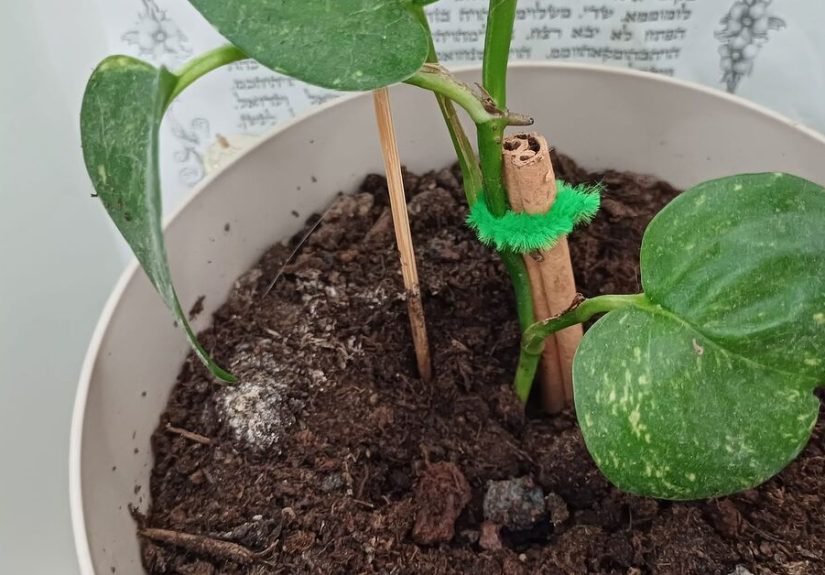
When gardeners talk about cinnamon helping “sturdier stems,” they’re often describing something indirect: preventing the seedling disease called
damping-off. Damping-off is caused by several fungi/oomycetes that thrive in cool, wet, stagnant conditions. Seedlings look fine one day,
then suddenly pinch at the soil line and collapse like a fainting goat.
Cinnamon can help by providing mild antifungal action on the soil surfacebut the real “sturdier stems” recipe is sanitation + airflow + smart watering.
Cinnamon is the optional seatbelt, not the entire car.
How to use cinnamon on seed-starting mix
- Start with clean basics: sterile seed trays (washed with hot soapy water), fresh seed-starting mix, and good drainage.
- After sowing and watering in, let the surface begin to dry slightly (not bone dryjust not swampy).
-
Dust lightly: using a pinch between your fingers, sprinkle a barely-there layer of ground cinnamon over the soil surface.
Think “mist of cinnamon,” not “cinnamon crust.” - Maintain airflow (a small fan on low, indirectly) and light so seedlings grow sturdy rather than stretchy.
- Water from below when possible and avoid keeping the mix constantly wet.
Example: The leggy tomato seedling rescue
You start tomato seedlings in a covered tray. They sprout… and then you keep the lid on too long because you’re busy (and because tiny plants are adorable).
Condensation builds. The surface stays wet. Suddenly stems look thin at the base. In that moment, cinnamon dusting can be a helpful supportbut the big fix is:
remove the humidity dome, increase airflow, bottom-water, and give stronger light.
Use #2: Cinnamon as a “Plant Bandage” for Cuts and Wounds
Fresh plant woundswhether from pruning, accidental snaps, or succulent beheading (no judgment)are open doors for microbes. A small amount of cinnamon
can act like a protective dusting that helps the cut dry cleanly.
Best cases for cinnamon “bandages”
- Succulents: after cutting, let the wound callus, and dust lightly to discourage rot.
- Houseplants: snapped stems, minor pruning cuts on tougher plants.
- Outdoor plants: small injuries (not major trunk wounds).
How to apply
- Make a clean cut with sanitized scissors or pruners.
- Pat the cut gently if it’s wet.
- Dip your fingertip in cinnamon and tap a tiny amount onto the wound.
- Let it dry before watering heavily.
If you’re dealing with a large woody wound (tree limbs, big shrubs), follow proper pruning practices instead of relying on pantry remedies.
Cinnamon is a gentle helper, not an arborist.
Use #3: Cinnamon for Cuttings (Propagation Without the Rot Drama)
Cinnamon is popular in propagation circles because it can reduce fungal and bacterial issues on the cut end of a stem. That matters because cuttings often fail
due to rotespecially in warm, wet media.
Important nuance: cinnamon is not a rooting hormone. It won’t “command” roots to appear. What it can do is help the cutting survive long enough
to root by lowering the microbial chaos at the wound site.
How to use cinnamon on cuttings (simple method)
- Take a cutting with at least one node (where roots commonly form).
- Remove lower leaves so they won’t rot in the medium.
- Lightly moisten the cut end.
- Dip the cut end into ground cinnamon and tap off the excess.
- Plant into a clean propagation medium (moist, not soggy) or water-prop if that’s your method.
Pro move: Combine cinnamon with real rooting hormone
If you use commercial rooting hormone, you can still dust cinnamon lightly nearby or use it as a separate “protective step” on the cut surface.
The rooting hormone provides auxins; cinnamon helps keep the cut cleaner.
Example: Pothos vs. rosemary
A pothos cutting will root if you look at it nicely. Cinnamon mainly helps prevent slime and rot if you’re prone to overwatering.
Rosemary, on the other hand, can be fussierso you’ll get better results using proper hormone + sterile medium + humidity control, with cinnamon as optional support.
Use #4: Cinnamon for Ants (Natural Pest Control That’s More “Detour” Than “Defeat”)
Ants aren’t always the bad guys. Some improve soil aeration; others are basically tiny livestock farmers who “manage” aphids for their honeydew.
When ants protect aphids, your plant loses. That’s when you want ants off the job site.
Cinnamon’s strong scent can disrupt ant scent trails, which may reduce traffic around pots and beds. It generally works as a repellent,
and it may need frequent reapplicationespecially after watering or rain.
How to use cinnamon against ants
- Barrier line: sprinkle a thin ring around the pot base or along ant trails.
- Entry points: dust near cracks, patio edges, or where ants march like they pay rent.
- Refresh often: if it gets wet, it loses effectiveness.
If ants are farming aphids, pair cinnamon barriers with the real fix: manage the aphids (water spray, insecticidal soap, beneficial insects, or targeted treatments).
Take away the “ant paycheck,” and they often leave.
Use #5: Cinnamon for Fungus Gnats (Helpful… But Don’t Skip the Main Strategy)
Fungus gnats love moist potting mix. Adults lay eggs in damp soil; larvae feed on fungi, algae, and organic matter near the surface.
That’s why you’ll hear cinnamon recommended: it can reduce surface fungal growth, making the environment less gnat-friendly.
Still, the #1 move for fungus gnats is almost always watering correction. Cinnamon is the side dish; drying the top layer is the entrée.
How to use cinnamon for fungus gnats
- Let the top 1–2 inches of soil dry between waterings (as your plant allows).
- Bottom-water when possible.
- Place yellow sticky traps to catch adults and monitor progress.
- Apply a thin dusting of cinnamon on the soil surface, then leave it alone (don’t keep re-wetting the surface).
If gnats are intense
For heavy infestations, consider a more complete plan: sticky traps + drying soil + a top dressing (sand or fine gravel) and/or biological controls
like beneficial nematodes or BTI products (often sold for mosquito/fungus gnat larvae). Cinnamon can still be part of the routine, but it shouldn’t be the only tool.
Use #6: Cinnamon Spray or “Cinnamon Tea” (When You Need Coverage)
If dusting isn’t practicalor you want to treat a broader areagardeners sometimes use a weak cinnamon “tea” as a spray. This approach is gentler than essential oils,
but also less potent.
Simple cinnamon tea (mild option)
- Steep 1–2 teaspoons of ground cinnamon in 1 quart of hot water.
- Cool completely, then strain through a coffee filter or fine cloth (to avoid clogging a sprayer).
- Spray on soil surface or lightly mist plant areas where mild surface mold appears.
- Test first on a small area and wait 24 hours.
Essential oil caution (strong option)
Cinnamon essential oil is extremely concentrated and can burn foliage if overdone. If you use it, keep the dilution very low,
use a proper emulsifier, and always spot-test. Many gardeners choose to skip essential oils entirely and stick with ground cinnamon
plus good cultural practices.
Use #7: Cinnamon Oil Products for Weeds (A Quick Note)
Some “natural herbicide” products use essential oils (including cinnamon oil) as contact herbicides. These can work on young, tender weeds
by damaging plant tissue on contact, but they’re not selectivemeaning they can also harm your desirable plants.
Translation: don’t casually spray cinnamon-oil weed killers near your seedlings unless you enjoy surprise “before and after” photos where the “after”
is sadness.
Common Mistakes (So You Don’t Accidentally Create a Cinnamon Problem)
1) Turning soil into cinnamon cement
A thick layer can crust and affect water absorption. If you can see a brown “top layer” clearly, it’s probably too much.
2) Using cinnamon to avoid fixing the real issue
If your seedlings keep damping-off, the fix is usually airflow, sanitation, and wateringnot just adding more cinnamon.
Same for fungus gnats: adjust moisture first.
3) Assuming cinnamon is harmless to every plant
Some plants may react poorly, especially if you get cinnamon on leaves repeatedly. Always spot-testespecially for delicate tropicals and orchids.
FAQ: Quick Answers
Will cinnamon make plant stems stronger?
Indirectly, it can help seedlings stay upright by reducing surface fungi linked to damping-off. But “strong stems” still come from good light,
proper spacing, airflow, and not overwatering.
Can I use cinnamon instead of rooting hormone?
Cinnamon can help prevent rot on cuttings, but it doesn’t replace true rooting hormone (auxins). Use it as a protective add-on,
not a complete substitute.
How often should I reapply cinnamon?
Reapply only when neededespecially if it’s washed away or you’re addressing a specific issue. For ant barriers, you may need to refresh after watering or rain.
For soil mold or seed trays, one light dusting is often enough alongside better airflow.
Conclusion: Cinnamon Is a Smart “Support Tool,” Not a Magic Spell
Used thoughtfully, cinnamon for plants can be a practical, low-cost way to support healthier propagation, discourage certain pests,
and reduce some surface fungal issueshelping seedlings avoid collapsing and keeping stems “sturdier” by staying disease-free at the base.
The best results come when cinnamon is paired with the fundamentals: clean tools, fresh potting mix, airflow, proper light, and sane watering habits.
Do that, and cinnamon becomes a helpful little upgradenot just something you sprinkle and hope for the best.
Experience Notes: of Real-World Cinnamon Experiments
Over the years, I’ve noticed cinnamon is most satisfying when you treat it like a “precision tool,” not confetti. The first time I tried it, I went full
cinnamon-overachiever and dusted an entire seed tray like I was breading chicken cutlets. It looked impressivelike a tiny tiramisu gardenbut the surface
crusted and water started beading instead of soaking in. The seedlings didn’t revolt, but they also didn’t thrive. Lesson learned: cinnamon works best in a
whisper, not a shout.
My favorite cinnamon win has been with cuttingsespecially plants that hate sitting in wet media. I once propagated a few pothos and philodendron cuttings
in a perlite-heavy mix. The batch without cinnamon did fine, but one cutting got that telltale “mushy base” that screams rot. The next round, I dipped the
cut ends in cinnamon (and tapped off the excess like a polite guest wiping their shoes). I still used clean scissors and a fresh mix, but I had noticeably
fewer rot issues. Did cinnamon “make roots happen”? No. Did it help prevent the gross stuff that stops roots from happening? It sure seemed to.
Indoors, cinnamon became my “fungus gnat morale booster.” When gnats show up, the real fix is drying the soil and catching adults with sticky traps.
But cinnamon made the surface feel less hospitableespecially in pots that tended to grow a thin film of algae or mold when I overwatered.
I’d let the top layer dry, add sticky traps, then do a light cinnamon dusting. The gnats didn’t vanish overnight (they never do), but the combination
helped me feel like I was actively taking away their favorite hangout spot.
Outdoors, I’ve had the best luck using cinnamon as an ant “detour sign.” Around container plantsespecially when ants were clearly guarding aphidsI drew a
thin cinnamon ring on the soil or saucer edge. It wasn’t permanent, and watering often ruined the barrier, but it reduced ant traffic long enough for me to
tackle the aphids directly. Once the aphids were controlled, the ants lost interest, like someone canceling their favorite TV show.
The biggest takeaway from all these experiments is that cinnamon shines when it supports good plant care instead of replacing it. If you’re using clean tools,
keeping soil from staying soggy, giving seedlings enough light, and watching for early signs of pests, cinnamon can be that extra nudge toward success. If you’re
hoping cinnamon will fix chronic overwatering or rescue a plant already in serious decline, it’s like putting a bandage on a leaky pipe. Helpful for small issues,
not a substitute for the real repair.