Table of Contents >> Show >> Hide
- Who Is Tom Gauld, and Why Do Readers Keep Coming Back?
- What Makes Tom Gauld’s Humor So Effective?
- The Big Themes Inside These 40 Humorous Comics
- Why Tom Gauld’s Comics Work So Well Online
- More Than Gags: Tom Gauld as a Cartoonist of Ideas
- The Experience of Reading These 40 Humorous Comics
- Conclusion
Some cartoonists go for chaos. Some go for punchlines so loud they practically kick down your front door. Tom Gauld does something trickier. He sneaks up on you with a tiny drawing, a dry caption, and a joke so smartly built that you laugh first and then, a few seconds later, laugh again because you realize it was even sharper than you thought. That is the secret sauce behind the appeal of Tom Gauld comics: they look calm, almost polite, but they carry the comic timing of someone who knows exactly when to whisper instead of shout.
The title of this article says it all. Tom Gauld has spent years making people laugh, and he does it with an unusual toolkit: minimalist figures, literary references, scientific absurdity, lonely dreamers, and the kind of deadpan delivery that could make a grocery list feel existential. Across these 40 humorous comics, readers are not just getting quick jokes. They are getting small, beautifully engineered machines of wit.
For longtime fans, that is the thrill. For new readers, it is the surprise. Gauld’s work can look almost modest at first glance, but the humor is anything but small. Whether he is poking fun at book culture, space-age loneliness, or the noble weirdness of scientists, he keeps proving that the smartest cartoon in the room can also be the funniest.
Who Is Tom Gauld, and Why Do Readers Keep Coming Back?
Tom Gauld is a Scottish cartoonist and illustrator whose work has become instantly recognizable to readers of major publications and comic collections alike. He has created cartoons for outlets such as The New Yorker, The New York Times, The Guardian, and New Scientist, while also building a book catalog that includes Mooncop, Goliath, You’re All Just Jealous of My Jetpack, Baking with Kafka, Department of Mind-Blowing Theories, Revenge of the Librarians, and more recently Physics for Cats. That range matters because it explains why his audience is so delightfully mixed: comics readers, literature nerds, science lovers, editors, academics, and anyone who has ever muttered, “Wow, that joke was alarmingly specific to my interests.”
His career also shows how flexible his style is. One minute he is creating cover art for a major magazine. The next, he is turning the anxieties of readers and writers into compact one-page cartoons. Then he pivots into science jokes, and somehow those land just as well. He even crossed into children’s books with The Little Wooden Robot and the Log Princess, proving that his storytelling instincts work beyond the gag-cartoon format.
That versatility is one reason these humorous comics travel so well online. A Tom Gauld strip can be shared by an English professor, a librarian, a lab researcher, and somebody who just appreciates a good joke about overly serious people taking nonsense very seriously. In other words, the internet was practically built for him.
What Makes Tom Gauld’s Humor So Effective?
1. He makes minimalism look easy
Gauld’s drawings are famously spare. His characters often have simple faces, small gestures, and uncluttered environments. But that simplicity is not the absence of craft. It is precision. He knows how little he needs to show for the reader’s brain to do the rest. A slight tilt of a head, a pause between panels, a blank expression in the middle of something ridiculous, and suddenly the joke lands harder because the comic never overexplains itself.
This is one reason Tom Gauld’s deadpan humor works so well. The art refuses to oversell the joke. He trusts the audience. That trust is flattering, and readers respond to it. Nobody wants to feel like a comic is elbowing them in the ribs and shouting, “Get it?” Gauld simply opens the door and lets you walk in.
2. He treats highbrow subjects like playground equipment
Literary humor is nothing new. But literary humor that feels welcoming instead of smug is harder to pull off. Gauld excels at it because he does not just mock literature, publishing, and academia from a distance. He clearly loves those worlds. His jokes about critics, classics, first drafts, book festivals, and bookstore culture work because they come from recognition, not contempt.
That warmth matters. In a weaker cartoonist’s hands, jokes about books can feel like inside baseball for people who alphabetize their poetry shelves. In Gauld’s hands, they feel like affectionate roasts of a tribe he knows intimately. Even when he is teasing literary seriousness, he is also celebrating the pleasure of caring so much about books that you could build an entire joke around a shelving category or a tortured authorial voice.
3. He knows that sadness and silliness are excellent roommates
One of the best examples of this balance is Mooncop, his quietly beloved graphic novel about a police officer on a nearly abandoned moon colony. On paper, that premise sounds melancholy. In practice, it is melancholy and funny, which is far more interesting. The character’s isolation creates a soft ache, but Gauld keeps puncturing the gloom with deadpan absurdity, such as bureaucratic nonsense, underwhelming technology, and the unforgettable presence of a therapy robot that is much less helpful than advertised.
That combination is central to the magic of Tom Gauld cartoons. He understands that humor does not always destroy emotion. Sometimes it reveals it. A joke can make loneliness feel sharper. A still panel can make a punchline feel sadder. A comic can leave you smiling and slightly weirdly moved, which is honestly a terrific deal for a few panels and some ink.
The Big Themes Inside These 40 Humorous Comics
Books, libraries, and the lovable chaos of reading culture
If you have ever spent too much time thinking about books, Tom Gauld probably already has a comic for you. His literary cartoons are filled with readers, writers, booksellers, critics, and all the rituals that grow around reading. In Baking with Kafka and Revenge of the Librarians, he turns literary culture into comic territory without flattening it into one-note jokes.
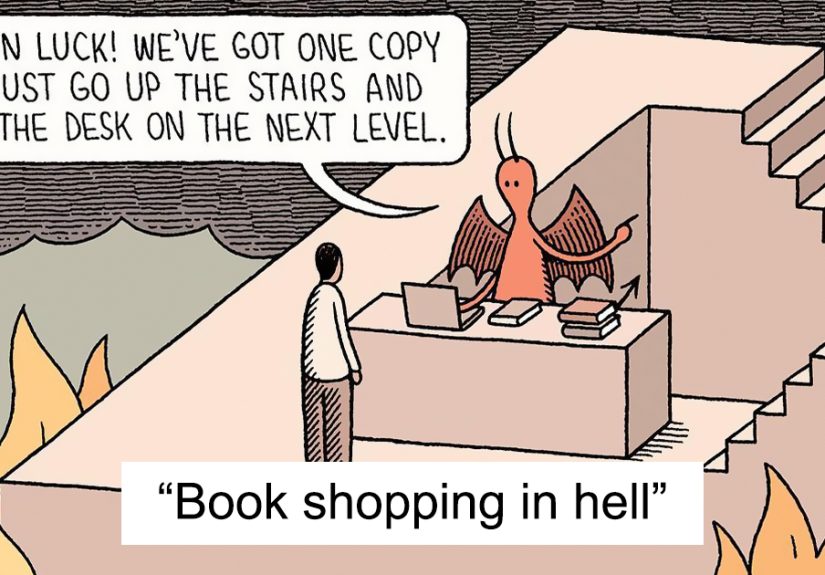
He is especially good at exposing the absurd side of intellectual life. A great Tom Gauld comic often begins with an utterly normal cultural assumption, then nudges it half an inch to the left until it becomes hilariously strange. Maybe a classic novel gets reduced to a brutally efficient summary. Maybe a reading habit is treated like a scientific condition. Maybe a bookstore category becomes a full personality assessment. The joke works because the exaggeration is tiny but devastating.
Readers love these comics because they feel seen. Not always gently, but definitely accurately.
Science, technology, and nerdy wonder
Gauld’s science cartoons deserve extra praise because they do something rare: they make STEM jokes feel playful rather than punishing. In collections like Department of Mind-Blowing Theories and Physics for Cats, he taps into the grandeur, confusion, ego, and beauty of science without reducing it to stereotypes. His jokes are often about how humans behave around knowledge, not just the knowledge itself.
That distinction matters. Good science humor is not merely, “Look, a lab coat!” Gauld knows that the funniest part is the human tendency to build complicated systems, then wander around inside them like confused squirrels. His comics can make particle physics, academic jargon, or speculative thinking feel both brainy and accessible. That is no small feat. Many people claim to love science. Fewer can make it funny without turning it into mush.
Loners, dreamers, and beautifully awkward people
Even when Gauld’s characters are tiny and stylized, they have a strangely rich emotional life. His worlds are full of introverts, overthinkers, creators, and oddballs. These are not usually swaggering protagonists. They are hesitant, observant, slightly offbeat figures trying to make sense of institutions, technology, art, or their own peculiar circumstances.
That is another reason the 40 humorous comics in circulation feel so memorable. They are funny, yes, but they are also inhabited by a consistent emotional atmosphere. A Tom Gauld comic often feels like a place where smart people are quietly trying their best while reality keeps behaving in deeply inconvenient ways. It is hard not to relate.
Why Tom Gauld’s Comics Work So Well Online
Some art goes viral because it is loud. Tom Gauld’s comics spread because they are shareable in a more durable way. They invite rereading. They reward niche communities. They let readers feel clever without locking everyone else out. A literature joke can be appreciated by hardcore readers, but the structure is usually simple enough that even somebody who has never read Proust can still enjoy the absurdity.
That balance between intelligence and accessibility is incredibly valuable online. Social media tends to flatten humor into instant reactions. Gauld’s comics resist that flattening just enough to remain interesting. They do not ask for a huge time commitment, but they also do not evaporate after one glance. You can return to them and find a second joke, a better rhythm, or a sharper implication waiting underneath.
There is also the visual factor. His style is clean and uncluttered, which makes each strip easy to process on a screen. But unlike mass-produced internet content, his comics still feel unmistakably handmade. The line work, pacing, and panel design remind you that a real person thought carefully about where each beat should land. In a very crowded digital world, that intentionality stands out.
More Than Gags: Tom Gauld as a Cartoonist of Ideas
Calling Gauld a humor cartoonist is accurate, but incomplete. He is also a cartoonist of systems, habits, and ideas. He looks at how people organize culture, how institutions speak, how experts posture, how readers dream, how technology disappoints, and how loneliness can become funny when framed just right. He is less interested in slapstick than in structure. He sees the absurd architecture inside ordinary life.
That is why his best comics feel so satisfying. They are not random jokes wearing glasses. They are observations with strong bones. Even the silliest premise often contains a small thesis about reading, science, art, or modern life. And because the ideas are delivered lightly, they never feel like homework.
That, really, is Tom Gauld’s superpower. He makes intellectual comedy feel airy. He can compress a complicated cultural observation into a handful of panels without squeezing out the fun. Readers come for the laugh, stay for the elegance, and then forward the comic to a friend with the deeply sincere message: “This is so you.”
The Experience of Reading These 40 Humorous Comics
Reading a run of Tom Gauld comics is a very specific pleasure. It does not feel like binging a loud sitcom or watching a comedian work a giant arena. It feels more like opening a drawer full of tiny, polished tools and discovering that every single one has been designed to fix a different absurdity in modern life. One comic will mock writerly self-importance. The next will lovingly roast scientists. Then suddenly you are staring at a panel about literature, outer space, or a bookstore shelf, grinning like somebody who just got away with an inside joke in public.
That experience is part of why these 40 humorous comics are so satisfying as a set. Together, they create a full comic ecosystem. You start to notice the recurring moods: the dry silence, the neat pacing, the emotional restraint, the almost ceremonial seriousness with which ridiculous ideas are presented. A weaker artist would burn through that formula quickly. Gauld somehow keeps finding fresh angles inside it. He can revisit books, libraries, robots, scholars, and lonely visionaries again and again without making the work feel repetitive. Instead, it feels like returning to a favorite bookstore where the staff somehow keeps putting the perfect weird title in your hands.
There is also something oddly comforting about how unhurried his humor is. In an age where comedy is often optimized for speed, reaction, and sheer volume, Gauld’s work feels calmly confident. He does not need twelve labels, ten emojis, and a giant red arrow pointing at the joke. He lets the panel breathe. He lets the white space do part of the work. He leaves room for you to meet the comic halfway. That makes the laugh feel earned, and maybe even a little personal.
For readers who love books, the appeal is immediate. Gauld understands that reading culture is full of sincere passion and low-level ridiculousness. People build identities out of genres, argue about classics, romanticize drafts, fetishize bookstores, and develop very intense feelings about fonts and blurbs. His comics do not mock that from the outside; they step right into the pile and gently stir it with a stick. The result is affectionate, not mean. You laugh because the joke is true, and because part of you knows you are absolutely one of the people being teased.
For readers who come to Gauld through science, the experience is a little different but just as rewarding. His science cartoons capture the special comedy of human beings trying to explain the universe while remaining comically, stubbornly human. Grand theories collide with petty habits. Cosmic scale bumps into office culture. Discovery arrives wearing awkward shoes. These jokes work because they respect curiosity. They are not anti-intellectual. If anything, they are pro-intellectual and anti-pompous, which is a much funnier combination.
And then there is the emotional afterglow. This is the part people sometimes miss when they describe Tom Gauld as merely witty. The best of these comics linger. A joke about a librarian, a moon colony, or a literary classic can leave behind a little ache, a little warmth, or a strange flash of recognition. You laugh, but you also feel the tenderness underneath. Gauld has a gift for drawing people who are small in scale but huge in implication. They are often solitary, mildly baffled, trying to hold onto meaning in systems that do not always reward it. That sounds heavy, but in his hands it becomes deeply charming.
So the experience of reading these 40 humorous comics is not just that they are funny. It is that they make intelligence feel playful, solitude feel relatable, and culture feel gloriously ridiculous. They remind readers that humor does not have to be noisy to be memorable. Sometimes the sharpest laugh comes from a quiet panel, a straight face, and one perfectly judged line. Tom Gauld has built a career on that principle, and thankfully for the rest of us, he keeps proving it works.
Conclusion
Tom Gauld’s comics succeed because they do two things at once: they make readers laugh, and they make readers feel smart for laughing. That is a rare balance. Across literature, science, art, and everyday awkwardness, he has developed a body of work that is unmistakably his own: minimalist, deadpan, warm, and sneakily profound. These 40 humorous comics are more than a collection of witty panels. They are a reminder that the best cartoonists do not simply tell jokes. They build worlds, invite readers in, and then leave them chuckling long after the panel ends.
If you are drawn to intelligent humor, literary cartoons, science jokes, or graphic storytelling with real personality, Tom Gauld is not just worth reading. He is worth rereading. And that may be the highest compliment a cartoonist can earn.