Table of Contents >> Show >> Hide
- Quick Tour
- Where Margot Is (and Why Lewes Makes Sense)
- The Story Behind Margot
- Step Inside: The Shop as a “Real Home”
- What You’ll Find on the Shelves
- Tableware: terracotta, tradition, and a little Mediterranean sunshine
- Table linens: mix-and-match, embroidery, and “yes, wrinkles are allowed”
- Kitchenware: everyday tools that don’t ruin the scene
- Lighting: warm brass, glass, and “mood” as a design choice
- The Pantry: recipe kits that connect “homewares” to real cooking
- A Homewares Shop with a Purpose
- How to Shop a Small Homewares Store (Without Regrets)
- Bring the Margot Mood Home
- Extra: of East Sussex “Margot Energy”
Some shops sell “stuff.” Others sell a feeling. Margot, a family-run homewares shop in East Sussex, is firmly in the second categoryan
old-world, softly lit, “should we just move in?” kind of space where terracotta carafes, breezy linens, and warm brass details conspire to make you forget
why you came in (and why your credit card is suddenly sweating).
Tucked on the High Street in Lewes, Margot is part homewares boutique, part living mood board, and part mission-driven project: profits
support the founders’ sister nonprofit, Cook School, which teaches kids how to cook delicious food that’s kind to their bodies and the planet.
In other words, it’s a shop where the “nice tray” you buy might also help a child learn to make dinner. That’s a pretty great origin story for your next
candleholder.
Where Margot Is (and Why Lewes Makes Sense)
Margot’s brick-and-mortar store sits at 207 High Street, Lewes, East Sussex (BN7 2NS), with opening hours listed as
10 a.m. to 5 p.m., Monday through Saturday. If you’re planning a visit, it’s the kind of place you’ll want to put on your “don’t rush”
listthe one that also includes bookstores, bakeries, and any bench with good sun. Lewes is a small-town sweet spot for this vibe: historic architecture,
independent storefronts, and the sort of walkable High Street that makes browsing feel like a hobby instead of a chore.
The shop itself is in an 18th-century, Grade II-listed building, which is design-speak for “this place has seen things” (and probably
has better bones than your entire neighborhood). The result is a setting where contemporary homewares don’t feel plopped on shelvesthey feel like they
belong to the building’s next chapter.
The Story Behind Margot
Margot is the brainchild of husband-and-wife team Kristian and Amanda Dean. Their backgrounds are a neat Venn diagram of design and
daily life: restoration and making, cooking and gathering, the practical and the beautiful. It’s also a story about evolutionhow a couple can build a
mission (teaching kids to cook) and then build a physical space that supports it, both financially and culturally.
Not just a storean extension of a lifestyle
Margot positions itself as a family-run interiors and lifestyle brand “from our home to yours,” rooted in domestic rituals: cooking, setting a table,
and gathering with family and friends. That framing matters because it influences what the shop sells. This isn’t a place that’s chasing every trend.
It’s curating objects that make repeat appearances in real lifepitchers, linens, candleholders, lights, kitchen toolsthings you touch every day and
therefore notice every day.
Why “Margot”?
According to the founders, the name “Margot” nods to the French “Marguerite,” associated with “beauty and rarity,” and it also happens to be the name
of their family cockapoo. If that sounds like an odd pairingrare beauty and an enthusiastic fluff-ballwelcome to the exact charm of the brand.
It’s elevated, but not precious. Considered, but not cold.
Step Inside: The Shop as a “Real Home”
The best homewares shops don’t just display products; they stage a believable life. Margot leans hard into that idea. The space was refurbished by the
founders, and instead of covering up history, the design let it lead. Layers were peeled back to reveal original details, including old paneling,
shelf marks, and historic ceiling elements. The goal isn’t “museum perfect.” It’s “lived-in, but make it elegant.”
A working kitchen (because life actually happens there)
One of the most distinctive choices is that Margot includes a fully working kitchenbecause the space is tied to Cook School and to the broader theme of
cooking as a ritual. In practical terms, this decision changes the feeling of the shop: it reads like a home you can learn from, not a showroom you’re
afraid to breathe in. The founders have also discussed using the space for supper clubs and chef residencies to raise awareness and fundsanother
reminder that “homewares” here isn’t just aesthetic; it’s active.
Soft structure: skirted counters, visible brackets, earthy neutrals
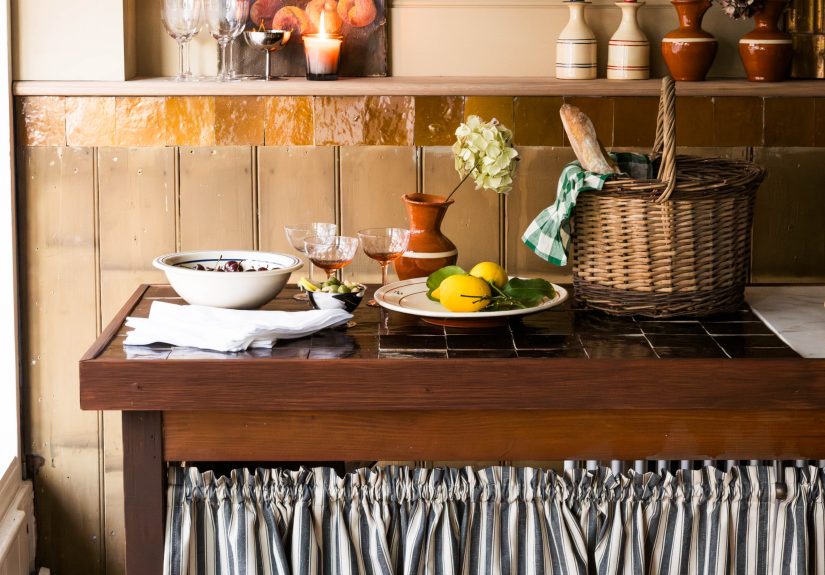
Margot’s interior details have a point of view: warm neutrals, earthy finishes, and a visible appreciation for craft. One standout: a large island wrapped
in a striped skirt rather than fitted cabinetry. It’s a smart design move because it adds softness (textiles do that), it’s flexible (fabric can change),
and it avoids the “built-in forever” feeling that sometimes makes spaces feel rigid. Add shelving supported by visible brass brackets and you get a space
that feels both classic and intentionally madestructured, but not stiff.
The storefront effect: an invitation, not a billboard
Outside, the shop is described as a chocolate-brown storefront on Lewes’s High Street. That matters more than you’d think. In a world of neon and
over-branding, a quiet storefront is a signal: come in if you’re curious; we’re not going to shout at you through the glass.
What You’ll Find on the Shelves
Margot’s assortment hits the sweet spot between “special” and “actually useful.” Think: the objects that turn an ordinary Tuesday into a slightly more
cinematic Tuesday. The store’s own collections focus heavily on tabletop, linens, kitchenware, and lightingcategories where small upgrades make a big
daily difference.
Tableware: terracotta, tradition, and a little Mediterranean sunshine
The tableware collection “reimagines classic interior pieces” centered on shared meals. The range includes terracotta wine and water carafes, salad bowls,
water jugs, plates, and candle holders, described as hand-thrown and painted in a studio in Spain. That’s a specific, coherent direction: earth-toned
pieces that look better the more you use them, and that pair well with both rustic and modern settings.
Practical note for the “I love it but I’m terrified” crowd: terracotta and hand-finished ceramics are meant to look human. Minor variations aren’t flaws;
they’re fingerprints. If you want everything to match perfectly, you’re shopping for uniforms, not homewares.
Table linens: mix-and-match, embroidery, and “yes, wrinkles are allowed”
Margot’s table linens are designed to mix and match, offered as napkins and tablecloths, with details like hand-blocked prints, embroidery, and whitework.
This is where the shop’s philosophy shows up: a table isn’t supposed to look sterile; it’s supposed to look welcoming.
If you’ve ever stared at a wrinkled linen tablecloth like it personally insulted you, here’s your permission slip: “rumpled linen” can be a vibe. Hosting
and lifestyle experts often treat linen as intentionally relaxedsteamed if you want, lightly ironed if you must, but never so crisp it feels like a hotel
conference room. (Unless your dream aesthetic is “annual budget meeting,” in which case: live your truth.)
Kitchenware: everyday tools that don’t ruin the scene
The kitchenware selection emphasizes everyday staplesmugs, utensils, and functional objectspresented as part of the broader story: cooking is a ritual,
not a task you rush through while doom-scrolling. When kitchen tools are beautiful and well-made, you’re more likely to leave them out, which means you’re
more likely to use them. Convenience, but make it charming.
Lighting: warm brass, glass, and “mood” as a design choice
Margot’s lighting mix includes brass and glass pieces, and that’s not a random aesthetic. Warm metals and soft diffusion help create the kind of light
that makes skin look alive and rooms feel calm. If you’ve ever wondered why some spaces feel inviting even when they’re minimal, it’s often the lighting.
Designers talk about layering: ambient light for general glow, task light where you need it, and accents for atmosphere. A well-chosen sconce or pendant
can do more for “cozy” than a truckload of throw pillows.
The Pantry: recipe kits that connect “homewares” to real cooking
Margot also carries recipe kits created by Cook School for children to cook, designed to make either a vegetarian meal or a sweet treat. That’s a clever
bridge between objects and behavior: it’s not just “buy the bowl,” it’s “learn what to do with it.”
A Homewares Shop with a Purpose
Margot’s mission element isn’t window dressing. The brand states that profits support Cook School, a nonprofit initiative teaching children how to cook
delicious food that’s kind to the planet and their bodies. This is one of the more interesting retail models in the homewares world: a design-forward shop
that uses commerce to fund education.
And conceptually, it makes sense. Homewares are tools for domestic life. Teaching kids to cook is an investment in domestic life. One supports the other,
and the shop becomes a physical reminder that “the home” isn’t just how it looksit’s how it functions and how it feeds people.
How to Shop a Small Homewares Store (Without Regrets)
Shopping a boutique like Margot is different from shopping a big-box store. The selection is curated; the objects have personality; and the temptation to
“treat yourself” is basically built into the lighting design. Here’s how to shop smart while still having fun.
1) Choose one anchor piece, then build outward
If you fall in love with a terracotta carafe, let that be the hero. Then pick two supporting players: maybe linen napkins in a complementary color and a
candleholder that echoes the same earthy tone. This “one hero + two helpers” rule keeps you from buying six unrelated things that only look good
individually (aka the “my home is a flea market argument” problem).
2) Mix patterns like a stylist: repeat one element on purpose
Table styling experts often recommend mixing patterns by repeating a color family or motif. For example: stripes in the napkins, a subtle check in the
runner, and solid plates that ground the whole thing. It feels collected rather than chaotic. The goal is “interesting,” not “visual shouting match.”
3) Treat linen like grown-up denim: care matters, but it’s not fragile
Linen can wrinkle; that’s part of the deal. Hosting and cleaning pros recommend thinking ahead: wash or steam in advance, dry gently, and store in a way
that avoids deep creases. For last-minute rescue, a steamer and gravity (hang it up!) can work wonders. The point isn’t perfectionit’s readiness.
4) Think in “touch points,” not rooms
Instead of shopping by room (“I need dining room things”), shop by touch points: what do you touch every day? Mugs, serving bowls, kitchen tools, bedside
lighting, hand towels. Upgrading touch points yields daily ROI. A beautiful mug you use twice a day is a better purchase than a decorative object you dust
once a month while muttering, “Why do I own this?”
5) Ask about materials, finishes, and caresmall shops expect it
In a boutique, it’s normal to ask: Is this hand-thrown? How do I wash it? Will it patina? A good shop will happily tell you, and you’ll buy with more
confidence. For example, independent testing in food and kitchen publications often notes that different materials wear differently: porcelain can resist
scratches better than some stoneware, while heavier stoneware can hold heat well for serving. Translation: material choices affect your daily experience.
Bring the Margot Mood Home
You don’t need an 18th-century listed building (or a budget that laughs at gravity) to borrow Margot’s vibe. The shop’s look is built on a few repeatable
principles: warmth, restraint, texture, and function. Here’s how to translate that into your own space.
Steal this palette: warm neutrals with “earth” accents
Think creamy whites, soft browns, terracotta, warm brass, and natural fibers. This palette works because it’s flexible. It plays nicely with modern
interiors, traditional homes, rentals, and apartments. It also photographs well, whichlet’s be honestmatters in the year of “I will not eat until I
take a picture of this table.”
Use textiles to soften hard edges
One of Margot’s smartest interior moves is the skirted island: fabric where you’d expect cabinetry. You can mimic that effect at home by swapping rigid
storage for softer layers. Try a linen runner on a console, a café curtain under a sink, or fabric baskets instead of plastic bins. Texture makes spaces
feel lived-in and human.
Open shelving, but edited
Home organization experts love the idea of open shelves until real life happens. The key is editing: vary heights, repeat shapes, and leave breathing
space. Keep a limited color story (like neutrals + terracotta) so your shelves don’t turn into a visual junk drawer. Also: if you don’t want to dust, don’t
put your entire glass collection out. Dust is not a décor style, no matter what Pinterest tells you.
Light like you mean it
Want your home to feel instantly more “boutique”? Layer your lighting. Use warm-toned bulbs, add a lamp in a corner that currently feels like a dead zone,
and consider a wall light or sconce where you want a cozy halo. Designers often emphasize mood lighting and task lighting as separate jobsone for
atmosphere, one for function. The best rooms do both.
Set the table on an ordinary day
Margot is essentially a love letter to gathering. So steal the simplest tradition: set the table, even if it’s just you and your takeout. A cloth napkin,
a candle, a favorite platetiny upgrades that make dinner feel like a moment instead of a pit stop.
Extra: of East Sussex “Margot Energy”
Picture a slow morning in Lewes: the kind where you can hear your own footsteps on the pavement and no one is sprinting like they’re chasing an airport
gate. You wander the High Street with a coffee in hand, pretending you’re “just browsing,” while your brain quietly calculates how many shelves you own
and whether any of them could be “reimagined” as a place for hand-thrown ceramics. (This is how it starts.)
Then you spot it: a chocolate-brown storefront that looks calm enough to lower your blood pressure from across the street. You step inside and immediately
understand why people romanticize small shops. The light feels softer. The objects feel intentional. The whole space reads like someone actually lives the
way they claim to livecooking real food, setting real tables, and lighting candles on a random Wednesday because the sun set at 4:30 and we’re all doing
our best.
You drift toward the tabletop pieces first, because humans are predictable and also because the terracotta carafes are doing the most.
They look like they belong at a long lunch, even if your current reality is “microwaved leftovers eaten over the sink.”
That’s the magic trick: good homewares don’t judge your life; they gently suggest a better version of it.
Next come the linensnapkins and tablecloths designed to mix and match. You run a hand over the fabric, and suddenly you remember every meal that felt
special for no practical reason: a friend coming over, a family birthday, a Sunday breakfast that turned into an afternoon. Linens are basically memory
triggers you can fold. And yes, you can choose to embrace the relaxed, slightly rumpled lookbecause nothing says “welcome” like a table that doesn’t look
like it’s bracing for inspection.
The kitchen area makes you linger, because it doesn’t feel like “display.” It feels usable. You can imagine a supper club here, someone stirring something
warm, conversation happening around the counter instead of the TV. Even if you never host a chef residency (most of us do not), you can borrow the idea:
make your kitchen a place where people naturally gather. Put the good mugs where you can reach them. Leave a bowl out for fruit. Add a small lamp or warm
sconce so the room feels inviting after dark. These are not grand renovations; they’re mood decisions.
When you finally leave, you might carry a small bagmaybe a candleholder, maybe napkins, maybe just a mental note to stop treating your home like a
storage unit with Wi-Fi. That’s the best souvenir Margot offers: permission to make everyday rituals feel a little more beautiful, a little more human,
and a lot more worth showing up for.