Table of Contents >> Show >> Hide
- The “Little Apple of Death” That Looks Weirdly Innocent
- What Makes the Manchineel So Dangerous?
- How Bad Is It, Really? A Reality Check Without the Horror-Movie Music
- If You Think You’ve Been Exposed: What to Do (and What Not to Do)
- How to Avoid the Manchineel (Without Becoming a Full-Time Botanist)
- Is the Manchineel the Only “Touch-and-Regret” Tree?
- Why We Should Respect (Not Erase) Dangerous Trees
- Conclusion: The Safest Way to Meet the World’s Most Dangerous Tree
- Real-World Encounters and Cautionary Tales (Experiences Section)
- SEO Tags
Picture this: you’re on a sunny beach, looking for shade like a responsible human who knows what UV rays do to your future selfies.
You spot a leafy tree near the sandperfect. You step underneath it… and a few hours later you’re learning a whole new vocabulary
for “my skin is on fire.”
Welcome to the legend (and very real problem) of the manchineel tree (Hippomane mancinella), often described as
the world’s most dangerous tree. This coastal plant can cause painful blistering, eye injuries, and other nasty reactions
from surprisingly small exposures. And yesjust touching it (or sometimes even letting rainwater drip off it) can be enough to ruin your day.
The “Little Apple of Death” That Looks Weirdly Innocent
Manchineel’s nickname in Spanish is famously dramaticthink “little apple of death”and the tree earns that reputation with style.
It can look like a perfectly normal seaside tree: glossy green leaves, a sturdy trunk, and small green fruits that resemble tiny apples.
That fruit is part of the problem: it looks snackable. It is, in fact, not snackable.
Where you might run into it
In the United States, manchineel grows in southern Florida, including areas around the Everglades and the Florida Keys.
Beyond the U.S., it’s found in parts of the Caribbean, Mexico, and Central Americaoften along shorelines and brackish, mangrove-adjacent areas.
It’s basically the plant equivalent of a villain who chooses scenic real estate.
Why it’s there (and why it doesn’t care about your vacation)
Despite the danger, manchineel plays an important role in coastal ecosystems. Its roots help stabilize sand and reduce erosion, and the tree can
function as a windbreak in storm-prone environments. In other words: it’s doing its job. The issue is when humans try to interact with it like it’s a
friendly shade umbrella.
What Makes the Manchineel So Dangerous?
The short version: every part of the tree is toxicleaves, bark, sap, and fruit. The longer version is where things get spicy.
Manchineel produces a thick, milky sap (a latex-like substance) loaded with irritant toxins. One frequently discussed culprit is
phorbol, which can trigger an intense skin reaction. That sap can end up on you through direct contact… or through water that drips
from leaves after rain.
1) Skin contact can cause burn-like blistering
Touching the bark, snapping a twig, brushing leaves, or getting sap on your skin can lead to irritant contact dermatitis.
People often describe it as a chemical-burn-style reaction: redness, swelling, pain, and blisters. The tricky part is that you might not realize you’ve
been exposed until discomfort ramps up later.
2) Eye exposure can be a fast track to urgent care
Sap in the eyes can cause severe irritation and inflammation. Even tiny exposures matter hereeyes are not “walk it off” body parts.
If you’ve ever had sunscreen migrate into your eye, imagine that experience… but with a plant that has no interest in your comfort.
3) Standing under it in the rain can still hurt you
This is the detail that makes people say, “Okay, that tree is personally offended by humanity.”
Rainwater can pick up irritants from the leaves and drip onto skin, potentially causing blistering or irritationwithout you ever laying a hand on the tree.
That means “I didn’t touch it” isn’t always the defense you think it is.
4) Burning it can create irritating (and dangerous) smoke
Burning manchineel wood is a spectacularly bad idea. The smoke can irritate eyes and mucous membranes and has been associated with severe eye symptoms.
In plain terms: don’t use it for a beach bonfire, a campfire, or a “how bad could it be?” science experiment.
5) Eating the fruit is the worst choice in the “choices” category
The fruit’s apple-like look has tricked people for centuries. Ingestion has been reported to cause intense burning in the mouth and throat, gastrointestinal
symptoms, and potentially severe complications. Even when outcomes aren’t fatal, the experience can be medically serious and extremely painful.
The fruit is sometimes called “beach apple,” but it’s more like “beach regret.”
How Bad Is It, Really? A Reality Check Without the Horror-Movie Music
“World’s most dangerous tree” makes a great headline, but the most useful take is practical: manchineel exposures can be medically significant.
Real clinical reports describe severe dermatitis and eye involvement. Importantly, experts emphasize that while deaths are often more legend than common modern reality,
injuries are absolutely real, and people do end up needing medical care.
A specific example from medical literature
In one documented case report, exposure led to a pronounced dermatitis that took weeks to fully resolve. The takeaway isn’t “panic,”
it’s “don’t gamble with a plant that can bench-press your immune system.”
If You Think You’ve Been Exposed: What to Do (and What Not to Do)
This section is general first-aid guidance, not a substitute for professional medical care. If symptoms are severeespecially eye exposure,
trouble breathing, extensive blistering, or intense painseek medical help right away.
Step 1: Stop the exposure
- Move away from the tree (and out from under it if it’s raining).
- Avoid touching your face or eyes with potentially contaminated hands.
- If you have pets or kids with you, keep them backcuriosity is not your friend here.
Step 2: Wash with soap and water
Rinse exposed skin thoroughly with soap and water as soon as you can. The goal is to remove irritants before they continue to do damage.
If clothing may have sap on it, remove it carefully and wash it separately.
Step 3: Eye exposure is an emergency-level problem
If sap or contaminated water got into your eyes, flush with clean water and seek urgent medical evaluation. Don’t rub your eyes.
Rubbing turns a bad situation into a “why did I do that?” situation.
Step 4: Get expert help fast if symptoms escalate
In the U.S., you can contact Poison Control at 1-800-222-1222 for guidance. They can help you decide whether home care is reasonable
or whether you should head to urgent care or the ER.
How to Avoid the Manchineel (Without Becoming a Full-Time Botanist)
Look for warnings
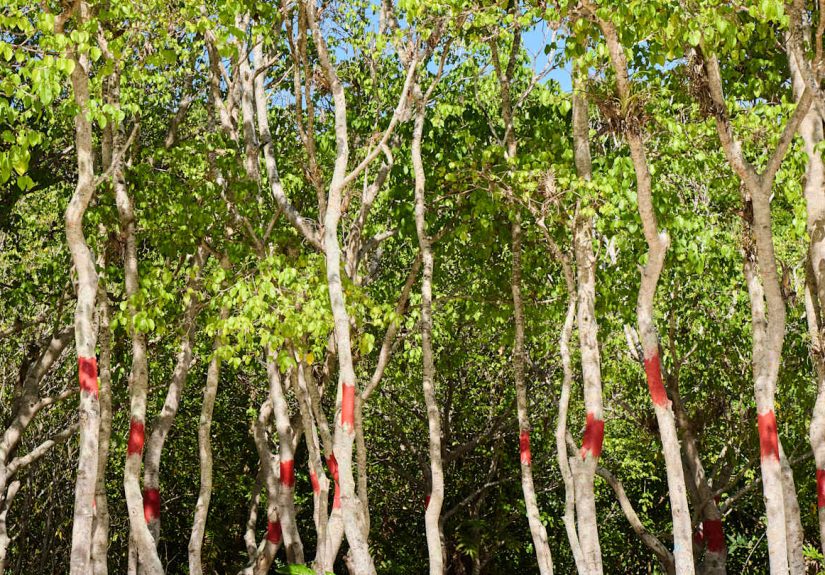
In places where manchineel grows, it may be marked with warning signage or painted indicators. If you see a sign telling you a tree is dangerous,
believe it. Nature doesn’t put up pop-up ads unless it’s serious.
Don’t eat mystery fruit on the beach
If a fruit looks like a tiny green apple and it’s lying under a coastal tree in manchineel territory, do not taste-test it.
This isn’t a cooking show. There is no prize for “most adventurous.”
Avoid using unknown wood for fires
If you’re camping or beachside grilling, use known safe firewood. Burning random coastal wood is risky even without manchineel in the mix.
With it? That’s an express lane to misery.
Stay on maintained trails in parks
In areas like coastal parks, following trails reduces accidental contact with hazardous vegetation. Park guidance isn’t there to ruin your vibeit’s there
because the ecosystem contains plants that fight back.
Is the Manchineel the Only “Touch-and-Regret” Tree?
Manchineel is famous, but it’s not alone in the “please don’t touch me” category. If you’re building a mental list of hazardous plants,
add this honorable mention: the gympie-gympie (a stinging tree from Australia). It’s not a manchineel relative, but it’s a masterclass
in how plants can cause pain.
Gympie-gympie: pain that can linger
Gympie-gympie is covered in microscopic stinging hairs that act like tiny needles delivering toxins. Reports describe intense burning pain that can last
for hours or days, and in some cases the pain has been reported to persist for weeks. It’s a different mechanism than manchineel, but the message is the same:
don’t treat unknown trees like friendly furniture.
Why We Should Respect (Not Erase) Dangerous Trees
It’s tempting to think, “Why does this tree even exist?” But ecology isn’t built around human convenience.
Manchineel helps protect shorelines, supports coastal habitats, and exists as part of a complex web of life.
The goal isn’t to remove itit’s to understand it, label it, and give it space.
Conclusion: The Safest Way to Meet the World’s Most Dangerous Tree
The manchineel tree is a perfect example of nature’s dark sense of humor: it looks harmless, offers shade, and grows in beautiful placeswhile quietly
packing chemical defenses that can send you to urgent care.
The good news? You don’t need to fear the outdoors. You just need to practice smart plant safety: don’t touch unknown trees, don’t eat mystery fruit,
avoid standing under suspicious shade during rain, and follow local warnings. Let the manchineel do its coastal-job in peacewhile you keep your skin,
eyes, and vacation plans intact.
Real-World Encounters and Cautionary Tales (Experiences Section)
The manchineel’s reputation didn’t come from internet drama aloneit’s backed by a long history of people learning the hard way that “tree” does not equal “safe.”
Some of the most commonly repeated experiences start with a totally normal goal: finding shade. Travelers in coastal regions have described ducking beneath a leafy tree
during a sudden rain shower, only to notice later that their skin felt irritatedthen painfully inflamedthen blistered. The detail that surprises most people is the
role of rain: water can drip from leaves carrying irritants, so you can end up “exposed” without ever touching bark or snapping a twig.
Another recurring theme is mistaken identity. Because the fruit resembles a small apple, stories pop up again and again of people assuming it’s edible.
Historical accounts describe sailors and explorers sampling the fruit and quickly regretting the decision with burning pain and mouth irritation.
Modern write-ups still warn about tourists being tempted by the apple-like look. Even when outcomes aren’t fatal, the experience can be intense enough to require
medical evaluationespecially if swelling or severe throat pain raises concern about airway irritation. The lesson here is simple and extremely boring (which is good):
don’t eat beach fruit unless you bought it from a store and it came with a barcode.
Medical case reports add another layer of “wow, this is real.” In at least one published report, a person developed a notable dermatitis after deliberate exposure
to the sap (an experiment that is fascinating on paper and a terrible life choice in practice). The reaction included significant skin changes and a prolonged healing
period. Clinical write-ups like these matter because they move the conversation from folklore to documented injuryproof that the manchineel’s toxins can cause serious,
lasting skin inflammation, not just a mild rash that disappears overnight.
Then there are the “campfire” experiencesusually framed as warnings. People in coastal areas have long noted that burning manchineel wood can create irritating smoke
that can inflame eyes and airways. Even if you never personally know someone who tried it, park guidance and expert sources keep repeating the same advice: don’t burn it.
When multiple independent warnings converge on “avoid the smoke,” it’s a hint that the risk is more than theoretical.
Finally, these stories often end the same way: with respect. In places like Florida and protected coastal parks, the manchineel is treated less like a monster and more
like a hazardous coworkerclearly labeled, given space, and not invited to team-building exercises. The best “experience” to aim for is the one where you recognize the
tree (or its warning sign), keep your distance, and go home with nothing more than a good story about the time you avoided the world’s most dangerous tree like a pro.
Nature has enough surprises. Your skin doesn’t need to be one of them.