Table of Contents >> Show >> Hide
- Koko Was Never Just “The Gorilla Who Signed”
- The First Kitten: All Ball and the Story That Made the World Melt
- Then Came the Two Baby Kittens
- Was Koko Really Unable To Have Her Own Children?
- Why the Kitten Story Resonated So Deeply
- The Science, the Skepticism, and the Emotional Middle Ground
- What Koko and the Kittens Still Mean Today
- Experiences People Relate To in Koko’s Story
- Conclusion
Some stories are so charming they practically skip past your brain and head straight for your heart. Koko the gorilla cuddling kittens is one of them. It has everything: a famous ape, tiny baby cats, surprising gentleness, and the sort of emotional whiplash that makes people say, “Well, now I’m crying over a gorilla and a kitten before lunch.”
But the reason this story has lasted for decades is not just because it is adorable. It is because Koko became a symbol for something bigger: animal empathy, grief, communication, and the complicated human desire to see ourselves in other creatures. The popular version goes like this: Koko wanted babies, could not have them, and poured that love into kittens instead. The fuller truth is more nuanced, more fascinating, and honestly more moving.
Koko, a western lowland gorilla born at the San Francisco Zoo in 1971, became internationally famous for her work with psychologist Francine “Penny” Patterson and for claims that she could understand spoken English and use signs to communicate. Over time, Koko’s public image expanded far beyond science. She became a cultural icon, appearing on magazine covers, in documentaries, and in children’s books. Yet among all the headlines about language, fame, and controversy, one part of her story consistently stood out: her extraordinary tenderness toward cats.
This article takes a closer look at the famous kitten story, the truth behind the headline, and why Koko’s bond with small animals still matters in conversations about animal intelligence, gorilla behavior, and the emotional lives of great apes.
Koko Was Never Just “The Gorilla Who Signed”
Before Koko became associated with kittens, she had already become one of the most recognizable animals in the world. She was born on July 4, 1971, and was given the name Hanabiko, often translated as “fireworks child.” Not exactly subtle, but memorable. As a young gorilla, she came under the care of Patterson, who began teaching her a modified form of sign language as part of a research project tied to Stanford University.
Supporters of the project argued that Koko demonstrated remarkable intelligence, symbolic communication, humor, and emotional depth. Skeptics, meanwhile, argued that claims about ape language were often overstated and that researchers could unintentionally influence what they believed they were seeing. In other words, Koko became both a scientific marvel and a scientific argument wrapped in black fur and a very expressive face.
That debate is important because it shapes how we interpret the kitten episodes. Did Koko truly “ask” for a kitten? Did she “mother” them in a way comparable to humans? Did she understand loss and family in a symbolic sense? Reasonable people still disagree on parts of that. What is harder to dispute is that Koko repeatedly showed unusual gentleness toward small creatures and became deeply associated with nurturing behavior.
The First Kitten: All Ball and the Story That Made the World Melt
The most famous chapter began in the early 1980s. According to accounts from The Gorilla Foundation and later news coverage, Koko had expressed interest in having a cat. She was first given a stuffed toy, which did not impress her. Fair enough. If you ask for a cat and somebody hands you a plush substitute, disappointment feels justified.
Eventually, Koko was allowed to choose from a litter of kittens. She selected a tailless gray-and-white kitten she named All Ball. The name became legendary because it seemed playful and oddly perfect. All Ball reportedly resembled a fuzzy pom-pom, and the phrase stuck in public memory the way only a weirdly charming name can.
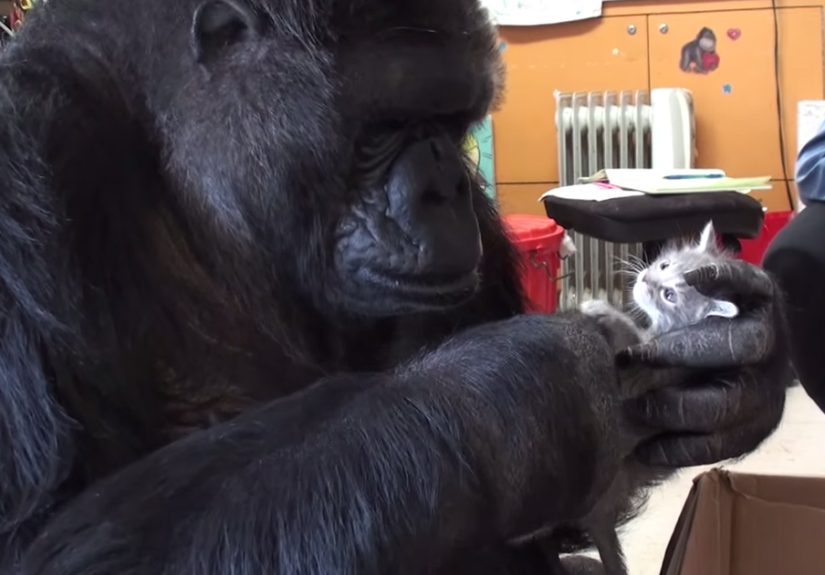
Koko’s behavior with All Ball fascinated people. She cradled the kitten, handled it with extraordinary care, and seemed to treat it with a mix of protectiveness and delight. For many observers, this was the moment when gorillas stopped looking like movie monsters and started looking like emotionally rich individuals. The image of a huge gorilla gently holding a tiny kitten did more public-relations work for gorillas than a thousand school assemblies and at least three very earnest wildlife posters.
Then came the heartbreak. All Ball later died after being hit by a car. Reports from the time said Koko showed signs of grief after being told what happened. That reaction became central to her legend. People were not just moved by the affection they saw. They were shaken by the idea that Koko may have understood loss in a deeply emotional way.
The story became so influential that it inspired the children’s book Koko’s Kitten, helped fuel one of National Geographic’s best-known animal features, and cemented Koko as a public ambassador for empathy across species.
Then Came the Two Baby Kittens
Years later, in 2015, Koko’s kitten story had a second act. On her 44th birthday, she was introduced to another litter of kittens. This time, she ended up keeping two of them, later known as Ms. Gray and Ms. Black. The images and videos spread quickly online because, well, of course they did. The internet has many priorities, but “gorilla carefully holding kittens” is very high on the list.
According to The Gorilla Foundation, Koko nurtured the kittens and treated them as if they were her babies. Caregivers described her as energized and highly engaged after the kittens arrived. These details mattered because the 2015 kitten story was not presented as a random cute moment. It was framed as a continuation of Koko’s long history of cross-species caregiving and emotional attachment.
That is where the headline “Koko adopts 2 baby kittens after being unable to have her own kids” comes from. It captures the emotional shape of the story, but it also compresses a complicated reality into a very tidy package.
Was Koko Really Unable To Have Her Own Children?
This is the part where accuracy matters more than sentiment. Public coverage of Koko’s life often emphasized that she never raised a baby gorilla of her own and that this seemed to be a major sadness in her life. Patterson repeatedly described Koko as wanting a baby. Some reports said Koko had a miscarriage. Others suggested that her social environment, housing conditions, and unusual living arrangement may have made successful reproduction less likely.
That is not quite the same thing as proving Koko was permanently unable to have children in a simple medical sense. The record suggests something more complicated: she did not end up having or raising a gorilla infant, there were efforts to help her start a family, and the reasons appear tied to a mix of biology, environment, social structure, and circumstance.
That distinction matters because the oversimplified version can turn a real animal life into a neat human morality tale. Koko’s story does not need that kind of polishing. It is already powerful. A gorilla living in an unusual human-managed setting formed maternal-looking bonds with kittens while never getting the chance to live a fully typical gorilla family life. That is not less emotional than the viral headline. It is more honest.
Why the Kitten Story Resonated So Deeply
People did not fall in love with the Koko story just because kittens are tiny and impossible to market badly. They responded because the story brought together several ideas that humans find irresistible.
1. It flipped the stereotype of gorillas
For generations, gorillas were often portrayed as violent, wild, or threatening. Koko holding a kitten rewrote that image in an instant. Suddenly the biggest animal in the room looked like the gentlest one.
2. It suggested empathy across species
Whether one interprets Koko’s behavior as maternal instinct, learned care, or a uniquely individual bond, the result was the same for viewers: it showed gentleness directed toward a vulnerable animal. That challenged assumptions about what nonhuman animals can feel.
3. It gave conservation a face
Koko was not just a celebrity gorilla. She was a western lowland gorilla, a critically endangered subspecies. Her popularity gave many people a personal emotional connection to gorillas they would never otherwise have had. In conservation, affection often arrives before action. Cute may not be a full strategy, but it definitely gets a foot in the door.
4. It made the question of animal consciousness feel personal
Scientists can debate syntax, symbolic language, and experimental design all day long. The public sees a gorilla cradle a kitten and asks a simpler question: “What is she feeling?” That question is messy, subjective, and incredibly human. It is also the reason Koko remained so compelling.
The Science, the Skepticism, and the Emotional Middle Ground
Any honest article about Koko needs room for both wonder and caution. Koko’s supporters saw her as proof that great apes possess profound emotional and communicative abilities. Critics argued that the strongest claims about sign language and linguistic understanding were not established to the standards mainstream science would demand today.
Those criticisms do not erase the significance of Koko’s life. They simply remind us not to confuse an emotionally persuasive story with a settled scientific conclusion. Koko may not have “spoken” in the way humans do, but her behavior still pushed millions of people to think harder about animal minds, welfare, enrichment, and the ethical treatment of great apes.
In that sense, the kitten story remains valuable even if you set aside the biggest claims. It captured something true enough to matter: Koko was an individual animal with preferences, attachments, routines, and relationships that affected the people around her. She made humans pay attention.
What Koko and the Kittens Still Mean Today
Years after Koko’s death, the image of her with kittens still circulates because it speaks to a stubborn hope many people carry: that empathy is not ours alone. We want to believe tenderness is older than language, bigger than species, and visible in the way a powerful being handles something fragile.
Koko’s life also raises harder questions. What does it mean when an animal becomes world-famous partly because she lives outside the normal life of her species? What do we owe intelligent animals kept in captivity? Can public fascination with one extraordinary gorilla translate into deeper care for all gorillas in the wild? Those questions are less viral than “gorilla loves kittens,” but they are the ones that matter most.
Still, the emotional force of the story has not faded. A gorilla who never got to raise a baby gorilla of her own became famous for nurturing kittens. That combination of tenderness, loss, and mystery still hits people right in the feelings, which is a technical term I am prepared to defend.
Experiences People Relate To in Koko’s Story
One reason Koko’s story stays with people is that it mirrors experiences many humans understand without needing a scientific paper to explain them. Plenty of people have felt a nurturing instinct land somewhere unexpected. Sometimes that love is directed toward a child, sometimes toward a pet, sometimes toward a rescue animal, and sometimes toward anyone small, vulnerable, and clearly in need of comfort. Koko holding a kitten feels familiar because the gesture itself is familiar. It looks like caregiving.
People who have lived with cats especially understand the strange beauty of the bond. Cats are affectionate, but on their own terms. They are not exactly known for saying, “Thank you for your service, giant primate.” Yet that mismatch is part of what made the Koko story so memorable. The kitten was tiny, independent, and breakable. Koko was huge, strong, and capable of accidental harm. The bond worked only because gentleness bridged that gap. Humans recognize that effort. Anyone who has ever held a nervous rescue kitten, bottle-fed an abandoned animal, or stayed up all night making sure a sick pet kept breathing knows that tenderness can be an action, not just a feeling.
There is also a quieter layer to the story: the way people redirect love when life does not go as planned. Many readers respond to Koko because the kitten story resembles something they have seen in their own lives. A person wants a family and cannot have one in the way they imagined. A caregiver pours their heart into nieces, nephews, pets, students, or foster animals. Someone grieving a loss becomes especially protective of another living being. These experiences are not identical to Koko’s, of course, but the emotional structure is recognizable. Love looks for somewhere to go.
Koko’s bond with kittens also reminds people of grief. Anyone who has lost a beloved animal knows how sharp that pain can be. It can feel irrational to outsiders and absolutely devastating to the person living it. That is another reason All Ball mattered. The public did not just see a cute friendship. They saw a story with attachment and loss, which made Koko seem less like a spectacle and more like a being with an inner life.
Even people who remain skeptical of the boldest claims about Koko often admit the same thing: the images changed them. They made viewers slow down. They made them reconsider what a gorilla might notice, prefer, fear, or cherish. In daily life, that kind of shift matters. It can shape the way people teach children about animals, donate to conservation, think about zoo enrichment, or simply speak about other species with a little more humility. And if a gorilla cuddling two kittens can do all that, then maybe the story’s endurance makes perfect sense.
Conclusion
Koko’s story is larger than a viral headline and richer than a cute-animal clip. Yes, she became famous for adopting kittens. Yes, the public linked that tenderness to her long-expressed desire for a baby of her own. But the enduring power of the story lies in what it revealed about us as much as about her. People saw Koko with kittens and recognized care, grief, attachment, and curiosity. They saw a gorilla not as a symbol of brute force, but as a creature capable of extraordinary softness.
That is why “Koko the gorilla adopts 2 baby kittens” still works as a headline years later. It promises charm, and it delivers that. But underneath the charm is a deeper truth: Koko helped millions of people imagine that the emotional distance between humans and other animals may be smaller than we once believed. That idea is not simple, not fully settled, and not always scientifically tidy. It is, however, unforgettable.