Table of Contents >> Show >> Hide
- What Does the Pad Actually Do?
- Laminate Flooring With Attached Pad
- Laminate Flooring Without Pad
- With Pad vs. Without: Which One Is Better?
- The Subfloor Changes Everything
- Noise, Neighbors, and the Myth of Silent Laminate
- Cost: Is One Option Actually Cheaper?
- Common Mistakes to Avoid
- Final Verdict
- Field Notes: Real-World Experiences With Laminate Flooring, With Pad vs. Without
- Conclusion
If laminate flooring had a dating profile, it would say this: affordable, good-looking, low-maintenance, and occasionally misunderstood. One of the biggest points of confusion is whether you should buy laminate flooring with attached pad or laminate flooring without pad and add a separate underlayment yourself. The answer is not as glamorous as a before-and-after renovation reel, but it is much more useful: it depends on your subfloor, your room, your noise concerns, and whether you want convenience or control.
In plain English, both options can work beautifully. Laminate flooring with an attached pad is often easier and faster to install. Laminate flooring without a built-in pad gives you more freedom to choose the exact underlayment you need for moisture protection, sound reduction, warmth, or minor subfloor imperfections. So the real debate is not “Which is always better?” It is “Which is smarter for this room?”
This guide breaks down the pros, cons, costs, installation differences, and real-world scenarios so you can choose the right setup without accidentally building a floor that squeaks, shifts, or makes every footstep sound like a tap dance recital.
What Does the Pad Actually Do?
Before comparing the two options, let’s clear up the vocabulary. In the flooring world, “pad,” “padding,” and “underlayment” often get tossed into the same conversation. For laminate flooring, the pad usually refers to a thin foam, felt, or specialty layer that sits between the laminate planks and the subfloor. Some laminate products come with this layer attached. Others require you to install it separately.
A good underlayment helps with several things:
1. Sound Reduction
Laminate flooring is durable, but it can be a little noisy. Without the right support beneath it, every footstep can sound hollow or clicky. A quality pad softens that effect and makes the floor sound more solid.
2. Comfort Underfoot
No, laminate will not suddenly feel like walking on a cloud wearing bunny slippers. But the right underlayment can reduce that hard, unforgiving feel and make the floor slightly warmer and more comfortable.
3. Moisture Protection
This matters most over concrete subfloors, basements, and other areas where moisture may be an issue. Some underlayments include a built-in vapor barrier, and that can make a huge difference in long-term performance.
4. Minor Subfloor Smoothing
Underlayment can help bridge tiny imperfections, but it is not a magic carpet. If the subfloor is seriously uneven, the pad will not save you. It will only help your bad decisions fail more quietly.
Laminate Flooring With Attached Pad
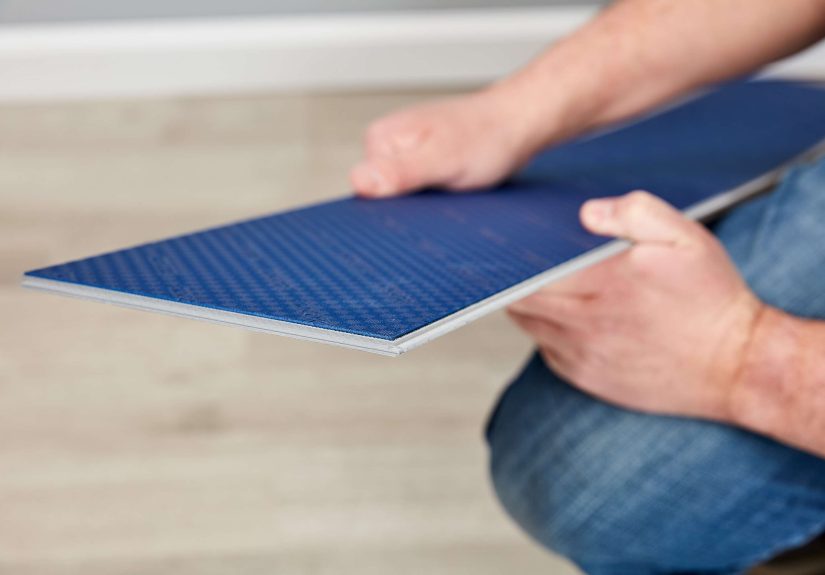
Laminate flooring with pad comes with underlayment already bonded to the underside of each plank. This option has become popular because it simplifies installation and removes one more variable from the project.
Pros of Laminate Flooring With Attached Pad
Faster installation: This is the big selling point. You do not have to roll out separate underlayment across the room before installing the planks. For DIY homeowners, that means less prep, fewer materials, and fewer opportunities to mutter at the floor.
Fewer purchasing decisions: Many shoppers do not want to compare foam versus felt versus cork versus “premium sound barrier with ultra-mega silver vapor shield.” Attached pad reduces the guesswork.
Cleaner, more straightforward workflow: Because the underlayment is already part of the plank, the install tends to feel more streamlined. That can be especially helpful in bedrooms, living rooms, and standard above-grade spaces.
Good basic performance: Many modern laminate products with attached padding do a solid job with everyday comfort and modest sound control. In normal household settings, that may be all you need.
Cons of Laminate Flooring With Attached Pad
Less customization: You are getting the pad the manufacturer chose, not the one your room may actually need. If your top priority is better acoustics, moisture defense, or a specific feel underfoot, attached pad can be limiting.
May not be enough for tricky subfloors: In a condo, basement, or older home with slight irregularities, the attached layer may not provide the level of performance you want. Some rooms simply demand more specialized underlayment.
Watch the “more is better” trap: A common mistake is assuming you can add another soft layer underneath pad-attached laminate for extra comfort. In many cases, that is a bad idea unless the manufacturer specifically allows it. Too much cushioning can create movement, stress the locking joints, and shorten the life of the floor.
Laminate Flooring Without Pad
Laminate flooring without attached pad requires a separate underlayment. At first glance, that sounds like extra work, because it is. But it also gives you more control, and that can be worth it.
Pros of Laminate Flooring Without Pad
More control over performance: This is the biggest advantage. You can choose an underlayment designed for soundproofing, moisture protection, thermal insulation, or a combination of features.
Better for room-specific needs: Installing over concrete? You may want a product with a vapor barrier. Working in an upper-floor condo? A denser acoustic underlayment may help reduce transmitted noise. Renovating an older home with a slightly imperfect subfloor? A better-quality pad can make the floor feel and sound more stable.
Potentially better overall feel: Separate underlayment can create a more refined walking experience when you choose the right material. Premium felt products, for example, are often favored for a more substantial sound and feel.
Cons of Laminate Flooring Without Pad
More labor: You need to roll it out, trim it, tape seams where required, and keep everything flat as you install. It is not difficult, but it does add time.
Higher chance of installation mistakes: Wrong underlayment, overlapped seams, missing vapor barrier, or using a layer that is too thick can all create problems. Convenience has value, and separate underlayment asks you to earn it.
Extra cost: Even when laminate without pad looks cheaper on the shelf, the total system cost may rise once you add the underlayment.
With Pad vs. Without: Which One Is Better?
Here is the honest answer: neither is universally better. The best choice depends on the room and the subfloor.
Choose Laminate Flooring With Pad If:
You want a faster, simpler installation; you are working in a standard living room, bedroom, hallway, or office; your subfloor is clean, level, and dry; and you do not need specialized acoustic or moisture performance.
Choose Laminate Flooring Without Pad If:
You need more control over sound, moisture, or warmth; you are installing over concrete; the room is below grade; building requirements call for specific sound reduction; or you simply want to choose a better underlayment than the factory-attached option.
The Subfloor Changes Everything
If there is one villain in most flooring stories, it is the subfloor. Laminate can only perform as well as the surface beneath it. Choosing between attached pad and separate underlayment should start with one question: what are you installing over?
Over Concrete
Concrete can release moisture, even when it looks perfectly innocent. That is why moisture management matters so much in basements, slab-on-grade homes, and lower levels. In these cases, many installations need a vapor barrier or an underlayment system designed for concrete. Attached pad alone may not be enough unless the manufacturer clearly says it is approved for that application.
Over Plywood or Wood Subfloors
Wood subfloors are often more forgiving. If the surface is level and dry, laminate with attached pad can be a smart, easy option. Separate underlayment still has advantages, especially for sound control, but the moisture demands are usually less intense than with concrete.
Over Existing Flooring
Some existing hard surfaces can serve as the base for laminate, but conditions matter. The floor beneath must be flat, stable, and compatible with the manufacturer’s instructions. Existing soft flooring or old cushioned layers are usually a no-go. Laminate likes support, not a trampoline.
Noise, Neighbors, and the Myth of Silent Laminate
If you live in a two-story home, condo, apartment, or townhouse, sound deserves more attention than it usually gets in showroom conversations. Attached pad may reduce everyday footfall noise enough for some households, but if you are dealing with downstairs neighbors, echo-prone rooms, or family members who walk like they are late for an airport gate, separate acoustic underlayment may be the smarter move.
This is where laminate flooring without pad can shine. It lets you choose a denser underlayment built for better sound dampening. That does not make the room library-quiet, but it can absolutely improve the experience compared with a thinner factory-attached layer.
Cost: Is One Option Actually Cheaper?
At first glance, laminate without pad may look less expensive per square foot. Then the underlayment joins the chat. Once you add a separate pad, tape, and possibly a vapor barrier, the total price can climb. Meanwhile, laminate with attached pad may cost more upfront, but it can save time and reduce material complexity.
So which is cheaper? Usually:
With pad: better for straightforward budgeting and faster DIY installs.
Without pad: potentially better value when you need a specific performance upgrade and would rather not compromise.
In other words, the cheaper floor is the one that does not need to be redone because the room sounded awful, trapped moisture, or flexed at the seams.
Common Mistakes to Avoid
Using extra-soft or overly thick padding
Laminate flooring needs support, not a mattress. Too much softness underneath can damage the locking system.
Ignoring manufacturer instructions
Every product is a little different. Some pad-attached laminates are designed to be installed as-is. Others may require specific moisture control measures depending on the subfloor.
Skipping subfloor prep
A pad is not a cure for dips, humps, debris, or moisture problems. If the base is wrong, the floor will tell on you later.
Assuming attached pad always includes a vapor barrier
Sometimes it does. Sometimes it does not. Read the specifications, not the marketing headline.
Final Verdict
When comparing laminate flooring with pad vs. without, the smartest choice is usually not the one with the flashiest label. It is the one that matches your subfloor and your priorities.
If you want a simpler installation and your subfloor is already in good shape, laminate with attached pad is often the practical winner. It is convenient, efficient, and perfectly suitable for many rooms.
If you need stronger sound control, better moisture management, or a more tailored installation system, laminate without pad is often the better long-term decision. It asks for more effort upfront, but it gives you more control where it counts.
The short version? Attached pad is great for convenience. Separate underlayment is great for customization. Choose the one that fits the room, not just the box copy. Your future self, standing quietly on a floor that does not creak like a haunted ship, will be grateful.
Field Notes: Real-World Experiences With Laminate Flooring, With Pad vs. Without
In real homes, the difference between laminate flooring with pad and laminate flooring without pad often shows up after installation, not during the shopping phase. On a showroom wall, both can look equally polished. Once they are on the floor, though, homeowners start noticing things that never appear on sample boards: the sound of footsteps at 6 a.m., the slight echo in a long hallway, the chill of a slab floor in winter, or the way the planks react in a room where humidity swings like a mood on moving day.
One common experience is the “easy install, decent result” story. This usually happens in bedrooms, guest rooms, home offices, or second-floor spaces with dry, level wood subfloors. Homeowners choose laminate with attached pad because they want a cleaner, faster project. The installation goes smoothly, the floor looks great, and everyone feels briefly invincible. In these situations, attached pad often delivers exactly what people hoped for: a nice floor with less hassle.
Then there is the “I wish I had thought more about the room” story. This tends to happen in condos, basements, or busy family rooms. The floor may still look beautiful, but the sound is sharper than expected, or the room feels a little harder underfoot. Sometimes the issue is not the laminate itself. It is that the built-in pad was only adequate when the space really needed a more specialized underlayment. Homeowners often describe the result with phrases like “a little hollow,” “louder than I expected,” or “fine, but not amazing.” That is usually the moment when people learn that convenience and optimization are not the same thing.
Older homes create another pattern. When the subfloor is slightly uneven, separate underlayment often gives better results because the installer can choose a product better suited to the conditions. This does not mean underlayment can fix a bad subfloor. It cannot. But in borderline situations, having that extra control matters. Many experienced installers would rather choose the underlayment themselves than accept whatever is factory-attached to the plank.
Concrete subfloors are where regrets tend to get expensive. Homeowners often focus on the style and color of the laminate, then realize too late that moisture management should have been part of the conversation from the start. In these spaces, laminate without pad paired with the right moisture-control layer often feels like the more thoughtful setup. It may take longer to install, but people are usually happier when the floor feels stable, sounds better, and is protected from conditions below.
The most repeated lesson from real-world installs is simple: the best laminate floor is not chosen by thickness alone, price alone, or whether the plank says “attached pad” in giant happy letters. The best result comes from matching the flooring system to the room. People who do that usually end up with the same review: “It was worth doing right the first time.”
Conclusion
Laminate flooring with pad is the quick, convenient option that works well in many ordinary rooms. Laminate flooring without pad is the more customizable path that can outperform it in challenging spaces. Neither one is automatically better. The winner depends on moisture exposure, subfloor condition, acoustics, comfort goals, and installation quality. Pick the system that fits the room, follow the manufacturer’s instructions, and you will be much closer to a floor that looks sharp and behaves itself.