Table of Contents >> Show >> Hide
- What Is Maria Milans I Studio?
- The MMIS Design Signature
- Camp O in the Catskills: The Project That Defines the Studio
- Hamptons Outdoor Living: A Smart Lesson in Lifestyle Design
- Beyond Residential Work: Research, Culture, and Teaching
- Why Maria Milans I Studio Matters in Today’s Design Landscape
- Final Thoughts on MARIA MILANS I STUDIO
- Extended Experience Notes (Approx. )
Some architecture tries to impress you in the first five seconds. Maria Milans I Studio (often styled as MMIS) plays a longer game. The work tends to unfold slowlythrough materials, light, climate, and the way a space feels when you actually live in it. That means fewer “look at me” gestures and more “wow, this is quietly brilliant” moments.
Founded by María Milans del Bosch, the practice operates between New York and Madrid and has built a reputation for projects that feel deeply considered, materially grounded, and highly livable. From house-studios in the Catskills to outdoor-living renovations in the Hamptons, MMIS blends architectural rigor with a hands-on, almost artisanal sensibility. If some firms design for photographs, MMIS designs for real lifethen happens to look excellent in photos too.
What Is Maria Milans I Studio?
Maria Milans I Studio is an architecture and design practice founded in 2012 by María Milans del Bosch. The studio is based in New York and Madrid and is known for work spanning architecture, interior design, commercial projects, and furniture/lighting design. That range matters because the studio’s projects often feel holistic: building, interior, material palette, and daily use are treated as one conversation rather than separate tasks handed off between teams.
A recurring theme in descriptions of the practice is a search for timeless design through materialityhow things are made, assembled, weathered, and experienced over time. In plain English: this is a studio that cares about what a wall is made of, how sunlight hits it at 4 p.m. in October, and whether it still makes sense ten years later.
MMIS also positions itself as a practice comfortable across scales, with projects ranging from renovations and installations to ground-up buildings and broader planning work. That flexibility is one reason the studio stands out: the design language stays coherent, even when the project type changes.
The MMIS Design Signature
1) Materiality Is Not DecorationIt’s the Main Event
Many studios talk about “material honesty.” MMIS actually appears to build around it. In project descriptions, materials are not treated as cosmetic finishes applied at the end. Instead, they are structural, climatic, and experiential tools. Wood, steel, concrete, and composite surfaces are chosen not just for appearance but also for durability, maintenance, thermal performance, and how they age.
2) Vernacular, Reinterpreted (Not Imitated)
One of the most interesting aspects of the studio’s work is its relationship to local building traditions. MMIS often references vernacular forms and familiar regional materialsbarn roofs, wood siding, simple volumesbut reorganizes them with a contemporary logic. The result is architecture that feels rooted without becoming nostalgic or fake-rustic.
3) Climate-Responsive Thinking
MMIS projects show strong attention to orientation, ventilation, sunlight, and seasonal use. This is the kind of thinking that improves daily life in ways clients notice immediately: cooler interiors, better daylight, fewer maintenance headaches, and spaces that work in both peak summer and shoulder seasons. It is design with a practical IQ, not just a visual personality.
4) Craft + Restraint
The studio’s work often reads as precise and restrained. There is a sense that every opening, material junction, and spatial move has a job. That restraint gives the architecture an unusual confidence. Nothing is screaming for attention, which is exactly why it feels sophisticated.
Camp O in the Catskills: The Project That Defines the Studio
If you want to understand Maria Milans I Studio quickly, start with Camp O, a house-studio in the Catskills where living and working coexist in one building. The project has been widely featured and, for good reason, it reads like a manifesto in built form.
A Contemporary Vernacular in Practice
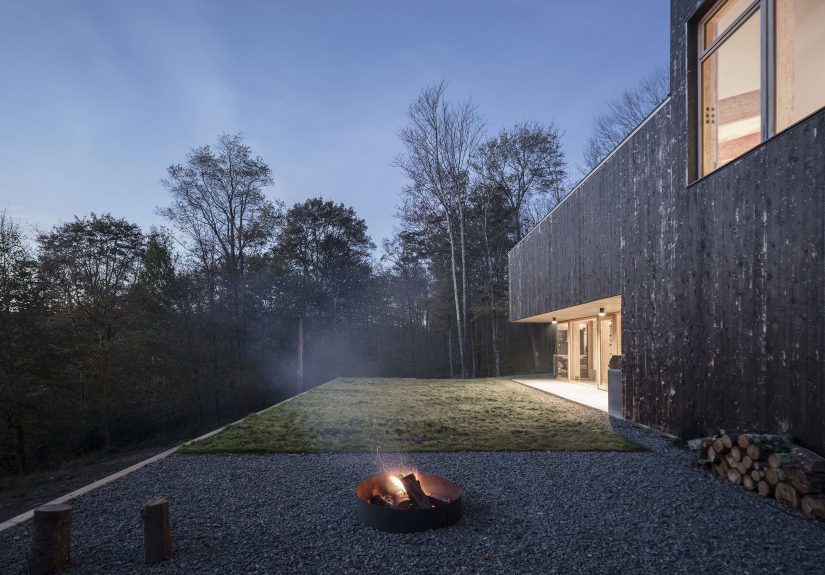
Camp O reinterprets local vernacular architecture using the same basic ingredients found in nearby barns, cabins, and houseswood framing, wood siding, plywood sheathing, and a pitched metal roofbut assembled with a contemporary approach. MMIS doesn’t reject the local language; it rewrites the grammar.
That strategy gives the house a rare dual personality: it feels native to the landscape and culture of the Catskills, yet clearly contemporary in proportion, detailing, and spatial organization.
Topography, Light, and Performance
Camp O is not just a pretty object dropped in the woods. The project addresses significant site slope and uses orientation as a performance tool. Openings are placed on the east and west facades to support cross ventilation, improve solar exposure, and reduce the impact of dominant winds. In other words, the windows are doing more than framing Instagram-worthy trees.
The envelope strategy is equally thoughtful. The insulation sits outside the main structural envelope, creating a continuous insulated volume that helps reduce thermal bridges. This allows more of the structure to remain exposed on the interior while improving performancean excellent example of architectural expression and building science getting along for once.
The Shou Sugi Ban Skin and Low-Maintenance Logic
One of Camp O’s most recognizable features is its cedar rainscreen treated with a charred finish (often referenced as Shou Sugi Ban). Beyond the visual drama, the choice supports durability and low maintenance while helping the exterior weather naturally with the surrounding woods. MMIS consistently treats material aging as part of the design story, not a future problem for someone else.
Interior Space as a Landscape Experience
Inside, the spatial sequence mirrors the experience of approaching the site. A narrower, more compressed entry zone opens into a double-height living/dining/kitchen/studio area, creating a strong sense of release. Project descriptions also highlight a disciplined dimensional rhythm (including alternating spans) that organizes openings, partitions, and built-in elements. That rhythm gives the home a calm, coherent ordereven if your weekend plans are gloriously chaotic.
The project has also been noted for how it frames views and daylight through carefully placed large openings and reconfigured roof geometry. This is one reason Camp O feels so memorable: the building does not merely “sit” in nature; it amplifies the experience of being in it.
Hamptons Outdoor Living: A Smart Lesson in Lifestyle Design
Another project that shows the range of Maria Milans I Studio is a Hamptons renovation focused on outdoor living, often described as a surgical transformation of a 1960s ranch-style house. Rather than relying on a massive addition, the design uses a series of targeted moves that dramatically change how the property is used.
From Divided Yard to “Outdoor Rooms”
The concept centers on creating a cascade of outdoor rooms through a long veranda, pool zone, and outdoor kitchen/dining areas. This approach improves circulation and social use while making the house feel more connected to the landscape. It is a strong example of MMIS designing for behaviornot just aesthetics.
The project also reflects the studio’s cross-cultural sensibility: a Mediterranean-inflected outdoor lifestyle translated to the Hamptons without turning the property into a theme park version of Spain.
Performance-Driven Outdoor Materials
The use of custom shade structures and powder-coated aluminum framing responds directly to the site’s coastal conditions and salinity. That kind of material decision says a lot about the studio’s priorities. It is easy to specify something beautiful. It is harder (and better) to specify something beautiful that also survives beach weather without becoming a maintenance nightmare.
Designing for Daily Rituals
One of the most charming details from the project is the outdoor kitchen designed around actual cooking practices, including paella preparation. This is peak MMIS energy: culturally specific, practical, and beautifully integrated. The result is not generic luxury outdoor living; it is a design that supports the way a particular family gathers, cooks, hosts, and moves through summer days.
Beyond Residential Work: Research, Culture, and Teaching
Maria Milans I Studio is not only about private homes. The studio’s published material points to a broader engagement with research, exhibitions, and educationan important dimension if you are evaluating the intellectual depth behind the work.
MoMA / MoMA PS1 and Rising Currents
The studio’s research section references the Rising Currents exhibition at MoMA, a major initiative developed with MoMA PS1 addressing sea-level rise and the future of New York Harbor through design research and “soft infrastructure” proposals. MoMA’s materials and related project pages for Matthew Baird Architects help situate this work within a serious institutional context focused on resilience, urban ecology, and future-facing design.
This matters because it shows MMIS’s design interests extend beyond single buildings into environmental systems and civic-scale thinking.
The Kitchen and Post-Sandy Adaptation
On the studio site, a project for The Kitchen (the nonprofit arts institution in Chelsea) describes a redesign following flooding during Hurricane Sandy. The renovation emphasizes flood-resistant finishes, durable raw steel cladding, and sustainable strategies suited to a post-Sandy urban setting. This is another example of the studio’s core pattern: material restraint + resilience + clear spatial intent.
Teaching and Speculation
MMIS also highlights teaching and speculative work, including studio-based explorations tied to housing ideas and a curatorial proposal for the Spanish Pavilion in the Venice Architecture Biennale context. Even for readers who are not architecture nerds (welcome, we have coffee), this signals something important: the studio’s built work is supported by ongoing conceptual inquiry.
Why Maria Milans I Studio Matters in Today’s Design Landscape
In a time when architecture is often pushed toward extremeshyper-minimal image-making on one side and over-programmed lifestyle branding on the otherMaria Milans I Studio occupies a compelling middle ground. The work is visually disciplined, yes, but it is also lived-in, climate-aware, and rooted in use.
MMIS feels especially relevant for clients and readers looking for:
- Architecture that responds to place without copying historic styles.
- Homes and renovations designed around real routines, not showroom staging.
- Material palettes that age gracefully and reduce maintenance over time.
- Projects with a strong point of view that still prioritize comfort and practicality.
Put simply, the studio’s work suggests that good architecture is not only about novelty. It is about relationshipsbetween inside and outside, object and landscape, craft and performance, everyday life and cultural memory.
Final Thoughts on MARIA MILANS I STUDIO
Maria Milans I Studio stands out because it brings together qualities that do not always coexist: intellectual rigor, tactile materiality, practical performance, and emotional atmosphere. The projects are thoughtful without feeling academic, and refined without feeling sterile.
If you are studying contemporary residential architecture, planning a design-forward renovation, or simply trying to understand what “timeless but not boring” actually looks like, MMIS is a studio worth watching closely. The work proves that restraint can be expressive, vernacular can be contemporary, and technical decisions can create beautynot just solve problems.
And honestly, any studio that can make climate strategy, charred cedar, and outdoor paella cooking feel like one coherent design language deserves a little applause.
Extended Experience Notes (Approx. )
To make this article more usefuland a bit more vividhere is an experience-focused interpretation of what Maria Milans I Studio’s work feels like from a user perspective. This section is not a fictional “I was there” story; it is an experiential reading based on published project descriptions, material choices, and spatial strategies associated with MMIS.
Imagine arriving at an MMIS project in late afternoon. The first thing you would likely notice is not a flashy facade but a sense of order. The building feels settled, as if it belongs to the site. The proportions are calm. The materials look intentional. Nothing is fighting for attention. That quietness is powerful because it lets the surroundingstrees, sky, wind, changing lightbecome part of the architecture.
As you move closer, the material experience becomes more interesting. Surfaces are rarely “pretty” in a fragile way. They have texture, density, and weight. You can imagine how they will age. You get the impression that the design expects weather, use, and timeand is ready for all three. In an era of finishes that look great for six months and tragic by year two, that is oddly refreshing.
Inside, the experience is often about sequence. MMIS seems to like transitions: tighter spaces that open into larger volumes, dimmer passages that release into daylight, framed views that appear at just the right moment. This creates a strong sense of movement through the house. Instead of seeing everything at once, you discover the project in layers. It feels less like scrolling and more like reading a good novelchapter by chapter, with better windows.
Another notable quality is how the spaces support actual routines. In many high-end homes, the architecture looks fantastic but leaves daily life feeling oddly inconvenient. MMIS projects, by contrast, seem tuned to use: where people gather, how they cook, where kids run, how guests circulate, where shade is needed, when sun becomes too intense, and how seasons change the way outdoor spaces are used. This attention to behavior makes the architecture feel generous.
There is also a strong emotional effect created by the studio’s relationship with landscape. Views are not simply “maximized”; they are curated. You may get a mountain view from one opening, treetops from another, and softer filtered light in circulation areas. That variety changes your mood as you move through the building. In practical terms, it keeps interiors dynamic throughout the day. In human terms, it makes you want to linger.
Perhaps the best way to describe the MMIS experience is this: the architecture feels composed, but never rigid. It invites living. You can host dinner, track mud, make coffee, watch the weather turn, and still feel like the design is working with you rather than demanding a perfect performance. That balancebetween beauty and use, concept and comfortis rare. It is also exactly why Maria Milans I Studio is so compelling.