Table of Contents >> Show >> Hide
- Who (and What) Is Messana O’Rorke?
- The Messana O’Rorke Signature: Minimalism That Actually Works
- Project Snapshots: Where the Ideas Become Real
- What Designers (and Homeowners) Can Learn From Messana O’Rorke
- Why the Messana O’Rorke Approach Feels So Current
- Experiences: What It Feels Like to Live With Messana O’Rorke Design
- Conclusion
If you’ve ever walked into a room and instantly felt your shoulders droplike the space just exhaled for youthere’s a decent chance you’ve encountered the design mood that Messana O’Rorke has been refining for decades. This New York City architecture and interior design studio is often associated with minimalism, but not the “empty white box that echoes your thoughts” kind. Think: restraint with intention, calm with craft, and a sharp sense of how light, materials, and circulation can turn everyday routines into something quietly cinematic.
Founded in 1996 by architects Brian Messana and Toby O’Rorke, the firm has built a reputation for spaces that look simple at first glanceand then keep rewarding you the longer you stay. Their first monograph, Messana O’Rorke: Building Blocks (published by Rizzoli in 2022), captures the studio’s signature: distilled forms, rigorously edited material palettes, and an almost musical approach to sequencewhat you see now, what you discover next, and how the room “lands” when you arrive.
Who (and What) Is Messana O’Rorke?
A New York studio built on two distinct design brains
Messana O’Rorke is a partnership in the truest sense. Brian Messana’s background includes an education at Columbia and early experience in high-design New York practices. Toby O’Rorke trained in the UK (Oxford Polytechnic, now Oxford Brookes University) and brought a deep interest in detailing and makinghow things go together, not just how they photograph. The result is a studio that can be concept-driven without drifting into “concept for concept’s sake.” In other words: poetic, but practical enough to keep your cabinet doors aligned.
Architecture + interiors, across types and scales
The firm’s portfolio spans private residences (city apartments, suburban renovations, mountain homes), retail environments, and other project types where atmosphere matters. They’re also frequently cited by major design publications and professional organizations, which is a polite way of saying: they’re not designing in a vacuum. They’re part of the conversation about what modern American design looks like when it grows up, stops shouting, and starts whispering something worth hearing.
The Messana O’Rorke Signature: Minimalism That Actually Works
1) “Volumes within volumes”: the box is not the enemy
One of the most recognizable moves in Messana O’Rorke projects is the use of a distinct “object” inside the larger spacean inserted volume that contains a function (sleeping, storage, circulation, even a threshold). These are not random sculptures; they’re space-planning engines. By concentrating clutter and program into a purposeful container, the rest of the room gets to breathe.
This approach is especially powerful in small homes, where the typical layout problem is not “Where do we put the sofa?” but “Why does everything I own look like it’s auditioning for a role in my living room?” The firm’s answer is to design a disciplined container so the visible space can stay calm.
2) A rigorously limited palette (aka: fewer materials, more impact)
Messana O’Rorke often works with a tight set of materialsthink oak, stone, metal, plasterthen elevates them through proportion, joinery, and alignment. When you’re not constantly switching textures, your eye starts noticing what actually matters: the edge of a reveal, the way a panel meets a floor, the glow of reflected daylight. It’s like cooking with five ingredients and somehow ending up with a dish that tastes like you spent your entire weekend on it.
3) Sequence: making a small space feel bigger without lying about the square footage
Their planning often emphasizes procession: a subtle “now this, then that” rhythm. Instead of showing you everything at once, they delay revealsviews, a kitchen, a sitting areaso the space unfolds. This doesn’t just feel elegant; it’s psychologically effective. Your brain experiences more “moments,” and those moments read as spaciousness.
Project Snapshots: Where the Ideas Become Real
The Jewel Box apartment: micro-living with maximum drama (and zero chaos)
The firm’s widely published “Jewel Box” project is often used as a shorthand for their approach. It’s a small West Village studio (not large enough to host a basketball gameunless your guests are action figures), yet it functions like a multi-room residence. The headline move: a bed contained within a cube-like volume clad in unlacquered brass, designed to patina over time. Inside, the sleeping area becomes a protected, almost theatrical chamberseparate from daily life without requiring walls that permanently shrink the space.
Beyond the brass, the project shows the studio’s love for honest luxury: real materials, carefully controlled surfaces, and a plan that makes the home feel like a boutique hotel suitewithout falling into gimmicks. It’s a reminder that “small” doesn’t have to mean “temporary,” “starter,” or “sorry about that.” Small can be deliberate.
Malin+Goetz retail: minimalism that sells (without begging)
Messana O’Rorke’s work for Malin+Goetz is a great example of their restraint translating into brand experience. In the Nolita store concept, the design draws inspiration from a 19th-century trader’s shop, but lands in a modern, high-contrast interior where the product is the star. The space uses dark surfaces (matte and glossy black) and crisp material contrasts to make white packaging and colorful accents “pop” without relying on loud signage or visual clutter.
Retail design has a tough job: it must feel elevated and calm, but also guide movement, encourage browsing, and support staff workflows. Messana O’Rorke tends to solve this by emphasizing claritystrong organization, clear focal points, and materials that feel both durable and refined. The result is minimalism with purpose, not minimalism as a personality trait.
Rutherford, New Jersey renovations: old + new without the awkward family dinner
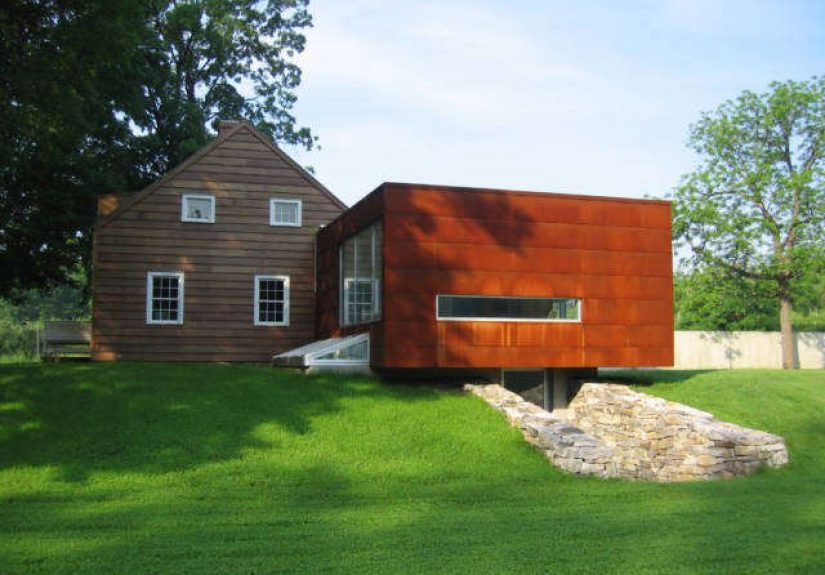
In suburban renovation projects associated with the studiooften in places where traditional homes dominatethe firm has shown a consistent ability to connect old and new. A recurring theme is preserving a home’s essential character while adding a modern volume that clearly belongs to “now.” Rather than disguising additions as fake-historic, they tend to articulate the new work honestly: clean geometry, contemporary windows, and warm modern cladding that complements (instead of copying) the original structure.
This is where their “poetic pragmatism” shows up in everyday life. Renovations have real constraints: budgets, existing walls, mechanical systems, family routines, school backpacks that multiply overnight. The firm’s planning approachorganize function, concentrate storage, simplify circulationhelps older homes feel current without stripping them of identity.
Junegrass House in Jackson, Wyoming: tradition, re-edited
In mountain contexts, Messana O’Rorke has explored a different kind of restraint: working with traditional materials and forms (stone, wood, pitched roofs) while maintaining modern space planning and crisp detailing. The challenge is obvious: when guidelines and vernacular expectations exist, “modern” can easily turn into “modern-ish, but nervous about it.”
The studio’s approach tends to be to respect the familiar silhouette while updating the experiencecleaner transitions, stronger indoor-outdoor relationships, and an interior language that feels contemporary without fighting the setting. Done well, this creates a house that feels grounded, not trendya home that can look right in ten years, not just on launch day.
What Designers (and Homeowners) Can Learn From Messana O’Rorke
Edit the plan before you decorate the plan
A lot of design advice starts with finishes. Messana O’Rorke’s work suggests the opposite: start with circulation and program clarity. If your path from entry to kitchen to living area is clean, your home feels calmereven before the first throw pillow arrives.
Use “containers” to control clutter
If you can’t make clutter disappear, you can at least make it behave. Built-in volumesstorage walls, concealed kitchens, sleeping pods, integrated cabinetrylet the rest of the space stay visually quiet. This is particularly useful in apartments, pied-à-terres, and compact family homes.
Limit materials, then invest in quality
A restrained palette doesn’t mean boring. It means you can afford to care about the millwork profile, the stone seam alignment, the sheen of the metal, and the way daylight changes the surface through the day. Fewer materials also tends to read as more timeless, which is great news if you don’t want your home to feel like a 2024 trend moodboard in 2027.
Why the Messana O’Rorke Approach Feels So Current
Today’s design culture is pulled in two directions: on one side, maximalism and personality; on the other, wellness-driven calm and “quiet luxury.” Messana O’Rorke sits comfortably in the second laneyet their best work avoids sterility. The calm comes from order, craft, and thoughtful sequence, not from wiping a room of identity.
Their projects also align with a practical sustainability argument: spaces built around durable materials, timeless planning, and long-term flexibility are less likely to be renovated again in five years. In an era where attention is expensive and noise is free, a well-planned quiet space is starting to feel like the ultimate luxury.
Experiences: What It Feels Like to Live With Messana O’Rorke Design
The following experience-style snapshots are compositesbased on commonly published descriptions of Messana O’Rorke projects and the way their signature moves tend to affect daily life. Think of them as a guided “how it lands” tour, not a diary.
1) Walking into a small apartment that suddenly has chapters
You open the door expecting the usual studio problem: one room trying to do five jobs, with the bed always in frame like an uninvited extra. Instead, the space gives you a sequence. There’s a moment to arrivean entry that doesn’t immediately dump you into everything you own. You move forward and the plan feels deliberate, almost paced, as if the apartment is saying, “Relax. I’ve got a system.”
Then you notice the volumethe “container” that anchors the layout. In the Jewel Box spirit, it’s not just storage; it’s an organizing idea. The bed doesn’t dominate the room; it has its own contained presence. That one move changes behavior. You’re more likely to tidy up because the space rewards it, and less likely to let clutter sprawl because it has fewer places to sprawl into. The apartment feels a bit like wearing a tailored jacket: it doesn’t make you a different person, but it does make you stand differently.
2) Shopping in a store where the product looks louder than the architecture
In a Messana O’Rorke retail environment, you often get the sensation that the room is intentionally stepping back so the merchandise can step forward. You don’t need fifteen signs yelling, “LOOK HERE!” because the geometry and contrast do the guiding. Dark surfaces can make a space feel intimate, but here they also act like a stage backdropclean, controlled, and a little mysterious. White packaging looks sharper, colors read more saturated, and the whole scene feels curated rather than crowded.
The experience isn’t only visual; it’s behavioral. Clear organization makes browsing feel easy, not overwhelming. You can scan, compare, and decide without feeling rushed by clutter. And because the palette is disciplined, your attention goes to what you came for: the products, the scent, the texture of packaging in your hands. It’s a subtle trick: you leave remembering the brand, not the drywall.
3) Living in a renovated home where “new” doesn’t erase “old”
Renovations can be emotionally complicated. People want modern function, but they also want the home to feel like it belongson the street, in the town, and in their own memory. In the Rutherford-style scenario, you might see a familiar older house paired with a contemporary addition that doesn’t pretend to be historic. Instead of awkwardly mimicking the past, the new work shows confidence: clean lines, honest materials, and modern openings placed where they make sense for light and privacy.
Day to day, this kind of planning changes the rhythm of family life. Storage is more intentional, circulation is clearer, and the “pinch points” disappearthose places where everyone collides because the house wasn’t built for today’s routines. You still feel the charm of the original structure, but you also feel the relief of modern space planning. It’s the difference between loving a vintage car for its beauty and actually wanting to drive it every day.
4) Morning light in a mountain home that feels both rugged and refined
In a setting like Jackson, Wyoming, the outdoors is the main character. A Messana O’Rorke approach tends to respect that by making the architecture feel groundedstone, wood, familiar rooflineswhile ensuring the interior experience is crisp and contemporary. Morning light becomes part of the design. You notice how shadows move across restrained surfaces, how a window placement frames landscape like a photograph you can walk into, and how the rooms feel composed without being precious.
The biggest “experience” shift is a sense of calm competence. The home feels ready for real lifemuddy boots, busy schedules, quiet eveningswhile still delivering moments of beauty that don’t require a special occasion. That’s the secret sauce: design that’s elevated, but not fragile; minimal, but not empty; quiet, but never dull.
Conclusion
Messana O’Rorke has earned its place in contemporary American architecture and interior design by proving that minimalism can be warm, functional, and emotionally resonant. Through disciplined planning, concentrated “containers,” and carefully edited materials, the studio creates spaces that feel calm without feeling cold. Whether it’s a micro apartment with a bold internal volume, a retail environment that lets the product shine, or a renovation that balances history with modern clarity, the through-line is consistent: order, craft, and a quietly confident sense of place.