Table of Contents >> Show >> Hide
- Quick verdict
- What the “AI Jet Ultra” actually is
- Key specs at a glance
- Design and setup
- Performance on real floors
- Pet hair test: can it defeat the tumbleweed?
- Smart features: useful AI vs. “my vacuum is texting me”
- Battery life and charging
- Filtration and allergy-friendliness
- Maintenance and ownership costs
- How it compares to the usual suspects
- Who should buy it
- Who should skip it
- Final thoughts
- Real-life cleaning experiences: 10 moments that tell you if it fits your home
- 1) The morning “pet glitter” sweep
- 2) The kitchen crumb festival after one snack
- 3) The couch cushion situation
- 4) The rug that eats vacuums
- 5) The baseboard dust line nobody admits exists
- 6) The stairs: the great cordless vacuum audition
- 7) The car cleanup that always gets postponed
- 8) Allergy season “fine dust” paranoia
- 9) The “I cleaned… but it doesn’t feel clean” problem
- 10) The household behavior change
Some vacuums clean your floors. Others clean your floors and quietly judge you for owning three rugs, two cats, and a dog who sheds like it’s a competitive sport.
Samsung’s AI Jet Ultra is firmly in the second categoryan unapologetically premium cordless stick vacuum that tries to solve the two biggest daily-cleaning annoyances:
(1) pet hair that multiplies overnight and (2) emptying dustbins that puff a tiny dirt-cloud into your face like a cartoon prank.
The headline promise is big: ultra-high suction, AI-driven adjustments across floor types, a self-emptying dock (Samsung calls it the All-in-One Clean Station),
and a pet-focused tool lineup that’s clearly designed by someone who has met… a golden retriever.
Here’s the fun part: when this vacuum is “on,” it feels like Samsung looked at the cordless stick category and said, “What if we made it a little extra?”
Then they hit “save” and shipped it.
Quick verdict
If you want the best parts of a cordless stick vacuum plus the convenience of an auto-empty station, the Samsung AI Jet Ultra is a standoutespecially for pet homes.
Its biggest wins are powerful cleaning performance, smart auto-adjustments that reduce the “dial fiddling,” and a dock that makes maintenance dramatically less gross.
The biggest downsides are price, ongoing bag costs, and the reality that “AI” helps most when you want conveniencenot when you expect it to magically remove every rug-tassel-related struggle.
What the “AI Jet Ultra” actually is
In the U.S. market, “AI Jet Ultra” generally refers to Samsung’s Bespoke AI Jet Ultra cordless stick vacuum lineuppaired with the All-in-One Clean Station
that charges the vacuum and automatically empties the dustbin into a disposable bag.
It’s positioned as a flagship model above earlier Bespoke Jet and Bespoke Jet AI versions, with upgraded AI Cleaning Mode (2.0) and higher advertised suction.
Key specs at a glance
- Class-leading advertised suction: marketed up to 400AW (Samsung also describes it as up to 400W in some materials)
- AI Cleaning Mode 2.0: adjusts suction and brush behavior based on floor conditions
- All-in-One Clean Station: auto-empties the onboard bin into a bag and acts as a charger
- Runtime: up to 100 minutes on the lowest setting (real-world runtime drops as power increases)
- HEPA + multi-layer filtration: designed to reduce dust escaping back into the air
- “Pet-ready” accessories: includes a dedicated pet tool and multi-surface floorheads
Design and setup
Unboxing: a vacuum with accessories for your accessories
Samsung doesn’t do “minimalist” here. The AI Jet Ultra is built to be a whole-home system: stick configuration for floors, handheld mode for furniture and cars,
plus multiple floorheads and detail tools for corners, edges, baseboards, and “how did dust get there?” places.
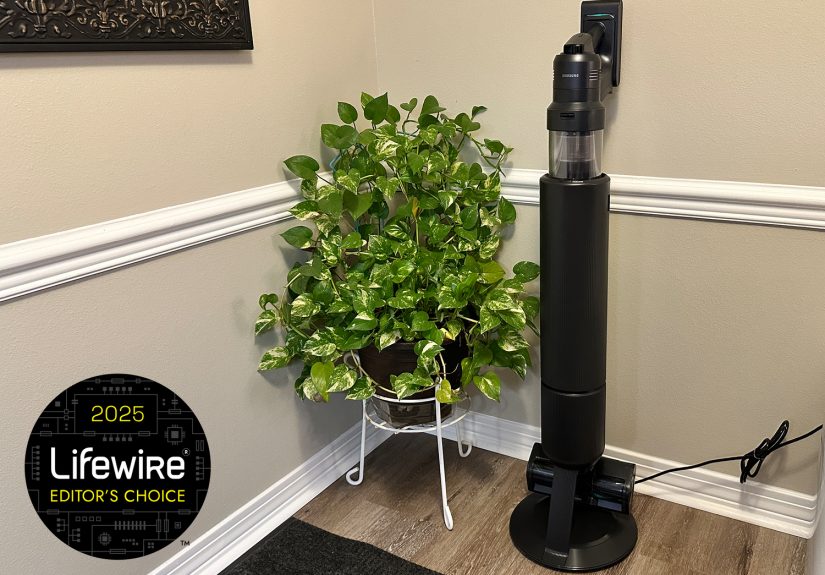
The dock is a major part of the product experience. Instead of tossing the vacuum into a closet, you’re meant to park it on the station after each cleanup.
That changes behavior in a good way: quick daily runs become easier because you’re not mentally budgeting time for emptying the bin.
One very modern quirk: several reviewers note setup leans heavily on QR codes and videos rather than a traditional printed manual.
It’s not complicated, but it can feel like the vacuum is asking you to join a small cleaning-themed streaming service before you can vacuum your hallway.
All-in-One Clean Station: the “no dust cloud” lifestyle
Here’s the feature that earns the word “premium”: you finish cleaning, park the vacuum on the station, and it automatically empties the dust cup into a sealed bag.
The result is less contact with dust and fewer trips to the trash.
The onboard bin is relatively small (as most stick vacs are), but the station’s capacity is much largermeaning you can go a while before you have to deal with disposal.
In practical terms, this is the difference between “I’ll vacuum later” and “fine, I’ll do it now.”
Performance on real floors
Hardwood and tile: the “crumb Olympics”
On hard floors, strong suction mattersbut brush design matters just as much.
The AI Jet Ultra’s multi-surface heads aim to pick up fine dust without sending larger crumbs skating across the floor like they’re trying to escape the scene.
In everyday use, this shows up when you clean around pet bowls, entryways, and kitchensthe places that generate debris with suspicious consistency.
The AI behavior is most useful here when your home has a mix of surfaces.
Instead of manually toggling up and down, the vacuum can adapt as you move from tile to area rug to hardwood, keeping you in a steady cleaning rhythm.
Carpet and rugs: from low pile to “shag regrets”
Carpet is where flagship cordless vacuums try to justify their price.
Samsung’s AI Cleaning Mode 2.0 is designed to recognize different cleaning environments and adjust suction and brush speed accordingly.
With the Active Dual Brush, Samsung says the vacuum can detect whether carpet is normal pile or long pile, and tune its behavior.
In plain English: on low-to-medium carpet, you can expect strong pick-up for tracked-in grit and pet hair.
On thicker rugs, you may still prefer choosing a manual setting (or switching heads) when you want maximum agitation and suctionbecause deep pile can be a workout for any cordless stick vacuum.
Think of AI as a great autopilot, not a teleportation device.
Pet hair test: can it defeat the tumbleweed?
Samsung clearly expects many buyers to have petsand it shows.
Multiple reviews highlight that this vacuum handles pet hair well on both hard floors and carpet, and that the dedicated pet tool helps with upholstery and rugs.
If you live with shedding animals, you already know the real enemy isn’t “dirt.” It’s hair that wraps, clumps, and reappears five minutes after you cleaned.
The most satisfying use case is the quick “daily sweep” after your dog has done a lap around the living room, or after your cat has hosted a private shedding party on the couch.
The vacuum’s ability to shift power when it senses changing resistance (like moving from bare floor to carpet) can reduce the number of passes you need.
One more pet-house perk: the docked auto-empty process reduces the mess of emptying hair and dust by hand.
It’s louder than normal vacuuming for a few seconds, but it’s also fastand it avoids the classic “dust puff + hair confetti” moment over the trash can.
Smart features: useful AI vs. “my vacuum is texting me”
AI Cleaning Mode 2.0: what it senses and why it matters
AI Cleaning Mode 2.0 is the practical “brains” of the vacuum.
Samsung describes it as sensing brush load and air pressure, classifying multiple cleaning environments, and automatically adjusting suction and brush speed
to maintain performance while using power more efficiently.
In everyday terms, it aims to deliver a strong clean without burning through the battery unnecessarily.
The best-case scenario is exactly what busy households want: you start cleaning, the vacuum “reads the room,” and you keep moving without micromanaging settings.
That’s especially helpful for multi-surface homes, or for people who vacuum in short bursts (because: pets, kids, life).
SmartThings + LCD notifications
Samsung ties the AI Jet Ultra into SmartThings, and the vacuum itself includes an LCD control panel that shows the usual info (battery, power mode),
plus some very Samsung-style extras.
Yes: some coverage notes it can show call/text notificationsand in certain setups, it can even integrate with your phone ecosystem.
Is that essential? No.
Is it slightly hilarious to imagine answering a call while vacuuming and shouting over the motor like you’re reporting live from a hurricane? Absolutely.
The more valuable “smart” piece is maintenance guidance and the overall ecosystem integrationespecially if you already use SmartThings.
Battery life and charging
Samsung promotes long runtimeup to 100 minutesunder best-case conditions (lowest power setting, and typically with a non-motorized tool).
In real homes, runtime depends on power mode and floor type.
The good news is that reviewers commonly describe the battery behavior in a way that makes sense:
low settings can cover large areas, while higher settings are there for deep cleaning and stubborn messes.
One review breaks down approximate usage time by mode: low can hit the advertised long runtime, while mid, max, and turbo-like modes shorten it significantly.
Charging is not instant. Retail specs list a charge time in the neighborhood of several hours.
That’s normal for a high-powered cordless stick vacuum, but it reinforces the “dock it after every use” routine.
Filtration and allergy-friendliness
Filtration is one of the most important (and most misunderstood) parts of a vacuum.
Strong suction is greatunless the vacuum also blasts fine dust back into the air.
Samsung describes a multi-layer filtration system and HEPA filtration designed to capture very small particles and reduce dust escaping during use.
The Clean Station helps here, too, because it reduces how often you manually dump debris.
If you’re sensitive to dust, the convenience is also a comfort feature.
Just remember: even a great filtration system needs maintenance.
Washable filters are only “washable” if you actually wash themand if you let them fully dry before reinstalling.
Maintenance and ownership costs
Premium cordless vacuums often hide their long-term costs in accessories. For the AI Jet Ultra, the main ongoing cost is disposable dock bags.
If you vacuum daily (hello, pet households), you’ll go through bags faster than someone who vacuums once a week.
On the plus side, the vacuum is designed to be relatively easy to maintain:
parts and filters can be cleaned, and the system can prompt you when something needs attention.
Think of it as a vacuum that wants to be a relationship: it communicates, it asks for upkeep, and if you ignore it, performance suffers.
How it compares to the usual suspects
Samsung AI Jet Ultra vs. Dyson Gen5 Detect
Dyson is the benchmark name in high-end cordless sticks, and comparisons are inevitable.
The AI Jet Ultra’s major differentiator is the self-emptying Clean Station and broader “system” approach.
If you want minimal hands-on emptying and a sleek docked experience, Samsung is playing a different game than a typical “hang it on the wall and dump the bin” model.
In raw cleaning, both brands target top-tier performance.
The smarter decision often comes down to your cleaning style: do you want a powerful cordless vacuum, or do you want a powerful cordless vacuum plus a low-maintenance dock routine?
Vs. Shark auto-empty sticks and other value picks
Value-focused competitors can offer auto-empty docks at much lower prices.
The tradeoff is often refinement: noise, materials, UI, accessory design, and how “polished” the dock experience feels.
Samsung’s pitch is that this is an appliance-grade flagshipsomething you don’t hide, and something that’s engineered to be a daily driver.
Who should buy it
- Pet households that vacuum frequently and want a dock that reduces dust and hair handling
- Multi-surface homes where AI adjustments save time and reduce constant mode switching
- People who hate emptying bins and want a more hands-off maintenance routine
- SmartThings users who like ecosystem integration and device diagnostics
Who should skip it
- Budget shoppers: you can get excellent cleaning for less if you don’t need a premium dock and flagship extras
- Small-space minimalists: if your home is small and you vacuum rarely, you may not benefit from the full system
- Anyone allergic to “ongoing costs”: dock bags are convenient, but they’re still a consumable expense
Final thoughts
The Samsung AI Jet Ultra is what happens when a company treats a cordless vacuum like a flagship smartphone:
high specs, high polish, smart automation, and a “premium lifestyle” dock that changes how you use it every day.
If you have petsor you just want your floors to stop whispering “crumbs” every time you walk into the kitchenthis vacuum makes daily cleaning easier to start and easier to finish.
Is it overkill? For some homes, yes.
But if you’re the kind of person who wants one vacuum that can handle quick pickups, deep cleaning, upholstery, baseboards, and car interiors
and you want the emptying process to be basically invisiblethis is one of the most compelling “smart, pet-ready” cordless systems currently on the market.
Real-life cleaning experiences: 10 moments that tell you if it fits your home
Below are “real-life” scenarios pulled from typical reviewer testing patterns and everyday household realitiesbecause specs are cute, but your dog’s shedding schedule is undefeated.
1) The morning “pet glitter” sweep
You wake up, walk into the hallway, and the sunbeam reveals what can only be described as airborne fur drama.
This is where a docked cordless vacuum shines: you grab it, do a five-minute run, dock it, and the station empties everything so you don’t have to.
The convenience isn’t just timeit’s psychological. You’re more likely to clean because the finish line is painless.
2) The kitchen crumb festival after one snack
Someone eats toast. Suddenly the floor looks like it hosted a tiny bread convention.
On hard floors, strong suction plus a good floorhead is what prevents the “crumb snowplow” effect.
AI adjustment helps when you move from tile to a runner rug without thinking about it.
This is the exact kind of low-drama cleanup that turns a vacuum into an everyday tool instead of a weekend event.
3) The couch cushion situation
Pet hair on upholstery is personal. It clings. It mocks lint rollers.
Switching to handheld mode with a pet tool (or mini motorized tool) is the difference between “I kind of improved it” and “okay, that looks normal again.”
The best part of a premium attachment kit is not that you use every tool dailyit’s that the right tool exists when a mess gets specific.
4) The rug that eats vacuums
Every home has one rug that behaves like a treadmill on max incline.
AI mode can help, but sometimes the smarter move is manual control: drop suction slightly so the head glides, then do a second pass if needed.
The flagship advantage here is that you have enough power in reserve to choose the right balance rather than feeling stuck at “weak” or “stuck to the floor.”
5) The baseboard dust line nobody admits exists
Stick vacuums are secretly baseboard specialistsespecially in handheld mode with a crevice tool.
This is where the “I’ll just do the edges real quick” habit forms, and once you start doing it,
it becomes extremely hard to stop because the before/after is so satisfying.
6) The stairs: the great cordless vacuum audition
Stairs reveal everything: weight balance, handheld usability, and whether your vacuum can deal with corners.
A model that feels “light enough” matters here. Even if the listed weight is similar to competitors, a good handle design makes the experience less tiring.
If you vacuum stairs weekly, the AI Jet Ultra’s system approach (tools + dock) is genuinely valuable.
7) The car cleanup that always gets postponed
The moment you realize you can vacuum your car quicklywithout extension cords and without fighting a heavy canister
is the moment you become the kind of person who actually vacuums their car.
Handheld mode with the right attachments turns this into a 10-minute win instead of a Saturday chore.
8) Allergy season “fine dust” paranoia
If you’re sensitive to dust, you notice when a vacuum smells dusty or puffs air in a way that feels… suspicious.
A sealed, multi-layer filtration design paired with an auto-empty station can reduce exposure compared to dumping a bin by hand.
The real-life takeaway: you still need to maintain filters, but the system makes cleaner ownership easier.
9) The “I cleaned… but it doesn’t feel clean” problem
Sometimes floors look okay, but grit still clings in carpet fibers.
This is where higher power modes earn their keepused strategically, not constantly.
A smart routine is to do everyday cleaning in AI or mid, then use max/boost mode as a targeted tool for entryways, pet beds, and high-traffic lanes.
10) The household behavior change
The most overlooked “experience” is how the product changes your habits.
When a vacuum lives on a nice-looking dock and empties itself, you clean more often in shorter bursts.
That’s the real premium value: you stop needing marathon cleaning sessions because the mess never gets the chance to become a personality.