Table of Contents >> Show >> Hide
- Solar flares: the “flashbang” that hits radio first
- The NOAA “R-scale” in plain English
- Radio communications: who’s actually vulnerable?
- CMEs and geomagnetic storms: when electronics feel the aftershock
- So… how precarious are we, really?
- What professionals do when the Sun starts acting spicy
- What to watch for without becoming “that friend who blames everything on solar flares”
- The “big one”: realistic risk without the movie trailer voice
- Bottom line: precarious in the seams, not in the gadgets
- Experiences from the field: when the Sun steals your signal (and your patience)
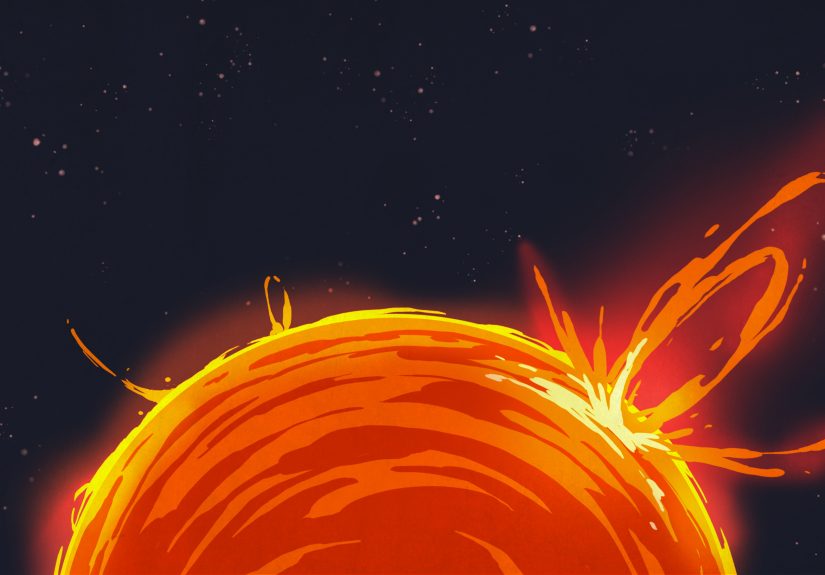
The Sun is a giant fusion furnace that mostly behaves like a dependable lightbulb. Mostly.
Every so often it throws a cosmic tantruman outburst of radiation and particles that can make
Earth’s upper atmosphere act like a bad Wi-Fi router in a crowded coffee shop: unpredictable,
moody, and suddenly “not connecting.”
Solar flares can black out high-frequency (HF) radio on the sunlit side of Earth in minutes.
Coronal mass ejections (CMEs) can arrive later and stir up geomagnetic storms that rattle GPS accuracy,
stress satellites, and push unwanted currents through long conductors like power lines.
So how precarious are our electronics, really? The honest answer: more resilient than doom headlines imply,
but more fragile than most of us realizeespecially when we stack modern life on top of precise timing,
satellite links, and “just-in-time everything.”
Solar flares: the “flashbang” that hits radio first
A solar flare is a sudden release of energy from the Sun’s atmosphere, blasting out intense
X-rays and extreme ultraviolet (EUV). Those wavelengths travel at the speed of light, so if a flare
erupts on the Sun-facing side, Earth’s upper atmosphere gets the message in about eight minutes.
Here’s the key: HF radio (roughly 3–30 MHz) relies on the ionospherelayers of charged particles
high above Earthto refract signals so they can travel far beyond the horizon. A strong flare rapidly increases ionization
in the lower ionosphere (the D-region), which is excellent at absorbing HF signals. Translation:
your signal doesn’t “bounce” nicelyit gets soaked up. Operators call it a shortwave fadeout.
NOAA’s space-weather products even map this absorption in near real time (because nothing says “fun” like watching
the sky quietly turn your radio into a very expensive paperweight).
What a radio blackout feels like
- It’s fast. HF can degrade within minutes of the flare’s peak.
- It’s lopsided. The sunlit side gets hit hardest; the night side may keep working.
- It’s frequency-dependent. Lower HF frequencies tend to get clobbered first.
- It’s usually short. Many flare-driven HF blackouts last minutes to a couple hours, not days.
The NOAA “R-scale” in plain English
NOAA classifies flare-driven radio blackouts using the R-scale (R1 to R5), based largely on X-ray intensity.
It’s a practical way to translate “the Sun did a thing” into “your HF link might be toast.”
| Level | Nickname | Typical HF impact (sunlit side) | Real-world consequence |
|---|---|---|---|
| R1 | Minor | Weak to minor degradation; occasional loss | Annoying dropouts, especially on lower HF |
| R2 | Moderate | Limited blackout; tens of minutes | Scheduled check-ins fail; backups suddenly matter |
| R3 | Strong | Wide-area blackout; about an hour | Polar and oceanic HF routes feel the pain |
| R4 | Severe | HF blackout; hours | Operational workarounds kick in (reroutes, alt comms) |
| R5 | Extreme | Complete HF blackout; prolonged | Rare, but the kind that turns plans into improvisation |
Important nuance: the R-scale is about the flare’s immediate radiation effects, not the later impact from CMEs.
Think of it like this: flare = instant flash, CME = later shove.
Radio communications: who’s actually vulnerable?
HF: the canary in the solar coal mine
HF is both amazingly useful and hilariously sensitive. It can cross oceans with modest power and a decent antenna,
which is why it still matters for aviation over oceans, maritime operations, emergency preparedness, and amateur radio.
But it also depends on the ionosphere behaving nicelyan arrangement the Sun did not sign a long-term lease for.
Aviation: polar routes and oceanic comms
Airlines and air-traffic systems plan around multiple communication methods, but HF remains important in regions where
line-of-sight systems aren’t available. The FAA explicitly flags space weather as a risk to aviation communications,
noting that solar events can degrade or black out frequencies, and that polar and oceanic regions are especially susceptible.
Public safety and “the boring stuff we depend on”
After the May 2024 G5 geomagnetic storm, the FCC’s Public Safety and Homeland Security Bureau even sought information about
communications disruptions in the U.S. sectoran unusually direct reminder that space weather isn’t just a ham-radio hobby topic.
It can show up in the real world where reliability is non-negotiable.
What about VHF/UHF, cell networks, and the internet?
Most everyday terrestrial systemscell towers, fiber internet, Wi-Fidon’t depend on ionospheric “skywave” propagation,
so they won’t fail just because HF fades out. That said, space weather can still create knock-on effects:
- GNSS timing dependencies: cellular and network synchronization can lean on GPS timing.
- Satellite backhaul: some remote connectivity depends on satellites that may be affected.
- Power reliability: severe geomagnetic storms can stress grids, and power loss is the ultimate “network outage.”
CMEs and geomagnetic storms: when electronics feel the aftershock
A flare is the flash. A coronal mass ejection (CME) is the shove: a huge cloud of magnetized plasma that can
reach Earth in roughly one to three days (sometimes faster). When a CME’s magnetic field couples efficiently with Earth’s,
it can drive a geomagnetic storm.
NOAA rates geomagnetic storms on the G-scale (G1 to G5). These storms can:
increase atmospheric drag (affecting satellite orbits), disrupt radio and navigation signals, and induce currents in long conductors.
Power grids: long wires are basically antennas for trouble
The electric grid is not “electronics” in the smartphone sense, but it’s the foundation that powers every other electronic system.
During geomagnetic disturbances, changing magnetic fields can induce a geoelectric field in the ground that drives
geomagnetically induced currents (GICs) through long transmission lines and transformers.
NERC standards address this because GICs can contribute to transformer heating, reactive power issues, and, in worst cases,
cascading problems that threaten reliability.
Satellites: radiation, charging, drag, and the occasional bad day
Satellites face two big space-weather headaches:
(1) energetic particles that can cause anomalies in electronics, and
(2) storm-time changes in Earth’s upper atmosphere that increase drag in low Earth orbit.
Operators manage risk with forecasting, safe modes, and operational constraintsbecause replacing a satellite is the
world’s most expensive “have you tried turning it off and on again?”
GPS and GNSS: accuracy depends on a calm ionosphere
GPS signals pass through the ionosphere, and space weather can change the ionosphere’s density and structure.
The result can be degraded positioning accuracy, signal scintillation (rapid fluctuations), and temporary loss of lock in some conditions.
NOAA summarizes multiple pathways for space weather to impact GPS, from altered signal paths to disturbed ionospheric conditions.
A memorable recent example: NOAA described how the May 2024 G5 storm coincided with GPS issues during a key U.S. planting period,
highlighting potential economic consequences when precision agriculture loses reliable positioning at the wrong time.
So… how precarious are we, really?
“Precarious” depends on what you mean:
1) Your toaster is probably fine
Household electronics aren’t directly fried by ordinary solar flares. The atmosphere protects us from much of the radiation,
and the biggest direct risk to consumer devices is usually indirectlike a power outage or a GPS-dependent service getting wobbly.
2) The systems that stitch modern life together are the real concern
Space weather targets connectivity and coordination:
radio links that bridge oceans, satellites that route data, and timing signals that synchronize networks and finance.
That’s why agencies focused on critical infrastructure treat extreme space weather as a real hazard.
CISA notes that extreme events could degrade critical infrastructure and disrupt power and communications networks.
3) We’re not helplessthere’s a whole playbook
The good news is that space weather is not a surprise category. NOAA and NASA monitor it continuously, publish alerts,
and run exercises and planning efforts with stakeholders. FEMA has also outlined operational concepts for impending space-weather events,
reflecting a recognition that planning and coordination are the difference between “inconvenient” and “cascading.”
What professionals do when the Sun starts acting spicy
Space-weather monitoring and forecasting
Space weather is tracked with spacecraft observations and ground monitoring. NOAA’s Space Weather Prediction Center provides alerts,
and NASA highlights how space weather affects technologies from satellites to power grids. The goal isn’t perfect prediction
(space is rude like that), but actionable lead time.
Operational mitigations by sector
- Aviation: use advisories, adjust procedures for polar operations, and lean on alternate comms and routes when needed.
- Power grid operators: monitor storm conditions, adjust operations, and follow reliability standards designed for GMD events.
- Satellite operators: manage charging risk, delay sensitive maneuvers, watch drag increases, and prioritize safe-mode strategies.
- GNSS-heavy industries: use multi-frequency receivers, augmentation systems, and cross-checks (because “trust, but verify” is a lifestyle).
- Radio operators: plan band/frequency flexibility and maintain fallback paths when HF is absorbed.
Design-level resilience: the unglamorous hero
A lot of resilience comes from boring engineering choices:
shielding, redundancy, surge protection, transformer design considerations,
diversified comms paths, and procedures that assume things will break sometimes.
The National Academies have repeatedly emphasized the broad societal reliance on space-weather awareness and the risks to
sectors like power, satellites, and navigation/timing.
What to watch for without becoming “that friend who blames everything on solar flares”
Space weather can be dramatic, but it’s also easy to over-credit it. A helpful mental model:
- If HF dies suddenly on the sunlit side: suspect flare-driven absorption (R-scale territory).
- If GPS is jumpy and auroras are widespread: suspect geomagnetic storm conditions (G-scale territory).
- If polar routes and high-latitude comms struggle for longer stretches: energetic particle effects may be involved.
And if your Bluetooth headphones cut out? That’s probably not the Sun. That’s just 2026 being 2026.
The “big one”: realistic risk without the movie trailer voice
Severe space weather is rare, but not hypothetical. Solar Cycle 25 has been active enough that NOAA and NASA have provided updated
cycle expectations and “solar maximum” messaging, while NOAA’s cycle progression products show that peak conditions can land within a range
rather than a single tidy date. In other words: there’s a lot of solar “weather,” and the odds of disruptive events rise when the Sun is busy.
The practical question isn’t “Will civilization end?” It’s:
How many critical services share the same hidden dependencies?
If GPS timing blips, can systems fail gracefully? If HF is out, is there a backup route?
If satellites experience anomalies, are there alternate pathways? Resilience lives in those answers.
Bottom line: precarious in the seams, not in the gadgets
Solar flares and geomagnetic storms mostly attack the connectionsradio links, satellite services, timing signals,
and long conductorsnot your laptop’s soul. Modern infrastructure is more robust than popular panic suggests, but it’s also
more intertwined than most people appreciate. The vulnerability is less “everything fries” and more
“a few stressed systems can create a cascade if nobody planned for a bad space-weather day.”
Fortunately, people have planned. Agencies monitor, sectors train, standards evolve, and operators keep learning.
The Sun will keep throwing curveballs. The goal is to keep them from becoming a knockout punch.
Experiences from the field: when the Sun steals your signal (and your patience)
Ask anyone who’s spent time around HF radiopilots on polar routes, maritime operators, emergency comms volunteers, or
amateur radio folks chasing long-distance contactsand you’ll hear a familiar story arc:
everything is fine, then suddenly it isn’t, and the explanation is somewhere between physics and dark humor.
One common experience is the “clean fade” that doesn’t feel like normal interference. There’s no slow creep of static,
no obvious local noise source, no storm rolling in on the horizon. Instead, a band that was lively ten minutes ago
goes eerily quiet. Stations that were strong vanish as if someone pulled a plug on the sky. That’s often the signature
of D-region absorption ramping up during a flare: it doesn’t politely degrade; it can remove your path.
Another classic moment: the scramble for alternatives. In aviation and maritime contexts, that can mean moving to other
frequencies, shifting to different comms systems, or changing operational expectations until conditions improve.
In emergency communications exercises, it’s the moment when the plan stops being a checklist and becomes a conversation:
“What still works? What’s our next best path? Who needs to know right now?” The most seasoned operators don’t panic;
they pivotbecause they’ve seen enough “perfectly timed” failures to treat redundancy like a personality trait.
GPS-dependent professionals have their own version of this story. Surveyors, precision agriculture operators, drone teams,
and logistics crews sometimes describe storm-time GNSS as “rubber-band positioning”everything looks normal, then the solution
jumps, drifts, or loses lock in bursts. The frustrating part is that the equipment isn’t broken; it’s doing its best with a
signal path traveling through an atmosphere that’s temporarily more chaotic than usual. The best teams respond with cross-checks,
tolerances, and procedures that treat GNSS as one inputnot the only truth in the universe.
Satellite operators and space-industry folks talk about space weather with the calm tone of people who’ve learned that
“invisible” does not mean “harmless.” A geomagnetic storm can change drag enough to complicate orbit predictions,
which then triggers extra tracking, updated conjunction assessments, and operational caution. The lived experience here isn’t
cinematic sparks flying from panelsit’s more like a long night of monitoring dashboards, adjusting timelines, and deciding which
maneuvers can wait until conditions settle down.
And then there’s the emotional reality: space weather is humbling. It reminds even the most tech-forward teams that the
“environment” isn’t just rain and windit’s also plasma, magnetic fields, and radiation. The people who handle it best tend to
share two habits: they pay attention to alerts, and they keep options open. If you want a practical takeaway from all these
experiences, it’s this: the Sun doesn’t have to break everything to break your plan. A short-lived blackout at the wrong time,
or a timing glitch in a tightly coupled system, can be enough. The winners are the ones who design and operate as if the sky
occasionally changes the rulesbecause it does.