Table of Contents >> Show >> Hide
- The Viral Moment: What Happened With Sinner’s Bag
- Sinner’s Response: Calm, Direct, and (Unfortunately) Necessary
- Why This Went Viral: Tennis Is Intimate, and the Internet Is Hungry
- US Open Crowd Behavior: The Bigger Pattern Behind the Bag Moment
- What Tournaments Can Do (Without Turning Tennis Into Airport Security)
- What Fans Should Take Away (Besides Towels, Ideally)
- Why Sinner’s Reaction Landed So Well
- Five Quick Lessons From the “Bag Moment”
- Experiences Related to the Topic: When Fandom Crosses the Line (Extra Section)
If you’ve ever watched the US Open, you know the vibe: tennis at maximum volume, celebrities in sunglasses at night,
and a crowd so close to the action you can practically hear the strings complain. Most of the time, that closeness is the sport’s charm.
Sometimes, though, it turns into a reality show subplot nobody asked forlike the moment a fan appeared to reach into
Jannik Sinner’s bag on live TV and instantly became the internet’s newest “main character.”
The clip didn’t go viral because it was dramatic in the Hollywood sense. It went viral because it was weirdly mundane and wildly invasive
at the same timelike watching someone try your front door handle while you’re standing right there holding groceries.
And when Sinner finally addressed it, his response was equal parts calm, practical, and painfully relatable:
sometimes what’s in an athlete’s bag isn’t just gear. Sometimes it’s… your whole life.
The Viral Moment: What Happened With Sinner’s Bag
A routine win, followed by a not-so-routine walk to the stands
The incident happened after Sinner’s fourth-round match at the 2025 US Open, where he steamrolled
Alexander Bublik in straight sets. Post-match, like many top players, he headed toward the stands to interact with fanshanding out
a towel, posing for a photo, doing the quick “thanks for coming, I see your sign, yes I will sign that” circuit.
It’s the kind of moment tournaments love because it humanizes stars and makes the expensive seats feel, well, worth it.
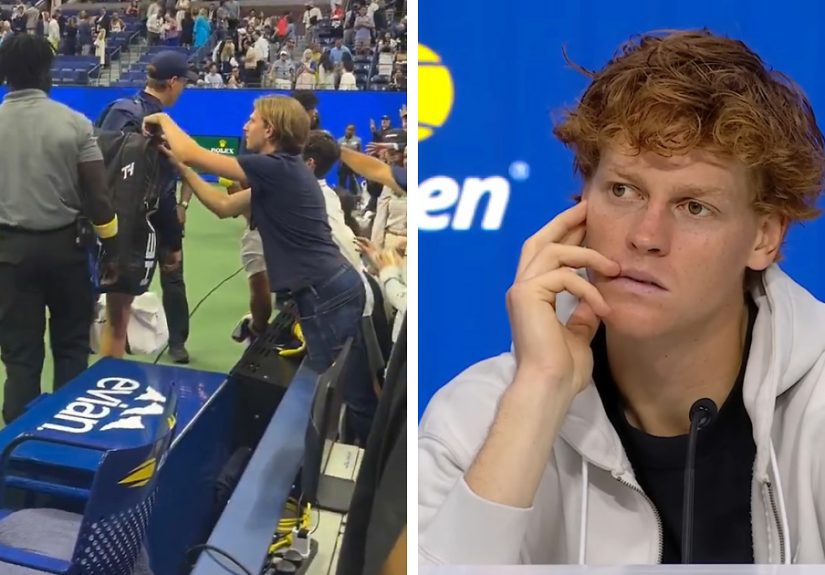
Then the camera caught a hand where it didn’t belong
As Sinner leaned in near the courtside crowd, a spectator appeared to reach toward the zipper area of Sinner’s bag.
Security intervened quickly, and the moment ended almost as soon as it startedwhich is part of why it spread so fast.
There was no chase scene, no dramatic tackle. Just a sudden “Waitdid he just…?” collective gasp and the universal internet reaction:
“Sir, absolutely not.”
Why it looked so bad (even if the intent wasn’t officially confirmed)
Here’s the thing: a courtside environment is not a garage sale, and a pro’s bag is not a “take one, leave one” bin.
Even if someone tried to argue it was a misunderstanding (good luck with that), reaching for a player’s belongings is a boundary violation.
And because the clip was filmed clearlybroadcast-quality, multiple angles, the whole HD experienceit became an instant “viral US Open moment”
in the way only modern sports oddities can.
Sinner’s Response: Calm, Direct, and (Unfortunately) Necessary
The “I checked straight away” detail that made everyone wince
Sinner addressed the incident after his next match, and he didn’t inflate it into some grand conspiracy or pretend it didn’t matter.
He went straight to the point: he checked to make sure nothing was takenbecause his bag isn’t just filled with racquets.
It also contains personal items he genuinely needs.
In other words: this wasn’t about a spare damp overgrip. This was about the kind of stuff that would ruin your whole week if it disappeared.
And when he mentioned those everyday items, the story shifted from “sports clip” to “oh wow, that’s unsettling.”
Because you can replace a racquet. Replacing your phone, wallet, IDs, cards, and the feeling of safety in your workspace?
That’s a different category of headache.
Praise for securityplus an important subtext
Sinner also credited security for reacting quickly and emphasized that on-court security at big tournaments helps players feel safe.
That’s a gracious response. It’s also a subtle reminder that even world-class athletes are still humans doing a job in public,
and the job goes better when people don’t treat them like props.
Why This Went Viral: Tennis Is Intimate, and the Internet Is Hungry
Courtside access meets content culture
Tennis is one of the few major sports where fans can get astonishingly close to athletes in real time.
That’s part of why it’s great. It’s also why it’s vulnerable.
Add the modern incentive structureeveryone filming, everyone posting, everyone trying to capture “the moment”and you get a pressure cooker
where good intentions can curdle into entitlement.
The Sinner bag incident wasn’t just a security story; it was a culture story.
The clip spread because it raised an uncomfortable question: are some fans starting to treat courtside access like backstage access?
Like paying for a ticket includes the right to touch, grab, or “collect” something that belongs to the athlete?
The souvenir economy doesn’t help
Sports memorabilia has always existed, but social media supercharged it.
A towel, wristband, ball, hatthese are no longer just souvenirs; they can become status symbols, collector items, or content bait.
When the desire for a keepsake becomes “I’m going to take this,” the line between fandom and theft starts to blur
(and, legally speaking, it stops being blurry real fast).
And yes, the bag itself is part of the story
Sinner’s relationship with luxury fashion has been a storyline of its own. He’s been known for bringing a designer bag courtside,
and the visibility of that bagcombined with the star power of the player wearing itadds another layer of temptation and attention.
But temptation isn’t an excuse; it’s the reason boundaries exist in the first place.
US Open Crowd Behavior: The Bigger Pattern Behind the Bag Moment
One headline is an incident. Multiple headlines are a trend.
The bag clip landed in an environment where “fans behaving badly” was already a running theme.
Around the same tournament period, another viral episode involved a grown man taking a hat intended for a young fan after a matchan incident
that sparked public backlash and apologies.
Different details, same underlying issue: some adults forgetting how to act in public when a camera is rolling and adrenaline is high.
Put these stories together and you get a tournament reality that’s tougher than it looks on TV:
event staff are not just managing a sporting event. They’re managing a massive crowd, thousands of emotions,
and the modern urge to turn everything into a personal storyline.
What Tournaments Can Do (Without Turning Tennis Into Airport Security)
1) Create clearer buffer zones for post-match interactions
Players want to interact with fansespecially kidsbut it works best when it’s structured.
A small roped-off lane, a controlled entry point, and a “hands visible” policy for people closest to the aisle can keep the moment fun
without making it risky.
2) Adjust the “bag proximity” problem
The simplest fix is also the least glamorous: keep the bag out of reach.
That could mean a staff member holds it during fan interactions, or the player hands it off before walking into the crowd.
It’s not about paranoia; it’s about removing opportunity.
3) Make consequences consistent
Viral incidents often spark the same debate: should the fan be banned? Escorted out? Charged?
The answer shouldn’t depend on how loudly the internet is yelling that day.
Clear policieswritten, posted, and enforcedcreate deterrence and protect the experience for everyone else.
What Fans Should Take Away (Besides Towels, Ideally)
The “do” list
- Do ask for autographs politely and accept “no” without making it weird.
- Do let kids have the front-row magic if you’re an adult with a full-time job and a credit score.
- Do remember that players are working, not browsing a meet-and-greet buffet.
The “please don’t” list
- Don’t touch a player’s bag, clothing, gear, or body. Ever.
- Don’t reach, grab, or “test the zipper” like you’re auditioning for a heist movie.
- Don’t assume your ticket includes ownership rights to anything within arm’s length.
Why Sinner’s Reaction Landed So Well
The most interesting part of the story wasn’t the attempted grabit was the response.
Sinner didn’t rant. He didn’t dunk on the fan. He didn’t turn it into a media circus.
He handled it like someone who’s focused on winning tennis matches, not winning internet arguments.
That calm reaction matters. Because when athletes respond with composure, it helps keep the story in the right frame:
not “look at this celebrity drama,” but “this is a safety and respect issue.”
And it reinforces a baseline truth: fans deserve access to the sport. Players deserve control over their personal space.
Those two things can coexistif everyone acts like an adult.
Five Quick Lessons From the “Bag Moment”
- Convenience is not consent. Being close enough to touch something doesn’t mean you should.
- Security is part of the show now. Not because tennis is dangerous, but because crowds can be unpredictable.
- Personal items make the story real. A phone and wallet in a bag changes the emotional math instantly.
- Structure protects fun. Controlled fan interactions can stay warm without becoming chaotic.
- Viral fame is not worth it. Becoming “that guy” on the timeline is a permanent life choice.
Experiences Related to the Topic: When Fandom Crosses the Line (Extra Section)
Most tennis fans have experienced the wholesome version of a post-match moment: the player walks over, signs a ball,
tosses a towel, snaps a quick photo, and the crowd leaves with a story that feels like a warm lightbulb in the memory.
That’s the magic tennis sellsaccess, intimacy, the sense that the sport still has human scale even when the stakes are enormous.
But the same closeness that creates those great stories can also create awkward, uncomfortable ones.
If you’ve ever stood courtside (or even just close enough in a stadium aisle), you’ve probably felt the tiny surge of possibility:
What if I could get a signature? What if I could get a ball? What if I could get noticed?
That feeling is normal. It’s part of being a fan. The problem starts when “possible” turns into “I’m entitled.”
For players, the experience is a constant balancing act. They want to reward the crowdespecially kidsbecause those moments
are good for the sport and genuinely meaningful. At the same time, they’re tired, sweaty, mentally fried, and often carrying their gear.
The walk to the stands is not just a stroll; it’s a transition between high-performance mode and human-interaction mode.
When someone reaches toward their belongings in that moment, it can create a jolt of suspicion that lingers longer than any autograph line.
Security staff live in that same tension. Their job isn’t to ruin fun. It’s to prevent the one “bad decision in the heat of the moment”
that can turn into a safety incident. And they have to do it fast, in a loud environment, while cameras capture everything.
If they step in too aggressively, people complain. If they step in too slowly, people complain louder.
The best security moments are the ones you barely noticequick intervention, minimal disruption, problem solved.
That’s exactly why the Sinner clip was so striking: you could see the intervention, and it reminded everyone that the line exists for a reason.
Fans also have their own complicated experiences in these moments. Some people travel across the country, save money for months,
and sit in those seats once in their lives. The temptation to “make it count” is real.
But “making it count” should look like cheering, respecting, and maybe getting lucky with a tossed souvenirnot treating the athlete’s bag
like it’s a prize chest in a video game. The best fan stories are the ones that don’t require anyone else to feel unsafe.
Ultimately, the experience everyone wants is simple: a great match, a great atmosphere, and a few small moments of connection
that make the day feel special. The lesson from the viral bag incident isn’t “stop letting players interact with fans.”
It’s the opposite: protect those interactions by keeping boundaries clear. Because when the line is respected,
the sport stays intimate in the best wayand nobody has to check their wallet after shaking hands with the crowd.