Table of Contents >> Show >> Hide
- The Skyscraper That Made Bangkok’s Skyline Look Like It Glitched
- Why It Looks Like It’s Missing Pixels on Purpose
- What’s Inside the Building Besides the Drama
- More Than a Skyline Flex
- Why the Building Became an Instant Conversation Starter
- The Real Reason It Still Matters
- Conclusion
- Experiences Related to Thailand’s Pixelated Skyscraper
- SEO Tags
If your eyes tell you this skyscraper hasn’t fully loaded yet, don’t worryyour internet is fine. Bangkok’s headline-grabbing MahaNakhon tower, now known as King Power Mahanakhon, was designed to look like someone took a giant bite out of a sleek glass high-rise and then walked away whistling. The result is one of the most unforgettable towers in Asia: part luxury address, part urban landmark, part architectural optical illusion.
When the building officially arrived on Bangkok’s skyline in 2016, it did more than add height. It added personality. At 314 meters and 77 stories, the tower overtook the long-reigning Baiyoke Tower II and instantly became the building everyone wanted to photograph, debate, praise, and squint at from across town. That reaction was exactly the point. MahaNakhon was never meant to be just another polished needle stabbing upward into the clouds. It was designed to look alive, a little unruly, and very much connected to the city below.
And honestly, in a world full of glass towers that often look like they were mass-produced by a very serious spreadsheet, that was a pretty bold move.
The Skyscraper That Made Bangkok’s Skyline Look Like It Glitched
MahaNakhon stands in Bangkok’s central business district near Chong Nonsi BTS station, which is exactly the kind of location a statement tower wants if it plans to be seen, talked about, and visited often. Designed by architect Ole Scheeren and developed as a mixed-use project, the tower was conceived as far more than a tall object. It was planned as a vertical slice of city life, with residences, hospitality, retail, public-facing experiences, and dramatic views folded into one address.
That mix matters. Plenty of tall buildings impress from a distance and become forgettable once you get to the sidewalk. MahaNakhon was built to do the opposite. It tries to pull the energy of Bangkok upward instead of sealing it out. The tower’s unusual carved-out form, direct transit access, and later public attractions helped turn it into something more than an executive backdrop. It became a destination.
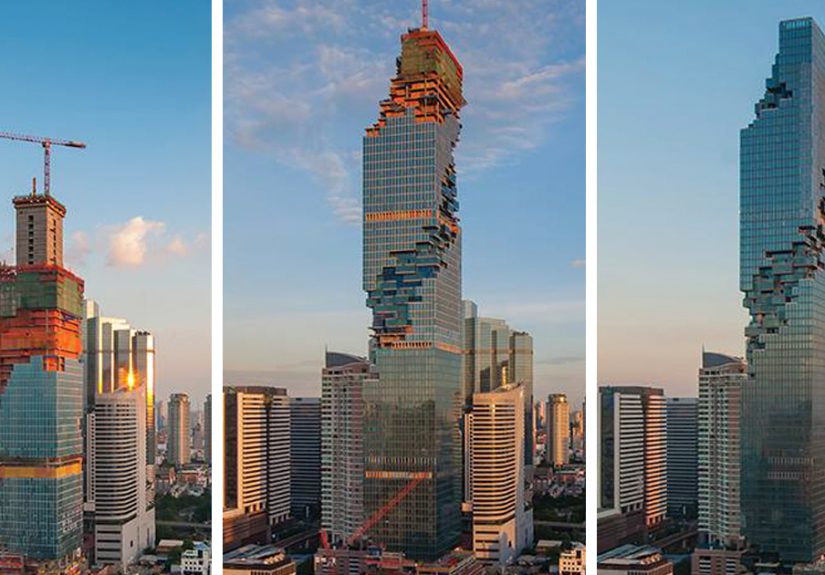
Its first impression, however, was pure visual chaosin the best possible way. Instead of a smooth, seamless curtain wall, the exterior appears to unravel as it rises. Cuboid cutouts wrap around the building like a giant digital ribbon, giving it a jagged, fragmented silhouette. From some angles, it looks unfinished. From others, it looks like a futuristic Jenga tower in the middle of an extremely expensive game night.
Why It Looks Like It’s Missing Pixels on Purpose
The “missing pixels” effect is not random decoration. It is the core architectural idea. Scheeren’s concept was to break the usual sealed-box logic of the skyscraper and reveal moments of life inside it. Those carved volumes create terraces, balconies, and projecting glass spaces that interrupt the tower’s sleek exterior. In plain English: the building looks like it has pieces removed because those missing chunks actually create usable, view-rich spaces.
A Tower Inspired by the Messy Energy of Bangkok
Bangkok is not a city that whispers. It buzzes, steams, honks, glows, stalls, surges, and occasionally dares you to cross a street as a personal growth exercise. Designing a perfectly aloof, perfectly smooth tower for that setting would have felt a little too neat. MahaNakhon responds by embracing contrast. It looks fractured, textured, and in motionmore like an urban event than a static monument.
That is part of why the tower works so well as an image. It reflects the rhythm of Bangkok without turning into a novelty prop. The pixelated ribbon is dramatic, yes, but it also gives the building identity in a skyline where tall glass structures can blur together. You do not need to know a single thing about architecture to remember this one. You glance at it once and your brain files it under: “Ah yes, the skyscraper that appears to be buffering.”
The Pixels Do Real Work
The cutouts are not just there to make social media happy. They create outdoor and semi-outdoor spaces uncommon in supertall living, especially in a tropical city where airflow, shade, and panoramic views matter. The design transforms what could have been wasted visual gimmickry into functional space. That is a big reason the building was taken seriously by architecture critics and industry observers. It may look playful, but it is not unserious.
In fact, that balance between spectacle and usefulness is what separates memorable design from gimmick design. A gimmick shouts once and gets old. A strong design gives you another reason to look closer.
What’s Inside the Building Besides the Drama
MahaNakhon was developed as a mixed-use complex, which is architect-speak for “a lot is going on in here.” At opening, the project combined high-end residences, retail and commercial components, dining spaces, and an observation offering that helped turn the tower into a public attraction instead of a private trophy. The residential component became especially notable for its luxury positioning, with Ritz-Carlton-branded residences adding another layer of prestige to the address.
Over time, the tower’s public identity only got stronger. Today, the building is closely associated with the King Power Mahanakhon SkyWalk, a high-altitude observation experience that lets visitors take in sweeping views of Bangkok from 314 meters above the city. For travelers who enjoy a little adrenaline with their skyline, the glass-floored section is the showstopper. It is the kind of attraction that makes people confidently say, “I’m not scared of heights,” right before they look down and renegotiate that statement.
The building also houses The Standard, Bangkok Mahanakhon, which helped give the tower a fresh cultural life beyond its original debut moment. That hotel presence matters because it turns the tower into more than a photo stop. It becomes a place where visitors can dine, stay, socialize, and experience the building from the inside out rather than treating it like a giant urban sculpture.
More Than a Skyline Flex
Let’s be honest: cities love tall buildings because they are bragging rights with windows. But the most interesting skyscrapers do more than win a height contest. MahaNakhon mattered because it challenged the visual language of the modern tower. Instead of presenting itself as a clean, distant object of corporate perfection, it offered a rougher, more human-scaled reading from afar. The cutouts make the tower seem less sealed and less indifferent.
That sense of openness extends to how the project connects with the city. Its location by Chong Nonsi BTS station gives it immediate public transit visibility and practical accessibility. In a traffic-heavy metropolis like Bangkok, that kind of connection is not just convenient; it is urban intelligence. A tower this conspicuous could have become a detached luxury island. Instead, it was designed to participate in the everyday city.
That approach helped make the project feel relevant rather than merely expensive. Bangkok did not need another anonymous international glass slab that could just as easily live in Dubai, Shanghai, or Miami. It got something stranger and more specificsomething that felt tied to the city’s intensity.
Why the Building Became an Instant Conversation Starter
People love buildings that make them feel something immediately. The emotion can be awe, confusion, delight, or mild suspicion that the contractor left early. MahaNakhon delivers all four. Its silhouette is impossible to ignore, and that alone gave it the kind of cultural traction many skyscrapers never achieve.
Architecturally, it appealed to design fans because it pushed against the boring elegance of the standard luxury tower. For everyday observers, it was simpler than that: the building looked cool, weird, and slightly broken. That combination is catnip for public fascination. It invites questions. Is it finished? Is that safe? Why is it crumbling in a perfectly stylish spiral? Suddenly, people who normally never discuss facade articulation are discussing facade articulation.
There is also something deeply modern about its visual language. The “pixel” idea translates instantly in a digital culture. Even if you know nothing about urban design, you understand the joke and the appeal. The building looks as if architecture briefly borrowed aesthetics from a loading screen, a video game, or a corrupted fileand somehow turned that into luxury real estate.
The Real Reason It Still Matters
Years after its debut, MahaNakhon still stands as a reminder that tall buildings do not have to choose between commercial appeal and architectural ambition. It proves that a skyscraper can be marketable, photogenic, and useful while still taking a genuine design risk. That is rarer than developers like to admit.
It also helped define a chapter in Bangkok’s ongoing architectural evolution. The city has long embraced visual contrast, with temples, old shophouses, infrastructure, malls, towers, and neon all sharing the same restless urban conversation. MahaNakhon fits that context beautifully because it does not try to calm the city down. It joins the noise with style.
And maybe that is why the building still resonates. It understands that a skyline is not just a row of structures. It is a city telling on itself. Bangkok’s version says it is bold, busy, chaotic, ambitious, and not especially interested in being subtle. MahaNakhon says the same thingjust from 314 meters in the air.
Conclusion
Thailand’s pixelated skyscraper did not become famous merely because it was tall. It became famous because it had the nerve to look different. When MahaNakhon opened, it announced that Bangkok’s skyline could be more than polished repetition. It could be playful, jagged, livable, public-facing, and a little bit rebellious.
That is why the building still captures attention long after the novelty should have worn off. The best skyscrapers do not just dominate a skyline; they change how people see it. MahaNakhon did exactly that. It made the city look more futuristic, more expressive, and just a little more fun. Not bad for a tower that, at first glance, appears to be missing a few pixels.
Experiences Related to Thailand’s Pixelated Skyscraper
Seeing MahaNakhon in person is very different from seeing it in photos. In pictures, the building’s pixelated cuts look clever. In real life, they look almost mischievous. You step out near Chong Nonsi and there it istowering over traffic, trains, cables, signs, and the usual Bangkok blurlooking like someone paused a skyscraper halfway through a digital transformation. The contrast is fantastic. Everything around it feels fast, loud, and human-scale, while the tower rises above the mess like a futuristic exclamation point.
One of the most memorable experiences is simply approaching it from street level. At first, you only notice the height. Then your eyes start following the broken ribbon that wraps around the facade, and the whole building suddenly becomes legible. The “missing” chunks stop looking random and start feeling rhythmic, almost like the tower is unzipping itself as it climbs. It is one of those rare buildings that rewards a slow look, which is ironic in Bangkok, where almost nothing encourages you to slow down.
Going up changes the experience again. Elevators, observation decks, and rooftop attractions are common enough in global cities, but the MahaNakhon SkyWalk feels extra theatrical because the building already prepared you for drama from the outside. By the time you reach the top, you are not just chasing a city view; you are stepping into the final act of the building’s personality. Bangkok spreads out in every directiondense, hazy, shimmering, and massive. From above, the city’s chaos softens into texture. Roads become ribbons. Towers become markers. The Chao Phraya River catches the light like a silver seam.
Then comes the glass floor, which is where confidence goes to be tested. It is one thing to say you enjoy observation decks. It is another thing entirely to stand on a clear panel high above a city and discover that your knees have opinions. Even people who laugh their way into the space usually do that tiny hesitation step before committing. That moment is part of the fun. It turns a scenic view into a physical memory.
The tower also creates a surprisingly complete urban experience. You can admire it as architecture, use it as a landmark, visit it as an attraction, stay in it as a hotel guest, or just file it away as the building in Bangkok that looks like it glitched stylishly. At sunset, it is especially effective. The glass catches warm light, the carved volumes deepen into shadow, and the tower stops looking quirky and starts looking cinematic. Then evening kicks in, Bangkok begins glowing below, and the whole thing feels like a set piece from a future that arrived early.
That is probably the best way to describe the experience of MahaNakhon: it feels like a building that turns ordinary city sightseeing into a story. You do not just visit a tall tower. You encounter a piece of architecture with attitude.