Table of Contents >> Show >> Hide
- What “better posture” really needs (and what it doesn’t)
- How we picked the 5 best lifts for posture
- 1) Romanian Deadlift (RDL)
- 2) Chest-Supported Row (or Seated Cable Row)
- 3) Face Pull
- 4) Lat Pulldown (or Pull-Up Progression)
- 5) Farmer’s Carry (Loaded Carry)
- A simple posture-friendly lifting plan (3 days/week)
- Technique tips that make posture gains show up faster
- Safety notes (because your spine is not replaceable)
- Real-world experiences: what it feels like when your posture starts changing (about )
- Conclusion
Posture is basically your body’s default “screensaver.” If you’ve been parked at a desk, hunched over a phone, or living that “I’ll fix it later” lifestyle, your shoulders may start creeping forward and your head may drift out in front like it’s trying to get better Wi-Fi.
The good news: better posture isn’t about standing like a toy soldier all day. It’s about building strength where modern life makes you weakupper back, deep core, glutes, and the muscles that keep your shoulder blades and spine doing their jobs. The fastest “posture upgrade” usually comes from smart strength training.
What “better posture” really needs (and what it doesn’t)
Posture problems are often a mix of muscle imbalances and poor movement habits. Common patterns include:
- Rounded shoulders (tight chest + weaker upper back/scapular stabilizers)
- Forward head posture (neck muscles working overtime while mid-back support is undertrained)
- Anterior pelvic tilt (tight hip flexors + weaker glutes/core, leading to an over-arched low back)
So yes, stretching helpsbut posture improves faster when you also strengthen the muscles that hold you upright. Think of it like upgrading from “duct tape posture” to “built-in support posture.”
How we picked the 5 best lifts for posture
These five weight-lifting exercises were chosen because they:
- Train the posterior chain (glutes, hamstrings, spinal erectors, upper back)
- Reinforce neutral spine and better bracing
- Build scapular control (shoulder blades back/down, not shrugged up by your ears)
- Scale well for beginners and still challenge advanced lifters
- Translate to real life (carrying, lifting, standing, walking without feeling like a folded chair)
1) Romanian Deadlift (RDL)
Why it helps posture
The RDL is a posture MVP because it teaches a clean hip hinge: you move at the hips while keeping your spine long and stable. That’s the opposite of the “round-your-back-and-hope” strategy many people use to pick things up. Stronger glutes and hamstrings also help counter the sitting-heavy lifestyle that nudges your pelvis forward and your low back into an exaggerated arch.
How to do it (quick cues)
- Stand tall with dumbbells or a barbell in front of your thighs, feet about hip-width apart.
- Soften your knees (not a full squat), then push your hips back like you’re closing a car door with your butt.
- Keep the weights close to your legs; your torso tips forward as your hips travel back.
- Stop when you feel a strong hamstring stretch and your back stays flat/neutral.
- Drive through your feet, squeeze your glutes, and return to standing.
Common mistakes (aka the posture thieves)
- Rounding the upper or lower back to reach lower (go only as far as you can hinge well).
- Turning it into a squat (knees bend a little, but the hinge is hip-dominant).
- Letting the weights drift forward (keep them close; pretend your legs are magnetized).
- Looking up hard (keep your neck neutralyour chin doesn’t need to audition for the sky).
Posture-friendly regressions and progressions
- Easier: Dumbbell RDL, kettlebell RDL, or “kickstand” RDL (one foot lightly behind for balance).
- Harder: Barbell RDL, tempo RDL (3 seconds down), or single-leg RDL.
Programming
Start with 3–4 sets of 6–10 reps. Keep it smooth and controlled. If your form breaks, that’s your body telling you “we’re done here.”
2) Chest-Supported Row (or Seated Cable Row)
Why it helps posture
If rounded shoulders had a kryptonite, it would be rows. Rows strengthen the mid-back muscles that pull your shoulder blades back and downthink rhomboids, mid traps, and rear delts. This helps counter the constant forward pull of phones, laptops, and “I sleep like a shrimp” habits.
How to do it (quick cues)
- Set an incline bench and lie chest-down with dumbbells (or use a cable row machine).
- Start with arms long and shoulders relaxednot shrugged.
- Pull elbows toward your hips, squeezing shoulder blades gently together.
- Pause for a beat, then lower with control.
Common mistakes
- Shrugging (keep shoulders away from ears; your neck deserves peace).
- Cranking the neck forward (keep your head aligned; no turtle impressions).
- Using momentum (if you’re “rowing the Titanic,” lighten the load).
Variations for different bodies and equipment
- Minimal gear: One-arm dumbbell row using a bench for support.
- Back-friendly: Chest-supported row reduces lower-back strain compared to bent-over rows.
- Posture combo: Add a 1-second squeeze at the top for better scapular control.
Programming
Aim for 3–4 sets of 8–12 reps. Rows respond well to moderate reps and pristine form.
3) Face Pull
Why it helps posture
Face pulls are a “corrective” favorite because they build the upper back and the small stabilizers of the shoulder (rear delts, rotator cuff, mid/lower traps). Translation: they help balance out all the pressing you do (bench, pushups, carrying bags, aggressively opening jars).
How to do it (quick cues)
- Set a cable at upper-chest to face height with a rope attachment (bands work too).
- Grab the rope with thumbs pointing behind you or slightly up.
- Pull toward your face while spreading the rope ends apart.
- Finish with elbows high-ish and shoulder blades back/downno shrugging.
- Return slowly. The slow part matters.
Common mistakes
- Going too heavy (face pulls are not a “max out” moment).
- Elbows dropping low (you want upper-back engagement, not a weird half-row).
- Ribs flaring (brace lightly; keep your torso stacked).
Programming
Think “shoulder health + posture”: 3–4 sets of 10–15 reps is a great range. If you feel it mostly in your neck, lighten the load and slow down.
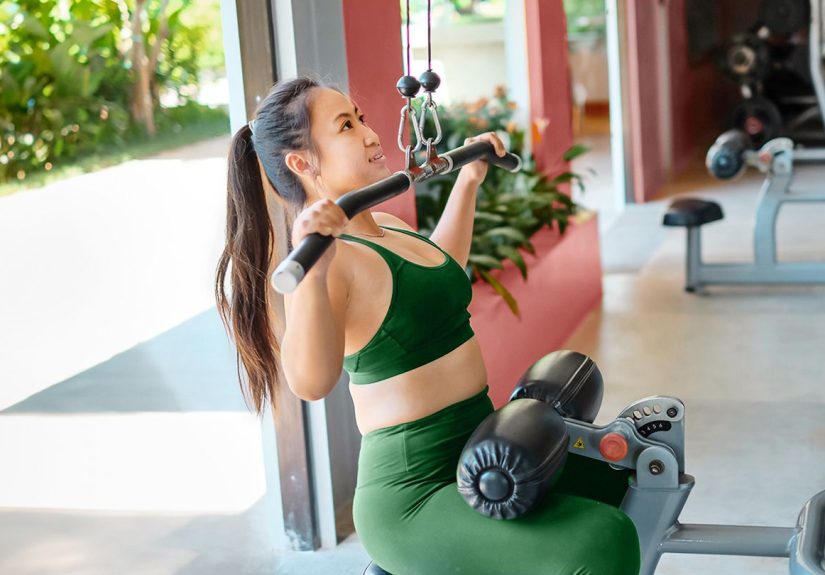
4) Lat Pulldown (or Pull-Up Progression)
Why it helps posture
Vertical pulls train the lats and upper-back muscles that stabilize your shoulder blades. When done well, pulldowns and pull-ups reinforce “shoulders down” controluseful for combating the hunched, elevated-shoulder posture that comes from stress, screens, and carrying life on your shoulders (emotionally and literally).
How to do it (quick cues)
- Sit tall at the pulldown station with a grip slightly wider than shoulders.
- Before pulling, set your shoulder blades: think down and back (not shrugged).
- Pull the bar toward the upper chest while keeping ribs from flaring.
- Pause, then return under control until arms are straight.
Beginner-friendly ways to earn your first pull-up
- Assisted pull-up machine or resistance band-assisted pull-ups
- Slow negatives: jump/step to the top, lower for 3–5 seconds
- Lat pulldown with strict form and full range
Common mistakes
- Leaning way back to turn it into a pseudo-row.
- Yanking with the arms instead of initiating with the shoulder blades.
- Half reps (use a range you can control, then build it up).
Programming
Use 3–4 sets of 6–12 reps. If you’re doing pull-ups, quality beats quantityespecially if your posture goals depend on clean shoulder mechanics.
5) Farmer’s Carry (Loaded Carry)
Why it helps posture
Farmer’s carries are sneaky-good for posture because they train you to stand tall under load while walkingcore braced, shoulders back and down, neck neutral. It’s basically “good posture practice” disguised as a grip challenge. Loaded carries also teach full-body tension and stability that supports healthier lifting patterns in everything else.
How to do it (quick cues)
- Pick up two dumbbells or kettlebells (start lighter than your ego requests).
- Stand tall: ribs stacked over pelvis, chin level, eyes forward.
- Pull shoulder blades slightly back and down (no shrugging).
- Walk slowly and steadily for distance or time, keeping your torso from leaning.
- Set the weights down with controldon’t just “drop and pray.”
Common mistakes
- Leaning forward (lower the weight and rebuild tall posture).
- Shrugging (think “long neck,” not “stressed-out turtle”).
- Rushing (smooth steps keep your core honest).
Progressions that level up posture fast
- Suitcase carry: one weight in one hand (anti-lean, anti-tilt core training).
- Offset carry: different weights each hand to challenge stability.
- Longer carries: build endurance for “all-day posture.”
Programming
Try 3–5 carries of 20–40 yards (or 20–60 seconds) with rest as needed. Start conservative and add weight or distance gradually.
A simple posture-friendly lifting plan (3 days/week)
You don’t need a 47-exercise spreadsheet to stand taller. Here’s a clean, repeatable template that supports posture correction:
Day A (Hinge + Upper Back)
- Romanian Deadlift 3–4 sets of 6–10
- Chest-Supported Row 3–4 sets of 8–12
- Face Pull 3 sets of 10–15
- Farmer’s Carry 3–4 rounds of 20–40 yards
Day B (Vertical Pull + Carry)
- Lat Pulldown or Pull-Up Progression 3–4 sets of 6–12
- Row Variation (cable row or one-arm row) 3 sets of 8–12
- Face Pull (lighter, stricter) 2–3 sets of 12–15
- Suitcase Carry 3 rounds per side of 20–30 steps
Day C (Repeat A or B, lighter and cleaner)
Keep the same moves, reduce the load, and aim for perfect technique. Posture improves when your nervous system learns the “right” positions under manageable stress.
Technique tips that make posture gains show up faster
- Own the start position: stacked ribs and pelvis, neutral neck, shoulders not shrugged.
- Pause reps are posture gold: a 1-second pause at the top of rows or face pulls teaches control.
- Train your “anti-movement” core: carries build stability without endless crunches.
- Stop chasing fatigue: posture work loves consistent quality more than sweaty chaos.
Safety notes (because your spine is not replaceable)
Mild muscle effort is normal; sharp pain, numbness, tingling, or symptoms that travel down an arm/leg are not. If you have a history of significant back, neck, or shoulder issues, consider getting form coaching from a qualified trainer or guidance from a clinician before loading these movements heavily.
Real-world experiences: what it feels like when your posture starts changing (about )
Most people don’t wake up one morning with perfect posture and a halo of excellent biomechanics. It usually happens in a series of small, slightly awkward winslike realizing you can sit at your desk for an hour without your neck staging a protest.
In the first week or two, a common experience is discovering muscles you didn’t know you owned. Rows and face pulls often light up the mid-back in a way that makes you think, “Oh, that’s what shoulder blades are for.” Some folks describe it as a gentle “between-the-shoulders burn,” which is basically your posture muscles sending a thank-you text you can feel.
The Romanian deadlift tends to bring a different kind of awareness: you start noticing how often you bend by rounding your back instead of hinging at the hips. After a few sessions, people often catch themselves picking up laundry baskets or groceries with a straighter spinewithout consciously trying. That’s the hidden magic of strength training for posture: you’re not just strengthening tissues; you’re rehearsing better movement.
Carries are where posture becomes weirdly obvious. The first time you do farmer’s carries with decent weight, your body immediately reveals your habits. If you typically slouch, your shoulders may want to creep up, your ribs may flare, or you might lean forward like you’re hurrying to an appointment with gravity. But then you correct itstand tall, brace, shoulders downand suddenly you feel “stacked.” A lot of people describe that stacked feeling as “stable” or “athletic,” like their body is finally one piece instead of a bunch of separate parts negotiating with each other.
Around weeks three to six (with consistent training), the changes start showing up in everyday snapshots: you catch your reflection and your head isn’t leading your body by a full zip code; your shoulders look less rounded in photos; your shirt hangs differently; your upper back doesn’t feel as tight at the end of the day. If you’re someone who lives on a laptop, you may notice you can reset your posture fasterlike you have an internal “undo slouch” button.
One of the most overlooked experiences is confidence. Better posture doesn’t just change alignmentit changes how you occupy space. People often report feeling more “open” and less compressed, especially after pulling movements and carries. It’s not a personality transplant; it’s just your body not folding in on itself like a travel umbrella.
The best part? You don’t need perfection. The lifters who see the biggest posture improvements are usually the ones who keep loads reasonable, repeat the basics, and treat technique like it’s the main workoutnot the warm-up for the “real” workout.
Conclusion
If you want better posture, focus on strength training that builds your upper back, posterior chain, and core stabilitythen practice standing tall under load. Start with the five lifts above, stay consistent for a month, and you’ll likely notice that “good posture” becomes less of a reminder and more of a default setting.