Table of Contents >> Show >> Hide
- Before You Decorate: Quick Rules for Holiday Houseplants
- 1) Poinsettia (Euphorbia pulcherrima)
- 2) Norfolk Island Pine (Araucaria heterophylla)
- 3) Christmas Cactus (Schlumbergera)
- 4) Amaryllis (Hippeastrum)
- 5) Paperwhites (Narcissus papyraceus)
- 6) Florist Cyclamen (Cyclamen persicum)
- 7) Rosemary “Christmas Tree” Topiary (Salvia rosmarinus)
- Easy “Plant + Décor” Formulas That Look Intentional
- Real-Life Holiday Plant Experiences (The “What Actually Happens” Section)
- 1) The “Cold Car to Warm House” Poinsettia Shock
- 2) The Norfolk Island Pine That Slowly Gets Crispy Tips
- 3) The Christmas Cactus That Drops Buds Right Before It Blooms
- 4) The Amaryllis That Leans Like It’s Reaching for Fame
- 5) Paperwhites That Smell Amazing… Then Make You Realize Fragrance Is a Lot
- 6) Cyclamen That Looks Perfect… Until the Room Gets Too Warm
- 7) The Rosemary Topiary That Makes You Feel Like a Kitchen Wizard
- Final Thoughts
Tinsel is fun. Twinkle lights are iconic. But if you want your home to feel like the holidays (and not like a craft store exploded),
add living décor. The best indoor plants for Christmas decorating do two jobs at once: they look festive now and
keep looking good after the last cookie is goneassuming you don’t “love them to death” with daily watering.
Below are seven Christmas-ready indoor plants that are widely available in the U.S., easy enough for normal humans (not just plant whisperers),
and flexible for everything from minimalist mantels to full-on “Clark Griswold but make it cozy” vibes. You’ll get styling ideas, care tips,
and a few reality checks so your holiday houseplants survive the season.
Before You Decorate: Quick Rules for Holiday Houseplants
1) Keep plants away from heat blasts
Forced-air vents, radiators, fireplaces, and drafty doors are the top saboteurs of winter houseplants. If you can feel hot air on your ankles,
your plant can feel it tooand it will complain by dropping leaves or crisping tips.
2) Bright light beats “mood lighting”
Christmas ambiance is often… dim. Most indoor holiday plants prefer bright, indirect light. If your décor plan involves turning your home into a candlelit cave,
place plants closer to windows (but not pressed against cold glass), or use a small grow light.
3) Water like a grown-up
Translation: check the soil first. Holiday plants usually prefer “evenly moist” or “water when partly dry,” not “a little splash every day.”
Overwatering is the fastest way to turn a festive plant into a sad science experiment.
4) If you have pets or curious toddlers, choose placement wisely
Some popular Christmas plants can irritate mouths or stomachs if chewed. You don’t need panicyou just need smart placement: higher shelves,
sturdy plant stands, or rooms your pets don’t access.
1) Poinsettia (Euphorbia pulcherrima)
Poinsettias are the holiday classic for a reason: big color payoff, instant Christmas energy, and a surprisingly modern look when styled in clean,
minimal containers. Bonus fun fact: those “flowers” are actually colorful bracts (modified leaves). The tiny yellow centers are the real flowers.
How to keep it happy
- Light: Bright, indirect light near a window.
- Temperature: Aim for comfortable indoor temps; avoid cold drafts and heat vents.
- Water: Water when the top of the soil feels dry. Dump any standing waterespecially if the pot is wrapped in decorative foil.
Decorating ideas
- Use three poinsettias in matching matte cachepots for a designer-worthy mantel lineup.
- Swap red for white, blush, or marbled varieties if your holiday palette is neutral.
- Make it look expensive: top the soil with moss, pinecones, or a ring of fresh greenery.
Good-to-know
Poinsettia sap can be irritating if chewed; keep out of reach of pets that snack on leaves. If your poinsettia suddenly drops leaves,
temperature swings and soggy roots are frequent culprits.
2) Norfolk Island Pine (Araucaria heterophylla)
Want an indoor Christmas tree alternative that fits on a table and doesn’t shed needles like it’s being paid per needle?
Norfolk Island pine looks like a soft, feathery evergreen and can be kept as a year-round houseplant. It’s not a true pine,
but it’s absolutely a true vibe.
How to keep it happy
- Light: Bright light is key; a sunny room with some indirect light is ideal.
- Humidity: Average to higher humidity helps (winter air can be dry).
- Water: Let the surface of the soil dry slightly, then water thoroughly and let excess drain.
Decorating ideas
- Use tiny ornaments, ribbon bows, or lightweight felt shapesskip heavy décor that bends branches.
- Try “micro-lights” (battery-operated) and keep cords away from the pot so you don’t trap water.
- Put it in a woven basket for a cozy “mini tree” look.
Good-to-know
Brown tips usually mean the air is too dry or watering is inconsistent. Keep it away from heating vents and don’t let the pot sit in water.
3) Christmas Cactus (Schlumbergera)
The Christmas cactus is the friend who shows up every year looking fabulous and asking for almost nothing. It’s a winter bloomer
with segmented stems and bright flowers (often pink, red, white, or salmon). It’s also one of the best “keep it forever” holiday plants.
How to keep it happy
- Light: Bright, indirect light (east- or west-facing windows are often great).
- Water: Water well, then let the potting mix dry out more than a typical leafy houseplant. Soggy soil invites rot.
- Temperature: Steady, moderate indoor temps; avoid cold drafts and heat sources.
Decorating ideas
- Place it on a pedestal stand so blooms “waterfall” over the edge.
- Pair it with candles and metallic accentsits blooms do the color work.
- Use a simple clay pot and let the plant look like the heirloom it’s trying to become.
Good-to-know
If your plant drops buds, the usual suspects are sudden temperature changes, moving it too often, or watering chaos. Once buds appear,
treat it like a diva: stable conditions, no drama.
4) Amaryllis (Hippeastrum)
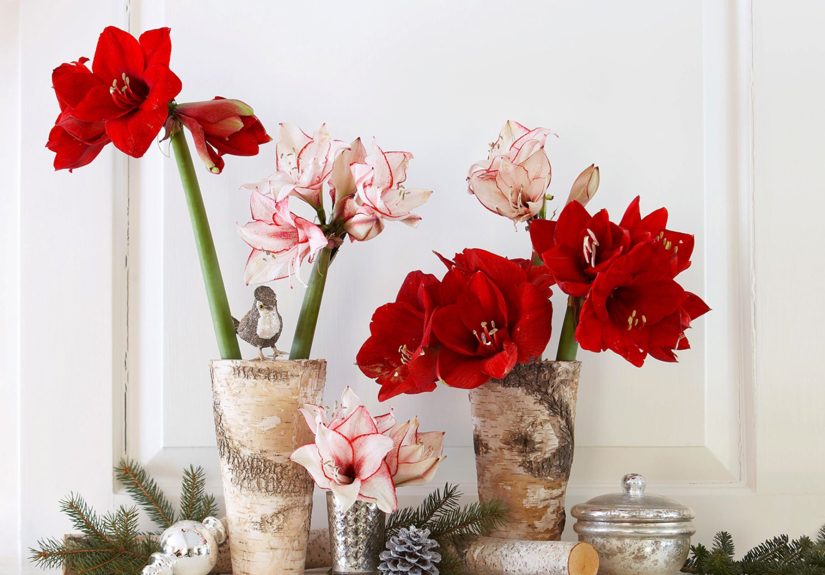
Amaryllis is basically a holiday fireworks show in plant formhuge trumpet blooms on tall stems, often in red, white, pink, or striped varieties.
It looks fancy even when you do almost nothing, which is my favorite decorating feature.
How to keep it happy
- Light: A sunny window helps keep growth sturdy.
- Water: Water when the top portion of soil feels dry; avoid soaking the bulb.
- Support: If the flower stalk gets top-heavy, stake it gently.
Decorating ideas
- Use a heavy pot (or add decorative stones on top) so it doesn’t tip during a dramatic bloom moment.
- Line up three amaryllis in matching containers for a clean, high-impact tablescape.
- For a modern look: choose white blooms + black pot + minimal greenery.
Good-to-know
You can often keep the bulb and encourage reblooming next year by keeping the leaves after flowering and providing strong light and periodic feeding
during its growth cycle.
5) Paperwhites (Narcissus papyraceus)
Paperwhites are the shortcut to winter fragrance. These bulbs are commonly grown indoors for clusters of small white blooms that feel instantly festive.
They’re also one of the fastest ways to make your home smell like “the holidays,” minus the scented candle headache.
How to keep it happy
- Light: Bright light helps keep growth sturdier.
- Water: Keep the growing medium lightly moistnot waterlogged.
- Temperature: Cooler rooms generally help blooms last longer.
Decorating ideas
- Grow bulbs in a shallow bowl with stones for a clean, Scandinavian centerpiece.
- Cluster several small containers down the center of a table like living “place markers.”
- Add pine sprigs around the pot for a simple evergreen frame.
Good-to-know
Stems can lean as they grow. The simplest fix is bright light and rotating the container so they don’t reach in one direction.
If they still flop, a discreet stake or a decorative ring support can keep things tidy.
6) Florist Cyclamen (Cyclamen persicum)
Cyclamen looks like it was designed by a Scandinavian furniture brand: neat mound of patterned leaves, plus elegant blooms that hover above on slender stems.
Colors range from pure white to deep red and magenta, and it thrives when your house is a little cooleraka, perfect for winter.
How to keep it happy
- Light: Bright, indirect light.
- Temperature: Cool is best. Cyclamen generally performs better away from heat sources.
- Water: Keep soil lightly moist, but don’t soak the crown. Many growers recommend watering from below to avoid rot.
Decorating ideas
- Set cyclamen in a metallic pot for instant holiday glam.
- Use white cyclamen + eucalyptus sprigs for a wintery centerpiece that’s not loud.
- Group cyclamen with small evergreens for a “mini winter garden” look.
Good-to-know
Yellow leaves often mean it’s too warm, too wet, or too drycyclamen is picky about extremes. Keep conditions steady and cool-ish for the longest bloom time.
7) Rosemary “Christmas Tree” Topiary (Salvia rosmarinus)
A rosemary topiary shaped like a tiny Christmas tree is the ultimate multitasker: festive décor now, fresh herb later.
It smells incredible, looks charming on a kitchen counter, and turns roast potatoes into a personality.
How to keep it happy
- Light: Rosemary needs very bright light indoorssunny windows are your friend.
- Water: Let the top of the soil dry a bit between waterings, and make sure the pot drains well.
- Temperature: Rosemary often prefers cooler indoor temps than tropical houseplants.
Decorating ideas
- Tie a ribbon bow at the base and call it “holiday minimalism.”
- Add tiny ornaments on florist wire (very lightweight) for a playful kitchen display.
- Use it as a centerpiece with citrus + cranberries + greenery for a natural look.
Good-to-know
Indoor rosemary fails when it’s kept too wet or too dim. Treat it like a sun-loving outdoor plant that’s temporarily staying inside for the holidays.
Easy “Plant + Décor” Formulas That Look Intentional
The Mantel Trio
One Norfolk Island pine in the center + two poinsettias (or cyclamen) on the sides. Add a simple garland behind them.
You get height, color, and softnesslike a holiday movie set, but with fewer commercial breaks.
The Dining Table Centerpiece That Won’t Block Anyone’s Face
Use paperwhites in a low bowl with stones. Surround the bowl with evergreen clippings and a few ornaments.
It’s fragrant, low-profile, and doesn’t force guests to shout, “WHAT?” across the table.
The Cozy Entryway Welcome
Place a rosemary topiary near the door (bright light permitting) with a poinsettia nearby. The scent hits first,
then the color. Guests will assume you have your life together. (You don’t have to correct them.)
Real-Life Holiday Plant Experiences (The “What Actually Happens” Section)
You can read care instructions all day, but holiday plant success usually comes down to a few real-life moments.
Here are common experiences people run into with Christmas plantsand how to handle them without turning your living room into a plant ER.
1) The “Cold Car to Warm House” Poinsettia Shock
A very normal scenario: you buy a poinsettia, walk it through cold air, and set it near a cozy vent because you’re trying to be kind.
Two days later, it drops leaves like it’s auditioning for autumn. The fix is mostly prevention: protect it from cold on the way home,
then give it a stable, draft-free spot with bright, indirect light. When it’s indoors, don’t trap the pot in foil that holds water.
Think “comfortable room,” not “blast furnace.”
2) The Norfolk Island Pine That Slowly Gets Crispy Tips
This one can feel confusing because the plant looks okay… until it doesn’t. Often the issue is dry winter air or inconsistent watering.
People tend to either forget it completely or overcompensate with frequent splashes. A steady rhythm works better:
water thoroughly when the soil surface is slightly dry and let excess drain. If your air is very dry, moving it away from heat sources
and giving it a little extra humidity (like grouping it with other plants) can help it look lush through the season.
3) The Christmas Cactus That Drops Buds Right Before It Blooms
This is the holiday equivalent of your phone dying at 2% when you really need directions. Bud drop is usually triggered by sudden changes:
moving the plant from room to room, a cold draft, heat blasting at night, or inconsistent watering. The experience most people have is
that the plant does best when you pick a good spot and stop “fixing” it. Once buds form, stability is the secret sauce:
bright, indirect light; moderate temperatures; and water only when the potting mix has dried appropriately.
4) The Amaryllis That Leans Like It’s Reaching for Fame
Amaryllis blooms are huge, and the stalk can become top-heavyespecially if it’s stretching toward a light source.
Many people find that rotating the pot every few days keeps it growing straighter. If it still leans, a stake is not a failure;
it’s just good engineering. Decor-wise, it’s also a chance to be clever: a beautiful support (bamboo, a decorative dowel, even a tasteful spiral stake)
can look intentional instead of “emergency plant brace.”
5) Paperwhites That Smell Amazing… Then Make You Realize Fragrance Is a Lot
Paperwhites are famous for their scent, and the experience ranges from “holiday heaven” to “wow, this is powerful.”
If the fragrance feels intense, the easiest adjustment is location: move them to a larger room, a hallway, or an entryway where the scent disperses.
Bright light and cooler temperatures also help the blooms last longer, which is great if you love the smelland potentially less great if you don’t.
(At least now you know your scent personality.)
6) Cyclamen That Looks Perfect… Until the Room Gets Too Warm
Cyclamen is one of those plants that rewards you for having a slightly cooler house. Many people notice it stays gorgeous in a bright, cool room,
then starts yellowing when it lives too close to a heat source. Another common experience is accidental overwatering.
Cyclamen prefers lightly moist soil, not soggy soiland it doesn’t love water sitting on the crown. If you keep it cool, bright,
and evenly watered (often with bottom-watering), it can bloom for weeks and look like you hired a florist.
7) The Rosemary Topiary That Makes You Feel Like a Kitchen Wizard
There’s a special kind of joy in snipping rosemary for potatoes or chicken while the plant still looks like a mini Christmas tree.
The flip side: rosemary indoors is not a low-light houseplant. People often discover that it declines when it doesn’t get enough sun
or when it stays wet. The best experience tends to happen in the brightest window you have, with excellent drainage and a “water,
then let it dry a bit” approach. It’s less “tropical spa plant” and more “Mediterranean sun enthusiast.”
If you remember only one thing: holiday plants usually don’t need more attentionjust the right attention.
Stable temperatures, decent light, and sensible watering will get you through Christmas decorating with living plants that still look great in January.
Final Thoughts
The best indoor plants for Christmas decorating aren’t just prettythey’re practical. Poinsettias bring instant color, Norfolk Island pine gives you a mini-tree moment,
Christmas cactus delivers reliable winter blooms, amaryllis provides dramatic flowers, paperwhites add fragrance, cyclamen brings cool-weather elegance,
and rosemary topiaries add scent plus dinner potential. Pick two or three that match your home’s light and temperature, style them with simple containers,
and let the plants do the festive heavy lifting.