Table of Contents >> Show >> Hide
- Why Exercise Matters When You Have Osteoporosis
- The 4 Pillars of the Best Osteoporosis Workout Plan
- The Best Workouts for Osteoporosis (With Specific Examples)
- Exercises to Avoid (or Seriously Modify) With Osteoporosis
- A Simple 7-Day Osteoporosis Workout Schedule
- Frequently Asked Questions
- Real-Life Experiences With Osteoporosis Workouts (What People Commonly Notice)
- Conclusion: Strong Bones Love a Smart Plan
Osteoporosis can feel like your skeleton is quietly running a “going-out-of-business” sale. (Spoiler: you did not consent to this.)
The good news is that bones aren’t inert sticks they’re living tissue that responds to smart, consistent stress. The trick is giving
your bones the right kind of challenge: enough to encourage strength, not so much that you’re auditioning for an X-ray commercial.
This guide breaks down the best osteoporosis workouts weight-bearing cardio, strength training, balance work, and spine-safe posture exercises
with specific examples, practical progressions, and a sample week you can actually follow. As always, if you’ve had fractures, severe osteoporosis,
or dizziness/fall risk, talk with your clinician or a physical therapist before you level up.
Why Exercise Matters When You Have Osteoporosis
If you remember one thing, make it this: bones get stronger when they’re used.
The “use” part is mechanical loading your muscles pulling on bones and your body working against gravity. Add in better balance and leg strength,
and you reduce falls (which is huge, because many serious fractures happen from falls rather than dramatic superhero landings).
Exercise won’t replace medication when it’s needed, and it can’t time-travel you back to the bone density of your 22-year-old self.
But it can help slow bone loss, support posture, strengthen hips and spine-supporting muscles, and improve confidence moving through the world
which is underrated until you realize how often “I’m afraid I’ll fall” quietly shrinks someone’s life.
The 4 Pillars of the Best Osteoporosis Workout Plan
1) Weight-bearing cardio (bones like gravity)
Weight-bearing cardio means you’re upright and your skeleton is supporting your weight: walking, stair climbing, dancing, hiking, low-impact aerobics,
or using an elliptical. These activities load bones in the legs, hips, and lower spine key areas for osteoporosis risk.
2) Strength training (muscles are bone’s best friend)
Strength training adds resistance (weights, bands, machines, or bodyweight). Strong muscles pull on bone and create a “build here” signal.
It also trains the exact sites that commonly fracture especially hips and spine-supporting areas when done with good form.
3) Balance and fall-prevention training (your “anti-slip” system)
Balance workouts train your nervous system, ankles, hips, and core to react quickly. Think tai chi, single-leg work, heel-to-toe walking,
and controlled stepping drills. This is not “cute extras” it’s fracture prevention.
4) Posture and spine-safe back strengthening (because slouching isn’t neutral)
Osteoporosis commonly affects the spine, and vertebral compression fractures can be triggered by risky bending and twisting.
Posture work and back-extensor strengthening help you stay “tall,” reduce excessive rounding, and support safer movement patterns.
The Best Workouts for Osteoporosis (With Specific Examples)
Workout Type A: Weight-Bearing Cardio That Builds Bone
The goal is most days of the week, building toward at least 150 minutes/week of moderate activity if possible. If you’re starting from zero,
don’t panic bones prefer consistency over heroics.
- Brisk walking: The classic. Add small hills or faster intervals as tolerated.
- Stair climbing: Powerful for hips and legs; start with 1–2 flights and build gradually.
- Dancing: Weight-bearing + multi-direction movement (great for coordination and hips).
- Low-impact aerobics: If it keeps you upright and moving, it counts.
- Elliptical training: Lower impact than running but still weight-bearing.
- Gardening (the active kind): Carrying, squatting safely, walking, and light lifting add up.
Progression idea: Start with 10–15 minutes, 5 days/week. Add 5 minutes each week until you hit 30 minutes.
Then add intensity (a faster pace or gentle incline) before adding time forever.
Note on high impact: Jumping or jogging can be bone-stimulating for some people, but may be inappropriate if you have
fractures or high fracture risk. This is where individualized medical advice matters.
Workout Type B: Strength Training That Targets Hips, Legs, Back, and Posture
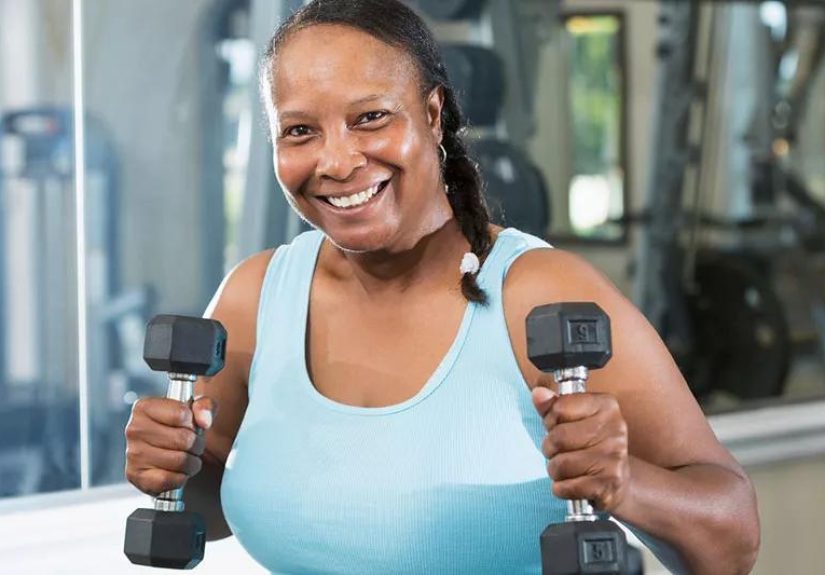
Aim for 2–3 days/week, nonconsecutive. You don’t need fancy equipment you need progressive resistance and good technique.
Keep your spine “long,” avoid rounding forward under load, and move with control.
A beginner-friendly, spine-safe strength session (30–40 minutes)
-
Warm-up (5–7 minutes):
Marching in place, easy walking, shoulder rolls, gentle hip hinges with hands on thighs. -
Sit-to-stand (chair squats):
2–3 sets of 8–12 reps. Add a light dumbbell at the chest later (goblet style). -
Step-ups (low step to start):
2–3 sets of 8–10/side. Hold a railing at first; add dumbbells later. -
Hip hinge practice (dowel or hands-on-hips cue):
2 sets of 6–10 slow reps. The goal is a neutral spine and “hips back,” not a deep forward fold. -
Row (band or machine):
2–3 sets of 8–12 reps. Great for posture and upper-back strength. -
Wall push-ups or incline push-ups:
2–3 sets of 6–12 reps. Progress by lowering the incline. -
Calf raises:
2–3 sets of 10–15 reps. Strong ankles help balance; calves matter more than they get credit for. -
Posture finisher: wall angels or scapular squeezes:
2 sets of 8–12 slow reps.
How hard should strength training feel? Challenging but controlled.
A good rule: you should finish a set feeling like you had 2–3 reps left in the tank. If your form gets sloppy or you’re holding your breath
like you’re trying to win an internal contest, lighten the load.
Progress without drama: Add 1–2 reps per set first. Then add a small amount of resistance. Then add another set if needed.
Bone-building favors gradual progression, not random acts of intensity.
Workout Type C: Balance Training (Your “Don’t Fall” Circuit)
Balance work can be done daily (even 5–10 minutes). Do it near a counter or sturdy chair because bravery is not a safety plan.
- Tandem stance (one foot in front of the other): hold 20–30 seconds each side.
- Heel-to-toe walk: 10–20 steps, slow and steady.
- Single-leg stand: start with fingertips on a counter; build to no hands.
- Side steps (with or without a band): 10–15 steps each direction.
- Clock taps: stand on one leg and tap the other foot forward/side/back like a clock.
- Tai chi: fantastic blend of balance, strength, and controlled movement.
Workout Type D: Mobility and Flexibility (Spine-Safe)
Mobility work helps you move better and may reduce fall risk by improving gait and posture. For osteoporosis, the main rule is:
avoid aggressive spinal flexion and loaded twisting. Translation: no deep toe-touch marathons and no “let’s wring out the spine”
stretches when your vertebrae are not in the mood.
Safer mobility ideas:
- Chest opener: doorway pec stretch, 20–30 seconds per side.
- Hip flexor stretch: half-kneeling or standing, gentle, spine tall.
- Calf stretch: against a wall, 20–30 seconds.
- Thoracic extension: supported upper-back extension over a rolled towel (gentle, no forcing).
- Neck and shoulder mobility: slow controlled circles and range work.
Exercises to Avoid (or Seriously Modify) With Osteoporosis
Not every “fitness” move is osteoporosis-friendly. Some exercises increase spinal compression or shear forces, especially when combined with
rounding and twisting.
- Deep forward bends (toe touches, repeated spine rounding under load).
- Traditional sit-ups/crunches (spinal flexion under effort).
- Forceful twisting at the waist (especially combined with flexion).
- High-impact jumping/running if you have fractures, very low bone density, or high fall risk.
- Jerky, rapid movements that compromise balance and form.
This doesn’t mean you must live in bubble wrap. It means you should train smart:
keep a neutral spine, hinge from hips, twist gently from the upper back when appropriate (and only if cleared),
and prioritize control.
A Simple 7-Day Osteoporosis Workout Schedule
Here’s a practical week that blends bone-loading, strength, and balance. Adjust duration and intensity to your level.
If you’re brand new, do half and call it a win.
- Monday: Strength session (Workout Type B) + 5 minutes balance
- Tuesday: Brisk walk 20–40 minutes (intervals if tolerated)
- Wednesday: Balance circuit 10 minutes + posture/back work 10 minutes
- Thursday: Strength session (repeat, or swap variations: lunges to split squats, band rows, etc.)
- Friday: Weight-bearing cardio 20–40 minutes (stairs, dance, incline walk, elliptical)
- Saturday: Spine-safe mobility 15 minutes + easy walk 15–20 minutes
- Sunday: Optional gentle walk + “life admin” recovery (sleep, protein, sunlight, hydration)
Frequently Asked Questions
Is walking enough for osteoporosis?
Walking is a great foundation, but the best osteoporosis workout plan includes strength training too.
Think of walking as your daily bone “maintenance,” and strength training as your bone “renovation project.”
(One keeps the lights on; the other upgrades the wiring.)
What about swimming or cycling?
Swimming and cycling are excellent for heart health and joint-friendly conditioning, but they’re not weight-bearing.
If those are your favorite activities, keep them just pair them with weight-bearing walks and strength sessions for bone support.
What if I already had a fracture?
You can often still exercise and you should but the program needs to be individualized. Many people benefit from guidance by a physical therapist
to strengthen safely, improve balance, and reduce fear of movement.
How soon will I notice results?
Balance and strength improvements often show up in weeks (better confidence on stairs, steadier gait, easier chair stands).
Bone density changes are slower and depend on age, nutrition, hormones, medications, and training consistency.
Don’t measure progress only by a number measure it by how safely and strongly you move.
Real-Life Experiences With Osteoporosis Workouts (What People Commonly Notice)
When people start exercising after an osteoporosis diagnosis, the first “workout” is often mental: getting past the fear that every movement is a
potential fracture. That fear makes sense being told your bones are fragile can make your body feel like a museum exhibit (“Please do not touch”).
But most people discover something important within the first month: smart movement builds confidence.
A common early win is the humble chair stand. People who felt wobbly standing up from a sofa notice that after a few weeks of sit-to-stands and step-ups,
their legs feel more reliable like they’re finally showing up to work on time. That reliability carries over into daily life: stairs feel less dramatic,
grocery bags feel less intimidating, and “I’ll just hold onto the wall” becomes “I can walk normally through the hallway.”
Many also notice posture changes. Not “I look like a runway model” (let’s not get carried away), but subtle shifts:
shoulders stop creeping forward, the upper back feels stronger, and breathing feels easier when the chest isn’t collapsing.
People who add rows, wall angels, and gentle thoracic extension often report that long car rides and desk time cause less upper-back fatigue.
Another pattern: balance practice feels weirdly hard at first. Standing on one leg can be humbling and that’s exactly why it matters.
People often start with fingertips on a counter and gradually reduce support. The first time someone realizes they can hold a single-leg stand for
20 seconds without panicking, it’s not just a “fitness” moment it’s a “I’m safer” moment. That sense of safety lowers stress,
and lower stress makes it easier to stay consistent (because nothing destroys motivation like feeling unsafe).
There are also classic speed bumps. One is doing too much too soon: a burst of motivation leads to long walks, extra stairs, and suddenly the knees,
shins, or lower back complain. The fix is almost always the same: cut volume, keep frequency, and build gradually. Bones like progressive loading;
tendons and joints also like progressive loading but they file complaints faster.
Another speed bump is “yoga confusion.” Some people hear “yoga helps balance” and jump into deep forward folds or twist-heavy flows.
Then they learn the hard way that osteoporosis-friendly yoga is a modified, spine-safe version. The good news? You don’t have to quit yoga
you just have to choose poses that keep the spine long and avoid aggressive flexion/rotation.
Perhaps the most meaningful long-term experience people report is this: the workouts stop being “osteoporosis workouts” and start being
“my life workouts.” Strength training becomes a tool for independence. Walking becomes a habit for mood and energy. Balance drills become
a tiny daily ritual that quietly reduces risk. And the diagnosis that once felt like a shrinking of options becomes a reason to build a plan
that protects your future self the version of you who wants to travel, play with grandkids, carry groceries, and live without constant fear.
Conclusion: Strong Bones Love a Smart Plan
The best workouts for osteoporosis aren’t mysterious they’re consistent. Combine weight-bearing cardio, strength training,
balance work, and spine-safe posture exercises. Avoid high-risk bending and twisting, progress gradually, and get help
if you’ve had fractures or feel unsteady.
Start small, stay steady, and remember: you’re not trying to “destroy” your workouts you’re trying to build your body.
Your bones will get the memo.