Table of Contents >> Show >> Hide
- What “The Nimitz Encounter” Actually Refers To
- A Quick Timeline (Because the Internet Loves Chaos)
- What We Know with the Most Confidence
- How the Nimitz Story Became a Pop-Culture Supernova
- The Big Claimsand What They Really Mean
- What Skeptics Get Right (Even If They’re Not Fun at Parties)
- What Believers Get Right (Even If Some of Their Group Chat Is Unhinged)
- What the U.S. Government Has Said in Recent Years
- So… Was the Nimitz “Tic Tac” Aliens?
- The “Truth” Most People Skip: What Evidence Would Actually Settle It
- Why the Nimitz Encounter Still Matters
- Bottom Line: The Most Responsible “Truth”
- Experiences People Report Around the Nimitz Story (500+ Words)
If you’ve spent any time online, you’ve probably heard the legend: U.S. Navy pilots chase a smooth white “Tic Tac”
over the Pacific, it zips around like it’s playing a video game with cheat codes, andboomproof of aliens.
The problem is that real life (and real sensor data) rarely behaves like a perfectly edited trailer.
The truth about the Navy’s Nimitz encounter is more interesting than a simple “it’s aliens” or “it’s nothing.”
It’s a layered story involving trained observers, confusing instrument readings, limited public data, and a national-security
system that’s historically been better at tracking missiles than… weird little somethings that don’t RSVP.
Let’s walk through what we know, what we don’t, and what the Nimitz sightings actually prove (and don’t prove)with a little humor,
because if you’re going to stare into the unknown, you might as well bring snacks.
What “The Nimitz Encounter” Actually Refers To
When people say “the Nimitz encounter,” they’re usually talking about events during naval training exercises off Southern California
in November 2004 involving the USS Nimitz Carrier Strike Group. The most famous moment centers on a flight led by
Navy pilot Cmdr. David Fravor, who described seeing an oblong, wingless object above disturbed waterone of the reasons the story
became known as the “Tic Tac” incident.
But here’s the first important truth: it wasn’t “one video” and “one sighting.” It’s a bundle of claims and observations:
radar contacts reported from the strike group, visual observations by aircrew, and later the release of short infrared targeting-pod
footage popularly associated with the broader UAP conversation.
A Quick Timeline (Because the Internet Loves Chaos)
- Early–mid November 2004: Unusual contacts are reportedly tracked in the training area.
- November 14, 2004: The best-known visual encounter occurs during a flight from the Nimitz group.
- 2017: Major media coverage brings Navy UAP videos and related Pentagon work into the mainstream.
- 2019: The Navy confirms the videos are authentic and prefers the term “UAP.”
- 2020: The Department of Defense authorizes the official release of three historical Navy UAP videos.
- 2021–2024 and beyond: U.S. government reporting expands; unresolved cases remain, but “unidentified” is not treated as “extraterrestrial.”
What We Know with the Most Confidence
1) Trained witnesses reported something unusual
One reason the Nimitz case won’t die is that it involves credible military personnel describing something they couldn’t identify.
Fravor has described an object roughly “Tic Tac” shaped, without visible wings, hovering near the surface and moving rapidly.
Multiple crew members across aircraft have said they observed something odd, not just a single person having a “wait, what?” moment.
2) There was infrared targeting-pod footage associated with the broader story
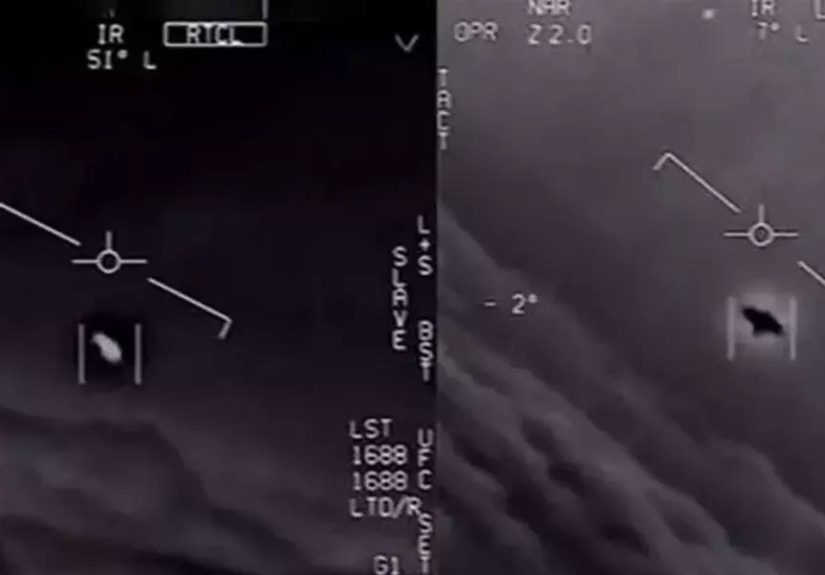
A separate piece that gets fused into the legend is the short infrared video commonly called “FLIR1.”
The public clip is brief, grainy, and (this matters) lacks the full context that analysts crave: raw sensor feeds, full flight telemetry,
complete radar records, electronic-warfare environment, and all the “boring” metadata that turns a mystery into a math problem.
The clip became famous because it looks strange and because pilots sound genuinely puzzled. But puzzling audio isn’t the same thing
as a physics-defying craft.
3) The U.S. government officially acknowledges the videos are realand still calls them “unidentified”
In 2019, Navy messaging emphasized the “UAP” label (Unidentified Aerial Phenomena) and framed the issue as a safety and security concern
about incursions into training ranges. In 2020, the Department of Defense formally authorized release of three Navy videos
(one from 2004, two from 2015), stating the phenomena in the footage remain “unidentified,” and that the release was meant to reduce
public confusion about authenticitynot to announce space visitors with great taste in minimalist design.
How the Nimitz Story Became a Pop-Culture Supernova
The Nimitz encounter might have stayed a niche military-aviation campfire story if not for a perfect storm:
leaked footage, major media reporting, and a growing public appetite for government transparency.
Once the videos hit mainstream coverage in 2017, the narrative gained momentum: “Top Gun pilots vs. impossible object” is a headline
that basically writes itself.
By 2019, the Navy was publicly emphasizing UAP reporting and trying to reduce stigma. Translation:
“Please tell us when weird things enter training airspacealso please don’t make the briefing slide say ‘ALIENS??’ in Comic Sans.”
The Big Claimsand What They Really Mean
People often repeat a greatest-hits list of capabilities attributed to the Nimitz “Tic Tac”:
rapid acceleration, abrupt turns, hovering with no visible propulsion, and quick transitions between high altitude and near sea level.
These claims matter, because if they’re accurate and supported by quality data, they would suggest either:
- Something human-made that’s operating where it shouldn’t (drones, balloons, test platforms, spoofing),
- Sensor/interpretation issues creating a misleading picture,
- Or something genuinely novel that deserves scientific attention.
The trouble is that the public does not have the complete dataset needed to confirm those capability claims in a rigorous way.
We have compelling testimony and fragments of imagerynot a full lab-grade package.
What Skeptics Get Right (Even If They’re Not Fun at Parties)
Sensor illusions are real, common, and sneaky
A targeting pod is not a magic truth camera. It’s a sophisticated instrument that can produce confusing results without the full context
of range, angle, background, and motion. Apparent speed can be exaggerated by perspective effects (like parallax), especially when you’re
looking at a small object at unknown distance while your own jet is moving fast.
“Unidentified” doesn’t mean “unexplainable”
In intelligence and aviation, “unidentified” often means “we don’t have enough reliable data to label this with high confidence.”
That’s not a cop-out; it’s how professionals avoid making up answers to fill blank spaces.
Some UAP cases elsewhere have plausible, prosaic explanations
Analysts have argued that certain famous UAP clips (especially in other incidents) can be explained by perspective, camera behavior,
or mundane objects like balloons. That doesn’t automatically solve the Nimitz visual storybut it does show how easily the brain and
sensors can collaborate to produce something that looks extraordinary.
What Believers Get Right (Even If Some of Their Group Chat Is Unhinged)
Witness credibility matters
It’s fair to take trained observers seriously, especially when they describe something clearly outside their experience.
Dismissing every report as “people are dumb” is lazy. Good analysis respects testimony while also acknowledging its limits.
Humans are excellent observers… and also excellent storytellers.
Multiple-sensor reports deserve attention
When observations involve more than one sensor type (radar, infrared, visual), the probability of a single simple error goes down
though it doesn’t go to zero. Correlation helps, but only if you can verify timing, calibration, and data quality.
National security is a real angle, not just a plot device
Even if every UAP case turns out to be drones, balloons, misidentifications, or clutter, incursions into military training airspace are
still a big deal. “Not aliens” can still mean “dangerous” or “important.”
What the U.S. Government Has Said in Recent Years
U.S. government reports have consistently leaned toward caution: limited data, multiple possible explanations, and a focus on safety and
foreign intelligence risks.
ODNI’s 2021 preliminary assessment: limited data, many unknowns
The 2021 ODNI preliminary assessment described a dataset of UAP reports largely from military sources and emphasized that most remained
unexplained due to insufficient information. It noted that a small subset of incidents involved reports of unusual movement patterns
and that UAP could pose flight-safety and national-security concernsespecially if any represent foreign collection platforms or advanced
tech. Importantly, it also laid out that UAP likely don’t have a single explanation, and that better data collection is needed.
AARO’s historical record framing: no verified extraterrestrial evidence
The All-domain Anomaly Resolution Office (AARO) has released historical reporting emphasizing that, across the investigations it reviewed,
it did not find verifiable evidence that reviewed cases represent extraterrestrial or “off-world” technology. At the same time, it
acknowledges that some cases remain unresolvedoften because the available data isn’t strong enough to do a definitive identification.
So… Was the Nimitz “Tic Tac” Aliens?
Here’s the most honest answer: the public record can’t prove that.
The Department of Defense calling footage “unidentified” is not a winking confession that E.T. just got a Pentagon badge.
It means the clips, as released, do not provide enough information for a confident IDand the government isn’t going to fill the gap with
vibes.
Could it have been a secret U.S. program? Possibly. Could it have been foreign tech? Possibly. Could it have been a mix of radar issues,
misinterpretations, and a real-but-mundane object seen in a confusing context? Also possible. Could it have been something genuinely
unknown? That’s the category “unidentified” is supposed to protect without jumping to conclusions.
The “Truth” Most People Skip: What Evidence Would Actually Settle It
If you want to move beyond internet arguments and into real analysis, you’d want:
- Raw radar data (not summaries), with calibration information and error estimates.
- Full targeting-pod telemetry: range, angles, track files, and mode settings across the entire encounter.
- Electronic warfare context: jamming, spoofing, and emissions logs.
- Time-synced multi-sensor fusion so analysts can confirm which signals refer to the same object.
- Independent corroboration (additional platforms, additional sensors, additional recordings).
Without that, we’re left with a famous, intriguing case that invites speculationand punishes overconfidence.
The Nimitz encounter is less like a solved detective story and more like finding one blurry photo from the security camera and arguing
whether it’s a raccoon, a backpack, or a time-traveling Roomba.
Why the Nimitz Encounter Still Matters
Even if the final answer is mundane, the Nimitz story matters because it changed the conversation:
- It pushed the military to treat UAP reporting as a flight-safety and security issue.
- It helped reduce stigma so pilots can report anomalies without feeling like they’ll be roasted forever.
- It highlighted a real gap: modern airspace is crowded with drones, balloons, and sensor noiseplus potential foreign surveillance.
In other words, the Nimitz encounter isn’t important only because of what it might be. It’s important because of what it reveals about
how hard it can be to identify things in real-world conditionseven with world-class equipment and highly trained people.
Bottom Line: The Most Responsible “Truth”
The truth about the Navy’s Nimitz encounter UFO sightings is not a neat punchline. It’s this:
Something unusual was reported. The most famous public footage is real Navy footage. The government still labels it “unidentified.”
And the publicly available data is not sufficient to prove an extraordinary conclusion.
If that feels unsatisfying, welcome to the scientific method. It’s basically a lifelong subscription to “maybe, but show me the data.”
The Nimitz case deserves curiosity, not certainty cosplay.
Experiences People Report Around the Nimitz Story (500+ Words)
The Nimitz encounter doesn’t just live in videos and reportsit lives in the experiences people describe when they brush up against the
edges of “I don’t know what that was.” And those experiences tend to fall into a few familiar categories, whether you’re a fighter pilot,
a radar operator, a journalist trying to keep a straight face on deadline, or a regular person who accidentally opened a comment section.
1) The “wait, that’s not on the checklist” moment
Military aviators train for a lot of scenarios: equipment failures, unexpected traffic, weather surprises, and the occasional bird that
chooses chaos. What many pilots say is most unnerving about UAP-style events isn’t “fear of aliens,” but the sudden realization that
something in the airspace doesn’t match known patterns. In accounts associated with the Nimitz story, the experience is described as
deeply professional: identify, assess, keep flying safely, report what you can. The emotional reaction comes lateroften when the brain
replays the memory and realizes it still can’t label it.
2) The “sensors disagree” headache
Another common experience is the frustration of conflicting information. People imagine military sensors as one all-seeing system, but in
reality, each sensor has strengths, weaknesses, and “weird days.” Radar might show tracks that don’t match expectations. Infrared might
show a shape that looks odd depending on zoom, contrast, and background. A human eyeball might see something that feels clear in the moment
but is hard to reconstruct later. When those inputs don’t line up cleanly, it creates the perfect environment for mysteryand for people to
argue forever. Analysts and skeptical investigators often describe the experience of rewatching short clips and thinking, “I can explain
three things… but that fourth thing still bugs me,” which is basically the UAP version of having one sock vanish in the laundry.
3) The “I don’t want to be the UFO person” dilemma
Many service members and civilians alike describe a social experience: the fear of being labeled dramatic, unreliable, or “that person.”
The Nimitz narrative helped popularize the idea that stigma can suppress reporting. People describe debating whether to file a report,
whether their peers will roll their eyes, and whether leadership will treat it as a serious safety issue or an unwanted distraction. The
irony is that aviation safety thrives on reporting anomalies, even when they turn out to be nothing. The healthiest versions of these
experiences end with a calm process: write it down, preserve the data, and let analysis do its jobno matter how spicy the internet wants
the conclusion to be.
4) The “community whiplash” effect
Civilians who get interested in the Nimitz encounter often describe a rollercoaster: one day they’re watching a serious interview with a
calm, credible pilot; the next day they’re being told the object is definitely extraterrestrial, definitely a balloon, definitely a secret
program, and definitely a hologramall before lunch. That whiplash experience is part of what makes the case culturally sticky. People end
up picking a “team” because it feels better than staying in uncertainty. But the more grounded experience many long-term followers describe
is learning to sit with ambiguity: collecting reliable sources, separating testimony from instrumentation, and being honest about what’s
missing.
5) The “curiosity upgrade” (the best outcome)
For a lot of people, the most lasting experience tied to the Nimitz story is a new respect for careful thinking. It’s easy to mock UFO
conversationsuntil you realize the core issue is identification under imperfect conditions, which is a real scientific and engineering
challenge. Many readers and researchers describe the Nimitz case as the moment they started caring less about labels (“UFO,” “UAP,” “aliens”)
and more about method: What data exists? What assumptions are we making? What would falsify this theory? That experienceturning mystery
into motivated skepticism and better questionsmight be the most valuable “sighting” of all.