Table of Contents >> Show >> Hide
- What “The Turning of the Table” Really Means
- The Beauty of Leaving the Mark Behind
- Why the Materials Matter
- Understanding “Between Centers” Without Needing a Workshop in Your Garage
- A Broader Design Idea: Honesty in Materials
- How the Table Performs in a Room
- What Makes Jorge de la Cruz’s Approach Stand Out
- Experiences Related to The Turning of the Table by Jorge de la Cruz
- Final Thoughts
Some furniture walks into a room and shouts. Some furniture clears its throat in a refined European accent and waits for you to notice it. Jorge de la Cruz’s The Turning of the Table belongs to the second camp. It is thoughtful, restrained, and quietly cleverthe kind of design that does not need glitter, gymnastics, or a neon sign screaming “I am art!” to make an impression. Instead, it does something more interesting: it lets the process of making become part of the beauty.
That idea is the heart of the piece. Rather than hiding the marks created by woodturning, de la Cruz leans into them. He turns traces of production into visual language. In a world full of furniture polished into anonymous perfection, that is a refreshing move. It is also a slightly rebellious one. Most mass-market furniture wants you to forget how it was made. This table does the opposite. It says, “Hello, I came from a real process, involving real wood, real tools, and probably at least one person covered in sawdust.”
Viewed through that lens, The Turning of the Table is more than a stylish object. It is a small manifesto about materials, memory, and modern design. It asks a simple but powerful question: what if the evidence of making is not a flaw to erase, but the story worth keeping?
What “The Turning of the Table” Really Means
The title is wonderfully literal and a little poetic at the same time. The “turning” refers to woodturning, the lathe-based process used to shape wooden elements into cylindrical or rounded forms. But it also hints at a conceptual turn: the table flips the usual design script. Instead of treating manufacturing marks as blemishes, it elevates them into a defining feature. That is the table’s central trick, and it is a good one.
De la Cruz’s work is often most compelling when it stays close to material logic. That is exactly what happens here. The table is not pretending to be handmade in some fake rustic sense, nor is it trying to look machine-perfect. It lives in the much more interesting middle ground where craft and industry shake hands instead of giving each other side-eye across the room.
This makes the piece feel intellectually sharp without becoming cold. It has an idea behind it, but it still behaves like furniture. You can use it. You can live with it. You can put books, coffee, or a dramatic bowl of lemons on it and carry on with your life. Good design should survive both critical analysis and Tuesday afternoon. This one does.
The Beauty of Leaving the Mark Behind
When process becomes ornament
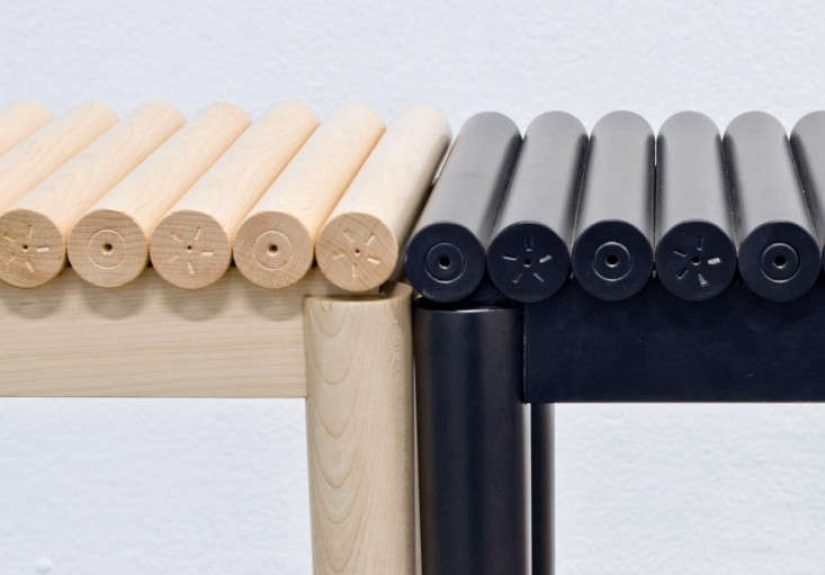
In many workshops, the marks left by the lathe’s centers are temporary. They are the backstage pass, not the final performance. They help hold the wood while it is shaped, then they are usually removed or hidden as the piece is refined. De la Cruz sees those marks differently. He treats them as visual evidence, almost like signatures left by the machine and the maker together.
That decision gives the table its identity. It transforms a technical necessity into an aesthetic detail. And because those marks are directly tied to how the wood was formed, the design never feels arbitrary. Nothing is pasted on. Nothing is fake. The decoration is not separate from the structure; it grows out of the making itself. That is the kind of elegance design people love because it is rare and hard-won.
A built-in narrative
There is also a storytelling quality here. Furniture often arrives in our homes stripped of context. We see the finished surface but not the journey. De la Cruz restores a bit of that journey. The table carries a visible reminder of what happened before it became “finished.” In that sense, the object holds onto its own biography. It remembers the factory instead of pretending it was born under perfect gallery lighting.
That memory matters. People tend to connect more deeply with objects that reveal something about their origin. It is the same reason exposed joinery, hand-tool marks, and natural grain patterns feel emotionally rich. We are not just looking at a product; we are looking at evidence of transformation.
Why the Materials Matter
The collection is associated with maple and black-dyed birch, and those choices make sense both visually and practically. Maple is known for strength, density, and a smooth, fine texture. It has enough toughness to handle everyday use, yet it can look refined rather than heavy-handed. In furniture, maple often reads as clean, solid, and quietly confidentbasically the design equivalent of someone who irons their shirt but does not brag about it.
Birch, meanwhile, offers a fine texture and generally straightforward grain, which makes it especially useful when a designer wants a crisp, calm surface. A black-dyed finish shifts birch from soft and familiar to graphic and dramatic. It adds contrast without changing the underlying logic of the piece. The result is a collection that can move between warmth and modernity depending on finish, light, and setting.
These woods also reinforce the concept of the work. Because both species respond well in furniture applications and reward careful shaping, they support the table’s emphasis on form and process. This is not a design where the material is incidental. The wood is not just there to be brown and cooperative. It is a full participant in the visual argument.
Understanding “Between Centers” Without Needing a Workshop in Your Garage
If you have never spent quality time with a lathe, the phrase “between centers” may sound like a graduate seminar in geometry. In woodworking, it is much simpler. The piece of wood is mounted between the headstock drive center and the tailstock center so it can spin while being shaped. This setup is fundamental to spindle turning, where square stock becomes round, tapered, or otherwise profiled through controlled cutting.
That matters because the table’s design concept comes directly from this setup. The very marks that most makers try to erase are born from those centers gripping the wood during turning. By preserving that evidence, de la Cruz makes the production method legible. The table becomes readable. Even if the viewer does not know the technical term, they sense that the object is telling the truth about how it came into being.
And truth, in design, is more powerful than polish alone. Plenty of furniture is polished. Not all of it is memorable.
A Broader Design Idea: Honesty in Materials
This table fits into a larger and long-running design conversation: should materials and construction be hidden, or should they be expressed? Modern design history has often admired honestyletting wood look like wood, letting structure read as structure, letting a joint look like a joint instead of disguising it behind decoration. De la Cruz’s table feels fully at home in that tradition, but with a contemporary twist. He is not just revealing structure. He is revealing manufacture.
That distinction is important. Older design debates often centered on whether ornament should be stripped away. Today, the more interesting question is what counts as ornament in the first place. De la Cruz suggests that the answer may lie in the process itself. Witness marks, machine traces, and production evidence can become expressive without feeling sentimental. They offer clarity, but also character.
This helps explain why the table still feels fresh. Many current designers are fascinated by visible process, raw textures, and the line between handcraft and industry. They are less interested in pretending objects emerged from nowhere. De la Cruz was working in a way that now feels especially relevant: transparent, materially aware, and alert to the poetry of fabrication.
How the Table Performs in a Room
One of the smartest things about the piece is that its concept does not overwhelm its function. The table is visually distinctive, but not loud. It can sit in a minimalist interior and deepen the space rather than dominate it. It can also work in a warmer, more layered room because wood always brings a sense of life that colder materials sometimes struggle to match.
The exposed turned ends act almost like punctuation marks. They create rhythm. They draw the eye to the corners and remind you that the object is assembled from shaped elements with a past. This gives the table a nice dual personality: from a distance it reads as clean and architectural; up close it becomes tactile and narrative.
That balance is hard to achieve. Too much conceptual design ends up feeling like a lecture with legs. Too much decorative furniture becomes visual wallpaper. De la Cruz lands in the sweet spot. The piece has enough theory for design lovers and enough calm usability for everyone else.
What Makes Jorge de la Cruz’s Approach Stand Out
What separates this work from a lot of contemporary furniture is restraint. De la Cruz does not rely on shock value, oversized gestures, or novelty for novelty’s sake. Instead, he pays close attention to how the material behaves, how a manufacturing process leaves traces, and how those traces might be reframed as meaning. That sounds modest, but it is actually a sophisticated design move.
It also aligns with other pieces associated with his broader body of work, where the history of fabrication and the expressive quality of wood take center stage. There is a real sensitivity to how wood grain, finish, and form communicate. This is not a designer trying to force wood into becoming plastic’s cooler cousin. It is a designer asking wood to be fully itselfonly smarter dressed.
That attitude gives the work longevity. Trendy furniture often expires the moment the algorithm gets bored. Material intelligence ages much better.
Experiences Related to The Turning of the Table by Jorge de la Cruz
One of the most interesting experiences related to this piece is the shift that happens when you stop seeing furniture as a neutral object and start seeing it as a record of decisions. A table like this changes the way people look. At first glance, someone might simply think, “Nice table.” Then they notice the turned ends, the visible marks, the sense that something has been left intentionally unresolved. Suddenly the object becomes a conversation. Not a loud one. More like the kind of conversation that begins with a raised eyebrow and ends with someone Googling wood lathes at midnight.
Design students, especially, would probably recognize that feeling. You encounter a piece like this and realize that good furniture is not only about silhouette or finish. It is about choosing what to reveal. Many young designers are taught to refine, correct, and perfect every visible surface. De la Cruz offers a different lesson: editing is not always about removing more. Sometimes it is about knowing which traces deserve to stay.
There is also the homeowner’s experience. Living with a table that reveals its making can subtly change the emotional temperature of a room. It introduces a sense of depth. The piece feels less disposable, less generic, less likely to be replaced the next time someone decides their personality is now “greige with boucle.” Because the table carries visible evidence of process, it feels anchored. It has a backstory even if you never explain it to guests.
Then there is the tactile experience. Wood has always invited touch, but turned wood especially has a way of pulling the hand toward it. Rounded transitions, softened edges, and visible end details create a strong temptation to run your fingers across the surface as if you are reading a sentence in Braille for design nerds. You do not just see the craft; you feel the logic of it.
Another related experience is rediscovering respect for workshop knowledge. In the digital age, a lot of design begins on screens, and that is not a bad thing. But work like this reminds people that the physical realities of tools, material resistance, pressure points, and grain direction are not annoying limitations. They are sources of meaning. The constraints of the lathe are part of the art. The process is not a hurdle standing between idea and object; it is the thing shaping the idea in the first place.
Finally, there is the quiet pleasure of noticing that a table can hold more than plates, laptops, or decorative candles you swear you are going to light someday. It can hold evidence. It can hold intention. It can hold the memory of a machine, the logic of a workshop, and the designer’s choice to keep that history visible. That is why a piece like The Turning of the Table stays with people. It is not just useful. It is legible. It invites curiosity, rewards attention, and proves that even a table can tell a surprisingly good story.
Final Thoughts
The Turning of the Table by Jorge de la Cruz is compelling because it turns a technical detail into a design philosophy. It shows how furniture can be elegant without being sterile, conceptual without being impractical, and contemporary without acting like it just discovered minimalism last Thursday. The piece respects the material, acknowledges the machine, and preserves the marks that connect one to the other.
That alone would make it worth discussing. But the deeper reason it matters is that it challenges a very common assumption in furniture design: that refinement means erasure. De la Cruz suggests the opposite. Sometimes refinement means choosing the right evidence to leave behind. In this case, the evidence is the whole point.
And honestly, that is a pretty wonderful twist for a table to pull off.