Table of Contents >> Show >> Hide
- What “French Eclectic” Really Means (and Why Gray Loves It)
- The Two-Gray Trick: Depth Without Drama
- A Real-World Case Study: A 1920s Cottage Kitchen That Went French Eclectic
- Picking Your Two Shades: Undertones, Lighting, and the “Why Does This Look Blue?” Moment
- Where to Put Each Gray (So Your Home Feels Curated, Not Confused)
- The French Eclectic Cheat Code: Warm Materials That Make Gray Feel Alive
- Pattern and Art: The “Eclectic” Part That Makes Gray Worth It
- Common Two-Gray Mistakes (and How to Fix Them Without Repainting Your Entire Life)
- Quick “Room Recipes” for Two Shades of Gray in a French Eclectic Home
- of Real-Life Style Experience: Living with Two Shades of Gray
- Conclusion: Two Grays, One Very French (and Very Livable) Story
Gray gets a bad rap. People act like it’s the color equivalent of a polite nod in an elevator. But in a French eclectic home,
gray is more like the perfect dinner-party host: it keeps the vibe sophisticated, makes everyone else look better, and never
steals the spotlight from the antiques, the art, or that one chair you bought because it “felt very Paris” (even though you live
nowhere near Paris and also the chair is technically from Facebook Marketplace).
The secret isn’t using a gray. It’s using two shades of grayclose enough to feel cohesive, different enough
to feel intentional. Done right, it’s effortless, layered, and quietly luxurious. Done wrong, it’s… a fog bank with cabinet doors.
Let’s do it right.
What “French Eclectic” Really Means (and Why Gray Loves It)
French eclectic style is less “matchy-matchy showroom” and more “collected over time.” Think old-meets-new, polished-meets-worn,
elegant-meets-everyday. You’ll see classic details (molding, vintage mirrors, curved silhouettes) sharing space with modern lines,
casual seating, and personal treasures that look like they have storiesbecause they do.
Gray works here because it’s a true neutral with range. It can lean warm and cozy like aged plaster, or cool and crisp like stone.
And in a French eclectic space, that flexibility matters: you might be pairing an antique wood table with contemporary lighting,
marble with linen, brass with black iron. A single, flat neutral can feel like a compromise. Two grays feels like a choice.
The Two-Gray Trick: Depth Without Drama
Two shades of gray create a “quiet contrast.” Instead of shouting with high-contrast black and white (which can skew modern and graphic),
you get depth that feels timeless. The typical pairing looks like this:
- Gray #1 (the envelope): a lighter gray for walls (and sometimes ceiling) that sets the mood.
- Gray #2 (the anchor): a slightly deeper or more saturated gray for cabinetry, trim, built-ins, or an island.
In French eclectic design, this reads as “considered but not fussy.” Like a blazer over a T-shirtpolished, but still relaxed.
A Real-World Case Study: A 1920s Cottage Kitchen That Went French Eclectic
One of the most charming examples of this approach comes from a renovated kitchen in a 1920s cottage in Scarsdale, New York.
The homeowner’s goal was refreshingly sane: create a space that feels modern but not trendy, while respecting
the home’s agesimple, with exquisite details, and designed for real family life.
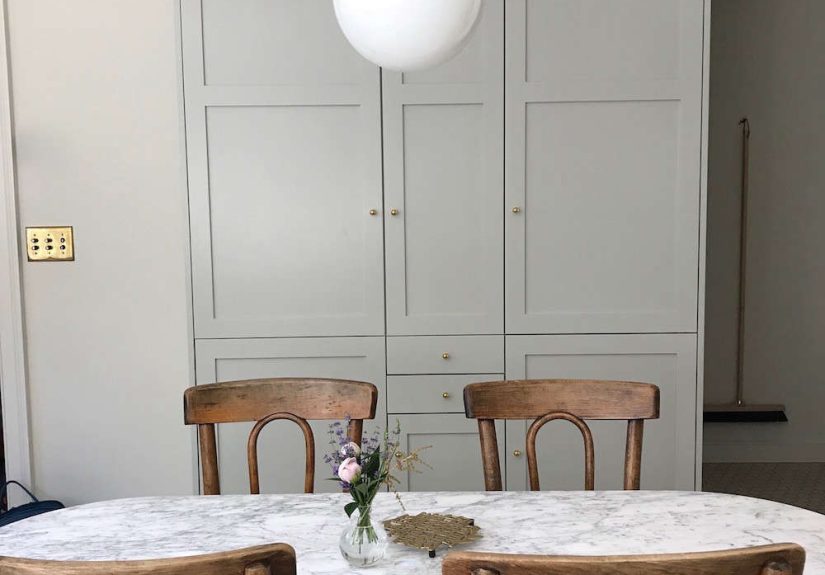
The “two shades of gray” move shows up as a gentle layering: a soft gray on the walls paired with cabinetry that reads as a
slightly greener, earthier gray (still grayjust with personality). The details do a lot of heavy lifting:
brass hardware that warms things up, classic cabinet fronts that nod to tradition, and light, small-format floor tile that feels
both vintage and clean.
The overall effect is French eclectic in spirit: tailored cabinetry meets casual, vintage-style seating; refined finishes meet
everyday comfort; the palette stays calm so the textures can speak.
Picking Your Two Shades: Undertones, Lighting, and the “Why Does This Look Blue?” Moment
If you’ve ever painted a room “perfect gray” and then watched it turn minty-blue by sundown, you already know the real boss here:
undertones and light.
1) Start with undertones: warm gray, cool gray, and greige
Grays aren’t just “gray.” Warm grays can have beige, brown, or subtle yellow-red undertones. Cool grays can show blue, green, or
violet undertones. “Greige” lives in the warm middleoften the sweet spot for French eclectic spaces because it plays well with
natural wood, brass, and stone.
2) Let the light bully your paint (before it bullies you)
Natural daylight is the truest read, but your room’s exposure can shift undertones. North-facing light often makes paint read cooler,
pulling out blue or green. Warm artificial bulbs can make gray look cozier (or slightly beige). Cooler bulbs can sharpen gray into
something icier. Translation: your “two grays” should be tested in the actual room, at multiple times of day.
3) Build contrast the French way: subtle, not stark
Instead of picking two totally different grays, choose shades with a shared undertone family. For example:
- Warm-with-warm: a light greige wall + a medium warm gray cabinet
- Green-gray family: a pale gray-green wall + a deeper gray-green built-in
- Stone family: a light “limestone” gray wall + a slightly deeper “slate” gray trim
Where to Put Each Gray (So Your Home Feels Curated, Not Confused)
Gray #1: The Background Gray
This is your mood-setter. In a French eclectic home, it should feel soft and architecturallike plaster, stone, or an old Parisian wall
that has watched 200 years of people dramatically sipping coffee. Use it on:
- Walls in main living areas
- Hallways (great place for a calming neutral)
- Ceilings if you want a “cocoon” effect (especially in dining rooms or libraries)
Gray #2: The Anchor Gray
This is your definition colorused where you want shape, structure, and emphasis. Use it on:
- Kitchen cabinetry (full run, or just lowers)
- Built-ins and bookcases
- Trim, doors, and shutters (a very French move when done subtly)
- A kitchen island (especially with a stone top)
If you’re nervous, make Gray #2 the cabinetry/built-ins and keep trim a soft white. If you’re feeling bold (in a calm, French way),
paint trim and doors the deeper gray and let the walls stay lighter.
The French Eclectic Cheat Code: Warm Materials That Make Gray Feel Alive
Gray needs friends. Specifically: warm, tactile friends. French eclectic design leans on contrast through materials rather than loud color,
so your grays should be supported by finishes that add softness and history.
Brass and aged metals
Brass hardware, faucets, and lighting add instant warmth and an old-world glint. It also plays beautifully against green-gray and greige,
which is why it shows up so often in French-inspired kitchens and baths.
Wood with visible grain
French eclectic rooms love wood that looks like it has lived a life: oak, walnut, or even painted wood with a hand-finished feel.
Pairing gray cabinetry with a wood counter section, a butcher block baking station, or a vintage table keeps the palette from feeling sterile.
Stone, marble, and “quiet luxury” surfaces
Marble (or a convincing marble-look surface) is a classic French signalrefined, but still practical when paired with forgiving finishes.
The trick is balance: let stone be elegant, then bring in everyday pieces (bistro chairs, simple pendants, worn ceramics) so it doesn’t feel precious.
Linen, toile, and texture for softness
French eclectic rooms often use textiles as the soul of the space: linen drapery, patterned cushions, woven rugs, and vintage-inspired prints.
Against two grays, a toile pillow or a faded stripe doesn’t feel busyit feels intentional.
Pattern and Art: The “Eclectic” Part That Makes Gray Worth It
Here’s the fun part: when your base palette is calm, you can layer personality without turning your home into a theme park.
French eclectic style loves:
- Collected art: vintage sketches, modern photography, flea market oils, even kids’ drawings (framed like you mean it)
- Mirrors: especially gilded or antique-style mirrors that bounce light and add drama
- Pattern mixing: stripes with florals, toile with checksunified by your gray base and a consistent texture story
If you’re unsure how to start, pick one “hero pattern” (say, a muted toile) and let everything else echo it in smaller doseslike a stripe
that shares a similar tone, or a rug that repeats the same warmth.
Common Two-Gray Mistakes (and How to Fix Them Without Repainting Your Entire Life)
Mistake 1: The grays don’t share undertones
If one gray leans purple and the other leans green, they’ll fight. Fix it by adjusting accessories and lighting temperature, or swapping one
of the two for a shade in the same undertone family.
Mistake 2: Everything is the same value
If the two grays are too close, the room can look flat. Fix it by increasing contrast through sheen (matte walls, satin cabinets) or adding a
darker “third neutral” in small doses (black iron, deep wood, or charcoal accents).
Mistake 3: The room feels cold
Cool gray plus cool lighting plus shiny finishes can feel icy. Fix it by adding warmth in layers: brass, warm bulbs, wood tones, woven textures,
and creamy whites.
Mistake 4: The cabinets look “too new” for French eclectic
French eclectic loves a touch of imperfection. If your cabinetry feels overly sleek, soften the look with vintage-style hardware, a more classic
door profile, open shelving with worn ceramics, or a small bistro table that introduces age and patina.
Quick “Room Recipes” for Two Shades of Gray in a French Eclectic Home
Kitchen
- Lighter gray walls (soft, warm-leaning)
- Cabinetry in a slightly deeper gray (often a gray-green or greige)
- Brass hardware and a few black accents for structure
- Classic tile (small hex, subway, or a subtle checkerboard)
- Vintage seating or a bistro-style table to keep it human
Living room
- Light gray walls as a gallery backdrop
- Deeper gray on built-ins or trim to frame the architecture
- Antique mirror + modern art (yes, together)
- Linen drapery, textured rug, warm wood table
Bedroom
- Soft gray walls for calm
- Deeper gray on the headboard wall or a painted dresser
- Crisp bedding with one patterned accent (toile, stripe, or floral)
- Brass reading sconces for that “boutique hotel in Paris” glow
Bathroom
- Light gray walls + deeper gray vanity
- Marble-look counter or classic white tile
- Warm metal fixtures (brass or polished nickel)
- One vintage element (mirror, stool, or art) to avoid “builder basic”
of Real-Life Style Experience: Living with Two Shades of Gray
Here’s what people don’t tell you about designing with two shades of gray: the decision is fast, but the relationship is long-term.
You’re not picking a trendy color fling. You’re choosing a palette that will see you through pancake breakfasts, frantic Tuesday mornings,
holiday chaos, and the occasional “Why is the wall green today?” crisis. And honestly? That’s where two grays shine.
The first experience most homeowners have is the lighting whiplash. In the morning, the lighter gray looks airy and elegant,
like a soft plaster wall in a Paris apartment. By late afternoon, it might pull warmer, suddenly hinting at beige. Then at night, under lamps,
the deeper gray on cabinetry can feel richer and more intimateless “paint color” and more “mood.” The lesson is simple: if you only like your
gray at one time of day, you don’t like that gray. The fix isn’t panic; it’s patience. Tape up samples, live with them, and let the room show
its full personality.
The second big experience is realizing that gray is a stage, not the show. Once the two grays are in place, the home starts to
feel like it’s waiting for your life to move in. A brass knob here, a vintage mirror there, a worn wood chair that doesn’t match anything but
somehow matches everythingthese details pop because the background isn’t competing. People often notice that they start buying fewer “decor” items
and more “forever” pieces. With a calm gray foundation, you can invest in one incredible light fixture instead of ten small distractions.
The third experience is the surprising way two grays make a home feel cleaner and calmer without feeling clinical. A single gray
can sometimes read flat. Two grays create gentle boundaries: walls recede, cabinetry or trim defines the architecture, and the space feels organized
even when real life is not. This is especially noticeable in kitchens, where the deeper gray on cabinets visually “grounds” the room, while the lighter
gray keeps the perimeter open. It’s the design equivalent of wearing sneakers with a tailored coatpractical, but still pulled together.
And then there’s the long-term experience that French eclectic lovers appreciate most: patina. Over time, gray doesn’t date the way
loud trend colors can. Instead, it becomes a backdrop for aging gracefully. Brass gets softer. Wood gets warmer. Textiles fade in a charming way.
Art gets swapped. A new rug appears. Your style evolves, but the two grays keep everything feeling cohesivelike the calm chorus in a song that lets the
verses change.
The most “French” part of living with two shades of gray is the mindset shift. You stop trying to make everything perfect. You let the home feel lived in.
You mix the inherited piece with the modern one. You hang the art a little off-center because it feels right. Two grays don’t demand attentionthey support
the life happening in front of them. And that’s the point: French eclectic isn’t about decorating. It’s about inhabiting.
Conclusion: Two Grays, One Very French (and Very Livable) Story
Two shades of gray in a French eclectic home are less about playing it safe and more about building a foundation with range. The lighter gray sets the mood,
the deeper gray adds structure, and the warm materialsbrass, wood, linen, stonebring the soul. From there, your collected pieces, patterns, and art get to
do what French eclectic does best: tell a story that looks effortless, even if you secretly tested nine sample swatches and had one minor meltdown.