Table of Contents >> Show >> Hide
- What the Snipex Alligator Actually Is (Spoiler: Not Your Typical “Sniper Rifle”)
- Why 14.5×114mm Is the Caliber Equivalent of “Hold My Beer”
- The Specs That Earned the “Beast” Nickname
- “Designed for Stuff”: What Anti-Materiel Really Means on a 2020s Battlefield
- Recoil Management: When Physics Sends You an Invoice
- Optics, Rails, and the Not-So-Secret Sauce of Extreme Range
- How the Alligator Compares to the Rifles Americans Know
- The “Longest Shot” Stories: Why They’re Viral, and Why They’re Messy
- Logistics: Carrying a 55-Pound Rifle Is a Team Sport
- Why the Snipex Alligator Matters (Even If You Never Touch One)
- Conclusion: A Beast With a Job, Not Just a Reputation
- Range-Day Reality Check: Reported “Experience” with a Rifle This Big
Some rifles feel “big” because they have a chunky scope and a serious attitude. The Snipex Alligator feels big because
it’s basically a precision-built argument with gravity. If a typical sniper rifle is a scalpel, the Alligator is the
scalpel’s older cousin who shows up to dinner wearing a leather jacket and carrying a canoe paddlebecause at roughly
6.5 feet long, it kind of is one.
Built in Ukraine and fielded in the middle of the most scrutinized modern battlefield on Earth, this 14.5×114mm anti-materiel rifle
has become a legend magnet: huge caliber, huge recoil management, huge headlines. But under the meme-worthy proportions is a very real concept:
give small teams a tool that can reach out, smack hardware, and solve problems that usually require something louder and less portable.
What the Snipex Alligator Actually Is (Spoiler: Not Your Typical “Sniper Rifle”)
The Alligator is best understood as an anti-materiel sniper riflea precision rifle designed less for “one shot, one person”
romance-novel sniping and more for disabling equipment. Think light vehicles, communications gear, radar/air-defense odds and ends,
parked aircraft, fortified positions, and other stuff that soldiers would prefer didn’t work today.
A heavy-caliber tool built for modern targets
Ukraine’s battlefield reality is a mix of trench lines, drone surveillance, quick relocation, and the constant need to punch above weight.
An anti-materiel rifle fits that world: it can threaten key components (engines, optics, antennas, exposed systems) and do it from standoff
distances that complicate the other side’s day.
And yes, it can be used against personnelalmost anything canbut the Alligator’s design logic is about hardware interdiction.
The rifle’s own coverage and commentary often stresses that it was built for targets bigger and tougher than a human silhouette.
Why 14.5×114mm Is the Caliber Equivalent of “Hold My Beer”
The Alligator’s calling card is its cartridge: 14.5×114mm. This round has a history that reads like a museum tour of
“things invented to stop other things made of steel.” It traces back to Soviet-era anti-tank rifle and heavy machine gun use, and it has
never fully stopped being overqualified for polite conversation.
Numbers that make .50 BMG look like it’s trying to be relatable
Depending on the load, you’ll see projectile weights commonly discussed in the neighborhood of roughly 59–66 grams,
with velocities often cited around ~1,000 m/s (about 3,300 fps). That combination produces energy figures that live in the
“this is why we wear eye protection” range.
A Western reader’s natural comparison is .50 BMG (12.7×99mm), the round behind rifles like the Barrett M107. The Alligator’s
14.5mm class is a step up in bore diameter and typical energymore “anti-materiel” than “big sniper,” and closer to the idea of precision
impact than precision marksmanship alone.
The Specs That Earned the “Beast” Nickname
The Alligator’s stats read like somebody dared an engineer to build a rifle that could bench-press a rifle.
Here are the headline traits that show up again and again across reporting:
- Caliber: 14.5×114mm
- Action: Manually operated, bolt-action
- Feed: 5-round detachable box magazine
- Overall length: about 2,000 mm (roughly 6 ft 7 in)
- Barrel length: about 1,200 mm (roughly 47 in)
- Weight: around 25 kg (about 55 lb), before you add optics and other necessities
- Role: Anti-materiel / long-range interdiction of equipment
- Range claims: often discussed with ~2,000 m “effective” class talk and much longer maximum ballistic travel
Translation: you don’t casually sling this over your shoulder for a nature walk. This is a system. It’s a plan. It’s a commitment.
“Designed for Stuff”: What Anti-Materiel Really Means on a 2020s Battlefield
If you’ve ever watched a modern conflict and thought, “Wow, that’s a lot of antennas, drones, sensors, and lightly protected vehicles doing important jobs,”
congratulationsyou already understand the niche an anti-materiel rifle tries to exploit.
Targets that don’t have to explode to be “done”
Anti-materiel work is often about causing a mission kill: disable a component, ruin a capability, force a recovery operation, or make a vehicle “alive”
but useless. A round with serious penetration potential can turn a “working system” into an “expensive problem” fast.
Some coverage highlights that the Alligator’s 14.5mm projectile can defeat certain armor plate thicknesses at meaningful distancesan indicator of the role
it was built for: light armor, equipment, and fortified material, not just paper targets.
Recoil Management: When Physics Sends You an Invoice
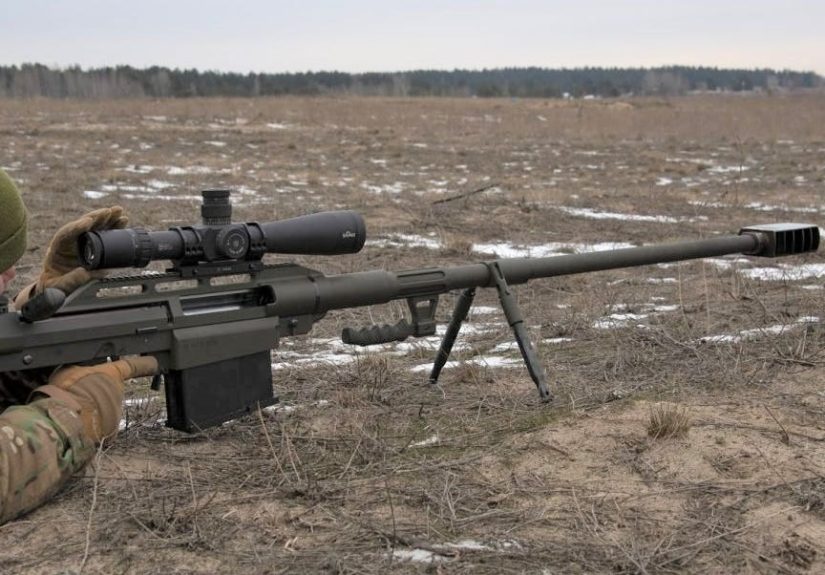
A 14.5mm rifle doesn’t ask permission; it introduces itself. So the Alligator leans hard into recoil mitigation. Reported design features commonly include:
a large multi-chamber muzzle brake, recoil isolation elements, and a padded shoulder interface. Add a bipod up front and a rear support to help keep the
system stable and repeatable.
Why that matters for real-world accuracy
Precision at long range is less about “the bullet goes far” and more about doing everything the same way, every time, while the environment does its best
to make a liar out of you. A stable platform helps the shooter manage follow-up shots, observe impacts, and stay on task without the rifle turning the
operator into a reluctant acrobat.
Optics, Rails, and the Not-So-Secret Sauce of Extreme Range
Extreme-range capability is a team sport: rifle, ammunition, optic, atmospheric data, spotting, and the kind of patience usually associated with people
who knit. The Alligator is typically described with a long top rail for optics, enabling serious glass and the kind of adjustment range you need when the
target is closer to “over there” than “right there.”
Modern warfare: precision meets sensors
In Ukraine, one of the biggest shifts in the “sniper” conversation has been the integration of drones and observation.
The rifle is still the final tool, but spotting, confirmation, and correction increasingly come from above. Some widely circulated stories even describe
AI-assisted calculations paired with drone reconnaissance in record-distance claimsmore on that in a moment.
How the Alligator Compares to the Rifles Americans Know
In U.S. terms, the easiest mental placeholder is the Barrett M107/M82 family: big rifle, big cartridge, anti-materiel heritage,
iconic silhouette. But the Alligator is playing in a different weight class of ammunition. It’s more “heavy machine gun cartridge in a rifle format”
than “large sniper cartridge.”
Within Snipex’s own lineup
Snipex (often associated in reporting with XADO’s industrial umbrella) has been linked to other big-caliber systems too, including the
Snipex T-Rex (another 14.5mm concept often described as a single-shot/breech-loading style in some coverage) and the
Monomakh (frequently mentioned as a semi-automatic companion concept). The Alligator stands out because it’s typically discussed as
a magazine-fed 14.5mm platformgiving it a different rhythm than single-shot monsters.
The “Longest Shot” Stories: Why They’re Viral, and Why They’re Messy
The Alligator shows up in long-range kill narratives for one simple reason: it’s capable, dramatic, and visually unforgettable. If you’re trying to explain
“extreme range,” a rifle that looks like it should come with a parking permit does half the storytelling for you.
What gets reported vs. what can be verified
Multiple U.S. outlets have discussed Ukraine-associated long-distance claims involving the Alligator, including reports in the “around 1.7 miles” range
during late 2022. More recently, widely circulated accounts describe an August 14, 2025 engagement claim at 4,000 meters
(about 2.5 miles), sometimes described as AI-assisted and supported by drone reconnaissance.
Here’s the important nuance: sniper “records” are often unofficial, inconsistently documented, and heavily dependent on what evidence is available.
In a war zone, there’s no global referee with a laser rangefinder, a clipboard, and a soothing whistle. So the responsible way to treat these stories is:
interesting, plausible within ballistic limits, but not universally certified.
Logistics: Carrying a 55-Pound Rifle Is a Team Sport
The Alligator’s biggest downside is also its most obvious feature: it’s gigantic. A roughly 25 kg rifle plus optics, support gear, and heavy ammunition
becomes a mobility puzzle. In practical terms, that pushes the system toward deliberate positions, planned movement, and often more than one pair of hands.
The tradeoff: portability vs. capability
You don’t bring an Alligator because it’s convenient. You bring it because it can threaten targets that smaller rifles can’tor can’t do so reliably.
The payoff is standoff disruption: the ability to force an enemy to treat certain assets as vulnerable, even when they’re not within reach of typical small arms.
Why the Snipex Alligator Matters (Even If You Never Touch One)
The Alligator isn’t just a novelty. It’s a symbol of how modern conflict blends:
homegrown manufacturing, specialized niche weapons, and sensor-driven targeting.
Ukraine’s defense ecosystem has had to innovate under pressure, and systems like this show a willingness to build tools tailored to the battlefield rather than
relying only on legacy imports.
It also highlights a larger trend: as drones spot more, as vehicles become more sensor-dependent, and as fortified positions rely on exposed hardware,
the value of “precision damage” rises. The Alligator is basically that idea, scaled up until it needs its own zip code.
Conclusion: A Beast With a Job, Not Just a Reputation
The internet loves the Snipex Alligator because it looks like a rifle designed by a committee of comic book artists. But the reality is more interesting:
it’s a purpose-built Ukrainian anti-materiel sniper rifle that reflects modern needsreach, disruption, and the ability to threaten equipment
from distances that complicate retaliation.
Call it a beast, call it a meme, call it a physics lesson with a trigger. Just don’t call it “only for show.” The Alligator exists because, on a modern battlefield,
sometimes the fastest way to change the other side’s plans is to make their most important hardware suddenly stop cooperating.
Range-Day Reality Check: Reported “Experience” with a Rifle This Big
Let’s be honest: most of us will never fire a 14.5×114mm rifle, and that’s probably for the bestyour local range officer deserves peace.
But we can still talk about what people who have handled comparable 14.5mm systems and what observers of the Alligator’s use tend to emphasize:
the experience isn’t “sniping,” it’s operating a portable precision cannon.
First, there’s the setup ritual. A normal rifle comes out of a case. A 55-pound rifle comes out like you’re unpacking gym equipment.
The bipod goes down, the rear support gets adjusted, the rifle gets settled, and suddenly your “shooting position” looks less like a hobby and more like a small
construction project. The vibe is: “Nobody touch anything. The laws of leverage are currently holding a meeting.”
Then there’s the blast. Even with aggressive muzzle brakes designed to tame recoil, the concussion is the part that people remember.
Big-bore shooters often describe it as a pressure wave that rearranges loose dirt, rattles teeth, and makes nearby observers reconsider all of their life choices.
If you’ve ever felt a .50 BMG’s shockwave and thought, “That’s intense,” a 14.5mm class rifle tends to be described as the next chapterlouder, deeper,
and less interested in your comfort.
Recoil itself is frequently described with a twist: it can be surprisingly manageable given the cartridge, because the system is heavy and the recoil
mitigation is serious. But “manageable” is not the same as “pleasant.” Think of it like getting shoved by a very large friend who is apologizing while doing it.
Your shoulder survives, your pride survives, but your internal organs file a formal complaint.
The practical challenge is stamina and repeatability. With a rifle this size, every small adjustment matters: where the rifle sits, how the rear
support is planted, how the shooter stays behind the gun. It’s less “snap shot” and more “slow, careful choreography.” That’s why so many real-world discussions
frame these systems as team tools: a shooter, a spotter, and increasingly some kind of external observation (from another optic, another position, or a drone feed).
Finally, there’s the psychological experience of scale. People who see the Alligator in photos often assume it’s a propuntil you notice the magazine, the rail,
the thickness of everything, and how it dwarfs the person beside it. The moment it clicks, you understand why it’s become famous: the rifle doesn’t just
do something unusual. It looks like it does. In a world full of similar silhouettes, the Alligator is unmistakablean unapologetic reminder that
sometimes precision isn’t about being subtle. Sometimes precision is about being exact… at a distance… with a round that could scare a small engine.