Table of Contents >> Show >> Hide
- First, what “sore” are we talking about?
- Should you work out when sore?
- Potential benefits of working out when sore
- Risks of working out when sore
- How to decide: workout, modify, or rest?
- Smart ways to work out when sore (without making it worse)
- Recovery tools that actually help (and what to skip)
- Specific examples: what to do when the soreness hits
- When soreness is telling you your program needs a tune-up
- Real-life experiences: what sore-day workouts actually feel like (and what people learn)
You crushed a workout yesterday. Today, your legs feel like they’re made of overcooked spaghetti and regret.
So… do you work out when sore, or do you declare a national holiday in honor of your glutes?
The real answer is gloriously unsexy: it depends on what kind of sore you are, how intense the soreness is,
and whether you’re dealing with normal muscle tenderness (hello, DOMS) or something that looks more like injury.
This guide breaks down the benefits, risks, and smart strategies for training through soreness without turning your fitness plan into a cautionary tale.
First, what “sore” are we talking about?
Normal workout soreness (DOMS)
The most common type is delayed onset muscle soreness (DOMS)the stiffness and tenderness that shows up
after a new workout, a harder-than-usual session, or a move that involves a lot of eccentric work (think: lowering into a squat,
downhill running, or slowly lowering dumbbells).
DOMS usually creeps in 12–24 hours after training, often peaks around 24–72 hours, and then fades.
It can feel achy, stiff, and annoying… but it typically improves as you warm up and move around.
Injury pain (the kind that doesn’t need a pep talk)
Pain that’s sharp, stabbing, sudden, localized to a joint, or paired with swelling, bruising, or instability isn’t “good soreness.”
That’s your body filing a formal complaint.
Should you work out when sore?
In many cases, yesif you scale the workout to match your soreness.
Light movement can temporarily reduce that stiff “tin man” feeling by increasing blood flow and warming the tissues.
But pushing hard on very sore muscles can worsen fatigue, mess with your form, and raise your risk of injury.
A simple soreness scale
- 0–3/10 (mild): Feels tight or tender, but you can move normally. Usually okay to trainwarm up well.
- 4–6/10 (moderate): Noticeable soreness, stiffness, or reduced range of motion. Train, but reduce load/volume and avoid max effort.
- 7–10/10 (severe): Walking downstairs requires a handrail and a prayer. Skip intense training on those muscles. Choose active recovery or rest.
Potential benefits of working out when sore
1) You keep the habit alive
One of the biggest “fitness superpowers” is consistency. A lower-intensity session on sore days helps you keep your routine
without needing to be a hero every time you step into the gym.
2) Light movement can ease stiffness (temporarily)
Gentle cardio, mobility work, or easy sets can make you feel better during and shortly after the session.
It’s not magic healingit’s more like turning on the faucet so things move more smoothly.
3) You can train around it
Sore legs don’t automatically mean a day off. It might mean it’s a great day for upper body,
core stability, technique work, or low-impact conditioning.
Risks of working out when sore
1) Your form gets weird
Severe soreness can change how you move. When your body starts “protecting” an area, other muscles take over,
mechanics get sloppy, and that’s when minor problems become major problems.
2) You can dig the recovery hole deeper
If you repeatedly stack high-intensity sessions on top of heavy soreness, you may end up chronically fatigued,
underperforming, and more prone to overuse injuries. More work isn’t always more progress.
3) Rare but serious: overdoing it can contribute to rhabdomyolysis
Rhabdomyolysis is a potentially dangerous condition where damaged muscle releases proteins into the bloodstream
that can harm the kidneys. It’s uncommon, but it’s important to know the red flagsespecially after extreme, unaccustomed workouts.
How to decide: workout, modify, or rest?
Use this quick “decision checklist” before you lace up.
Green light: train (but still be smart) if…
- You can perform normal daily activities without limping or compensating.
- The soreness improves after 5–10 minutes of warm-up.
- Range of motion is mostly intact.
- No sharp pain, swelling, or joint instability.
Yellow light: modify if…
- You feel noticeably weaker (bar speed is down, pace feels unusually hard).
- Movement feels stiff and you can’t hit good positions (like depth in a squat).
- Soreness is moderate and localized to muscles you planned to train hard.
Red light: rest or get checked if…
- Pain is sharp, sudden, or localized to a joint.
- You have major swelling, bruising, numbness, or loss of function.
- You feel sick (fever, chills) or unusually weak.
- You notice very dark urine, very low urine output, or severe muscle pain/weakness that’s out of proportion.
Smart ways to work out when sore (without making it worse)
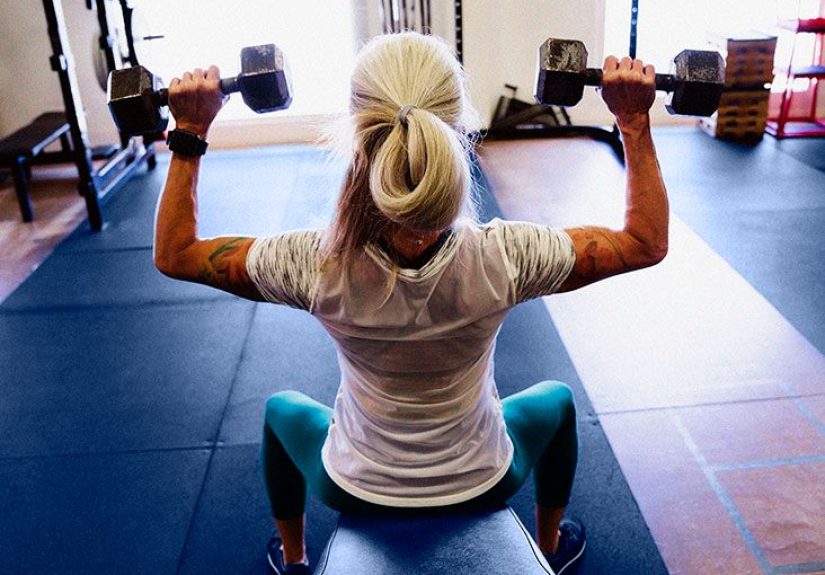
1) Keep intensity, reduce volume
A practical rule: keep the session easy-to-moderate and cut the total work.
If you normally do 5 sets, do 2–3. If you normally lift heavy, use lighter loads and smooth reps.
You’ll still get movement quality and blood flow without turning soreness into a multi-day drama.
2) Train a different muscle group
This is the simplest “workaround” in training history.
Sore from deadlifts? Do pushing and pulling for upper body.
Arms sore from pull-ups? Train lower body technique or do a steady walk.
Your body is not one big muscle. It’s a well-organized committeeannoy one department and meet with another.
3) Choose low-impact cardio for active recovery
Walking, cycling, swimming, or an easy elliptical session can reduce stiffness and keep you moving.
Aim for a pace where you can talk in full sentences without sounding like you’re auditioning for a survival show.
4) Warm up like you mean it
A good warm-up is a soreness “volume knob.” Try:
- 5–10 minutes of easy cardio
- Dynamic mobility for the tight area (hips, ankles, shoulders)
- Ramp-up sets: start very light and increase gradually
If the warm-up makes everything feel better, you can train (with modifications).
If it makes everything feel worse, that’s a useful clue.
5) Use “technique practice” as the goal
On sore days, chase quality instead of personal records.
Practice your squat pattern with lighter weight and crisp form.
Work on controlled tempo, breathing, and bracing. You’ll build skill and confidence without adding a recovery tax.
Recovery tools that actually help (and what to skip)
Sleep: the underrated performance supplement
Most recovery strategies are “nice.” Sleep is “necessary.”
If you’re routinely sore for days, take an honest look at your sleep quality and quantity before you buy another gadget.
Food: protein + carbs for repair and refuel
Soreness is more likely to linger when you train hard and under-eat.
A protein-rich meal plus carbohydrates after training supports muscle repair and glycogen replenishment.
You don’t need a perfect macro spreadsheetjust consistent, balanced meals.
Hydration: basic, boring, effective
Dehydration can make workouts feel harder and recovery feel slower. Keep water intake steady, especially if you sweat heavily.
Foam rolling and massage
Many people find foam rolling and massage reduce soreness and improve how they feel and move.
The effect may be modest and individual, but if it helps you restore range of motion and relax tight areas,
it can be a useful toolespecially when paired with gentle movement.
Ice, heat, stretching
Heat often feels great for general stiffness. Ice can help when there’s acute irritation or you just want that numb “reset.”
Stretching is fine if it’s gentle and doesn’t cause painbut aggressive stretching on a very sore muscle can backfire.
Use these as comfort tools, not as the main event.
Specific examples: what to do when the soreness hits
If your legs are sore from squats
- Do: upper-body strength, easy cycling, brisk walking, hip mobility, light goblet squats
- Avoid: max-effort lower-body lifting, sprints, heavy plyometrics
If your upper body is sore from push day
- Do: lower body technique, steady cardio, core stability, scapular mobility
- Avoid: heavy pressing, high-volume dips, grinding reps
If you’re sore everywhere (the full-body “why did I do that?”)
- Do: 20–40 minutes of easy movement, mobility flow, light stretching, a rest day with a short walk
- Avoid: trying to “sweat it out” with another brutal workout
When soreness is telling you your program needs a tune-up
Occasional DOMS is normalespecially when you’re new, returning after time off, or progressing your training.
But if you’re regularly so sore you can’t move well, your program may be too aggressive.
- Increase workload more gradually (volume, intensity, or new exercises).
- Alternate hard and easy days.
- Rotate muscle groups and movement patterns.
- Deload periodically if you’re training hard for weeks at a time.
Real-life experiences: what sore-day workouts actually feel like (and what people learn)
If you ask a gym full of people what it’s like to work out when sore, you’ll get a surprisingly consistent set of stories.
Not because everyone trains the same way, but because bodies are wonderfully predictable in how they complain.
One common experience: the first five minutes feel like a mistake. People often describe warming up on a sore day as
“rusty hinges” or “walking like a baby deer.” Then something interesting happensonce the heart rate rises and the joints move,
stiffness often eases. That doesn’t mean the muscle is fully recovered; it means warm tissue moves better than cold tissue.
Many lifters learn to treat the warm-up as a test: if movement quality improves, the session continues (modified).
If it doesn’t, they pivot to something gentler.
Another frequent lesson: your ego is louder when you’re sore. People will say things like,
“I didn’t want to skip because I’m ‘disciplined’,” when the honest translation is, “I didn’t want to feel behind.”
With experience, most realize discipline isn’t doing the hardest thing every dayit’s doing the right thing consistently.
That often means swapping heavy squats for easy cycling, or turning a planned HIIT session into a steady walk.
Nobody posts that on social media with a fire emoji, but it’s how long-term progress is built.
Many runners notice a pattern: DOMS changes their stride. On sore legs, steps get shorter,
cadence changes, and little aches pop up in places that didn’t hurt yesterday. That’s usually a sign to keep the run easy or switch to low-impact cardio.
Over time, people learn that “pushing through” severe soreness doesn’t make them tougherit makes their mechanics sloppier.
And sloppy mechanics are basically an invitation for cranky knees, hips, or shins to RSVP.
Strength trainees often report that soreness isn’t evenly distributed.
After a new lift (like Romanian deadlifts), people feel sore in muscles they didn’t even know had names.
The experience teaches them a useful truth: novelty creates soreness.
Once the movement becomes familiar, the same workout usually causes less DOMS even as performance improves.
That’s why experienced lifters rarely chase soreness as proof of a good sessionthey chase progressive, repeatable training.
Then there are the “uh-oh” stories: someone does an extreme workout after a long break,
feels abnormally weak and painfully swollen, and notices very dark urine or barely peeing.
The shared takeaway from those experiences is simple: some signals aren’t motivationalthey’re medical.
Knowing the difference between normal soreness and red flags is part of training maturity.
The best “sore-day” wisdom people tend to arrive at sounds almost too practical:
move a little, train what you can train well, don’t force intensity onto a body that’s asking for recovery,
and remember that fitness is a long game. If you can do that, soreness becomes a speed bumpnot a roadblock.