Table of Contents >> Show >> Hide
- What Is NASA’s Solar Sail?
- Why Does the Solar Sail Shine So Brightly?
- How Solar Sailing Works
- Why ACS3 Matters for Future Space Missions
- How to Watch NASA’s Solar Sail in the Night Sky
- Can You Photograph the Solar Sail?
- Solar Sails and the Long History of Light-Powered Flight
- Why the Solar Sail May Not Always Be Visible
- What Makes ACS3 Different From Other Satellites?
- Simple Step-by-Step Guide for Skywatchers
- The Bigger Picture: A New Way to Move Through Space
- Personal Viewing Experience: What It Feels Like to Watch a Solar Sail
- Conclusion
If you have ever looked up at twilight and thought, “Was that a star, a plane, or my neighbor’s drone making a dramatic exit?” NASA has added a much cooler possibility to the list: a solar sail. The Advanced Composite Solar Sail System, better known as ACS3, is a small spacecraft with a shiny sail large enough to catch sunlight and, under the right conditions, catch your eye from Earth.
Unlike a rocket that burns fuel like a teenager burns phone battery, a solar sail uses the gentle pressure of sunlight for propulsion. That may sound like science fiction wearing a lab coat, but it is real engineering. NASA’s ACS3 mission is testing lightweight composite booms and a reflective sail that could help future spacecraft travel through space without carrying heavy chemical propellant.
For skywatchers, the bonus is delightful: when the sail is properly lit by the Sun and angled toward observers on Earth, it can appear as a bright moving point in the night sky. It does not glow by itself. It reflects sunlight, much like a mirror cruising hundreds of miles above your head with a NASA badge and excellent timing.
What Is NASA’s Solar Sail?
NASA’s Advanced Composite Solar Sail System is a technology demonstration mission designed to test solar sail deployment and maneuvering in low Earth orbit. The spacecraft launched on April 23, 2024, and successfully deployed its sail on August 29, 2024. The mission is managed by NASA Ames Research Center, while NASA Langley Research Center designed and built the deployable composite boom and solar sail system.
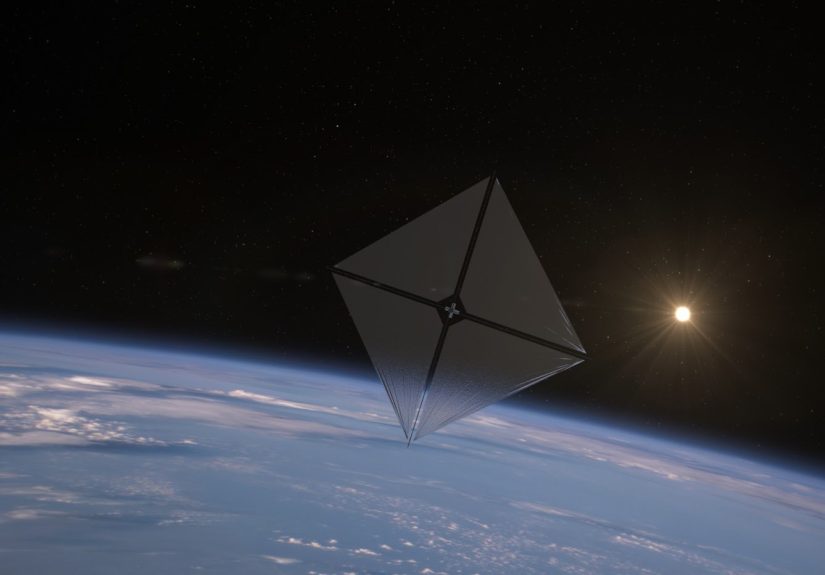
The spacecraft itself is a small CubeSat, but once the sail is unfurled, the mission becomes anything but tiny. The square sail measures about 30 feet per side and covers roughly 860 square feet, or about 80 square meters. That is about the size of a small apartment, although admittedly not one with a kitchen, Wi-Fi, or a landlord asking for first and last month’s rent.
The sail is supported by four lightweight composite booms. These booms are important because future solar sail missions will need structures that are strong, light, compact, and reliable. A sail that cannot unfold properly is not a sail; it is space origami with commitment issues.
Why Does the Solar Sail Shine So Brightly?
The simple answer is reflection. ACS3’s sail is made from a thin, reflective material designed to interact with sunlight. When sunlight hits the sail, some of that light bounces toward Earth. If your location, the spacecraft’s position, and the Sun’s angle line up just right, the sail may brighten dramatically as it crosses the sky.
NASA has noted that once fully deployed and properly oriented, the sail’s reflective material could appear nearly as bright as Sirius, the brightest star in the night sky. However, brightness is not guaranteed every time. The spacecraft can vary in visibility because its orientation changes. When the sail faces the right way, it can flash or glow brightly. When it turns away, it may fade or disappear from view faster than your motivation to fold laundry.
This is why watching the solar sail is different from watching the Moon or a planet. The Moon is dependable. Jupiter is patient. ACS3 is more like a glittering space postcard being waved around at orbital speed. You need timing, a good viewing angle, and a little luck.
How Solar Sailing Works
Solar sailing is based on a beautifully simple principle: light carries momentum. Photons from the Sun have no mass, but they can still push against a surface. The force is extremely small, so a solar sail must be large, lightweight, and reflective to make useful progress.
Think of it like wind pushing a sailboat, except the “wind” is sunlight and the ocean is space. There is no breeze ruffling the sail, no salty spray, and no captain yelling nautical phrases for dramatic effect. Instead, the spacecraft slowly changes its path by adjusting the sail’s orientation to sunlight.
The advantage is endurance. A rocket engine delivers powerful thrust but needs fuel. A solar sail produces tiny but continuous thrust as long as sunlight reaches it and the spacecraft remains functional. Over time, that persistent push can become meaningful, especially for missions that need long-duration, low-thrust propulsion.
Why ACS3 Matters for Future Space Missions
ACS3 is not just a pretty object for stargazers. Its main job is to help NASA learn how advanced composite materials behave in space. The mission tests whether lightweight booms can deploy a sail successfully, hold its shape, and support maneuvering operations.
Future solar sails could support several types of missions. They may help spacecraft monitor space weather, observe near-Earth asteroids, or serve as communications relays for exploration missions. Space weather missions are especially interesting because solar sails could help spacecraft maintain unusual vantage points between Earth and the Sun, where constant low-thrust propulsion is valuable.
Solar sails also reduce dependence on onboard propellant. In space mission design, mass is money. Every pound launched into orbit matters. If future spacecraft can use sunlight instead of carrying extra fuel, missions may become lighter, more flexible, and potentially less expensive.
How to Watch NASA’s Solar Sail in the Night Sky
To watch ACS3, start with timing. Satellites are usually easiest to see shortly after sunset or before sunrise. During those windows, the observer is under a darkening or dark sky, while the satellite overhead may still be illuminated by the Sun. That creates the perfect stage for reflected sunlight.
Next, use a satellite tracking tool. NASA has promoted viewing opportunities through its mobile app, and skywatching websites such as Heavens-Above list satellite passes, including ACS3 Solar Sail. These tools can show when the spacecraft may pass over your area, how bright it might appear, what direction to look, and how high above the horizon it will travel.
Choose a location with a clear view of the sky. You do not need a mountaintop observatory guarded by owls, but you do want fewer buildings, fewer trees, and less light pollution if possible. A backyard, park, school field, or open sidewalk can work if the pass is bright enough.
Best Viewing Conditions
The best conditions include a clear sky, low light pollution, and a pass that takes the sail high above the horizon. Objects near the horizon are harder to see because you are looking through more atmosphere, haze, and city glow. A pass that climbs high overhead is usually easier.
Moonlight matters too. A bright Moon can wash out faint satellites, although a strong solar sail reflection may still be visible. If the forecast says clouds are moving in, trust the clouds. They are undefeated in ruining astronomy plans.
What Will It Look Like?
Do not expect to see a giant square sail with your naked eye. From the ground, ACS3 will usually look like a bright moving dot. It may glide steadily, brighten, dim, or briefly flare depending on how the sail reflects sunlight. It should not blink like an airplane, and it will not have red or green navigation lights.
Its movement should be smooth and silent. If you hear a buzzing sound, congratulations: you are probably looking at a drone, a bug, or your own imagination trying to add surround sound.
Can You Photograph the Solar Sail?
Yes, but keep expectations realistic. A smartphone may capture a bright pass if you use night mode, stabilize the phone, and avoid shaking. A tripod helps tremendously. If your phone allows manual settings, try a short exposure of a few seconds and adjust based on the brightness of the sky.
For better results, use a camera with manual controls. A wide-angle lens can capture the sail’s path across the stars. Longer exposures may show the spacecraft as a streak. The trick is to know exactly when and where it will pass, set up before it arrives, and avoid bumping the camera at the crucial moment. Space waits for no one, especially not someone still unlocking their phone.
Binoculars are optional. They can help if the pass is dim, but satellites move quickly, making them tricky to track through magnification. For many viewers, the naked eye is simpler and more satisfying.
Solar Sails and the Long History of Light-Powered Flight
ACS3 is part of a broader history of solar sailing. The idea has fascinated scientists and science fiction writers for decades. Previous missions, including Japan’s IKAROS and The Planetary Society’s LightSail 2, helped prove that sunlight can be used for propulsion in space. NASA’s ACS3 builds on that heritage by focusing on deployable composite boom technology.
The innovation is not only the sail itself but the support structure. Large sails need strong, lightweight frames. If the booms are too heavy, they reduce efficiency. If they are too weak, they may bend or fail. ACS3 provides real orbital data that engineers can use to design larger and more capable systems.
That is why the mission matters even if you never spot it. Every deployment image, attitude-control test, and brightness observation helps researchers understand how solar sails behave outside the tidy comfort of computer simulations.
Why the Solar Sail May Not Always Be Visible
One of the most important things to know is that ACS3 visibility can be inconsistent. After deployment, NASA reported that the spacecraft was slowly tumbling while the mission team analyzed data and worked on attitude control. Tumbling changes the sail’s angle relative to the Sun and Earth, which changes how much light reflects toward observers.
This means one pass could be impressive, while another pass could be underwhelming. The sail may appear bright, faint, or not visible at all. That is not failure; that is geometry. Space is full of geometry, and geometry is famous for humbling people who thought they were just going outside to look up.
Satellite tracking predictions are useful, but they cannot guarantee a spectacular show. Treat each viewing attempt as a chance, not a scheduled fireworks display.
What Makes ACS3 Different From Other Satellites?
Most satellites reflect sunlight from compact bodies, solar panels, antennas, or other surfaces. ACS3 has a broad reflective sail, making it more likely to produce noticeable brightness changes. Its shape and material create a unique skywatching target.
Compared with the International Space Station, ACS3 is much smaller overall, but the reflective sail gives it a special visual character. Compared with ordinary CubeSats, ACS3 is far more eye-catching when the sail catches sunlight. It is a small spacecraft wearing a very large shiny cape, and honestly, that is a strong fashion choice.
Simple Step-by-Step Guide for Skywatchers
1. Check a Tracking App or Website
Search for ACS3 Solar Sail in a trusted satellite tracking tool. Set your exact location for accurate pass times. A difference of even a few miles usually is not disastrous, but accurate location settings improve predictions.
2. Pick a Bright Pass
Look for passes with higher elevation angles and better predicted brightness. A pass that rises high overhead is usually easier to see than one scraping the horizon.
3. Go Outside Early
Step outside at least five to ten minutes before the predicted pass. Let your eyes adjust to the darkness. Also, give yourself time to find north, south, east, and west without spinning in circles like a confused compass.
4. Watch for a Steady Moving Dot
Look for a point of light moving smoothly across the sky. It may brighten or dim. It should not blink like an aircraft.
5. Be Patient
If you miss it, try again another evening. Satellite watching rewards patience, planning, and the ability to resist checking notifications for four whole minutes.
The Bigger Picture: A New Way to Move Through Space
The beauty of ACS3 is that it turns a quiet force into motion. Sunlight is everywhere in the inner solar system, yet we rarely think of it as something that can push. Solar sailing changes that perspective. It reminds us that space exploration is not only about bigger engines. Sometimes progress comes from better materials, clever folding systems, and the patience to let physics do its slow, elegant work.
Solar sails will not replace every rocket. Rockets are still needed to launch spacecraft from Earth and perform high-thrust maneuvers. But solar sails could become valuable tools for specialized missions, especially where long-term efficiency matters more than instant acceleration.
ACS3 is a step toward that future. It is a demonstration, a testbed, and, when the angle is right, a tiny moving sparkle in the sky that says, “Yes, humans really did unfold a reflective sail in orbit and ask sunlight to help steer it.”
Personal Viewing Experience: What It Feels Like to Watch a Solar Sail
Watching for NASA’s solar sail is not quite like watching a meteor shower, where you lean back and wait for the universe to throw glitter across the ceiling. It is more deliberate. You check the pass time, study the direction, step outside, and suddenly become the kind of person who says, “It should appear in the northwest at 7:42,” which sounds impressively scientific even if you are wearing slippers.
The first experience is often full of doubt. You look up and see stars, airplanes, maybe a planet, and perhaps one suspiciously bright porch light ruining the atmosphere. Then, if the timing is right, a small point of light begins to move. It does not rush. It glides. For a few seconds, your brain tries to classify it. Plane? No blinking lights. Meteor? Too slow. Star? Stars do not casually commute across the sky.
That moment of recognition is the fun part. You are not just seeing a satellite. You are seeing a spacecraft that unfolded a sail in orbit and is testing a propulsion idea that sounds like it escaped from a science fiction paperback. The fact that it may be visible without a telescope makes the experience feel oddly personal. No ticket, no observatory dome, no expensive equipment. Just your eyes, the sky, and a little patience.
There is also something charming about the unpredictability. The sail may brighten suddenly, then fade. It may be obvious one night and shy the next. That variability makes the observation feel alive, even though it is really a matter of angles, sunlight, and reflective material. The solar sail does not care whether you are impressed. It is busy orbiting Earth. But when it flashes brightly, it feels like a tiny cosmic wink.
For families, students, and casual skywatchers, ACS3 is a perfect excuse to go outside and learn the sky. You can point out Venus, identify a few constellations, talk about low Earth orbit, and explain that sunlight can push spacecraft. Children tend to accept this faster than adults. Adults often need a minute because we have spent years assuming sunlight is mainly for beach days, houseplants, and making car seats too hot.
The best viewing experiences usually happen when the preparation is simple. Check the pass, choose a dark spot, bring a light jacket, and keep expectations flexible. You may not see anything. You may see a faint dot. Or you may catch a bright reflection that makes everyone outside say, “Whoa,” which is the official international word for successful skywatching.
Even if the pass is brief, it can leave a lasting impression. The solar sail is a reminder that the night sky is not static. It is full of motion: planets turning, satellites passing, spacecraft testing new ideas, and sunlight doing more work than we usually give it credit for. Watching ACS3 is not just about seeing something shiny. It is about witnessing a small experiment with big implications.
And perhaps that is the real magic. A solar sail does not roar. It does not blaze across the sky like a launch. It simply reflects, moves, and quietly demonstrates that exploration can be graceful. Sometimes the future of space travel looks less like fire and thunder and more like a bright little speck sailing through twilight, proving that even sunlight can become a steering wheel.
Conclusion
NASA’s Advanced Composite Solar Sail System gives skywatchers a rare treat: a chance to see an experimental spacecraft reflect sunlight from orbit while engineers test technology that could shape future missions. ACS3 is not just another satellite passing overhead. It is a solar sailing demonstration designed to help spacecraft move through space using the pressure of sunlight.
To watch it, use a reliable satellite tracking tool, choose a clear twilight pass, and look for a steady moving point of light. The sail may brighten, fade, or flare depending on its orientation. That uncertainty is part of the fun. One evening, you may simply see stars. Another evening, you may spot a reflective spacecraft silently sailing above Earth like a tiny silver kite with interplanetary ambitions.
In a world where space news often focuses on giant rockets and dramatic launches, ACS3 offers a quieter kind of wonder. It shows that innovation can be thin, lightweight, reflective, and patient. So the next time the sky is clear after sunset, look up. NASA’s solar sail may be passing overhead, catching sunlight and turning the night into a small lesson in the future of exploration.