Table of Contents >> Show >> Hide
- Why the “Great Ass” Scene Still Confuses Viewers
- The Legit Explanation: Vincent Hanna Was Written With a Hidden Drug Habit
- Why Michael Mann Cut the Explicit Detail
- Pacino’s Performance Makes More Sense Beside De Niro’s
- Was the Line Improvised?
- The Scene’s Real Job: Keeping Marciano Off Balance
- Why Fans Love the Scene Anyway
- What the Scene Reveals About Heat as a Whole
- Experience Section: Rewatching the Scene Changes Everything
- Conclusion
- SEO Metadata
Every great crime movie has one scene that lives rent-free in the audience’s head. In Heat, Michael Mann’s 1995 Los Angeles crime epic, there are plenty of candidates: the diner face-off between Al Pacino and Robert De Niro, the downtown bank shootout, Val Kilmer’s ice-cold reload, Neil McCauley staring into the blue city night like he’s trying to out-brood the Pacific Ocean. And then, suddenly, there is Al Pacino shouting about a woman’s “great ass” with the force of a man trying to wake up every car alarm in Los Angeles County.
The moment is funny, startling, oddly aggressive, and so wildly Pacino that it can seem like the movie briefly gets hijacked by a live wire. For years, viewers have asked the same question: Why is Detective Vincent Hanna behaving like that? Is it improvisation? Is it overacting? Is it a character choice? Did Pacino simply decide the scene needed to be launched into orbit?
The answer is: yes, sort ofbut there is a legitimate explanation. Pacino later revealed that Hanna was conceived as a man with a hidden stimulant problem, a detail that did not make it clearly into the finished film. Once you know that, the scene changes. What once looked like random theatrical thunder starts to resemble a missing puzzle piece from a very deliberate performance.
Why the “Great Ass” Scene Still Confuses Viewers
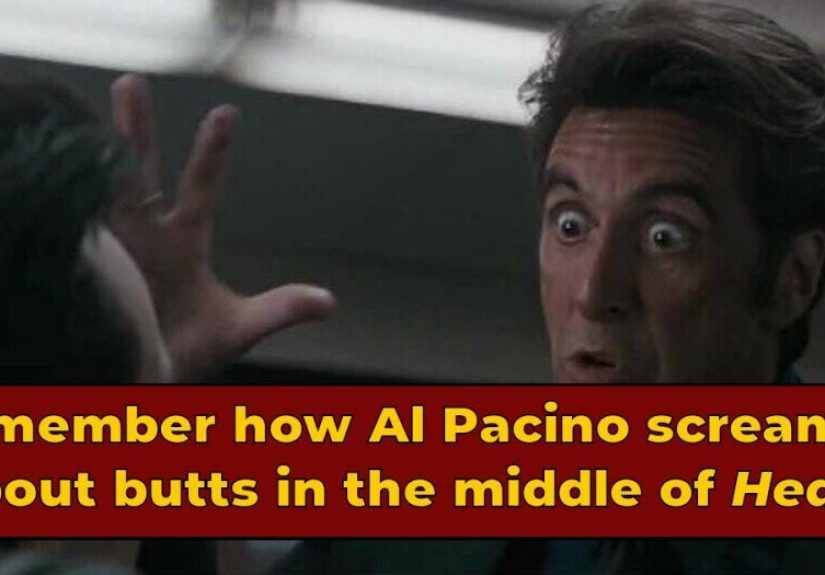
The scene comes when Vincent Hanna interrogates Alan Marciano, played by Hank Azaria. Marciano has been having an affair with Charlene Shiherlis, the wife of Chris Shiherlis, one of Neil McCauley’s crew members. Hanna needs Marciano as leverage. He wants information, cooperation, and control. In true Hanna fashion, he does not gently knock on the door of the conversation. He kicks it open, throws the furniture around, and somehow still calls it police work.
Marciano wonders why he got involved with Charlene. Hanna’s response is the infamous eruption. Pacino does not simply deliver the line; he detonates it. His voice spikes, his eyes widen, and Azaria’s startled reaction feels so real because, by many accounts, it largely was. The moment has become one of the most quoted, memed, and lovingly mocked pieces of Heat history.
What makes it baffling is not only the volume. Heat is otherwise a controlled, cool, steel-blue movie about discipline. Neil McCauley lives by a strict code: do not get attached to anything you cannot walk away from in thirty seconds. Hanna, by contrast, is emotional, loud, and chaoticbut even for him, the outburst seems extreme. It feels like the movie temporarily swaps a police interrogation for a one-man opera about bad decisions.
The Legit Explanation: Vincent Hanna Was Written With a Hidden Drug Habit
Pacino has said that Vincent Hanna was imagined as someone who occasionally used cocaine, though the direct evidence of that behavior was removed from the film. That missing context helps explain why Hanna sometimes operates at a frequency only dogs, helicopters, and fellow Pacino characters can hear.
This matters because Heat never stops to tell us, “Attention, audience: Detective Hanna’s nervous system is currently hosting a jazz solo.” Without the deleted context, viewers are left to interpret the performance from the outside. Hanna’s sudden spikes can look like pure acting excess. With the backstory, they become part of a psychological portrait: a brilliant detective burning himself down from the inside while chasing a criminal who is, in many ways, his mirror image.
Hanna Is Not RandomHe Is Unstable by Design
Vincent Hanna is a man addicted to pursuit. His job has wrecked his marriages, strained his home life, and turned ordinary conversations into tactical operations. He can be charming one second and volcanic the next. He understands criminals because he shares their obsessions: discipline, risk, momentum, and the inability to live peacefully in normal domestic life.
The hidden drug detail does not excuse Hanna’s behavior or make him “cool.” Instead, it makes him more tragic and more believable as a man who cannot regulate himself. He is sharp enough to track Neil McCauley, but messy enough to scare civilians, suspects, informants, and probably his own coffee mug.
Why Michael Mann Cut the Explicit Detail
Michael Mann is known for precision. Heat is full of procedural texture: surveillance, criminal planning, firearms training, police jargon, emotional routines, and the geography of Los Angeles. Mann rarely includes details by accident. So why remove a scene that would have made Hanna’s behavior easier to decode?
The likely reason is that Heat works best when it trusts viewers to observe rather than be spoon-fed. Mann’s movie is not built like a detective explaining a case board to the audience. It is built like a city at night: glowing fragments, partial views, private lives glimpsed through glass. Hanna’s volatility is there on screen, even if the cause is not underlined.
Cutting the explicit drug moment also keeps Hanna from being reduced to one explanation. If the movie clearly showed him using drugs, every outburst might become “because of that.” Without it, Hanna remains larger and stranger: a stressed investigator, a failed husband, a performer, a predator of predators, and a man who uses noise as a weapon.
Pacino’s Performance Makes More Sense Beside De Niro’s
The brilliance of Heat is its contrast. Robert De Niro’s Neil McCauley is controlled, minimalist, and nearly monastic. He speaks quietly, moves economically, and treats emotion like a security risk. Al Pacino’s Vincent Hanna is the opposite: expansive, theatrical, impulsive, and emotionally explosive. If McCauley is a locked safe, Hanna is a siren with a badge.
That contrast is not a flaw. It is the engine of the movie. Mann places these men on opposite sides of the law while showing that they understand each other better than anyone else does. Their famous diner scene works because neither man is simply “good” or “bad.” They are professionals trapped inside identities they chose long ago.
Seen this way, the baffling interrogation scene is not a break from the movie’s tone. It is one of the clearest examples of Hanna’s method. He overwhelms Marciano. He throws him off balance. He turns embarrassment into pressure. He uses comedy, aggression, and shock as interrogation tools. Subtle? Absolutely not. Effective? In Hanna’s world, very often yes.
Was the Line Improvised?
Part of the scene’s legend comes from the sense that nobody in the room saw it coming. Pacino has acknowledged that the delivery had an improvised quality, and Hank Azaria’s reaction has often been discussed as genuine surprise. That spontaneity is exactly why the moment still feels alive decades later.
In many films, improvisation sticks out because it sounds like actors trying to be funny. In Heat, the line works because it fits Hanna’s unstable rhythm. He is a man who might say something outrageous not because he planned a joke, but because his brain is moving faster than the room can handle.
That is also why the scene does not destroy the film. It should. On paper, a detective screaming about someone’s body in the middle of a high-stakes crime drama sounds like tonal sabotage. But Pacino commits so fully, and Mann’s world is so intense, that the outburst becomes another strange tile in the mosaic. It is ridiculous, yes. It is also unforgettable.
The Scene’s Real Job: Keeping Marciano Off Balance
Hanna’s goal is not to have a normal conversation. He wants Alan Marciano rattled, exposed, and compliant. Marciano is already ashamed and frightened. Hanna pushes directly into that shame. The outburst is crude, but it is also strategic. He reduces Marciano’s romantic self-image to a humiliatingly simple explanation, then uses that humiliation to dominate the room.
This is classic Hanna. He does not merely ask questions. He attacks the story people tell themselves. If a suspect thinks he is clever, Hanna makes him feel stupid. If an informant thinks he has options, Hanna makes the walls close in. If Marciano thinks he got swept up in romance, Hanna reframes it as weakness.
The result is a scene that is both comic and cruel. We laugh because Pacino’s delivery is absurdly huge. We tense up because Hanna is not joking in a safe way. He is using humor like a crowbar.
Why Fans Love the Scene Anyway
The “great ass” moment has become part of Heat fandom because it provides a pressure valve. The movie is nearly three hours of doomed professionalism, broken relationships, surveillance, betrayal, and men pretending they do not have feelings until the feelings show up with automatic weapons. A burst of outrageous Pacino energy gives viewers something to quote at parties, in parking lots, and in group chats where everyone thinks they are the first person to type it in all caps.
It also captures a specific era of Pacino’s screen persona. In the 1970s, Pacino often played inward-burning men: Michael Corleone, Frank Serpico, Sonny Wortzik. By the 1990s, his performances could become more explosive, more operatic, and more openly theatrical. Heat benefits from both versions. Hanna has intelligence and grief, but he also has big, barking, room-shaking electricity.
What the Scene Reveals About Heat as a Whole
Heat is often remembered as a heist movie, but it is really a study of obsession. Neil is obsessed with freedom. Hanna is obsessed with pursuit. Chris is pulled between loyalty and self-destruction. Charlene is trapped between desire, survival, and fear. Even the city feels obsessed with motion: freeways, lights, helicopters, sirens, glass towers, night streets.
The baffling Pacino scene belongs to that world because it shows obsession without elegance. Neil’s obsession looks cool because De Niro plays him with stillness. Hanna’s obsession looks messy because Pacino lets the wires show. Both men are damaged. One hides it better.
That is why the deleted character detail is so useful. It does not turn the scene into a simple “drug explanation.” It reveals how much turbulence Mann and Pacino had built into Hanna. The movie may remove the obvious signpost, but the performance keeps the smoke.
Experience Section: Rewatching the Scene Changes Everything
The first time many viewers see Heat, the “great ass” scene lands like a dropped cymbal. You are watching a sleek crime drama, admiring the mood, the pacing, the Los Angeles atmosphere, and the professional tension between cops and thieves. Then Pacino suddenly goes full thunderstorm, and your brain briefly asks whether someone switched the channel to a different movie where every line is delivered from a balcony.
On a rewatch, though, the scene becomes more interesting. Once you know Hanna was designed as a man running on dangerous internal fuel, his behavior feels less like a random acting choice and more like a warning light blinking across the entire film. He is not merely intense because the case is difficult. He is intense because intensity is his normal operating system.
This is one of the pleasures of revisiting older films: small moments grow new meanings. A scene that once seemed too loud can become revealing. A line that once felt like a meme can become character evidence. A reaction shot from Hank Azaria can suddenly feel like the audience’s own face staring back at them. That is how Heat keeps rewarding repeat viewers. It gives you the big stuff immediatelythe shootout, the diner, the final runway chasebut it saves some of its stranger flavors for later.
The scene also teaches a useful lesson about performance. Real people are not always tonally consistent. Under pressure, they say awkward things, make bad jokes, overreact, posture, deflect, and use volume when they are losing control. Hanna is a professional, but he is not balanced. His skill and instability are tangled together. Pacino plays that contradiction at maximum volume, and whether you love or hate the choice, you remember it.
For writers, filmmakers, and movie lovers, the moment is a reminder that “too much” can work when it comes from a clear character engine. If an actor goes big for no reason, the scene collapses. If an actor goes big because the character is using performance as a weapon, the scene can become iconic. Hanna’s outburst is funny, but it is not empty. It exposes how he corners people. It shows how he turns discomfort into leverage. It hints at the chaos he carries into every room.
In that sense, the most baffling scene in Heat may be one of its most honest. Neil McCauley wants to leave everything behind. Vincent Hanna cannot leave anything alone. Neil disappears into silence. Hanna explodes into noise. One man survives by cutting attachments; the other survives by attacking them. That one ridiculous, unforgettable line is not just a meme. It is Vincent Hanna in miniature: brilliant, inappropriate, tactical, exhausted, and burning way too hot.
Conclusion
Al Pacino’s most baffling Heat scene has lasted because it sits at the perfect intersection of great acting, strange character psychology, behind-the-scenes mystery, and internet-ready quotability. Without context, it looks like Pacino grabbing the steering wheel and driving the movie straight through a wall. With context, it becomes a sharp glimpse into Vincent Hanna’s hidden instability and aggressive interrogation style.
Michael Mann’s Heat endures because even its strangest moments have architecture beneath them. The “great ass” scene is loud, funny, and wildly memorable, but it is not meaningless. It is a flash of Hanna’s inner chaos, a missing deleted scene echoing through the final cut, and a reminder that sometimes the most confusing movie moments become legendary because they are secretly doing more work than they first appear to be doing.