Table of Contents >> Show >> Hide
- Why Decluttering Feels So Hard
- The 3-Step Decluttering Method
- Step 1: Reset the Room and Remove the Obvious
- Step 2: Sort Everything Into Simple Categories
- Step 3: Put Back Only What Belongs and Prevent Re-Cluttering
- Room-by-Room Examples of This Method
- Common Decluttering Mistakes to Avoid
- How Long Does It Take to Declutter a Room?
- What Decluttering a Room Really Feels Like: Real-World Experiences
- Final Thoughts
Decluttering sounds simple until you are standing in the middle of a room holding a mystery charger, one lonely sock, a candle with no wick, and a framed photo from 2014 that somehow feels emotionally binding. Suddenly, “clean this room” turns into a full-blown identity crisis. The good news? It does not have to be dramatic.
If you want to know how to declutter a room in 3 easy steps, the secret is not buying fancy bins first or pretending you are one label maker away from enlightenment. The real trick is using a method that is fast, realistic, and easy to repeat. When you break the job into three clear phases, you can make visible progress without turning your home into a cardboard-box convention.
This guide walks you through a practical decluttering method that works in bedrooms, living rooms, offices, guest rooms, kids’ rooms, and even that “temporary” chair piled with clothes that has been working full-time for months. You will learn how to start, how to make decisions quickly, and how to keep the room from getting cluttered all over again.
Why Decluttering Feels So Hard
Before we jump into the three steps, let’s clear something up: clutter is rarely just about stuff. It is also about delayed decisions. Every pile usually represents one of the following: something you meant to put away, something you are not sure whether to keep, or something that belongs somewhere else but never made the trip.
That is why cluttered rooms feel mentally noisy. A crowded space can make it harder to relax, harder to find what you need, and weirdly easier to avoid the room altogether. The room starts bossing you around, and frankly, it is rude.
The answer is not to organize every single item with military precision. The answer is to reduce what is in the room, make faster decisions, and give what remains a clear home.
The 3-Step Decluttering Method
Here is the easy version:
- Reset the room and remove obvious clutter.
- Sort everything into simple decision categories.
- Put back only what belongs and create a maintenance plan.
That is it. Three steps. No mystical chanting. No “become a new person by sunset” nonsense. Just a repeatable system.
Step 1: Reset the Room and Remove the Obvious
Start with a visible win
The fastest way to build momentum is to remove the easiest stuff first. Start with anything that is clearly trash, recycling, dirty laundry, dishes, or items that obviously belong in another room. This is not the moment for deep thinking. This is the moment for obvious action.
Grab a trash bag, a laundry basket, and a box or tote for items that belong elsewhere. Then do a quick sweep of the room. Pick up wrappers, empty bottles, random papers, shopping bags, broken items, and things sitting on the floor for absolutely no good reason. If the room has dirty mugs, rogue water glasses, or snack evidence from three nights ago, remove those too. We are decluttering, not preserving a crime scene.
Work in one zone at a time
Do not bounce around the whole room like a caffeinated squirrel. Choose one zone and finish it before moving on. Start with the bed, then the nightstand, then the dresser. Or start with the sofa, then the coffee table, then the bookshelf. Working in zones keeps your brain from overheating and helps you see progress quickly.
If the room is especially messy, begin with the most visible area. Clear the floor near the doorway. Clear the top of the dresser. Clear the chair in the corner. When the first thing you see looks better, the whole room instantly feels less overwhelming.
Use a timer if you procrastinate
If starting is the hardest part, set a timer for 10, 15, or 30 minutes. Timers help because they turn decluttering into a short mission instead of an all-day punishment. You are not promising to finish the room forever. You are promising to give the room one honest burst of effort.
At the end of Step 1, the room should already look noticeably better. Not perfect. Better. That matters. Progress creates motivation, and motivation is easier to keep than to manufacture from scratch.
Step 2: Sort Everything Into Simple Categories
Do not overcomplicate your decisions
Now that the obvious clutter is gone, it is time to deal with what is left. This is where many people get stuck, because they create seventeen categories and then wonder why they are sitting on the floor debating the future of a scented candle holder.
Keep your categories simple. Use these four:
- Keep – I use this, need this, or genuinely love this.
- Donate – Someone else could use this more than I do.
- Toss – Broken, expired, stained, or unusable.
- Relocate – This belongs somewhere else in the house.
That is your whole system. If you create a maybe pile, it will breed. Avoid it when possible.
Ask better decluttering questions
When you pick up an item, ask practical questions instead of emotional ones. “Should I keep this?” is often too vague. Try these instead:
- Have I used this in the last year?
- Would I buy this again today?
- Would I pack this if I were moving tomorrow?
- Does this item support how I live now, not how I imagine I might live someday?
- Is this worth the space it takes up in this room?
Those questions cut through guilt fast. They also help with the most common clutter trap: keeping things “just in case.” Be careful with that phrase. “Just in case” has a talent for renting space in your room and never paying a cent.
Declutter by category when possible
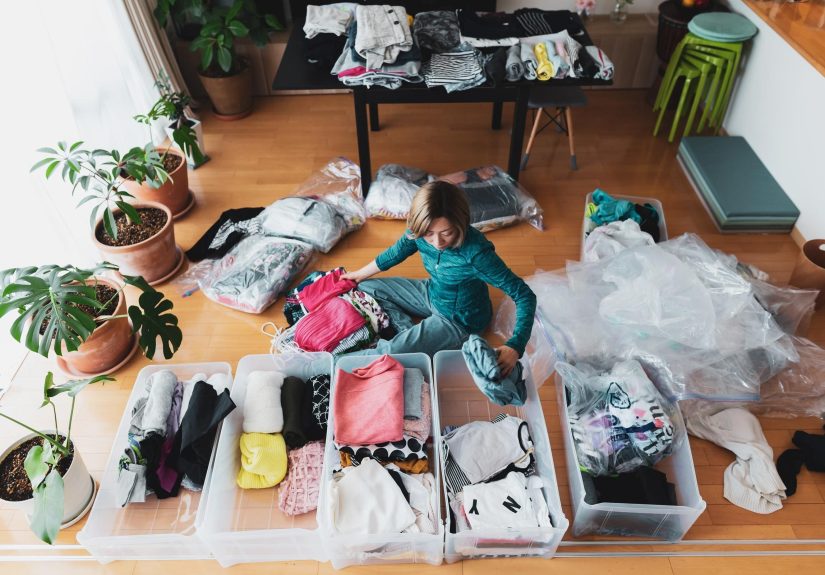
If the room contains lots of similar items, gather them together before deciding. Pull all the books into one stack. Put all the cords together. Collect all beauty products, notebooks, throw blankets, or shoes into one place. It is much easier to decide how many you need when you can actually see how many you own.
This method is especially helpful in bedrooms and home offices, where duplicates multiply quietly. Suddenly you discover you do not own “a few pens.” You own a pen civilization.
Be honest about sentimental items
Sentimental clutter deserves kindness, but it still deserves boundaries. You do not have to get rid of every meaningful object. You just need to choose the best ones instead of keeping everything by default. Save the items that truly tell the story. Display a few. Store a few carefully. Release the rest.
A room should support your life, not become a museum gift shop dedicated to every chapter you have ever survived.
Step 3: Put Back Only What Belongs and Prevent Re-Cluttering
Give every kept item a home
Once you have finished sorting, only the keep items should go back into the room. And when they go back, they need a specific home. Not a vague area. Not “somewhere on this shelf.” A real home.
Put frequently used items in easy-to-reach spots. Store occasional-use items higher up or farther back. Group like with like: books with books, chargers with chargers, stationery with stationery. The more logical your setup is, the easier it becomes to maintain.
If you are tempted to buy storage products, pause first. Bins are helpful only after you know what you are keeping. Otherwise, you are just buying tiny apartments for your clutter.
Use the room for its real purpose
A decluttered room works better when you define what it is for. A bedroom is for sleep, dressing, and calm. A living room is for relaxing and gathering. A home office is for focused work. When a room starts doing six jobs badly, clutter rushes in to finish the chaos.
If your bedroom doubles as an office, reading nook, gym corner, and laundry processing center, you may need to create small zones. Keep work items together. Keep laundry contained. Keep surfaces mostly clear. Boundaries make a room feel calmer and more functional, even when space is limited.
Create one simple maintenance habit
The final step is the one that keeps all your hard work from unraveling by next Tuesday. Choose one maintenance habit you can actually live with. Examples:
- A 5-minute nightly reset
- One in, one out for clothing or decor
- A donation bag kept in the closet
- A weekly surface clear-off
- A rule that nothing lives on the floor
You do not need a complicated reset routine. You need a repeatable one. Tiny habits beat heroic weekend cleanups every time.
Room-by-Room Examples of This Method
Bedroom
Start with laundry, cups, trash, and clothes draped on furniture. Then sort through the nightstand, dresser top, and closet floor. Keep only what helps the room feel restful and easy to use. If “worn but not dirty” clothes keep piling up, give them a dedicated basket or hook so they stop colonizing the chair.
Living Room
Clear flat surfaces first: coffee table, side tables, media console. Remove anything that belongs in another room. Then edit books, blankets, decor, magazines, and toys. Keep the living room easy to reset by adding a basket for remotes, a tray for small essentials, and a trash can if wrappers or receipts tend to gather there.
Home Office
Throw away old notes, packaging, dried-up pens, and duplicate supplies. Group paperwork by action: file, shred, scan, or handle. Keep only the tools you use regularly on the desk. A clear desk does not magically do your work for you, but it does stop your stapler from living under three notebooks and a charging cable knot.
Kids’ Room
Use category sorting: books, stuffed animals, art supplies, building toys, dolls, games. Keep favorites accessible and rotate the rest if needed. Broken toys and incomplete sets are prime decluttering candidates. Fewer toys often make cleanup faster because children can actually see what they have.
Common Decluttering Mistakes to Avoid
- Buying organizers too early: Declutter first, organize second.
- Trying to do the whole house at once: One room is enough. One corner is enough. Start there.
- Keeping things out of guilt: Guilt is not a storage system.
- Creating giant maybe piles: Delayed decisions often become permanent clutter.
- Leaving donation bags in the room: Once you decide to donate, move them out quickly.
How Long Does It Take to Declutter a Room?
That depends on the size of the room, the amount of clutter, and how attached you are to every charger you have owned since 2017. A lightly cluttered room might take 30 to 60 minutes. A heavily cluttered room may need several sessions. That is normal.
The goal is not speed for the sake of speed. The goal is steady progress that leaves the room easier to use. Even one focused session can change how a room looks and feels.
What Decluttering a Room Really Feels Like: Real-World Experiences
In real life, decluttering usually does not begin with beautiful background music and an inspiring sunrise. It often begins with annoyance. Someone trips over shoes for the third time. Someone cannot find a bill, a charger, or a clean corner of the desk. That frustration can actually be helpful, because it creates the push to stop tolerating a room that no longer works.
One common experience happens in bedrooms. A person starts by planning to “just tidy up a little,” then realizes the room has become a storage unit with pillows. The floor is crowded, the dresser is covered, and the chair is wearing half the wardrobe. After Step 1, they remove laundry, water glasses, receipts, and random items that belong elsewhere. The room already looks calmer. After Step 2, they realize they have five similar black T-shirts, three empty gift bags, and a drawer full of products they forgot they owned. Step 3 is the breakthrough: once every category has a real home, getting dressed in the morning feels easier, and the room feels like a place to sleep instead of a place to apologize to.
Another familiar experience happens in living rooms, especially in busy households. The room slowly becomes a drop zone for backpacks, mail, cords, blankets, toys, and shopping bags. At first, nobody notices because each item arrives one at a time. Then one day the coffee table disappears under a layer of “I’ll deal with this later.” Using the three-step method helps because it replaces vague cleaning with concrete action. Trash goes out. dishes leave. Items that belong upstairs go in a basket. The remaining decor gets edited so the room can breathe again. The biggest surprise for many people is not how much they removed, but how much bigger the room looks once the surfaces are clear.
Home offices create a different kind of clutter experience. The mess there is often quieter but more draining. Paper piles, unopened mail, old tech, empty notebooks, and mystery cables create visual pressure. A person may think they need more motivation to work, when what they really need is to stop sharing a desk with six abandoned projects. Once the obvious clutter is gone and supplies are grouped together, the room becomes easier to focus in. That change is small but powerful. A functional workspace can reduce the friction of starting tasks, paying bills, or sitting down to think clearly.
Many people also discover that decluttering changes their habits after the room is finished. They become less likely to drop things on the nearest surface, because the surface is now useful. They become more aware of what they bring into the room. They notice duplicates sooner. Most importantly, they stop seeing decluttering as a giant event and start seeing it as a short reset they know how to do. That confidence matters. A room does not stay tidy because life gets less busy. It stays tidier because the room finally has a system that can survive real life.
Final Thoughts
If you have been putting off the task, remember this: decluttering a room does not require perfection, unlimited energy, or a personality transplant. It requires a method. When you reset the room, sort with simple categories, and return only what truly belongs, the space becomes lighter, easier to manage, and far more pleasant to live in.
So if you are wondering how to declutter a room in 3 easy steps, here is the whole playbook one more time: remove the obvious clutter, make quick keep-or-let-go decisions, and give the remaining items a clear home. That is the formula. Use it once, and the room improves. Use it regularly, and the room starts working for you again.