Table of Contents >> Show >> Hide
- What Is IBM’s Hybrid Classical-Quantum System?
- Why IBM Is Moving Beyond Standalone Quantum Computers
- The Role of IBM Quantum System Two
- What Makes the System “Hybrid”?
- Qiskit: The Software Bridge
- Why CPUs, GPUs, and QPUs Need Each Other
- Real-World Use Cases: Where Hybrid Quantum May Matter
- The Error Problem: Why Quantum Is Hard
- What IBM’s 2026 Reference Architecture Adds
- Why This Matters for Businesses
- What This Means for Developers and Researchers
- Challenges IBM Still Has to Solve
- Why the Hybrid Model Is Probably the Right Direction
- Experience Notes: What Working Around Hybrid Quantum Computing Feels Like
- Conclusion: IBM’s Quantum Supercomputer Idea Is About Teamwork
For decades, quantum computing has sounded like the technology equivalent of a dragon egg: mysterious, powerful, and always “about to hatch.” IBM’s latest quantum supercomputer idea, however, is less fantasy and more engineering blueprint. Instead of imagining a quantum computer as a single glowing machine that replaces every classical computer in sight, IBM is pushing a more practical concept: a hybrid classical-quantum system where quantum processors work alongside CPUs, GPUs, high-performance computing clusters, networking layers, shared storage, and modern software orchestration.
In plain English, IBM is not saying, “Throw away your supercomputer.” It is saying, “Let’s add a quantum engine to the supercomputer garage, then teach all the engines to work together.” That idea is called quantum-centric supercomputing, and it may be one of the most important steps toward useful quantum computing.
The phrase sounds fancy enough to scare off a coffee machine, but the core idea is simple: classical computers are excellent at many tasks, while quantum computers may eventually outperform them on specific problems involving quantum physics, chemistry, materials, optimization, and complex simulations. A hybrid classical-quantum system combines both strengths instead of forcing one machine to do everything.
What Is IBM’s Hybrid Classical-Quantum System?
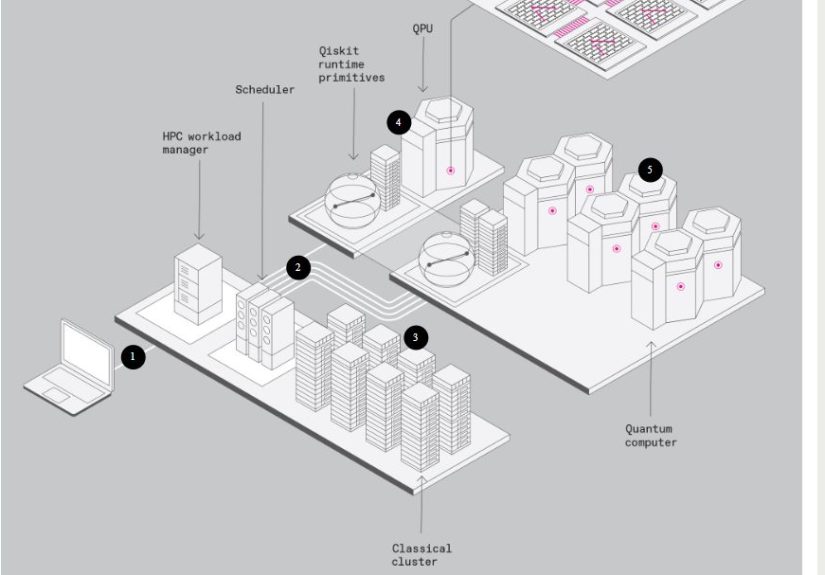
IBM’s hybrid classical-quantum system is a computing architecture that connects quantum processing units, or QPUs, with classical computing resources such as CPUs, GPUs, accelerators, storage, and networking. Rather than treating a quantum computer as an isolated laboratory instrument, IBM’s model places it inside a broader supercomputing environment.
This matters because real scientific workloads are rarely one-step magic tricks. A chemistry simulation, for example, may need classical preprocessing, quantum circuit execution, error mitigation, data analysis, visualization, and repeated refinement. The quantum chip might handle the most quantum-heavy part of the problem, while classical systems manage everything around it.
Think of it like a movie production. The quantum processor is not the entire studio. It is the specialist who handles the hardest visual effect. The CPUs, GPUs, storage systems, schedulers, and software tools are the directors, editors, lighting crew, sound engineers, and producers. Without coordination, the film becomes chaos. With orchestration, the result can be impressive.
Why IBM Is Moving Beyond Standalone Quantum Computers
Early quantum computing discussions often focused on qubit counts, as if the future depended only on who had the biggest number. Qubits are important, but they are not the whole story. A useful quantum computer also needs low error rates, fast control systems, reliable calibration, good software, efficient compilers, powerful classical support, and a way to return meaningful results.
IBM’s latest thinking recognizes that quantum computing is not a replacement for classical computing. It is a partner. The company’s quantum-centric supercomputing approach brings quantum hardware into the same operational world as high-performance classical machines. That shift is important because industries already use supercomputers for drug discovery, climate modeling, financial risk analysis, materials science, logistics, and artificial intelligence.
If quantum computers are going to help with those workloads, they need to fit into existing computational pipelines. Scientists and engineers do not want to manually babysit every quantum circuit like it is a nervous houseplant. They need systems that can schedule tasks, move data, call quantum resources when needed, and combine results with classical calculations.
The Role of IBM Quantum System Two
IBM Quantum System Two is a key part of this vision. It is designed as a modular quantum computing platform, meaning it can support scalable cryogenic infrastructure, control electronics, classical runtime servers, and multiple quantum processors in a data-center-style environment.
That modular design is important because quantum systems must scale carefully. You cannot simply tape more qubits onto a chip and call it progress. Quantum processors need extremely controlled environments, often operating at temperatures colder than deep space. They also need classical electronics to send control signals, read measurements, and manage feedback.
IBM’s System Two concept points toward a future where quantum computers are not rare standalone cabinets but parts of larger computing centers. In that future, a researcher might submit a workload that moves through classical simulation, quantum execution, GPU acceleration, and post-processing without manually stitching everything together.
What Makes the System “Hybrid”?
The word “hybrid” is doing real work here. In IBM’s model, the classical and quantum sides are not merely sitting in the same room. They are expected to cooperate through software, middleware, and orchestration layers.
1. Classical Computers Prepare the Problem
Most useful quantum workflows start with classical data. A molecule, material, optimization problem, or physics model must be translated into a form that a quantum circuit can handle. Classical processors help create those circuits, optimize parameters, and reduce unnecessary complexity.
2. Quantum Processors Handle Specialized Computation
The quantum processor then runs circuits that may be useful for simulating quantum systems, estimating molecular energies, or exploring complex mathematical spaces. Today’s quantum machines are still noisy, so the goal is not universal domination. The goal is to target the parts of a workload where quantum behavior may offer an advantage.
3. Classical Systems Analyze the Results
After the QPU runs, classical systems collect measurement results, apply error mitigation, compare outputs, update parameters, and decide what to run next. Many hybrid algorithms are iterative, meaning they bounce between classical and quantum resources many times.
4. Middleware Keeps the Workflow Moving
Middleware is the unglamorous hero of this story. It helps manage jobs, resources, scheduling, data movement, and communication between different computing components. Without it, a hybrid system becomes a very expensive traffic jam.
Qiskit: The Software Bridge
IBM’s open-source quantum software ecosystem, especially Qiskit, plays a central role in making hybrid quantum computing usable. Qiskit allows developers to build quantum circuits, optimize them for hardware, run jobs, and process results. IBM’s Qiskit Runtime and Qiskit Serverless tools are designed to support workloads that span quantum and classical resources.
This is crucial because quantum computing will not succeed only by building better hardware. It also needs better developer experience. If only a handful of physicists can use the machines, adoption will be slow. But if chemists, materials scientists, finance researchers, and software engineers can access quantum resources through familiar workflows, the ecosystem becomes much stronger.
In that sense, IBM’s hybrid classical-quantum system is as much a software story as a hardware story. The company is trying to build the operating environment for quantum-era research, not just the quantum chip itself.
Why CPUs, GPUs, and QPUs Need Each Other
Modern supercomputing is already hybrid. CPUs handle general-purpose logic. GPUs accelerate parallel workloads such as AI training, simulations, and matrix-heavy calculations. FPGAs and other accelerators can handle specialized tasks. IBM’s quantum-centric model adds QPUs to that family.
Each processor type has a personality. CPUs are flexible. GPUs are fast at parallel math. QPUs may be powerful for certain quantum simulations and algorithmic structures. None of them is perfect at everything. That is why the future of computing looks less like a single superhero and more like a very nerdy Avengers team.
The exciting part is not that quantum processors will replace GPUs or CPUs. The exciting part is that they may extend what classical systems can do. For example, a classical supercomputer might model the large-scale structure of a chemical problem, while a QPU tackles the most quantum-mechanical component. Then classical resources interpret and refine the result.
Real-World Use Cases: Where Hybrid Quantum May Matter
Chemistry and Molecular Simulation
Chemistry is one of the most promising areas for quantum computing because molecules are quantum systems. Classical computers can simulate many molecules, but the calculations become brutally difficult as systems grow more complex. Hybrid quantum-classical workflows may help researchers study molecular behavior, reaction pathways, catalysts, and protein-related structures.
Materials Science
Better batteries, superconductors, solar materials, and advanced alloys all depend on understanding interactions at the atomic and electronic level. Quantum-centric supercomputing could support simulations that help scientists screen materials more efficiently. The payoff could be huge: cleaner energy systems, better electronics, and stronger industrial materials.
Drug Discovery and Life Sciences
Pharmaceutical research involves enormous chemical and biological complexity. Hybrid quantum systems are not about instantly discovering miracle drugs with one button labeled “Science, Please.” Instead, they may eventually help researchers model difficult molecular interactions more accurately, narrowing the search space for promising compounds.
Optimization Problems
Many industries face optimization challenges: routing vehicles, balancing portfolios, scheduling factories, managing supply chains, and allocating energy resources. Quantum computing may contribute to some optimization techniques, especially when combined with classical heuristics and high-performance computing.
Artificial Intelligence
Quantum computing is not a shortcut to making artificial intelligence sentient, and thankfully your toaster is not applying for a management role yet. But quantum-classical systems may support certain machine learning research areas, including optimization, sampling, and data representation. The most realistic near-term path is not “quantum AI replaces everything,” but “quantum tools join larger AI and HPC workflows.”
The Error Problem: Why Quantum Is Hard
Quantum computers are delicate. Qubits are easily disturbed by noise, temperature, electromagnetic interference, and control imperfections. That makes error correction one of the biggest challenges in the field.
IBM’s long-term roadmap points toward fault-tolerant quantum computing, where logical qubits are protected by error correction. The company has discussed IBM Quantum Starling as a future large-scale fault-tolerant quantum computer designed to run far deeper circuits than today’s noisy machines.
This is where the hybrid system becomes even more important. Error correction itself requires fast classical processing. The quantum chip produces information that must be decoded quickly, and classical hardware must help decide how to correct errors. In other words, even a future fault-tolerant quantum computer will not be “purely quantum.” It will depend on classical systems working at high speed behind the scenes.
What IBM’s 2026 Reference Architecture Adds
IBM’s 2026 reference architecture gives more structure to the idea of quantum-centric supercomputing. It describes how QPUs can be integrated into high-performance computing environments with CPUs, GPUs, accelerators, storage, networking, orchestration, middleware, and application layers.
This is important because the quantum industry needs more than inspiring demos. It needs repeatable architecture. A reference architecture helps research labs, universities, government agencies, and enterprises understand how quantum systems might fit into real computing infrastructure.
Instead of asking, “Where do we put the quantum computer?” the better question becomes, “How do we connect quantum hardware to the workflow, scheduler, software stack, data environment, and application layer?” IBM’s blueprint attempts to answer that question.
Why This Matters for Businesses
For most businesses, the hybrid classical-quantum system is not something they will install next to the office printer. Please do not put a dilution refrigerator beside the coffee machine. But the concept still matters because it shows how quantum computing may become accessible through cloud platforms, research partnerships, and industry-specific applications.
Businesses should pay attention for three reasons. First, hybrid systems may reduce the barrier to experimenting with quantum workloads. Second, quantum-centric platforms may make it easier to test use cases without building an entire quantum lab. Third, companies that understand the technology early may be better prepared when practical advantages appear.
The smartest organizations will not treat quantum computing as a magic purchase order. They will treat it as a research capability. They will identify hard computational problems, build internal literacy, partner with experts, and test hybrid workflows carefully.
What This Means for Developers and Researchers
For developers, IBM’s idea shifts the focus from “learn quantum mechanics perfectly or leave” to “learn how quantum services fit into computational workflows.” That is a healthier and more realistic path. A developer may not need to design quantum hardware, but they may need to understand circuits, primitives, error mitigation, runtime environments, and how quantum jobs interact with classical code.
For researchers, the hybrid model is exciting because it allows quantum systems to become part of existing scientific computing workflows. Instead of throwing away decades of HPC expertise, quantum-centric supercomputing builds on it. That is not just practical; it is respectful to the enormous amount of software, infrastructure, and knowledge already powering modern science.
Challenges IBM Still Has to Solve
The hybrid classical-quantum system is promising, but it is not a finished victory parade. Several challenges remain.
Hardware reliability must improve. Qubits need lower error rates, better coherence, and scalable control. Error correction must become practical at larger scales. Software orchestration must become smoother so users can run complex workflows without wrestling with every detail. Standards and interoperability will matter because the broader quantum ecosystem includes many hardware types and software approaches. Real advantage must be demonstrated on meaningful problems, not only carefully selected benchmarks.
In other words, IBM’s idea is not “mission accomplished.” It is more like “mission architecture approved.” That may sound less dramatic, but in technology, architecture is often what turns experiments into infrastructure.
Why the Hybrid Model Is Probably the Right Direction
The hybrid model is compelling because it matches how computing actually evolves. Mainframes did not vanish when personal computers arrived. CPUs did not disappear when GPUs became popular. Cloud computing did not eliminate local computing. Instead, each new layer found a role.
Quantum computing will likely follow the same pattern. It will not replace every classical system. It will become a specialized part of a larger computing environment. IBM’s hybrid classical-quantum system reflects that reality.
This makes the idea both ambitious and grounded. It does not promise that quantum computers will solve every problem by Tuesday. It says quantum processors should be connected to the classical computing world in a serious, scalable way. That is the kind of boring-sounding infrastructure move that often changes everything.
Experience Notes: What Working Around Hybrid Quantum Computing Feels Like
Working with the idea of a hybrid classical-quantum system feels very different from the popular image of quantum computing. The popular image is cinematic: a glowing machine, a genius in a lab coat, and perhaps a dramatic hum that suggests the universe is being politely negotiated with. The practical experience is more like building a careful workflow across many systems, each with its own strengths and limitations.
The first lesson is humility. Quantum computers are powerful in theory, but today’s systems require careful problem selection. You quickly learn that not every problem deserves a quantum approach. Some tasks are better handled by a laptop, a GPU cluster, or a traditional supercomputer. A good hybrid workflow begins by asking where quantum computation might actually help, not by forcing every problem through a quantum circuit because it sounds futuristic.
The second lesson is patience. Running a hybrid quantum workflow involves preparation, execution, measurement, and interpretation. You may build circuits, optimize them, submit them to a backend, wait for results, apply mitigation, compare outputs, and repeat. It feels less like pressing a button and more like tuning an instrument. When the system works, the reward is not fireworks. It is a result that makes a hard scientific or mathematical question slightly more tractable.
The third lesson is that classical computing never leaves the room. Even when the quantum processor is the star, classical systems do the heavy lifting around it. They prepare data, optimize parameters, manage queues, run simulations, decode results, and decide what happens next. In practice, the “hybrid” part is not a footnote. It is the whole workflow.
The fourth lesson is that software experience matters enormously. Tools like Qiskit make the field more approachable because they give developers a way to express quantum problems without building every layer from scratch. Good abstractions do not remove the complexity, but they make it manageable. That is exactly what quantum computing needs if it is going to move beyond specialist circles.
The fifth lesson is that quantum progress feels incremental until it suddenly feels important. A better compiler, faster runtime, improved error mitigation method, more stable processor, or clearer architecture may not sound like a moon landing. But these steps accumulate. IBM’s hybrid classical-quantum system is exciting because it connects those steps into a larger vision: quantum processors as usable parts of real computing environments.
For anyone watching the field, the most useful mindset is balanced curiosity. Be excited, but do not believe every headline that says quantum computers will replace everything. Be skeptical, but do not dismiss the field because it is hard. The future of quantum computing will probably arrive through practical hybrid systems, not science-fiction shortcuts. IBM’s latest idea points in that direction, and that is why it deserves attention.
Conclusion: IBM’s Quantum Supercomputer Idea Is About Teamwork
IBM’s latest quantum supercomputer idea is not just about building a bigger quantum chip. It is about creating a computing environment where quantum and classical systems work together. That is a major shift in how people should think about quantum computing.
The hybrid classical-quantum system recognizes that the future of computing will be heterogeneous. CPUs, GPUs, QPUs, storage systems, networking layers, and software tools will need to cooperate. IBM’s quantum-centric supercomputing approach gives that future a clearer shape.
The road ahead is still challenging. Error correction, scalability, usability, and proven real-world advantage remain difficult problems. But IBM’s blueprint is important because it moves quantum computing from isolated experimentation toward integrated infrastructure.
In the end, the quantum future may not arrive as one machine that conquers all others. It may arrive as a team: classical computers doing what they do best, quantum processors tackling specialized problems, and software keeping everyone from stepping on each other’s cables. Honestly, for a technology built on probabilities, that sounds like a pretty sensible plan.