Table of Contents >> Show >> Hide
- Why Mine Countermeasures Still Matter
- The Avenger-Class Fleet: Old, Useful, and Nearly Gone
- The Littoral Combat Ship Was Supposed to Fix This
- Why the Fleet Looks So Fragile
- The Strategic Risk: Chokepoints and Crisis Response
- What the Navy Is Trying to Do Right
- What Needs to Change
- Experience-Based Lessons: What Mine Warfare Teaches the Hard Way
- Conclusion
Sea mines are the naval equivalent of banana peels with explosives attached: cheap, sneaky, and capable of turning a billion-dollar warship into a very expensive insurance claim. Yet the United States Navy, the most powerful maritime force on Earth, has spent decades treating mine warfare like the dusty toolbox in the garageimportant, yes, but apparently never important enough to organize, fund, and modernize with urgency.
Today, the U.S. Navy’s minesweeper fleet is in bad shape not because sailors forgot how dangerous mines are, but because the service allowed a specialized mission to shrink while waiting for a replacement system that arrived late, struggled through testing, and still raises major questions. The old Avenger-class mine countermeasures ships are being retired after decades of service. The new answer, the Littoral Combat Ship mine countermeasures mission package, is high-tech, unmanned, and theoretically safer. The key word is “theoretically,” which is doing a lot of heavy lifting here.
This problem matters far beyond Navy budget charts. Sea mines threaten the Strait of Hormuz, the Red Sea, the Taiwan Strait, the Korean Peninsula, and other chokepoints where global trade and military access can be held hostage by small, inexpensive weapons. A navy that cannot clear mines quickly cannot guarantee freedom of navigation, protect merchant shipping, or move forces confidently through contested waters.
Why Mine Countermeasures Still Matter
Modern naval conversations usually orbit aircraft carriers, hypersonic missiles, submarines, drones, and cyberwarfare. Mine countermeasures rarely get invited to the cool table. That is a mistake. Mines are one of the most effective asymmetric weapons available to weaker adversaries. They do not need a sophisticated navy, a large crew, or a glorious command center with dramatic lighting. They need patience, concealment, and a shipping lane worth threatening.
A single minefield can slow a fleet, close a port, disrupt oil traffic, or force commanders to spend daysor weeksclearing water before major operations can begin. Unlike a missile launch, mine warfare is often ambiguous. Who laid the mine? When? Is there one, or are there fifty? Is that sonar contact a mine, a rock, or an underwater shopping cart with delusions of grandeur? Mine hunting is slow because guessing wrong is not a career-enhancing event.
The Persian Gulf Lesson
The Persian Gulf has repeatedly shown why mine warfare cannot be ignored. During the Tanker War of the 1980s, commercial shipping and U.S. naval operations were threatened by Iranian mines. In 1988, USS Samuel B. Roberts struck a mine and nearly sank, triggering Operation Praying Mantis. During the 1991 Gulf War, USS Princeton and USS Tripoli were damaged by Iraqi mines. These were not theoretical PowerPoint problems. They were smoking hulls, injured sailors, emergency damage control, and hard lessons paid for in steel and blood.
The lesson should have been simple: if the Navy wants to operate in narrow seas, it needs a strong, ready, specialized mine countermeasures force. Instead, over time, the dedicated mine warfare community became smaller, older, and increasingly dependent on replacement plans that were always just a few years awayrather like that friend who says he is “almost there” while still brushing his teeth.
The Avenger-Class Fleet: Old, Useful, and Nearly Gone
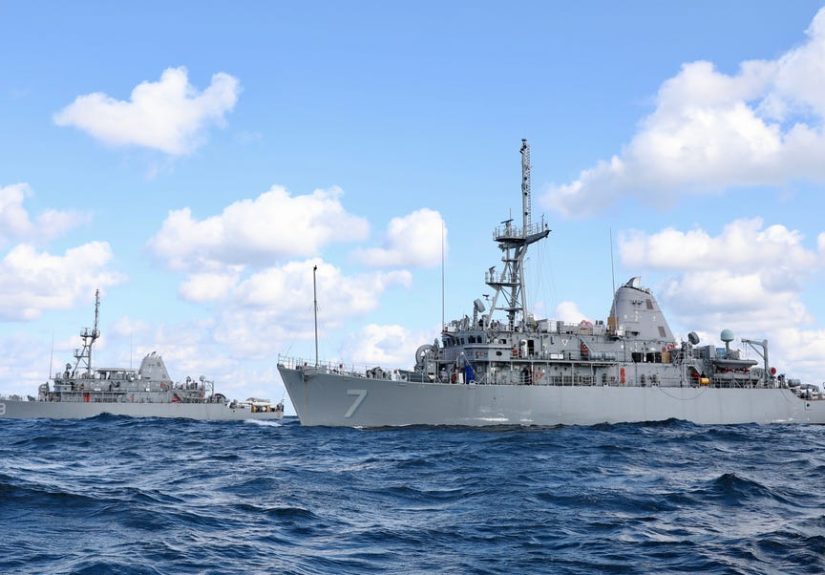
The Avenger-class mine countermeasures ships were built for the job. Their fiberglass-sheathed wooden hulls reduced magnetic signatures, helping them operate near mines without accidentally inviting disaster. They used sonar, remote vehicles, cable cutters, and mine-neutralizing systems to locate, classify, and destroy moored and bottom mines. They were not glamorous ships. They were not fast. Nobody mistook them for sleek destroyers. But they were purpose-built, crewed by specialists, and proven in the real world.
That is why their retirement creates such a capability gap. Four Avenger-class mine countermeasures ships based in BahrainUSS Devastator, USS Dextrous, USS Gladiator, and USS Sentrywere decommissioned in 2025 after more than three decades of service. Their departure ended a long-standing U.S. mine countermeasures presence in the Middle East. Only four Avenger-class ships remained active afterward, forward-deployed to Sasebo, Japan: USS Patriot, USS Pioneer, USS Warrior, and USS Chief.
That means America’s dedicated minesweeper fleet has been reduced to a tiny number of aging ships, all concentrated in the Indo-Pacific. In a world where mine threats can appear in the Persian Gulf, Red Sea, Baltic Sea, Taiwan Strait, or Korean waters, that is a thin blanket for a very cold night.
The Littoral Combat Ship Was Supposed to Fix This
The Navy’s replacement plan centered on the Littoral Combat Ship, or LCS, equipped with a mine countermeasures mission package. The idea sounded excellent on paper: instead of sending sailors into a minefield, keep the ship outside the danger area and use unmanned surface vehicles, underwater systems, helicopters, sensors, and neutralization tools to detect and destroy mines from a safer distance.
In theory, that is the right direction. Mine warfare is exactly the kind of mission where unmanned systems should shine. Nobody wants a sailor leaning over the side of a ship whispering, “Is that thing explosive?” if a robot can do the job instead. The LCS mine countermeasures package includes systems such as unmanned surface vehicles, sonar payloads, airborne mine detection equipment, and mine-neutralization tools. NAVSEA has described the package as a modern, integrated system designed to remove sailors from the minefield and permit retirement of legacy MCM ships.
But the transition has not been smooth. The LCS mine countermeasures mission package achieved Initial Operational Capability in 2023, but its first operational deployments came years later than originally expected. The package was once anticipated much earlier, but development challenges, reliability problems, restructuring, and testing delays stretched the timeline. Meanwhile, the Avenger ships kept aging, and the Navy kept waiting.
The Testing Problem
The biggest issue is not whether the LCS mine countermeasures package is clever. It is. The issue is whether it is proven, reliable, and operationally effective enough to replace a dedicated class of ships in dangerous waters. Oversight reports have raised uncomfortable questions. DOT&E has noted that operational testing and data have been insufficient to determine the full effectiveness and suitability of key components of the LCS mine countermeasures package.
That sentence may sound polite, but in defense-acquisition language it is roughly equivalent to a mechanic saying, “The brakes are interesting.” The Navy certified the LCS-based system, combined with expeditionary mine countermeasures capabilities, as meeting U.S. Central Command requirements in 2025. Yet independent evaluators still reported insufficient data on important systems, including airborne detection and neutralization elements, and concerns about cyber survivability evaluation.
In practical terms, the Navy is moving from an old but known capability to a newer but less proven one. That can be acceptable if the new system is clearly better, fully tested, and available in sufficient numbers. The problem is that each of those points remains debatable.
Why the Fleet Looks So Fragile
The bad shape of the U.S. minesweeper fleet comes from several overlapping problems. None of them alone is fatal. Together, they look like a naval version of “some assembly required,” except the assembly is happening while adversaries may already be tossing mines into strategic waterways.
1. Too Few Dedicated Ships
Four remaining Avenger-class ships are not enough for a global navy. Mine countermeasures missions take time, maintenance, training, and local knowledge. Ships cannot teleport from Japan to the Persian Gulf because a crisis decides to be inconvenient. Even if they sail quickly, mine-clearance operations are slow by nature. A tiny fleet creates a tiny margin for error.
2. Old Hulls and Aging Systems
The Avengers were impressive, but they were also built between the late 1980s and mid-1990s. Wooden-hulled mine countermeasures ships require specialized maintenance, and age is not kind to naval platforms. Keeping old ships alive can be done, but it usually involves money, spare parts, ingenuity, and sailors who know how to persuade vintage machinery to behave.
3. The LCS Reputation Problem
The Littoral Combat Ship program has long been criticized for cost growth, changing mission concepts, reliability issues, and early retirements. GAO has reported that promised capability levels were not always fulfilled and that sustainment costs became a major concern. The LCS was supposed to be modular, flexible, and affordable. Instead, it often became a symbol of acquisition optimism colliding with engineering reality at flank speed.
4. Mine Warfare Is Specialized
Mine countermeasures are not just a matter of buying gadgets. They require trained crews, experienced operators, careful planning, environmental knowledge, and institutional memory. A sailor who can tell the difference between a mine-like object and a harmless piece of seabed clutter is not created overnight. When a small specialty community shrinks, its expertise shrinks with it.
The Strategic Risk: Chokepoints and Crisis Response
The United States relies on sea control not only to fight wars, but also to reassure allies, keep commerce flowing, and deter coercion. Mines are ideal weapons for adversaries who want to create delay, uncertainty, and economic pressure without directly challenging U.S. naval superiority. That is why the condition of the minesweeper fleet should worry anyone who cares about global shipping lanes.
The Strait of Hormuz is the obvious example. A small number of mines in or near that waterway can raise insurance costs, slow tanker traffic, and force military planners into a grinding clearance operation. The Red Sea presents another challenge, where commercial shipping already faces missiles, drones, and maritime insecurity. In the Indo-Pacific, the Taiwan Strait and approaches to key ports could be threatened by mines in a conflict scenario. The Korean Peninsula remains another classic mine-warfare environment.
A weak mine countermeasures force does not mean the Navy cannot operate. It means operations become slower, riskier, and more dependent on allies, contractors, helicopters, explosive ordnance disposal teams, and improvisation. Improvisation can be heroic. It should not be the plan.
What the Navy Is Trying to Do Right
To be fair, the Navy is not ignoring the problem entirely. The move toward unmanned mine countermeasures is sensible. Keeping sailors outside minefields is a worthy goal. The LCS mine countermeasures mission package, expeditionary MCM teams, underwater vehicles, airborne sensors, and future neutralization systems all point toward the right technological future.
The Navy has also trained with allies, especially Japan, whose mine warfare forces are highly relevant in the Indo-Pacific. U.S. Mine Countermeasures Squadron 7 has participated in bilateral mine warfare exercises with the Japan Maritime Self-Defense Force, practicing mine hunting, detection, neutralization, and combined operations. This allied cooperation is essential because mine warfare is often too large, slow, and specialized for one navy to handle alone.
The problem is not direction. The problem is capacity, timing, and proof. A future mine warfare architecture built around unmanned systems may be exactly what the Navy needs. But future capability does not clear today’s minefield. A robot that works beautifully in a briefing but struggles in rough water, poor visibility, complex currents, cyber-contested environments, or maintenance-heavy operations is not a replacement yet. It is homework with propellers.
What Needs to Change
The Navy needs a larger, more resilient mine countermeasures strategy that does not depend on a handful of old Avengers or a small number of LCS mission packages. First, it should increase operational testing under realistic conditions. Mine warfare systems must prove themselves in shallow, cluttered, turbid, congested, and contested environmentsthe exact places where adversaries are likely to use mines.
Second, the Navy should distribute mine countermeasures capability across more platforms. If unmanned systems can operate from LCS, expeditionary sea bases, amphibious ships, commercial vessels, or “vessels of opportunity,” then the Navy should build doctrine, training, and logistics around that flexibility. Modularity should not mean “we can theoretically move a container.” It should mean commanders can deploy working systems quickly with trained people and reliable support.
Third, the Navy should rebuild mine warfare expertise as a serious professional community. Hardware matters, but specialists matter more. Mine warfare officers, sonar operators, EOD teams, aviation crews, maintainers, analysts, and unmanned-systems technicians need a clear career path and enough exercises to stay sharp.
Finally, Congress should treat mine countermeasures as an access mission, not a niche support task. No amphibious landing, convoy escort, carrier movement, or port-opening operation looks impressive if ships are waiting outside the danger area for someone else to clear the water.
Experience-Based Lessons: What Mine Warfare Teaches the Hard Way
The most important experience related to the U.S. Navy’s minesweeper problem is that mine warfare punishes arrogance. A fleet can have the best aircraft, missiles, radars, and submarines in the world, and still be stopped by a weapon that costs less than the paint on a fighter jet. That is not a technical insult; it is a strategic reality. Mines work because they attack time, confidence, and movement.
The experience of the Persian Gulf shows this clearly. When tankers and warships moved through mined waters during the 1980s, the issue was not simply whether a ship could survive a blast. The deeper problem was uncertainty. Once a mine is discoveredor worse, once a ship hits onecommanders must assume more may be nearby. Traffic slows. Routes change. Escorts become cautious. Mine countermeasures teams begin the painstaking work of searching water that may be full of false contacts. The enemy gains influence even before another mine explodes.
The Gulf War added another lesson: mines can disrupt offensive plans. If amphibious forces cannot approach a beach or naval forces cannot maneuver freely, the entire campaign design may need adjustment. Mine warfare is not a side quest. It can shape the main operation. That is why the Navy’s reduced dedicated minesweeper fleet is so concerning. It limits options before a crisis even begins.
There is also a human lesson. Mine countermeasures sailors often serve far from the spotlight. They do slow, dangerous, repetitive work where success can look like nothing happening. No explosion. No headline. No dramatic footage. Just ships passing safely because someone spent hours identifying contacts on a sonar display. That kind of competence is easy to undervalue until it is gone.
The transition to unmanned systems adds another practical experience: technology must be maintained, trained, and trusted. A drone is not magic. It needs operators, spare parts, software, communications, launch-and-recovery procedures, and repair capacity. In calm water during a demonstration, an unmanned system may look like the future. In a hot, crowded, dusty, high-threat operating area with currents, clutter, and enemy interference, it has to be more than promising. It has to work repeatedly.
The Navy’s experience with the LCS mine countermeasures package should therefore be treated as a warning, not a failure sentence. The concept is smart. The execution needs depth. If the Navy learns the right lesson, it can build a distributed, unmanned, allied, and expeditionary mine countermeasures force that is safer and more scalable than the Avenger-era model. If it learns the wrong lesson, it will retire old ships, celebrate new acronyms, and discover during the next crisis that water does not care about acquisition optimism.
Mine warfare is patient. It waits. The U.S. Navy should not.
Conclusion
The U.S. Navy’s minesweeper fleet is in bad shape because the service is caught between an aging legacy force and a modern replacement that still needs more proof, scale, and operational maturity. The Avenger-class ships were old but specialized. The LCS mine countermeasures package is modern but still contested by testing concerns and capacity limits. Meanwhile, the world’s most important waterways remain vulnerable to mines that are cheap, hard to detect, and strategically powerful.
This is not a call to return blindly to the past. Wooden-hulled minehunters are not the long-term answer. The future should include unmanned systems, distributed platforms, allied cooperation, better sensors, stronger cyber resilience, and highly trained specialists. But the Navy must close the gap between ambition and readiness. Mine countermeasures are not glamorous, but neither is waiting outside a mined strait while global commerce backs up like rush-hour traffic with torpedoes.
The Navy does not need mine warfare to be fashionable. It needs it to be ready.



![Hackaday Reader [David] Wins A Camera From Make And Nikon](https://factxtop.com/wp-content/uploads/2026/05/hackaday-reader-david-wins-a-camera-from-make-and-nikon-jlpGNg0K-thumb.jpg)