Table of Contents >> Show >> Hide
- The Setup: A Retirement Announcement Nobody Quite Believed
- Then Came Letterman, Patron Saint of Awkward Television
- What Phoenix Meant by “Lacerate Me”
- I’m Still Here Turned the Interview Into Something Bigger
- Why the Bit Succeeded and Failed at the Same Time
- Letterman Was the Perfect Sparring Partner
- The Apology Tour and the Strange Afterlife of a Viral Train Wreck
- What the Moment Says About Celebrity Culture
- Related Experiences: What Watching It Felt Like in Real Time
- Conclusion: A Disaster, a Performance, and a Pop-Culture Time Capsule
Some celebrity interviews are polished. Some are charming. And then there are the ones that make you want to crawl behind the couch and live there forever. Joaquin Phoenix’s now-legendary David Letterman appearance belongs in that third category, filed somewhere between “performance art” and “public secondhand embarrassment with a studio audience.”
More than a decade later, the moment still floats around the internet like a cursed party balloon. Why? Because it managed to be funny, baffling, uncomfortable, strategic, and weirdly brilliant all at once. And in 2025, Phoenix added fresh fuel to the story when he revealed that he wanted Letterman to “lacerate” him during the interview. Not gently tease him. Not toss a couple of softballs. Lacerate him. That single word turned an already infamous late-night moment into an even richer piece of celebrity folklore.
If you are trying to understand why the Joaquin Phoenix David Letterman interview still matters, the answer is simple: it wasn’t just a strange TV segment. It was a collision between a serious actor, a sharp-edged host, a fake career meltdown, and a media culture that could never resist the smell of chaos.
The Setup: A Retirement Announcement Nobody Quite Believed
Back in late 2008 and early 2009, Joaquin Phoenix appeared to be stepping away from acting. He was publicly talking about quitting movies and pivoting into hip-hop, which is the kind of sentence that sounds fake even when you say it slowly. The timing was especially bizarre because Phoenix had already built a reputation as one of the most intense and respected actors of his generation. This was not some lightweight celebrity trying on a hobby between fragrance launches. This was the guy from Gladiator and Walk the Line saying, essentially, “Thanks for the Oscars talk, I’m off to become a rapper now.”
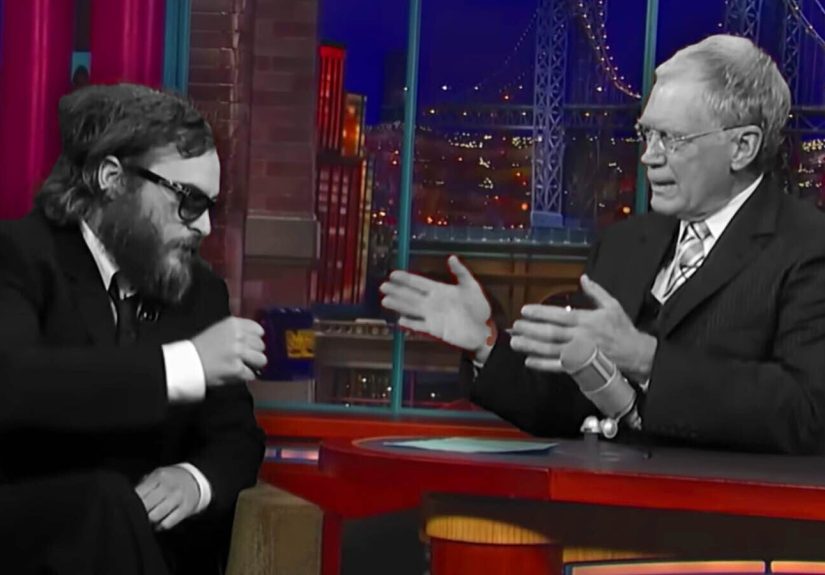
The look helped sell the confusion. Phoenix showed up with a massive beard, dark sunglasses, messy hair, and the general aura of a man who had either discovered underground truth or misplaced his sleep schedule in 2007. The transformation was so complete that audiences could not tell whether they were witnessing an unraveling, a prank, or the most committed bit of method performance since somebody stayed in character for three straight press junkets and ruined brunch for everyone.
Then Came Letterman, Patron Saint of Awkward Television
Enter David Letterman, a host who was never afraid of silence, discomfort, or the comedic possibilities of a guest digging their own on-air hole. That is part of what made the 2009 interview so potent. If Phoenix had pulled the same stunt on a warmer, more cuddly host, the segment might have fizzled. Letterman, however, had the perfect mix of amusement, skepticism, and deadpan menace. He could turn a strange interview into a public autopsy with one raised eyebrow.
From the moment Phoenix sat down, the conversation felt off. His answers were short, mumbled, and foggy. Letterman poked. Phoenix barely volleyed back. The audience laughed, but it was the nervous laugh people use when they are not sure whether they are watching comedy or an HR incident. Letterman, sensing blood in the water, kept pressing. By the time he closed with the now-classic line, “Joaquin, I’m sorry you couldn’t be here tonight,” the clip had already earned its place in the museum of immortal late-night weirdness.
That line did what great late-night lines always do: it summed up the entire moment in one neat little dagger. Phoenix was physically present, but psychologically he seemed to be broadcasting from another dimension.
What Phoenix Meant by “Lacerate Me”
Fast-forward to Phoenix’s later reflection on the episode, and suddenly the logic of the madness came into focus. He explained that he wanted Letterman to go hard at him. He wanted danger. He wanted the exchange to feel sharp, unpredictable, and real enough to provoke a genuine reaction. In other words, he was not aiming for a safe, wink-at-the-camera stunt. He wanted friction. He wanted the bit to bruise.
That changes how the interview reads. Phoenix was not simply trying to act odd. He was trying to build a pressure cooker on live television. He wanted the host to challenge him so intensely that the audience would have no stable place to stand. Was it a joke? A breakdown? A publicity stunt? A documentary in progress? The answer, inconveniently and beautifully, was “sort of all of the above.”
His choice of the word “lacerate” is especially revealing. It suggests he wanted the performance to feel cutting, not cute. Not quirky. Not “look at me, I’m being eccentric.” He wanted public discomfort with teeth. That is a wildly ambitious plan for a late-night interview, and also a strong sign that actors should not always be allowed to design their own publicity games unsupervised.
I’m Still Here Turned the Interview Into Something Bigger
The interview eventually became inseparable from I’m Still Here, the Casey Affleck-directed project built around Phoenix’s supposed departure from acting. The film blurred documentary and mockumentary so aggressively that plenty of viewers spent months trying to decide whether they had been manipulated, enlightened, or simply punked by two famous men with cameras and stamina.
In that context, the Letterman appearance was not a random detour. It was one of the project’s crown jewels. The stunt worked because it escaped the boundaries of the movie itself. Phoenix did not keep the performance sealed inside a film frame. He dragged it into interviews, public appearances, and news cycles. Suddenly the audience was not just watching a story. The audience was inside the story, reacting in real time, becoming part of the experiment.
That move now feels oddly prophetic. Before every celebrity became their own 24/7 content engine, Phoenix and Affleck were already playing with the idea that image, publicity, and narrative could all be folded into one giant hall of mirrors. Today, that kind of thing feels normal. In 2009, it felt like a fever dream in sunglasses.
Why the Bit Succeeded and Failed at the Same Time
This is where the Phoenix story gets more interesting than a simple “gotcha.” By his own later telling, the interview was both a success and a nightmare. That sounds contradictory until you remember what he was trying to do. If the goal was to generate reaction, confusion, and conversation, mission accomplished. The clip exploded. People argued about it endlessly. It became internet folklore. It was so effective that many viewers genuinely believed Phoenix was spiraling in public.
But that same success was also the failure. The performance was convincing enough to stick to him. Instead of being admired as daring character work, it was often discussed as evidence of instability. That is the risk when you make discomfort the product. The audience may not walk away praising the craft. They may just remember the discomfort.
And that seems to be part of why Phoenix later sounded regretful. He did not merely play a role. He attached his own public image to a live-wire persona and then watched people respond to it as though it were real life. That can be artistically thrilling, sure. It can also be emotionally exhausting, professionally risky, and socially awkward enough to make you apologize on television years later.
Letterman Was the Perfect Sparring Partner
One reason this story has lasted is that David Letterman was not just a passive witness. He was an active ingredient. Letterman’s style was built for moments like this. He could be playful, but he could also turn chilly in a heartbeat. He knew how to make discomfort entertaining without fully rescuing the guest from it. That mattered.
Phoenix may have brought the fog, but Letterman supplied the knife. He needled him about the beard. He questioned the rap career. He let the pauses hang in the air long enough for everyone at home to reconsider their beverage choices. Whether Letterman knew everything, knew something, or simply sensed nonsense at an elite professional level, the result was the same: he played it like a veteran. He turned the interview into a pressure test and made sure the audience felt every second.
That is why the segment still plays so well. It has structure. It has rhythm. It has escalation. And it has a host who understood that the funniest response to bizarre behavior is often not panic but precision.
The Apology Tour and the Strange Afterlife of a Viral Train Wreck
Phoenix eventually returned to Letterman and apologized, which only deepened the mythology. The apology did not erase the original segment. If anything, it preserved it. Once the stunt was acknowledged more openly, the interview transformed from a confusing pop-culture event into an artifact of performance art, celebrity manipulation, and media appetite.
Then came the later twist: years after the fact, the story did not die. Instead, it kept resurfacing whenever people discussed the wildest talk-show appearances ever aired. It made “most awkward interviews” lists. It inspired think pieces. It showed up in retrospectives about Letterman’s sharpest moments. It even picked up extra mystery as different reports and recollections raised questions about how much Letterman knew before the cameras rolled.
That uncertainty actually helps the legend. If the whole thing had been cleanly explained in one press release, it would feel smaller. But because parts of it remain fuzzy around the edges, the interview still has static in it. It still hums.
What the Moment Says About Celebrity Culture
The real staying power of this story has less to do with beard jokes and more to do with what it exposed. Celebrity culture loves transformation, but only when it arrives in packaging the audience can understand. A heroic comeback? Great. A reinvention arc? Lovely. A chaotic anti-performance designed to make everyone uncomfortable? That is a harder sell.
Phoenix’s Letterman appearance poked at the machinery of fame itself. It asked whether the public can tell the difference between authenticity and performance when both are happening at once. It asked whether the media rewards sincerity or spectacle. Most importantly, it showed that a bizarre late-night interview can become a Rorschach test. Some viewers saw genius. Some saw self-destruction. Some saw a man who desperately needed a sandwich and a nap.
That ambiguity is what made the whole thing bigger than gossip. The interview became a case study in how quickly audiences and outlets build narratives around celebrities, especially when those celebrities stop behaving in ways that feel easy to categorize.
Related Experiences: What Watching It Felt Like in Real Time
To understand why the phrase “Unhinged Joaquin Phoenix Wanted David Letterman to ‘Lacerate Me’” still grabs attention, you have to remember the audience experience around it. Watching that interview in real time did not feel like consuming a normal celebrity promo stop. It felt like accidentally walking into a dinner party argument, except the dinner party was on CBS and everyone in America had access to the appetizer tray.
For viewers, the experience was defined by uncertainty. This was not the polished social-media era, where stars now arrive with carefully tuned personal brands, crisis managers, and a thousand layers of image control. In 2009, there was still room for a genuinely destabilizing TV appearance to hit the culture like a rogue wave. People did not immediately receive a tidy explainer thread. They got a clip, a vibe, and a lot of questions.
That created a very specific kind of pop-culture experience: communal confusion. One person thought Phoenix was joking. Another thought he was in trouble. Someone else thought Letterman was being too harsh. Another person thought Letterman was the only sane man left in the building. By the next morning, offices, blogs, entertainment shows, and message boards were all doing the same thing: replaying the clip and trying to decode it like it was found footage from a glamorous alien landing.
There is also the emotional experience of watching a truly awkward interview. It is weirdly physical. You lean forward. You laugh, then feel bad for laughing. You brace for impact every time the host asks another question. You start bargaining with the screen. “Maybe the next answer will make sense.” It does not. “Maybe now we’re settling in.” Absolutely not. The tension becomes the entertainment. The discomfort is the plot.
For longtime Letterman viewers, the moment also fit into a broader experience of watching Dave do what Dave did best: probe, needle, and let the silence do half the work. That made the segment feel both unique and perfectly on-brand. It was shocking, but it was also the kind of shock Letterman could shape into comedy. He did not panic. He sharpened.
And for people who later learned it was tied to I’m Still Here, the experience shifted again. What first felt like disaster became something more layered: an experiment in audience manipulation, media performance, and celebrity mythmaking. That does not mean everyone loved it in hindsight. Plenty of people still think the stunt was a self-indulgent mess. But even that reaction is part of the experience. The moment asked viewers to decide where they stood on art, fakery, fame, humiliation, and spectacle.
That is why it lasted. We do not keep replaying it just because it was odd. We replay it because it made millions of people feel something at once: confusion, fascination, comedy, dread, suspicion, and the irresistible urge to ask the nearest human, “Did you just see that?”
Conclusion: A Disaster, a Performance, and a Pop-Culture Time Capsule
Joaquin Phoenix wanting David Letterman to “lacerate” him sounds outrageous because it was. But it also perfectly explains why the interview still matters. Phoenix was not chasing a pleasant anecdote or a goofy viral hit. He wanted an encounter with edges. He wanted friction strong enough to blur the line between role and reality. And because he chose Letterman, he got exactly that.
The result was a late-night appearance that functioned as comedy, confrontation, publicity, performance art, and cultural confusion all at once. It was a mess. It was a plan. It was successful. It was regrettable. And in the grand tradition of unforgettable television, it was impossible to ignore.
So yes, the Joaquin Phoenix David Letterman interview remains one of the strangest celebrity moments of the century. Not because it was merely awkward, but because it captured something bigger: how fame performs itself, how audiences react when the script falls apart, and how one uncomfortable couch conversation can live forever in pop-culture memory.