Table of Contents >> Show >> Hide
- 1. Death Valley Is Not Just Hot. It Is Also the Lowest Place in North America.
- 2. The Park’s Most Mind-Bending Feature Might Be Its Elevation Range.
- 3. It Used to Hold a Huge Ancient Lake, and Sometimes Water Still Comes Back.
- 4. Those “Moving Rocks” Are Real, and No, Ghosts Are Not Pushing Them.
- 5. Death Valley Has a Surprisingly Recent Volcanic Past.
- 6. The Salt Flats Are Still Being Built, One Flood and One Evaporation Cycle at a Time.
- 7. For a Place Called “Death,” It Supports an Astonishing Amount of Life.
- 8. Wildflower Seasons Can Turn the Park Into a Desert Color Explosion.
- 9. Death Valley Is One of the Best Stargazing Spots in America.
- 10. The Famous Twenty Mule Team Era Was Surprisingly Short.
- 11. Death Valley Is a Cultural Homeland, Not an Empty Wasteland.
- Why Death Valley Keeps Humbling People
- What It Actually Feels Like to Experience Death Valley
Note: This HTML body is ready for web publishing. SEO tags are included in JSON format at the end.
Death Valley has one of those names that sounds like a dare. It suggests a place where water files for a restraining order, plants give up on life, and your car’s dashboard starts speaking in tongues. But the truth is far more interesting. Death Valley National Park is not just hot, dry, and dramatic. It is a place of wild contrasts, strange science, deep history, and surprisingly stubborn life.
Most people know the headline version: it is blisteringly hot and looks like another planet. That part is true. But the deeper story is what makes this landscape unforgettable. Beneath the salt, rock, and heat shimmer is a park filled with moving stones, temporary lakes, ancient fish, recent volcanoes, star-drenched skies, and a human story that goes back long before tourists arrived with giant water bottles and bigger sunglasses.
Here are 11 things you probably did not know about Death Valley, along with a few reasons it deserves much more respect than its grim name suggests.
1. Death Valley Is Not Just Hot. It Is Also the Lowest Place in North America.
Badwater Basin sits 282 feet below sea level, making it the lowest point in North America. That sounds impressive on paper, but it feels even stranger in person. You can stand on a vast white salt flat, look up at a small sign on the cliff above you that marks sea level, and suddenly realize the landscape is playing a very weird game with your brain. The basin is normally dry, blindingly bright, and so flat that it can look almost fake in midday light. It is a geological flex, plain and simple.
2. The Park’s Most Mind-Bending Feature Might Be Its Elevation Range.
Death Valley is famous for frying thermometers, yet Telescope Peak rises to 11,049 feet above sea level and sits only about 15 miles from Badwater Basin as the crow flies. In other words, one part of the park can feel like a giant outdoor oven while another looks like it belongs in a mountain calendar. Snow can cap the high peaks in winter while the valley floor stays dry and mild. That dramatic elevation swing helps explain why the park is more diverse than people expect. Death Valley is not one big flat furnace. It is a stacked world of extremes.
3. It Used to Hold a Huge Ancient Lake, and Sometimes Water Still Comes Back.
Today, Death Valley is known for salt flats and desolation. In the past, though, it held an ancient lake called Lake Manly. During wetter climatic periods, the valley filled with water for long stretches of time. That old lake helped shape the basin and left behind clues written into the landscape. Even now, the valley occasionally surprises everyone by turning wet again after major storms. Temporary lakes have reappeared at Badwater Basin in recent years, reminding visitors that this “dry forever” place is actually more dynamic than it looks. Death Valley may seem static, but it still knows how to change the script.
4. Those “Moving Rocks” Are Real, and No, Ghosts Are Not Pushing Them.
Racetrack Playa is home to one of the park’s most famous mysteries: rocks that leave long tracks behind them as if they wandered off for a midnight stroll. For years, the sailing stones inspired theories ranging from pranksters to aliens to the desert doing desert things. Scientists eventually documented the process. Under the right winter conditions, a thin sheet of ice forms on a shallow pond, then breaks into panels that push rocks across the slick mud when light winds pick up. So yes, the rocks really move. They are just incredibly slow performers who only work when conditions are perfect.
5. Death Valley Has a Surprisingly Recent Volcanic Past.
Many people picture Death Valley as nothing but old rock and older heat. But Ubehebe Crater tells a much more explosive story. This dramatic crater and its neighboring maars formed when rising magma met groundwater, creating violent steam-driven eruptions. Geologists say some of these craters formed as recently as about 2,100 years ago, which is practically yesterday in geologic time. Standing on the rim feels like peeking into a giant wound in the earth, with dark volcanic debris and steep walls all around. Death Valley is not just a monument to erosion. It is also a reminder that the ground here has not always been calm.
6. The Salt Flats Are Still Being Built, One Flood and One Evaporation Cycle at a Time.
It is tempting to think the salt flats are ancient leftovers that simply sit there looking dramatic for tourists and photographers. In reality, they are still being shaped. Floodwaters carry dissolved minerals into the basin, and when the brutal sun evaporates the water, salt and other minerals are left behind. Over time, that process creates the crusty, polygon-patterned surface that makes Badwater Basin so iconic. At Devils Golf Course, the salt becomes jagged and sharp enough to look like the earth had a bad attitude and decided to show it. The valley floor is still working, still changing, and still building its strange beauty the hard way.
7. For a Place Called “Death,” It Supports an Astonishing Amount of Life.
The name is spectacularly misleading. Death Valley National Park has more than 1,000 described plant species, and it supports wildlife that has adapted to conditions that seem downright rude. One of the most remarkable residents is the Salt Creek pupfish, a tiny fish that lives in salty desert water and behaves like this is all perfectly normal. Mesquite, creosote, reptiles, birds, insects, and desert mammals all find ways to survive here through timing, specialization, and sheer biological stubbornness. In Death Valley, life does not just persist. It improvises, adapts, and quietly shows off.
8. Wildflower Seasons Can Turn the Park Into a Desert Color Explosion.
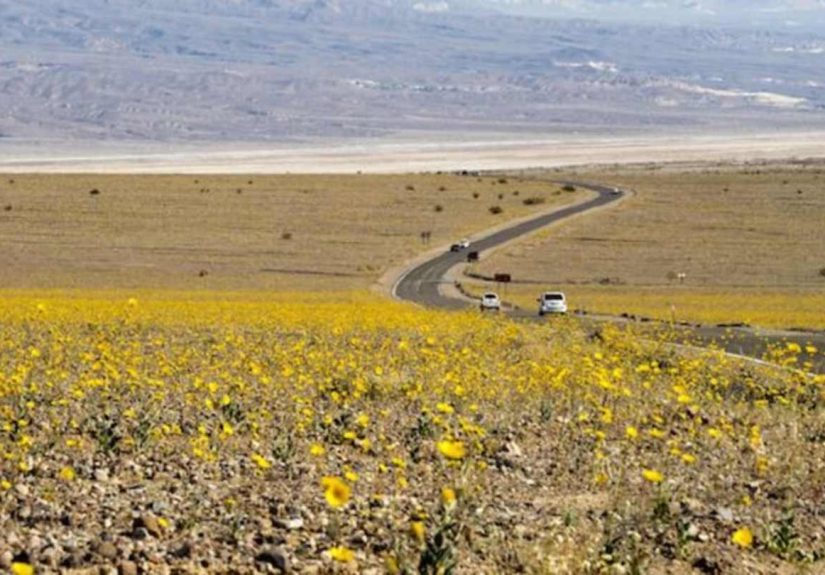
People who think Death Valley is permanently beige should meet it in a good wildflower year. When rainfall arrives at the right time, followed by the right temperatures and enough calm weather, the desert can erupt in blooms. Hillsides may glow with desert gold, phacelia, paintbrush, and other flowers that seem completely out of character for such a severe place. Some years bring only scattered blossoms. Other years become what visitors love to call a superbloom, when the valley floor and lower slopes look like spring hijacked the desert for a while. It is one of nature’s greatest plot twists.
9. Death Valley Is One of the Best Stargazing Spots in America.
When the sun finally stops trying to roast everybody, the night sky steps in and steals the show. Death Valley is recognized as a Gold Tier Dark Sky Park, the top rating for darkness. With very low light pollution, dry air, and wide-open horizons, the park offers spectacular views of the Milky Way, meteor showers, and constellations that many people barely notice back home. In some places, the stars feel so bright and so numerous that the sky looks crowded. You go in expecting darkness. Instead, you get one of the most brilliant ceilings on Earth.
10. The Famous Twenty Mule Team Era Was Surprisingly Short.
When many people think of Death Valley history, they picture borax wagons hauled by massive twenty-mule teams. That image is iconic, but the original hauling era from Harmony Borax Works was shorter than most people realize. The teams ran for only six years, from 1883 to 1889, moving borax 165 miles to the railhead near Mojave on a grueling ten-day trip. Even so, the image stuck. It became one of the most enduring symbols of the American West, proof that a short chapter can leave a very long shadow when it involves giant wagons, brutal conditions, and enough determination to make modern road trips look embarrassingly easy.
11. Death Valley Is a Cultural Homeland, Not an Empty Wasteland.
Long before outsiders gave the valley its dramatic English name, the Timbisha Shoshone lived here and knew exactly how to move through this environment. They followed seasonal patterns, used water sources wisely, gathered food in different elevations, and understood the land as home rather than hostile emptiness. That matters. Too many people still imagine deserts as blank spaces, when in reality they are lived-in landscapes full of meaning. The Timbisha Shoshone Homeland Act formally recognized the tribe’s ancestral connection to Death Valley and established an important framework for stewardship. The park is not just scenic land. It is cultural land too.
Why Death Valley Keeps Humbling People
Death Valley is often marketed as a place of records and extremes, and fair enough, because it has plenty of both. But the park’s real power comes from contrast. It is blistering yet full of life. It is dry yet shaped by water. It feels ancient, yet some of its most dramatic features are geologically recent. It looks empty, yet it holds history, culture, and scientific mysteries almost everywhere you turn.
That is why people leave Death Valley talking about more than heat. They remember the scale, the silence, the strange textures, the impossible stars, the colors on the hills, and the realization that this so-called wasteland is one of the most complex landscapes in the United States. Death Valley does not just challenge your idea of a desert. It completely rewrites it.
What It Actually Feels Like to Experience Death Valley
Reading about Death Valley is one thing. Standing in it is another. The first surprise is how big everything feels. Photos flatten the place into salt, dunes, and brown mountains, but in person the valley has a scale that makes your sense of distance feel hilariously unreliable. You look at a ridge and think, “That seems close enough.” Then you drive toward it for twenty minutes and realize the ridge was basically lying to your face.
Early morning is when Death Valley feels almost gentle. The light rolls over the salt flats in soft gold, the dunes look sculpted rather than savage, and the air can be cool enough to make you briefly forget the place’s reputation. It is the kind of calm that feels suspicious, like the desert is being polite before introducing itself properly. At Badwater Basin, the ground crunches under your shoes and the white salt polygons stretch outward with a clean, geometric weirdness that looks like nature hired a minimalist architect.
By late morning, the mood changes. The heat becomes physical in a very direct way. It is not just “warm.” It presses on you. It pulls moisture out of your skin, dries your lips faster than you thought possible, and makes shade feel less like a convenience and more like a legal right. Even the silence seems hotter. There is something eerie about hearing almost nothing but wind while surrounded by a landscape that looks powerful enough to make noise all on its own.
Then there are the colors. People expect tan and more tan, but Death Valley keeps sneaking in surprises. Artist’s Palette throws out green, pink, mauve, and blue tones like the hills accidentally wandered through a paint store. Ubehebe Crater looks black, rusted, and raw. At sunset, the dunes take on peach and amber shadows, while the distant mountains become layered in purples and smoky blues. The park never feels visually boring. It feels edited by a perfectionist.
Night may be the biggest shock of all. Once darkness settles in, the sky opens up in a way that can make even chatty people go quiet. The Milky Way appears less like a faint band and more like a statement. Stars multiply until the whole sky seems textured. You stop looking at the darkness and start looking through it. In that moment, Death Valley stops feeling harsh and starts feeling enormous in a totally different way.
That is the real experience of Death Valley. It is not just extreme weather and famous viewpoints. It is a place that keeps changing personality as the hours pass. It can feel serene, hostile, elegant, ancient, and oddly emotional, sometimes all in one day. You arrive expecting a desert checklist. You leave with the sense that you just visited one of the strangest and most beautiful classrooms on Earth.