Table of Contents >> Show >> Hide
- The Real Mistake: Treating Cabinet Hardware Like a Last-Minute Add-On
- Why This Mistake Stands Out So Much in a Kitchen
- How to Get Cabinet Hardware Right From the Start
- Examples of Cabinet Hardware Choices That Usually Work
- Cabinet Hardware Mistakes to Avoid, Even If They’re Trendy
- The Best Mindset Shift: Think of Hardware Early, Not Last
- Real-World Experiences: What People Learn After Getting Cabinet Hardware Wrongand Then Right
- Final Thoughts
Kitchen remodels have a funny way of turning grown adults into philosophers. People will debate quartz versus marble like it is a Senate hearing, obsess over paint swatches with names like “Whispered Oat,” and spend three weekends discussing whether the island should seat four or “a cozy four.” Then, after all that drama, cabinet hardware gets picked in about six minutes.
That, designers say, is exactly the problem.
The biggest cabinet hardware mistake in kitchens is treating it like an afterthought. Not the backsplash. Not the pendant lights. Not whether you chose knobs instead of pulls. The real trouble starts when homeowners save cabinet hardware for the end, grab whatever is trendy, and hope a tiny piece of metal will somehow sort itself out. Spoiler: it will not.
When cabinet hardware is chosen too late, it often ends up undersized, uncomfortable to use, visually disconnected from the cabinetry, or weirdly competitive with the faucet, lighting, and finishes around it. The result is a kitchen that feels just a little off. Sometimes the room looks cheap. Sometimes it looks unfinished. Sometimes it looks like the cabinets borrowed jewelry from another outfit entirely.
The good news is that getting cabinet hardware right does not require a design degree, a crystal ball, or a 19-tab spreadsheet. It just takes a more intentional approach. Here is what designers notice, why this cabinet hardware mistake happens so often, and how to choose hardware that makes your kitchen look polished, practical, and beautifully pulled together.
The Real Mistake: Treating Cabinet Hardware Like a Last-Minute Add-On
Cabinet hardware may be small, but it is not minor. It is one of the few design details you see up close and touch every single day. That alone should make it worthy of more attention than a rushed midnight online order.
Designers often compare hardware to jewelry, and honestly, that metaphor has lasted this long because it works. A great outfit can be elevated by the right accessories, and a gorgeous kitchen can be sharpened, softened, warmed up, or modernized by the right knobs and pulls. But the wrong “jewelry” can also throw the whole look sideways.
When homeowners treat hardware as the final leftover decision, a few predictable things happen:
- They choose a size that is too small for the cabinets.
- They pick a finish that clashes with nearby metals and materials.
- They prioritize trendiness over comfort and durability.
- They install everything in one uniform style, even where function suggests otherwise.
- They forget to test proportions before drilling holes.
In other words, the mistake is not just “bad hardware.” It is bad timing, bad scaling, and bad coordination.
Why This Mistake Stands Out So Much in a Kitchen
Kitchens are not shy rooms. They are full of strong visual lines, hard-working surfaces, reflective finishes, and repeated shapes. Cabinet hardware lives right in the middle of all that action. Because it appears over and over across drawers and doors, even a small mistake gets multiplied. Fast.
1. Wrong scale makes cabinets look cheaper
If you put tiny pulls on big drawers, the cabinetry can look skimpy and underdressed. If you slap oversized industrial bars on delicate cabinet fronts, the room can feel heavy-handed. Hardware has to relate to the size of the door or drawer, not just look cute in a product photo.
This is one reason designers often mock up hardware before committing. A pull that looks elegant in your hand may look strangely timid on a 30-inch drawer front. On the flip side, a massive pull can dominate a small door and make it look like it is trying too hard.
2. Poor finish choices break visual harmony
Your cabinet hardware does not have to match your faucet exactly, but it does need to make sense with the rest of the room. A kitchen already has enough going on: faucet, sink, appliances, lighting, stools, shelving brackets, maybe even a pot filler if you are feeling fancy. Hardware should join that conversation, not interrupt it with a megaphone.
That means the finish should either coordinate quietly or contrast intentionally. Random contrast is not a design strategy. It is an accident.
3. Cheap hardware feels cheap
Here is a truth designers and homeowners alike learn quickly: you can feel low-quality hardware. Flimsy pulls, rough edges, lightweight knobs, and weak finishes may look acceptable online, but daily use reveals the truth. Cabinet hardware is tactile. It should feel good in the hand, not like a compromise you regret every time you reach for the snack drawer.
4. Function matters as much as style
Cabinet hardware is not wall art. It has a job. Large drawers full of pots and pans need sturdy, comfortable pulls. Busy family kitchens benefit from pieces that are easy to grip and easy to clean. Sleek little knobs may look refined, but they are not always the best choice for heavy drawers or high-use storage.
How to Get Cabinet Hardware Right From the Start
If the biggest mistake is treating cabinet hardware like an afterthought, the fix is simple in theory: stop doing that. The smarter move is to choose hardware early enough that it can be part of the kitchen’s design language, not a late-stage patch.
Start with the cabinetry style
Look at your cabinet fronts first. Are they shaker, slab, inset, traditional, beaded, or full of decorative detail? The hardware should support that architecture.
For example, simple slab doors often pair beautifully with streamlined bar pulls, edge pulls, or minimalist shapes. Shaker cabinets can flex in many directions, which is why they are everywhere. They work with classic cup pulls, sleek modern bars, rounded knobs, or mixed hardware depending on the overall kitchen style. More decorative cabinet fronts generally call for hardware with restraint. When the cabinet door already has personality, the hardware does not need to do stand-up comedy too.
Use proportion, not guesswork
This is where many kitchens either become elegant or mildly confusing.
As a general guideline, wider drawers usually need longer pulls, and smaller cabinet doors can handle knobs or shorter pulls. Many designers and hardware pros use a one-third-ish rule of thumb for drawer pull length because it tends to look balanced without feeling fussy. It is not a law carved into stone, but it is a useful starting point.
If you are replacing existing hardware, measure the center-to-center distance between screw holes before you fall in love with something else. This saves you from drilling new holes, patching old ones, and saying words your kitchen should not have to hear.
Choose knobs and pulls based on function
There is no universal commandment that says every cabinet in a kitchen must use the same hardware. In fact, mixing knobs and pulls often creates a more custom, designer-approved look.
A common and practical setup looks like this:
- Knobs on doors
- Pulls on drawers
- Longer pulls on wide or heavy drawers
Why does this work so well? Because it makes visual sense and functional sense. Doors typically need a lighter touch. Drawers, especially deep ones, benefit from the grip and leverage of a pull.
You can also mix shapes while keeping the same finish family. That gives the kitchen variety without chaos. Think of it as coordination, not cloning.
Coordinate finishes with the rest of the room
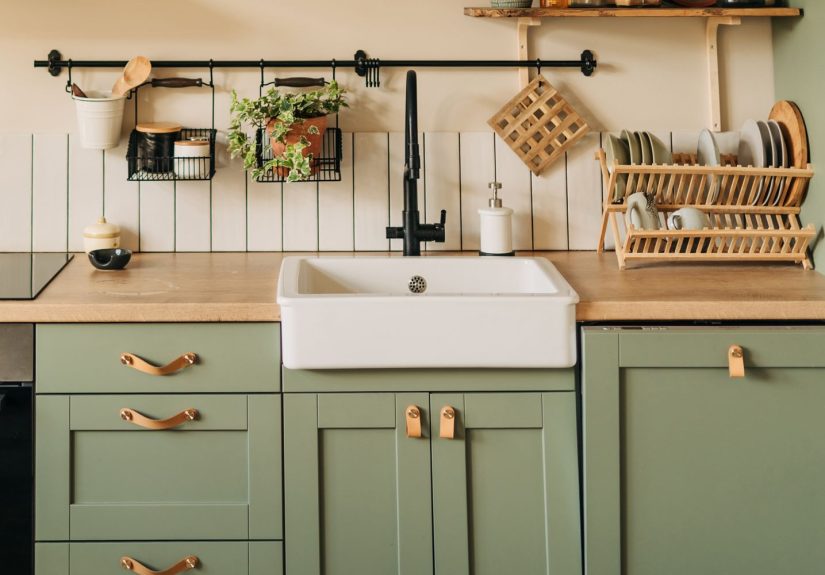
Cabinet hardware finish should connect to the kitchen’s bigger story. Warm wood cabinets often love brass, bronze, or aged metal finishes. Crisp white or painted cabinets can go almost any direction depending on the mood. Brushed nickel remains a safe and flexible classic. Matte black can look sharp, but like all once-hot trends, it works best when it actually suits the room instead of trying to rescue it.
If your faucet, pendants, and cabinet hardware all come from different planets, the kitchen will show it. Aim for cohesion, whether that means matching metals, using neighboring tones, or intentionally repeating one finish in a few key places.
Test before you commit
This is one of the least glamorous and most valuable tips in kitchen design: mock it up.
Tape a sample pull to a drawer. Hold up two size options. Step back. Open the cabinet. Imagine using it with wet hands, grocery bags, or a child asking for a cup for the fourth time in six minutes. Hardware lives in real life, not in a perfect online product image.
If you can, order samples. If you cannot, use paper templates or painter’s tape to preview the size and placement. That extra step can save you from making a very expensive “learning opportunity.”
Install consistently
Even beautiful hardware can look wrong if placement is sloppy. Consistency matters. Pulls and knobs should be installed at a visually logical height and line up neatly from one cabinet to the next. On stacked drawer banks, small adjustments can help the hardware appear centered to the eye, not just centered mathematically.
Use a jig if you are installing hardware yourself. Future You will be grateful, and Current You will get to keep your blood pressure in a more decorative range.
Examples of Cabinet Hardware Choices That Usually Work
For a classic white shaker kitchen
Try polished nickel, aged brass, or unlacquered brass hardware. Use knobs on upper doors and pulls on lower drawers. Keep the shape simple and substantial enough to show up against the cabinet fronts.
For a modern flat-panel kitchen
Look at longer bar pulls, edge pulls, or a minimal integrated look. Keep lines clean. In this kind of kitchen, hardware should feel crisp and intentional, not decorative for decoration’s sake.
For a warm wood kitchen
Bronze, brass, pewter, or darkened metal finishes often look richer than bright chrome. The goal is to echo the warmth of the wood, not fight it.
For a cottage or traditional kitchen
Cup pulls, latches, rounded knobs, and gently detailed pieces can be charming. Just avoid turning every cabinet into a costume drama. A little character is lovely. Too much can make the kitchen feel themed.
Cabinet Hardware Mistakes to Avoid, Even If They’re Trendy
- Choosing hardware that is too small: Tiny pulls disappear on big cabinetry and make the whole kitchen feel less custom.
- Buying only by trend: If you picked it because everyone online has it, pause. Your kitchen is a room, not a trend report.
- Using one pull size everywhere: Uniformity can work, but it often ignores the scale of individual drawers and doors.
- Ignoring comfort: Sharp edges, awkward grip, and slippery shapes lose their charm quickly.
- Mixing finishes without a plan: Layered can be lovely. Random rarely is.
- Going bargain-basement on quality: Cabinets are expensive. Weak hardware can drag down the whole investment.
The Best Mindset Shift: Think of Hardware Early, Not Last
If there is one practical takeaway from designers, it is this: cabinet hardware should be chosen during the design process, not after the “big stuff” is done. It affects scale, style, finish coordination, and daily function. That is too much influence to be left to the final fifteen minutes of a renovation.
When you select cabinet hardware early, you can make smarter decisions about faucet finish, lighting, cabinet style, and even how the kitchen will feel to use. That is what makes a kitchen look considered. Not expensive for the sake of being expensive. Considered.
And that is usually the difference between a kitchen people like and a kitchen people quietly admire while pretending they are only there for the guacamole.
Real-World Experiences: What People Learn After Getting Cabinet Hardware Wrongand Then Right
One of the most common experiences homeowners describe is surprise. They are shocked by how much cabinet hardware changes the kitchen once it is installed. This is especially true when the old hardware was too small, too shiny, too flimsy, or simply too forgettable. People often expect a subtle update and end up feeling like the entire room suddenly makes more sense.
A typical story goes like this: someone renovates the kitchen in phases. Cabinets get painted. Counters get replaced. Lighting is upgraded. Then the hardware decision is rushed because the budget is tired and everyone is ready to be done. They order something safe, small, and inexpensive. Once installed, the kitchen technically looks finished, but it does not feel elevated. The cabinets still seem bland. The drawers feel awkward to open. The finish does not relate to the faucet. Instead of a polished final layer, the hardware becomes the one detail that whispers, “We panicked.”
Then comes the second round. The homeowner sees a friend’s kitchen, visits a showroom, or finally holds a better-quality pull in person. Suddenly the difference is obvious. A more substantial pull feels better. A warmer finish softens the room. A slightly longer handle makes wide drawers look balanced instead of pinched. The kitchen has not been remodeled again, but it looks more custom because the scale finally matches the cabinetry.
Another common lesson comes from people who choose hardware only by appearance. They fall for a beautiful knob with an awkward grip or a sleek pull with sharp corners. It looks fantastic on installation day and becomes mildly annoying by week two. That frustration adds up because cabinet hardware is one of the most touched elements in the entire kitchen. Families notice when a trash pull is hard to grab. Cooks notice when deep drawers feel heavy with the wrong hardware. Parents notice when greasy fingerprints collect on a finish that is too precious for real life.
There are also homeowners who assume every piece of hardware needs to match exactly across every door and drawer. Later, they realize the kitchen feels flat. Once they switch to a more thoughtful mix, such as knobs on doors and pulls on drawers in the same finish family, the room starts to feel layered and intentional. It is a small design move, but it often gives the kitchen that custom look people thought would require a much larger budget.
Perhaps the most helpful experience people report is learning to slow down. Bringing home samples, taping templates to drawers, comparing finishes in daylight, and actually opening cabinets before buying everything may not be thrilling, but it works. Those simple steps help homeowners spot proportion issues early and avoid expensive do-overs later.
In the end, the lesson is pretty universal: cabinet hardware is not just a finishing touch. It is part of how the kitchen looks, feels, and functions every day. When people finally get it right, they almost always say the same thing: “I wish I had taken this seriously the first time.”
Final Thoughts
The number-one cabinet hardware mistake designers see in kitchens is not choosing brass over nickel or bars over knobs. It is thinking cabinet hardware does not matter enough to plan. That one mindset mistake leads to bad scale, clashing finishes, weak function, and a kitchen that falls short of its potential.
Get it right by choosing hardware early, measuring carefully, testing proportions, thinking about daily use, and coordinating the finish with the rest of the space. Good cabinet hardware should feel like it belongs there. It should make the kitchen look more complete, more intentional, and more like itself.
Which is exactly what great design does. Quietly. Repeatedly. Every time you open the silverware drawer.