Table of Contents >> Show >> Hide
- What Is a Paper Boomerang, Exactly?
- What You’ll Need
- How to Make a Simple Paper Boomerang
- How to Throw a Paper Boomerang So It Actually Comes Back
- Why a Paper Boomerang Comes Back
- Common Mistakes and How to Fix Them
- Tips for Better Paper Boomerang Performance
- Fun Ways to Experiment With Your Design
- Is It Better to Make a Folded Origami Boomerang or a Cut-Out One?
- Safety and Setup
- Real-Life Experiences With Making a Paper Boomerang
- Conclusion
- SEO Tags
If you have ever thrown a paper airplane and thought, “Nice, but what if this little show-off came back to me?” then welcome to the wonderfully nerdy world of the paper boomerang. It is part craft, part mini science lesson, part living-room entertainment, and part “why is this suddenly my entire personality today?”
A paper boomerang is a lightweight flying toy designed to curve through the air and return toward the thrower when it is built and launched correctly. The secret is not magic, wizardry, or yelling “return to sender” at it. It is all about shape, stiffness, balance, and spin. Get those ingredients right, and a humble piece of paper can pull off a pretty dramatic comeback.
In this guide, you will learn how to make a simple paper boomerang, how to throw it the right way, why it works, how to fix common problems, and how to make the whole experience more fun without turning your hallway into a paper-powered disaster zone.
What Is a Paper Boomerang, Exactly?
Before we get into the cutting and tossing, let’s clear something up. A paper boomerang is not the same as a traditional wooden boomerang. It is a lightweight classroom or home craft inspired by the returning flight path of a boomerang. Think of it as the friendly, indoor cousin of the real thing.
For beginners, the easiest and most reliable version is a four-wing paper boomerang made from card stock, a manila folder, or another stiff paper material. You cut out a symmetrical four-armed shape, give it a clean launch with plenty of spin, and let physics do the rest.
If you are hoping for a perfect movie-style return on the first throw, I admire your confidence. But like most paper crafts that also fly, this one usually takes a little tweaking. That is part of the fun. You are not just making something. You are building, testing, adjusting, and improving it like a tiny engineer with scissors.
What You’ll Need
- 1 sheet of card stock, index card stock, or half of a manila file folder
- Pencil
- Ruler
- Scissors
- Optional: markers for decorating
- Optional: a coin or bottle cap to trace a center hole
Best paper choice: regular printer paper is usually too floppy for a beginner paper boomerang. A stiffer material works better because it holds its shape in the air. Card stock is a solid choice, while a manila folder is the classic “school science activity” favorite.
How to Make a Simple Paper Boomerang
The easiest beginner-friendly version is a four-wing boomerang. If you have ever seen a cross-shaped propeller-looking design, that is the one. It is simple, symmetrical, and surprisingly effective.
Step 1: Draw the shape
Take your card stock or folder material and draw a small square in the middle that is about 1.5 inches by 1.5 inches. From each side of that square, draw one rectangular wing that is about 3 inches long and 1 inch wide. When you are done, the whole shape should look like a neat plus sign or four-armed cross.
Round the outside corners slightly instead of leaving them super pointy. This helps the boomerang move through the air more smoothly and makes it a little less stabby, which your fingers will appreciate.
Step 2: Add a center hole
In the middle square, draw a small circle about the size of a nickel or bottle cap. Carefully cut it out. This center opening helps reduce weight in the middle and also gives you a handy place to catch the boomerang later if it hovers for a moment on the way back.
Step 3: Cut it out neatly
Now cut out the full shape. This is not the time for “close enough” cutting. A paper boomerang loves symmetry. If one wing is noticeably wider, longer, or sloppier than the others, the flight path can get weird fast. Weird can be fun, but it usually does not return to you.
Step 4: Check the balance
Lay the boomerang flat and compare all four wings. They should look as similar as possible. If one side is heavier or chunkier, trim it slightly. Tiny changes matter more than you think.
Step 5: Make gentle bends if needed
For many paper boomerangs, a flat shape will already fly. But if yours needs a little more lift, gently bend the leading edge tip of each wing upward just a tiny bit, like a very small flap. Do not overdo it. You are aiming for “subtle aerodynamic improvement,” not “paper taco.”
Step 6: Decorate lightly
Yes, you can decorate it. Absolutely. Give it flames, lightning bolts, stars, or a tiny dramatic face if that helps motivation. Just do not tape on heavy extras or glue on anything bulky. A paper boomerang is a diva about weight distribution.
How to Throw a Paper Boomerang So It Actually Comes Back
You can make a beautiful paper boomerang and still have it flop instantly if you launch it the wrong way. This is the part where technique matters.
Hold it vertically
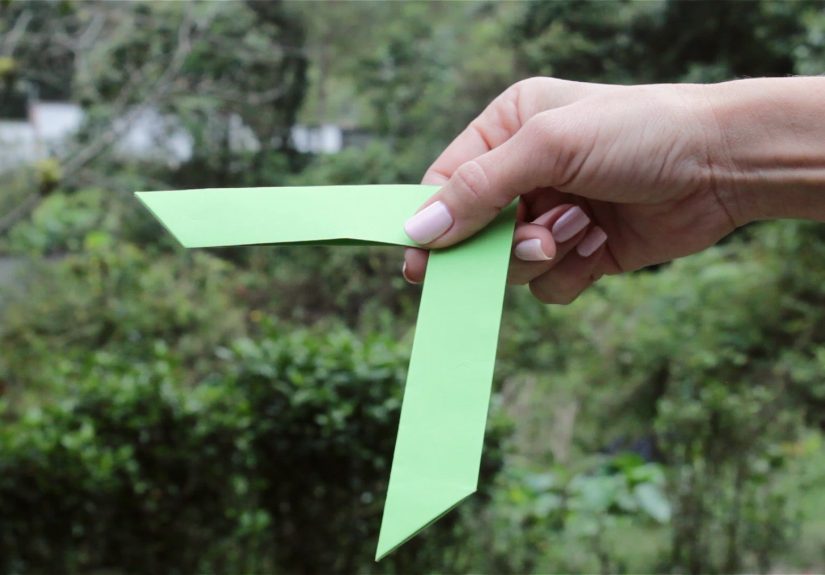
Grip one wing between your thumb and index finger. Hold the boomerang in a mostly vertical position rather than flat like a frisbee. For most right-handed throws, the boomerang should be nearly upright with a slight tilt.
Throw straight forward with spin
The throw should be short, quick, and snappy. Think of it as a chopping motion combined with a wrist flick. The goal is not brute force. The goal is spin. A paper boomerang with lots of spin and moderate forward force usually performs better than one launched like it owes you money.
Use a calm space
Paper boomerangs love still air. Indoors is usually best, especially in a hallway, classroom, garage, or large room with enough open space. Outdoors can work on a calm day, but even a light breeze can send your masterpiece off on a dramatic side quest.
Expect a short return path
This is not a full-size sporting boomerang. A paper version usually flies out a short distance, curves, levels out, and heads back toward you. Sometimes it hovers briefly before dropping. When it does, catch it by clapping your hands lightly around it, or guide a finger through the center hole if it slows enough.
Why a Paper Boomerang Comes Back
Now for the fun science part. A paper boomerang returns because it is not just a shape. It is a spinning wing system. As it moves through the air, each wing generates lift. But because the boomerang is spinning, the forces on different parts of it are not perfectly equal at every moment. That imbalance, combined with spin, causes the boomerang to curve rather than continue in a straight line.
In plain English: the wings push against the air, the air pushes back, and the spinning motion helps turn the flight path into a loop. Lift, drag, torque, gravity, and angular momentum all join the party. Physics is basically standing in the corner saying, “I told you this would be fun.”
The most important ingredient is spin. Without spin, a paper boomerang is just a funny-shaped piece of card stock having a bad day.
Common Mistakes and How to Fix Them
It dives straight to the floor
Your material may be too flimsy, your throw may be too weak, or the boomerang may not be getting enough spin. Try stiffer paper and a quicker wrist flick.
It shoots away and never curves back
You may be throwing it too hard forward and not giving it enough rotation. Ease up on the force and focus on spin. Also check whether the wings are symmetrical.
It wobbles like a confused fan
That usually means the shape is uneven or one wing is bent differently from the others. Lay it flat, compare each arm, and trim or rebend as needed.
It works once and then stops
Paper remembers its bends. After a few crashes, the wings may be warped. Smooth them out or make a fresh one. The good news is that paper boomerangs are quick to replace and oddly addictive to improve.
It only works in one room
Honestly, that can happen. Ceiling height, airflow, furniture placement, and tiny drafts all matter. If your paper boomerang thrives in the dining room but behaves like nonsense in the kitchen, congratulations, you have discovered environmental testing.
Tips for Better Paper Boomerang Performance
- Use stiff paper: card stock and manila folders usually outperform plain copy paper.
- Keep cuts clean: neat edges help the air move more evenly across the wings.
- Stay symmetrical: equal wings are a big deal.
- Start indoors: calm air makes learning much easier.
- Throw with spin, not rage: fast rotation matters more than raw strength.
- Adjust one thing at a time: if you change everything at once, you will not know what actually helped.
Fun Ways to Experiment With Your Design
Once your first boomerang returns even a little, the temptation to experiment becomes very real. Lean into it.
Try different materials
Make one from index card stock, one from a cereal box panel, and one from a manila folder. Test which one gets the smoothest return.
Change the size
Make a slightly smaller version and a slightly larger version. Smaller ones often spin faster, while larger ones can feel steadier. The trade-off is part of the experiment.
Test slight wing bends
Try tiny upward bends on each wing tip. Then make another version with perfectly flat wings. Compare the flight path. This is a great way to understand how lift changes with shape.
Create a family tournament
Set up challenges like “closest return,” “smoothest loop,” or “best catch.” Suddenly everyone is an aerodynamics expert, or at least acting like one.
Is It Better to Make a Folded Origami Boomerang or a Cut-Out One?
Both are fun, but for beginners, a cut-out four-wing paper boomerang is usually easier to make and easier to troubleshoot. A folded origami boomerang can work beautifully, but it demands more precision and more patience. If you enjoy folding tiny, exact creases and muttering at paper under your breath, origami is a great next step.
If your goal is to learn the basic flight behavior quickly, start with the cut-out style. It is easier to understand, easier to modify, and easier to explain in a classroom or family setting.
Safety and Setup
A paper boomerang is much safer than a wooden one, but let’s keep expectations realistic. It still has edges, it still moves fast, and it still has a talent for finding lampshades. Use a clear space, avoid throwing near faces, pets, or fragile objects, and supervise younger kids when scissors are involved.
The best setup is a calm indoor space with a bit of room in front of you and no ceiling fan trying to become part of the experiment.
Real-Life Experiences With Making a Paper Boomerang
The first time you make a paper boomerang, it feels deceptively simple. You draw a cross shape, cut it out, maybe add a center hole, and think, “Surely this is enough.” Then you throw it and it dives into the floor with all the grace of a sleepy sandwich. That is the moment the project gets interesting.
Making a paper boomerang is one of those activities that turns ordinary materials into a tiny science lab. You stop thinking of paper as just paper. Suddenly, thickness matters. Smooth edges matter. Symmetry matters. One wing trimmed a little too much can change the whole flight. One tiny bend can transform a flop into a satisfying curve. It is weirdly thrilling to watch such small adjustments create such obvious results.
There is also something deeply charming about the testing phase. The throw is quick, the flight lasts only a second or two, and then you immediately want to try again. You step back, aim, flick, and watch. Maybe it loops a little farther. Maybe it rises and hovers for a split second. Maybe it still crashes, but now in a more sophisticated way. Progress can be hilariously subtle. You become the sort of person who says things like, “I think the left wing is dragging,” which is objectively funny when you are standing in a hallway with a marker-decorated paper toy.
Kids usually love the instant feedback. Adults do too, though they often pretend this is for “educational purposes” while secretly trying to beat their own best throw. A paper boomerang is one of those rare crafts that feels active instead of decorative. It does not just sit there looking nice. It demands a launch, a test, a redesign, and another launch. It invites trial and error in a way that feels playful instead of frustrating.
It also creates the kind of memory that sticks. You remember the one that almost came back perfectly. You remember the one that hit the couch, bounced off a pillow, and somehow returned better than expected. You remember the version covered in stars that flew terribly but looked fantastic doing it. Even when the flights are messy, the process is satisfying because every throw teaches you something.
That might be the best thing about learning how to make a paper boomerang. It is not just about the finished object. It is about the small discoveries along the way: that careful cutting matters, that spin beats force, that light materials can still do impressive things, and that failure is often just a first draft with better ideas hiding inside it. In a world full of expensive hobbies and complicated gadgets, there is something refreshing about getting this much fun out of a sheet of paper, a pencil, and a couple of throws.
And when it finally does come back toward you, even a little, it feels ridiculously rewarding. It is a tiny comeback story made by hand. Honestly, paper does not get enough credit.
Conclusion
Learning how to make a paper boomerang is one of those delightfully low-cost, high-reward projects that mixes craft time with science and just enough chaos to keep things exciting. The basic recipe is simple: use stiff paper, keep the design symmetrical, cut carefully, and throw with plenty of spin. From there, everything gets more interesting.
A good paper boomerang does not have to be fancy. It just has to be balanced, cleanly made, and launched with the right motion. Once you get the hang of it, you can experiment with size, wing shape, bends, and materials to see what flies best. That is when the project stops being a quick craft and starts becoming a satisfying little aerodynamics obsession.
So grab a sheet of card stock, clear a little room, and make one. Your first throw may be awkward, your second may be dramatic, and your fifth might be magic. That is a pretty good deal for something made out of paper.