Table of Contents >> Show >> Hide
- What Is CERN’s New Particle Accelerator?
- Why Does CERN Want a New Accelerator?
- How the Future Circular Collider Would Work
- Timeline: When Could CERN’s New Accelerator Be Built?
- What Would Scientists Study?
- How Much Would the Future Circular Collider Cost?
- Environmental and Engineering Challenges
- The U.S. Role in CERN’s Future Collider
- Why the Future Circular Collider Matters for Ordinary People
- Arguments For and Against the New CERN Particle Accelerator
- Experience Notes: What Following CERN’s New Accelerator Feels Like
- Conclusion: A Bigger Ring for Bigger Questions
Note: This article is written for web publication in standard American English and synthesizes current, real information about CERN’s proposed Future Circular Collider, the next major particle accelerator concept being studied for the post-LHC era.
CERN has never been shy about thinking big. This is the laboratory that built the Large Hadron Collider, found the Higgs boson, and made “smash tiny things together to understand the universe” sound like a perfectly normal career path. Now, the scientific world is watching CERN’s proposed new particle accelerator: the Future Circular Collider, often called the FCC. If approved, it could become the next great discovery machine after the Large Hadron Collider, pushing particle physics into a new chapter that is bigger, cleaner, more precise, andyesmuch more expensive than your average home renovation.
The phrase “New Particle Accelerator CERN” usually points to this ambitious Future Circular Collider program. It is not a single machine in the simple sense. It is a proposed staged research infrastructure that would begin with an electron-positron collider, known as FCC-ee, and later reuse the same underground tunnel for a far more powerful proton-proton collider, called FCC-hh. The first phase would study the Higgs boson, the W and Z bosons, and the top quark with extraordinary precision. The later phase would chase new particles and unexplored physics at collision energies far beyond today’s LHC.
In other words, CERN wants to build a microscope for reality itself. Unfortunately for the universe, CERN’s microscope is about 91 kilometers around.
What Is CERN’s New Particle Accelerator?
The proposed new CERN particle accelerator is the Future Circular Collider, a massive underground ring planned as a possible successor to the Large Hadron Collider. The LHC is already the world’s largest and most powerful operating particle accelerator, with a circumference of about 27 kilometers. The FCC proposal would create a tunnel of roughly 90.7 kilometers, making it more than three times larger than the LHC.
The Future Circular Collider would sit in the region around Geneva, crossing areas near the French-Swiss border. Its design includes deep underground infrastructure, surface access sites, detector locations, technical systems, and connections to CERN’s existing accelerator complex. That last part matters: CERN is not starting from zero. The FCC would build on decades of accelerator knowledge, engineering experience, computing infrastructure, and global scientific collaboration.
The Two-Stage Plan: FCC-ee First, FCC-hh Later
The FCC program is designed in stages. The first machine, FCC-ee, would collide electrons and positrons. These particles are much lighter than protons, which makes their collisions cleaner and easier to interpret. Think of it as switching from a fireworks show to a high-resolution laboratory scan. There is still drama, but the data is tidier.
FCC-ee is often described as a Higgs factory because it would produce enormous numbers of Higgs bosons for detailed study. It would also work as an electroweak and top-quark factory, operating at different energies to investigate several major pieces of the Standard Model of particle physics.
The second stage, FCC-hh, would replace the electron-positron machine with a high-energy hadron collider. This proton-proton collider could reach collision energies of about 100 teraelectronvolts, far beyond the LHC’s design energy. If FCC-ee is the precision scalpel, FCC-hh is the cosmic sledgehammerscientifically elegant, but still very much a sledgehammer.
Why Does CERN Want a New Accelerator?
The short answer is simple: the Higgs boson changed the map, but it did not finish the journey. The discovery of the Higgs boson in 2012 confirmed a key part of the Standard Model, the framework that explains the known elementary particles and their interactions. But the Standard Model is not the final theory of everything. It does not explain dark matter, dark energy, the imbalance between matter and antimatter, the origin of neutrino masses, or why the Higgs boson has the properties it does.
That is where the new CERN particle accelerator becomes important. The LHC discovered the Higgs boson. The FCC-ee would measure it with much greater precision. Those measurements could reveal tiny deviations from Standard Model predictions. In particle physics, tiny deviations are not boring. They are the scientific equivalent of finding a suspiciously hidden door in a movie castle.
If the Higgs behaves exactly as expected, that is valuable information. If it does not, the difference could point toward new particles, unknown forces, or deeper laws of nature. Either way, scientists win. The universe may remain smug, but scientists win.
How the Future Circular Collider Would Work
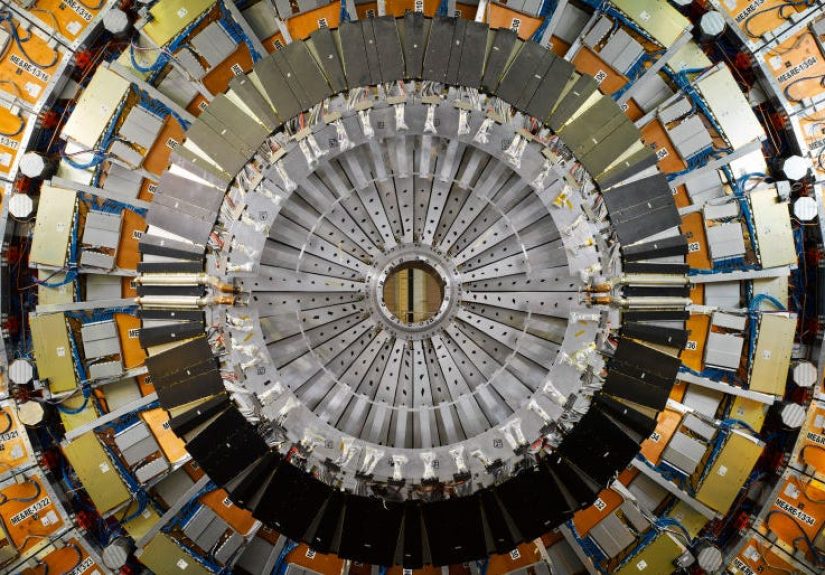
Particle accelerators use electric fields to speed up particles and magnetic fields to guide them. In a circular collider, beams travel in opposite directions around a ring and collide at specific interaction points. Around those points sit enormous particle detectors that record the debris from the collisions. The detectors do not “see” particles the way a phone camera sees a selfie. They reconstruct particle tracks, energies, and decay patterns from signals in layers of advanced technology.
The FCC-ee phase would focus on precision. Electrons and positrons are elementary particles, so their collisions are cleaner than proton collisions. Protons are composite particles made of quarks and gluons, which makes proton collisions wonderfully powerful but messy. If a proton-proton collision is a crowded rock concert, an electron-positron collision is a studio recording.
Later, FCC-hh would use stronger magnets and advanced accelerator systems to bend extremely energetic proton beams around the same tunnel. Achieving 100 TeV collisions would require major advances in superconducting magnet technology, cryogenics, vacuum systems, beam control, detector design, and computing. The machine would not simply be a bigger LHC; it would need to be a generational upgrade.
Timeline: When Could CERN’s New Accelerator Be Built?
The Future Circular Collider is still a proposal, not an approved construction project. CERN released a major feasibility study in 2025, examining technical, financial, geological, environmental, and infrastructure questions. The next major decision point is expected around 2028, when CERN Member States and international partners may decide whether to move forward.
If approved, construction could begin in the early 2030s. The FCC-ee phase could begin operations in the late 2040s and run for roughly 15 years. The FCC-hh phase could follow in the 2070s and continue into the later part of the century. That timeline may sound long, but particle physics is not a fast-food counter. Building a machine to test the structure of reality takes patience, international cooperation, and a lot of concrete.
What Would Scientists Study?
1. The Higgs Boson
The Higgs boson is central to the FCC’s scientific case. It is connected to the Higgs field, which gives mass to elementary particles. Since its discovery, scientists have studied how the Higgs interacts with other particles, but many questions remain. Is the Higgs truly alone, or is it part of a larger Higgs sector? Does it interact with itself in the way theory predicts? Could it be connected to dark matter or the fate of the universe?
FCC-ee would allow physicists to measure Higgs properties with a level of precision that the LHC cannot easily match. The goal is not merely to “find another Higgs.” The goal is to understand the Higgs so well that even the smallest odd behavior becomes visible.
2. Dark Matter
Dark matter is one of science’s most famous invisible troublemakers. Astronomers see its gravitational effects, but particle physicists still do not know what it is made of. A future collider could search for signs of dark matter candidates directly or indirectly. If dark matter particles interact weakly with known particles, new accelerator experiments may detect missing energy patterns or unusual decay signatures.
3. Matter and Antimatter
The universe contains far more matter than antimatter, and that imbalance is one of the great mysteries of modern physics. The FCC program could help probe subtle differences in particle behavior that might explain why the early universe did not simply cancel itself out. Fortunately for us, matter won. Otherwise, this article would be very short.
4. New Particles and Forces
The FCC-hh phase would reach energy levels where new heavy particles might appear. These could include particles connected to supersymmetry, extra dimensions, dark sectors, or entirely unexpected physics. The best discoveries are often the ones that do not politely follow the planning document.
How Much Would the Future Circular Collider Cost?
CERN’s feasibility work estimates the construction cost of the FCC-ee stage, including the tunnel and infrastructure, at around 15 billion Swiss francs. That investment would likely be spread over about 12 years beginning in the early 2030s. The funding question is one of the largest challenges facing the proposal.
Supporters argue that major scientific infrastructure produces long-term benefits in technology, training, international cooperation, computing, engineering, and industry. Critics ask whether the money could be better spent on smaller experiments, climate research, medical technology, or other scientific priorities. Both sides have serious points. A 91-kilometer collider is not something a lab slips into the budget between coffee filters and printer paper.
Environmental and Engineering Challenges
A project of this size must face environmental questions directly. The FCC feasibility study includes geological, territorial, civil engineering, energy, and sustainability considerations. CERN has emphasized ecodesign, energy efficiency, potential heat recovery, and ways to reduce the project’s footprint. Still, digging a huge tunnel and operating advanced accelerator systems requires resources, land-use planning, power, materials, and careful public consultation.
The engineering challenges are equally serious. The project would require advanced superconducting radio-frequency systems, extremely precise beam control, powerful magnets, reliable cryogenic infrastructure, robust detectors, and computing systems capable of processing vast amounts of data. It is the kind of project where “measure twice, cut once” becomes “simulate for years, drill carefully, and please do not surprise the geologists.”
The U.S. Role in CERN’s Future Collider
Although CERN is based in Europe, particle physics is deeply international. U.S. laboratories, universities, engineers, and physicists have long contributed to CERN experiments, including the LHC. Fermilab, Argonne, Brookhaven, SLAC, universities, and other U.S. institutions are part of the wider conversation about future colliders.
Recent U.S. particle physics planning has supported participation in an international Higgs factory at CERN while also encouraging domestic research into future collider technologies, including muon collider development. This matters because future particle physics will not be built by one country alone. The machines are too complex, the budgets too large, and the science too global.
Why the Future Circular Collider Matters for Ordinary People
It is fair to ask what a new CERN particle accelerator has to do with everyday life. Most people do not wake up needing a Higgs boson measurement before breakfast. But fundamental science often creates benefits that are hard to predict in advance. Accelerator research has contributed to medical imaging, cancer therapy, materials science, radiation technology, superconducting systems, cryogenics, vacuum engineering, electronics, and large-scale computing.
CERN itself is famous not only for particle physics but also for technological spillovers, including the birth of the World Wide Web. Nobody built the LHC to improve your online shopping cart, but modern science has a funny habit of creating tools that escape the lab and change the world.
Arguments For and Against the New CERN Particle Accelerator
The Case For It
Supporters say the FCC is the most comprehensive path to answer the biggest open questions in particle physics. It would give scientists a precision Higgs factory first and an energy-frontier collider later. That combination is powerful because it allows researchers to search for new physics in two complementary ways: through tiny deviations in known particles and through direct production of unknown heavy particles.
The project would also train generations of scientists and engineers. It would push industry to develop better magnets, sensors, electronics, superconducting systems, data tools, and sustainable infrastructure. Big science is not just about discoveries; it is also about building the people and technologies that make discoveries possible.
The Case Against It
Critics point to cost, uncertainty, energy use, environmental impact, and opportunity cost. The LHC discovered the Higgs but has not yet found a clear new particle beyond the Standard Model. Some researchers argue that building an even larger collider without a guaranteed discovery target is risky. Others believe the money could support a broader portfolio of smaller experiments, astrophysics, neutrino research, quantum technologies, or climate-related science.
This debate is healthy. Science should be ambitious, but ambition should also bring receipts. A project this large deserves scrutiny, public discussion, and transparent planning.
Experience Notes: What Following CERN’s New Accelerator Feels Like
Following the story of CERN’s new particle accelerator is a little like watching the blueprint for a cathedral appear one line at a time. Nobody involved expects instant results. The project lives on long timelines, slow decisions, and careful engineering. That can feel strange in a world where people get annoyed if a video takes three seconds to load. But particle physics operates on a different clock. It asks questions that have been waiting since the beginning of the universe, so apparently the universe is not in a rush.
One experience that stands out is how the Future Circular Collider changes the way people think about scale. A 91-kilometer underground ring is not just a machine. It is geography, politics, engineering, geology, energy planning, international finance, and human curiosity braided into one enormous scientific instrument. Reading about it makes the LHC, already gigantic, seem like the older sibling who suddenly looks modest at the family reunion.
Another memorable part of the FCC conversation is the tension between wonder and practicality. The wonder is easy to understand. Who would not want to know whether dark matter can be produced in a laboratory, whether the Higgs boson hides new secrets, or whether nature has another layer below the one we currently see? The practical side is tougher. The project costs billions, demands decades of commitment, and requires public trust. It is not enough for scientists to say, “Trust us, the universe is cool.” The universe is cool, yes, but taxpayers and policymakers still need clear reasons.
For science communicators, the FCC is a fascinating topic because it forces plain-language explanation. You cannot rely on jargon when describing why smashing electrons into positrons could help explain why atoms exist. You have to translate without dumbing things down. The Higgs field becomes the reason particles have mass. The collider becomes a precision instrument. The detectors become giant cameras for events too small and fast for imagination. The whole project becomes less like science fiction and more like humanity’s most complicated question mark.
There is also something inspiring about the generational nature of the plan. Students entering physics today may help design the detectors. Their future students may analyze the first FCC-ee data. Another generation may work on FCC-hh. That continuity gives the project emotional weight. The FCC is not just about what scientists can discover next year. It is about building a bridge for people who are not even in graduate school yet, and maybe not even born yet.
The experience of studying CERN’s proposed accelerator also makes one appreciate uncertainty. The FCC may be approved, modified, delayed, or replaced by another option. That uncertainty is not a weakness. It is part of how major science decisions should work. The proposal must compete with alternatives, survive technical review, answer environmental questions, and prove that its scientific promise justifies its scale. In a way, the debate itself is a sign that science is functioning properly.
In the end, the Future Circular Collider represents a very human impulse: the desire to look deeper. We build telescopes to see farther, microscopes to see smaller, and colliders to ask matter what it is hiding. CERN’s new particle accelerator may or may not become the next flagship machine of particle physics, but the questions behind it are not going away. The universe is still holding cards we have not seen. The FCC is one of the boldest proposed ways to ask it to show its hand.
Conclusion: A Bigger Ring for Bigger Questions
The new CERN particle accelerator proposal is not merely about building a larger machine. It is about deciding how humanity should investigate the deepest laws of nature in the second half of the 21st century. The Future Circular Collider could begin as a Higgs factory, measuring known particles with extraordinary accuracy, and later become a 100 TeV discovery machine searching for new physics directly.
The project is expensive, complex, and still uncertain. It faces legitimate questions about funding, sustainability, priorities, and scientific risk. Yet it also offers a rare opportunity to explore the Higgs boson, dark matter, matter-antimatter asymmetry, and the foundations of the Standard Model in ways no current machine can match.
If CERN’s Future Circular Collider is built, it will not just be a new particle accelerator. It will be a long-term scientific bet that nature still has surprises waiting beneath the surface. Based on history, betting that the universe is weirder than expected has usually been a pretty good strategy.